Terpt Village Church: A Medieval Church in Germany
Site at a Glance
- Popularity
- Very Low
- Country
- Germany
- Primary era
- Medieval
- Eras represented
- Medieval, Early Modern, Modern
- Civilizations
- Unclassified
- Site type
- Religious
- Remains
- Church
On this page10 sections
History
Medieval origins
Terpt Village Church is a medieval church in Terpt, Germany, built in the early 14th century. Its first documented mention comes from a document issued by the Bishop of Meissen on 29 September 1366. The document names a priest, Matthias, serving in Terpt and is also the earliest documented reference to the village.
Later history and affiliation
The church was remodeled around 1845. Its interior was restored in 1927, the altar in 1929, and the tower and roof in 1966. Between 2014 and 2016, workers secured the altar area and nave and replaced roof timbers affected by dry rot.
Today the church belongs to the Terpt regional church congregation, a local church unit serving Terpt, Alteno, and Groß Radden, a community district of Lübbenau/Spreewald. The congregation is part of the Niederlausitz church district, an administrative unit of the Evangelical Church of Berlin-Brandenburg-Silesian Upper Lusatia, a Protestant regional church body.
Remains
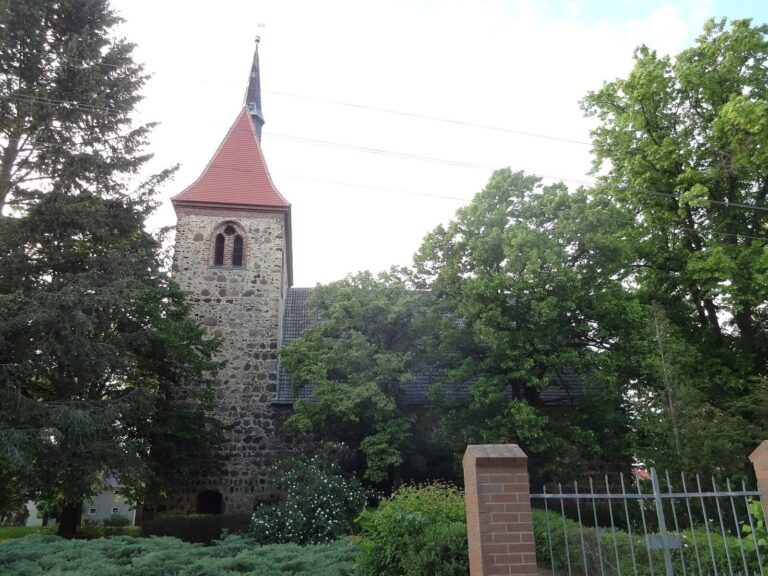
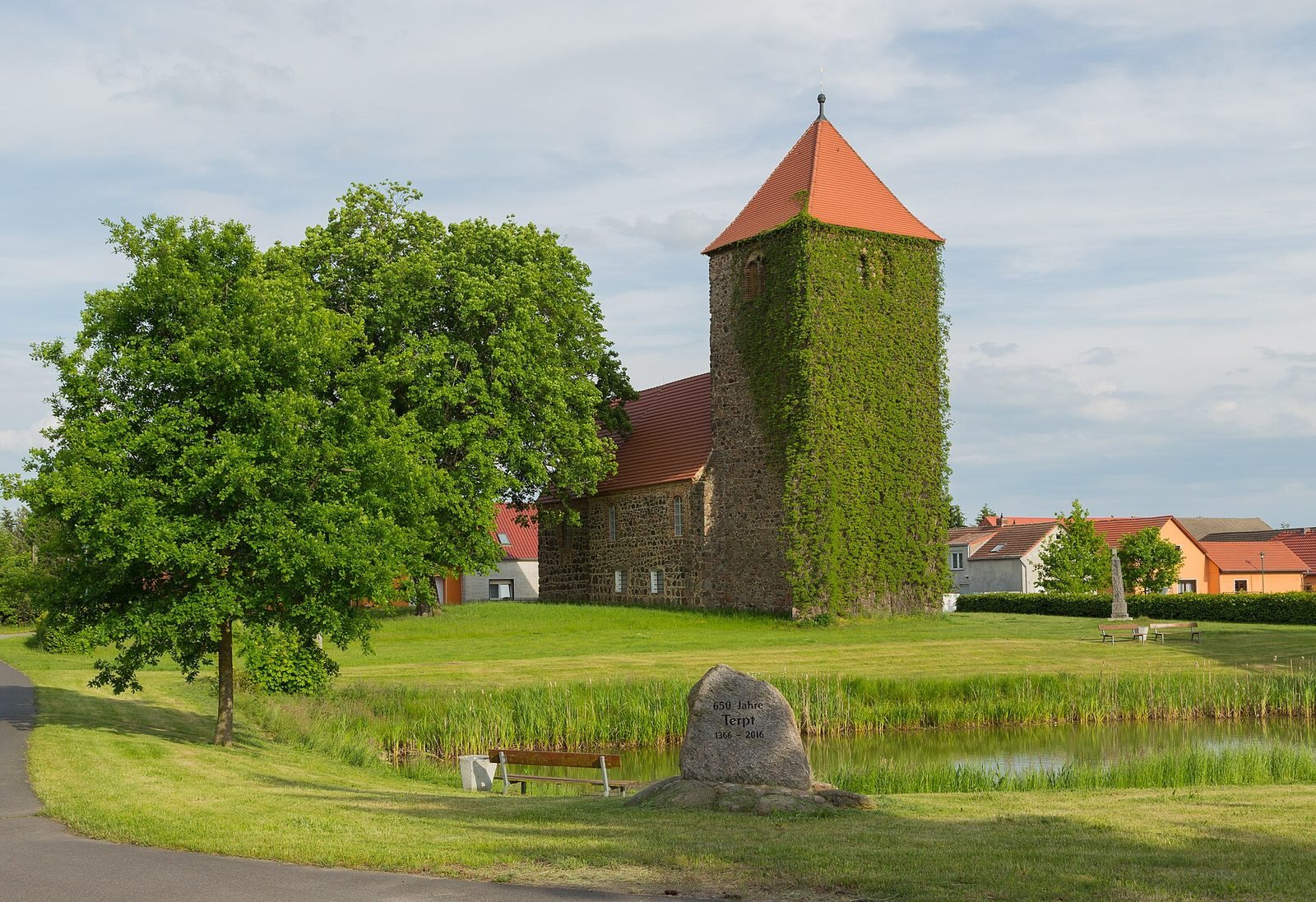
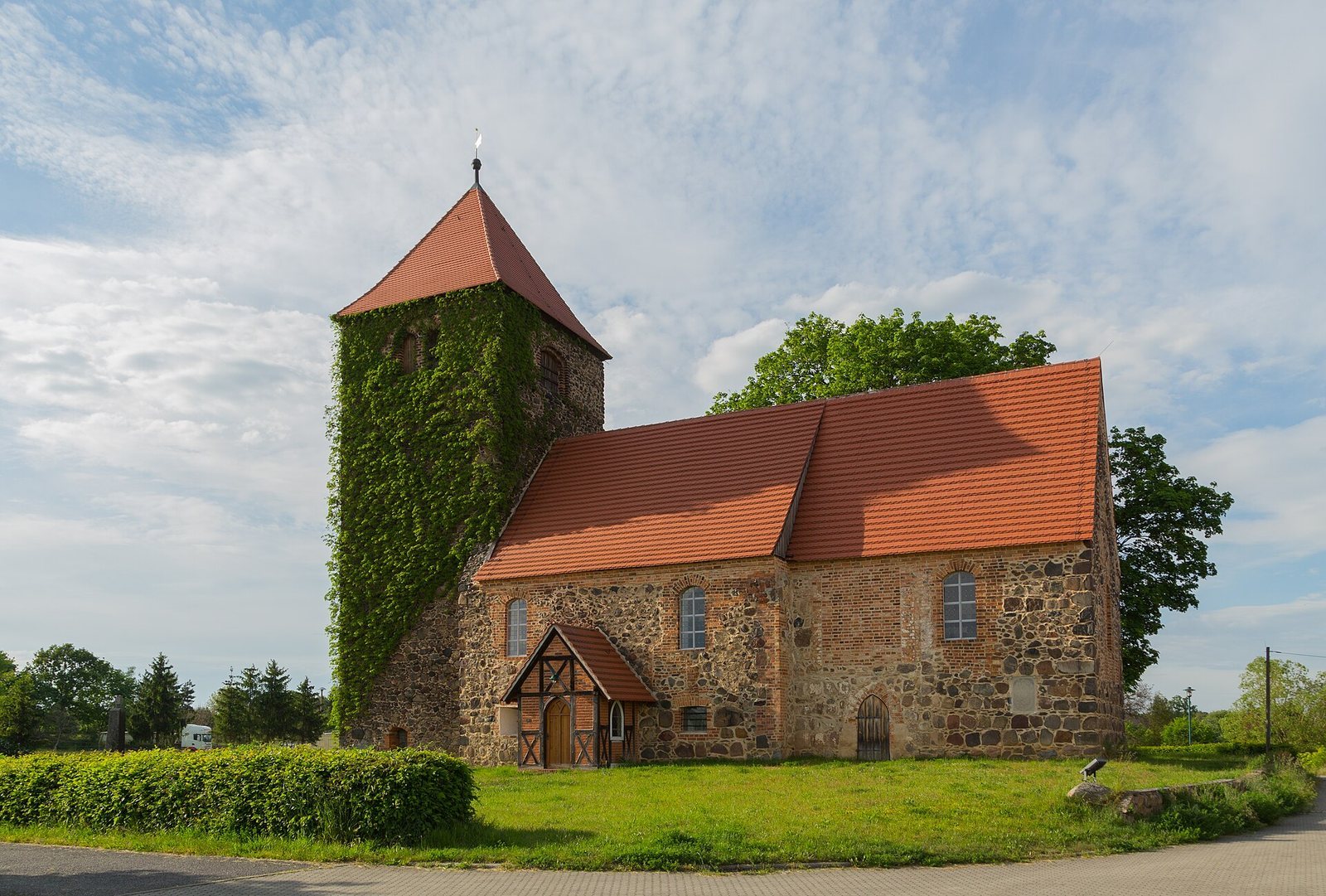
The church is a short fieldstone hall with an altar area integrated into the building and a square tower at its western end. Its surviving exterior and interior bring together features from the medieval building and later alterations.
Exterior
The church stands on the village green between Terpter Hauptstraße and Terpter Gartenstraße, with a small pond in front. A checkerboard-patterned stone at the south portal came to light during repair work in 2003. The nave windows were enlarged and reshaped with flat arches in 1845; their brick surrounds mark the alteration, and one window on the south wall is bricked up. Two timber-framed porches with brick infill were added on the south side. The eastern porch was removed in early 2015 because of structural defects. Paired, round-arched openings for the bells sit in the tower’s bell stage, and the bells date from the 17th century.
Interior fittings
Gallery
The interior has a flat ceiling and a horseshoe-shaped gallery dating from the 17th century. Its second tier was removed in 1845, while the east gallery is dated to 1740.
Pulpit altar
The pulpit altar, which combines an altar and a pulpit, was assembled in 1740 by carpenter C. F. Vieth using parts from 16th-century altars. Its many-sided pulpit basket has Renaissance-style decorative painting and stands between two Tuscan columns, a plain classical column form. Childlike decorative figures, known as putti, adorn the altar’s side panels. The predella, the lower panel of the altarpiece, carries a Last Supper scene dated 1600; a Crucifixion painting from the early 17th century appears on the pulpit door.
Baptismal angel
A wooden baptismal angel, given to Hans Christian von Thermo in 1722, survives in part.
Organ
The organ was made in the early 20th century, probably in 1927, in the workshop of Gustav Heinze in Sorau. It uses a case dating from 1809 and has seven stops, which control sets of pipes, two manuals, or hand-played keyboards, and a pedal played with the feet. Its air-powered stop action operates cone-shaped valves that regulate airflow to the pipes.