Schloss Lübben: A Medieval Castle Complex in Germany


Site at a Glance
- Rating
- 4.6
- Popularity
- Very Low
- Country
- Germany
- Primary era
- Early Modern
- Eras represented
- Medieval, Early Modern, Modern
- Civilizations
- German, Habsburg, Holy Roman Empire
- Site type
- Military
- Remains
- Castle
On this page12 sections
History
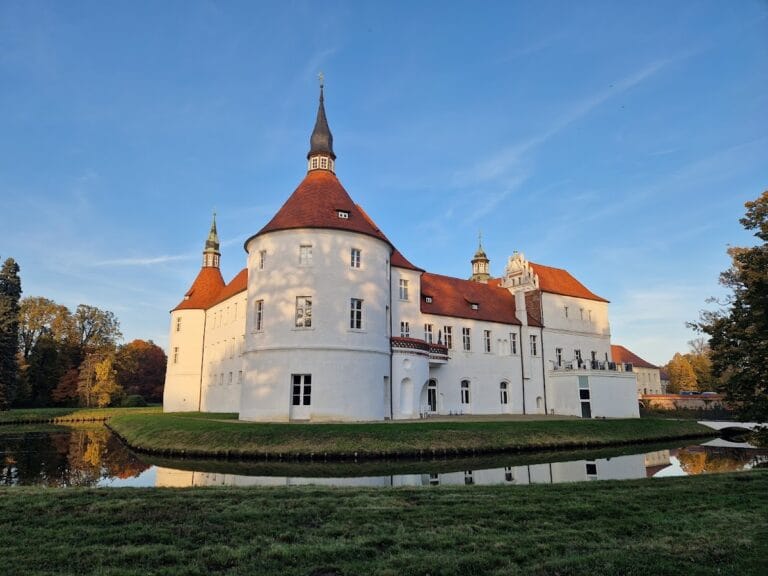
Schloss Lübben is a medieval castle complex in Lübben, Germany, occupying the site of a twelfth-century water castle near an earlier Slavic ringwork. Its position beside a passage through the Spreewald lowlands helped Lübben develop as an economic, administrative, and military centre of Lower Lusatia.
Medieval foundations and regional government
The castle served a territory whose political allegiance changed repeatedly. Lower Lusatia passed under Wettin, Ascanian, Wittelsbach, Bohemian-Luxembourg, Jagiellonian, Habsburg, Saxon, Saxe-Merseburg, and Prussian rule. Lübben became the seat of the Landvogt, a territorial governor who administered the region for its sovereign, and the castle consequently accommodated successive ruling authorities.
From the fourteenth century onward, the complex was repeatedly altered and enlarged. The present principal building was commissioned under Landvogt Bohuslav Felix von Lobkowitz and Hassenstein, who considered the earlier structure so unsafe that it offered no secure living room. He gave it a more representative form in preparation for a visit by the Bohemian king and Lower Lusatian margrave Maximilian II. The building first appears in written evidence in 1561.
War, rebuilding, and changing institutions
The Thirty Years’ War caused severe damage to the castle. In 1635 Lower Lusatia passed to Electoral Saxony, and after the Saxon territorial division of 1657 it came under the dukes of Saxe-Merseburg. Duke Christian I of Saxe-Merseburg ordered a comprehensive rebuilding. In 1679 the structure was taken down to its masonry and rebuilt, with the work finished in 1682. The Marstall, a former stable building, dates from 1669, while its eastern counterpart belonged to the later rebuilding period.
The construction of the Ständisches Landhaus opposite the castle in the early eighteenth century changed the complex’s institutional role. The new building became the home of the regional estates, and the former Huldigungssaal, or ceremonial homage hall, lost its function as the centre of the castle. The Landvogt nevertheless continued to work there.
After the Congress of Vienna in 1815, Prussia received Lower Lusatia. In anticipation of the centenary of Prussian rule and a hoped-for visit by Kaiser Wilhelm II, the historic tower underwent extensive modernization between 1899 and 1915 under Adolf Zeller. Fighting for Lübben in April 1945, during the final phase of the Second World War, inflicted major damage. The castle was repaired after the war, while the eastern counterpart to the Marstall remained destroyed.
Museum use and cultural interpretation
A city museum with a natural-history focus occupied the tower until it closed in the late 1960s, after which the building housed a vocational school. The Stadt- und Regionalmuseum opened in the castle on 1 June 2001. Its displays address the cultural history and archaeology of Lübben and Lower Lusatia, as well as the Sorbian/Wendish tradition, a West Slavic cultural and linguistic heritage associated with Lusatia. The permanent presentation is supplemented by changing exhibitions on Lübben’s history.
The complex now accommodates Museum Schloss Lübben and a restaurant in the ground floor of the Oberamtshaus. The Wappensaal, or heraldic hall, is used for municipal and museum events, readings, concerts, and weddings. A restaurant returned to the Oberamtshaus on 1 June 2023 after a six-year absence.
Remains
The castle stands on the southern edge of Lübben’s old town on Museum Island. The Spreewald, a lowland landscape shaped by numerous channels of the River Spree, extends south of the complex, while the public park called Schlossinsel lies across a stream from the castle. The surviving buildings combine medieval defensive fabric with Renaissance, Baroque, and later historicist alterations.
Tower and heraldic hall
Castle tower
The late-medieval tower has an approximately square plan and walls about three metres thick. It began as a defensive structure and was altered after the Thirty Years’ War, in the early 1680s, with segmental-arch windows, rusticated corners, and a timber-framed residential storey for the duke. That storey was removed in 1914 and 1915 and replaced by a mansard hipped roof. Damage from 1945 was repaired in 1982, when the façade was replastered, its painted decoration from 1914 to 1917 was recreated, and the northern portal was renewed.
A relief by Hermann Engelhardt from 1914 and 1915 is set beside the entrance. Its two pairs of putti represent the military acquisition of Lübben by Saxony and the peaceful acquisition by Prussia, linking the decoration to Lower Lusatia’s change from Saxon to Prussian rule. An inscription above the portal refers to Frederick the Great and uses wording from Johann Wilhelm von Archenholz’s popular history of the Seven Years’ War in Germany, the conflict fought from 1756 to 1763.
Wappensaal
A mid-seventeenth-century vault survives on the tower’s ground floor. The two upper storeys contain the Wappensaal in its present form, created between 1898 and 1915 from elements associated with the earlier Huldigungssaal and the original sixteenth-century building. A west-facing gallery was formed during the 1914 alterations after the ceiling was removed to open the space into the upper storey. The former covered exterior entrance between the castle and the homage hall was also replaced by a permanent passage.
The hall’s central mural, measuring four by seven metres, was painted by August Oetken. It shows Brandenburg Elector Frederick II “Eisenzahn” being welcomed on 18 October 1448. The elector and his entourage face the people of Lübben, led by Mayor Bartil Sonnenwald, who offer baskets of fish and eggs in accordance with Sorbian custom. The scene presents the town’s handover as peaceful and later served as an image of the peaceful Prussian acquisition of Lower Lusatia in 1815.
The Wappensaal contains 115 coats of arms, including 23 city arms, 41 arms of knightly families, the Hohenzollern arms, and 22 arms of Lower Lusatian noble families. Together they portray the society of estates during the German Empire. Adolf Zeller added a four-metre-wide light crown of black-fired iron in 1915 and patented its construction method. During the East German period, a Lübben company produced large cloths that covered the walls and helped preserve the room. The hall was restored in 1982, when a coat of arms belonging to PHG Drei Schilde was added despite objections from heritage conservators.
Oberamtshaus and Marstall
Oberamtshaus
The Oberamtshaus was built south of the tower between 1679 and 1682 as a prominent three-storey brick building. Its plastered walls rise beneath a gabled roof. The original arrangement had seven transverse and three longitudinal axes, while the 1899 alteration added three axes on the west side and another staircase.
The façade reflects Christian I of Saxe-Merseburg’s rebuilding campaign. Its eastern gable has a curved late-Renaissance form, and Corinthian columns divide the upper two storeys. Stucco ornament, articulated cornices, and rectangular windows with elaborate surrounds enrich the exterior. On the northern side, a shallow-arched portal with seating niches is framed by an aedicule on Ionic double columns. The gable bears the Lower Lusatian coat of arms and the date 1682. A balustraded balcony on the south side dates from 1899, the western addition imitates late-Renaissance forms, and a covered connection to the tower was built in 1914 and 1915.
Marstall
The Marstall was built in 1669 as a long, two-storey plastered building with a half-hipped roof. Restored after 1980, it now houses Lübben’s municipal library. Its eastern counterpart was destroyed near the end of the Second World War.
Museum objects and archaeological evidence
The museum’s displays include a replica of the Burger cult wagon, whose original dates from the tenth to the eighth centuries BC. Other material includes coin finds from Straupitz and Schlepzig, part of a wooden road excavated during construction work in Lübben, a sled used to transport condemned people to executions, and an execution sword approximately two metres long. Exhibitions also present Sorbian culture, including traditional clothing, and the development of the Spreewald as a tourism region.
Nearby sites