Helpensteinmühle: A Historic Watermill in Ratingen-Lintorf, Germany
Site at a Glance
- Popularity
- Very Low
- Country
- Germany
- Primary era
- Early Modern
- Eras represented
- Medieval, Early Modern, Modern
- Civilizations
- Duchy of Berg, German, Holy Roman Empire
- Site type
- Economic
- Remains
- Watermill
On this page12 sections
History
Medieval mill and ducal rights
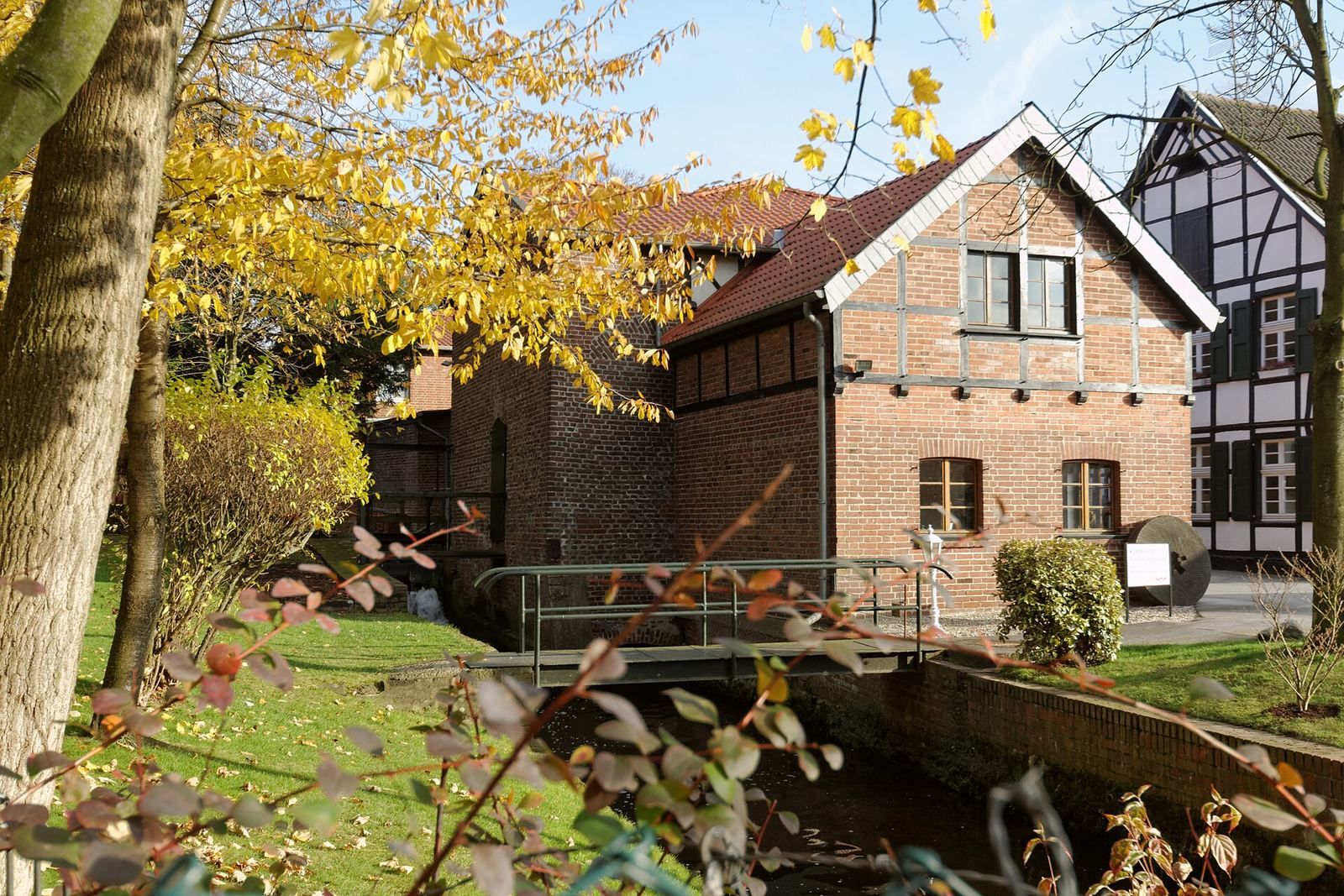
Helpensteinmühle is a historic watermill on the Dickelsbach at the entrance to Ratingen-Lintorf, Germany. It is first mentioned probably in 1157, and its present form dates to about 1650–1700. The mill is among the oldest surviving watermills in the historic Bergisches Land region.
A lord of Helpenstein received a mill as a fief, property held under a superior lord’s authority. Further mentions followed in 1385 and 1420. In 1420, Duke Adolf of Berg renewed the lease for an annual payment of three Malter of rye. A Malter was a measure of grain whose exact value varied by region and period. Adolf also made the mill compulsory for Lintorf and half of Breitscheid, meaning people in those districts had to use it to grind grain. The miller was exempt from many taxes, while the estate owed the duke a saddled horse each year and, in wartime, an armed rider. The lease was renewed in 1585 and 1604.
War and changing ownership
The mill and estate were abandoned during the Thirty Years’ War, the European conflict fought from 1618 to 1648. The Helpenstein family lived at the estate until a date given as either 1563 or 1577. The Pempelfort family held it from 1577 to 1798, followed by the Stockfisch family, first as tenants and then as owners from 1826 to 1894. The Krefter family held the property from 1894 to 1908, and the Weber family from 1908 to 1914.
In 1750, the estate covered nearly 1,000 Morgen, a historical land measure whose value varied by region and period. Its fortifications were dismantled around 1780–1790. On 9 March 1914, Westphalian master miller Johann Fleermann purchased the mill and the remaining 27-Morgen estate. The property has remained with his descendants.
Industrial use and preservation
Fleermann Agrar & Garten, founded in Münster in 1910, stopped producing flour for bakeries in 1953 and shifted to making and wholesaling animal feed and fertilizers. A retail shop opened at the street frontage in 1963 and was later enlarged. An adjacent electric mill continued to produce rolled oats for horses until the end of 2011.
A major renovation in 1998–1999 preceded the mill’s opening to the public. Helpensteinmühle is a protected historic monument, and all its buildings are under monument protection.
Remains
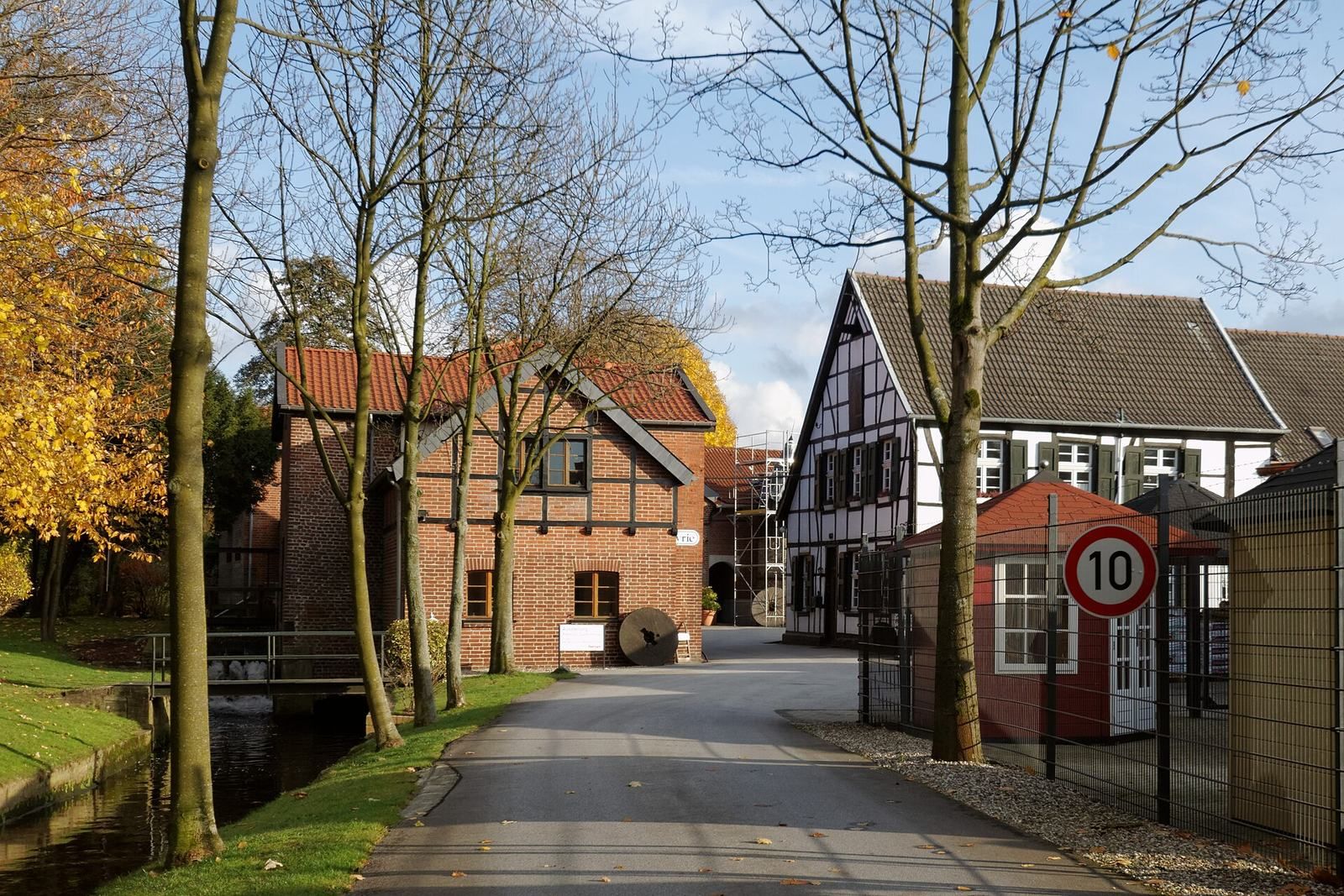
The surviving complex brings together the watermill, residential and work buildings, and equipment associated with grain processing. Its buildings stand beside the Dickelsbach, and the mill’s water system includes a wheel and two sluices.
The mill and its machinery
Mill building and waterwheel
The mill’s present form dates to about 1650–1700. Its steel waterwheel is breastshot, meaning water strikes it around the middle. The wheel measures 550 centimetres in diameter and has 16 spokes and 64 paddles. Two sluices form part of the mill’s water system.
Grinding equipment
The mill contains three grinding units: a flour mill, a grist mill, and a roller mill. Its equipment includes a Condux grist mill, a winnowing mill dating to about 1910 that separates grain from chaff, and a plansifter, which sorts milled grain by particle size. A lifting crane has a screw spindle for raising loads. The mill remains technically functional, and an exhibition includes older technological equipment.
Estate and working buildings
Half-timbered house
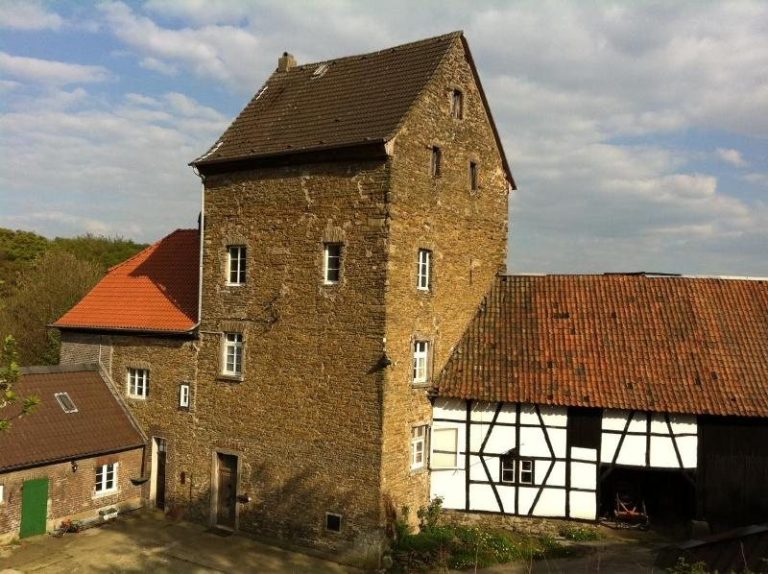
A half-timbered house at the complex dates to 1788–1789.
Dovecote tower
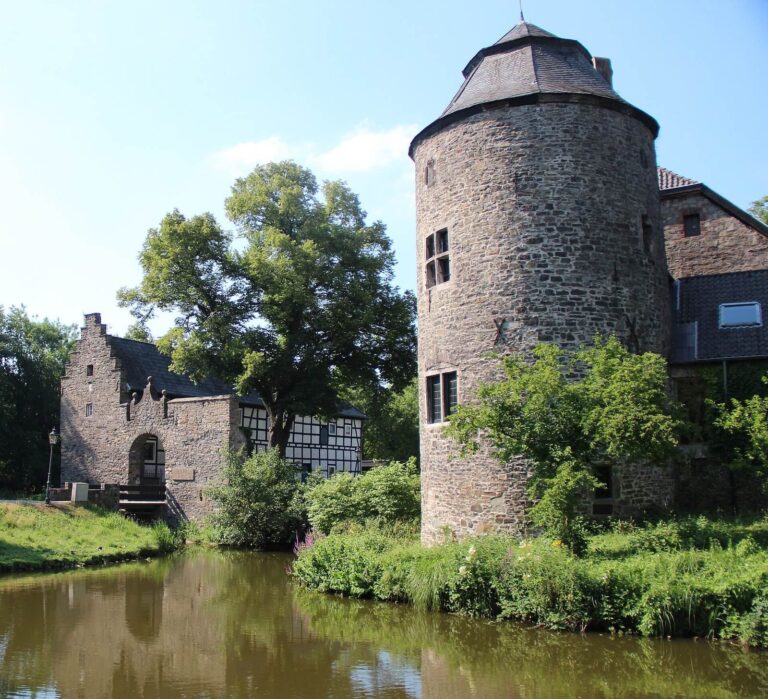
A medieval dovecote tower dating to the 13th century survives at the estate. It represented the owners’ right to let pigeons fly freely.
Buildings dating to 1878
The complex also includes a bone mill, a bakehouse, and an engine house, all dating to 1878.