Tintignac: A Gallic Sanctuary and Gallo-Roman Religious Complex in France
Site at a Glance
- Popularity
- Medium
- Country
- France
- Primary era
- Classical
- Eras represented
- Classical
- Civilizations
- Celtic, Roman
- Site type
- Religious
- Remains
- Sanctuary
On this page16 sections
History
Tintignac is a Gallic sanctuary that grew into a Gallo-Roman religious complex near Naves, France, with its earliest phase dating to the third century BC. It formed part of a secondary settlement, a community smaller than a major town.
Gallic origins and Roman transformation
The sanctuary bordered an old trade route that carried tin from Armorica or Cornwall toward the Mediterranean. The Lemovices, a Gallic people, are thought to have traded gold and iron mined in the Corrèze valley with merchants using this route.
The site’s first major transformation appears to have coincided with Romanization, the adoption of Roman cultural practices and institutions, at the end of the first century BC. It may have been destroyed by Gallic elites seeking to accommodate the new Roman authority.
Road, expansion, and destruction
During the reign of the Roman emperor Hadrian, a road connecting Lyon and Bordeaux through Clermont-Ferrand and Périgueux crossed the older trade route at Tintignac. The road may have brought more pilgrims to the sanctuary and encouraged its expansion.
The complex reached its high point in the third century AD, when its theatre was built. In the fourth century, the site appears to have been deliberately set on fire. Early Christian evangelizers may have been responsible if they regarded it as a surviving place of pagan worship.
The name and archaeological investigation
The ancient name of the site is unknown because Tintignac has not been identified in surviving Roman writings. Its name appears in the twelfth or thirteenth century as the Occitan form Tintinhac. It may derive from the Latin personal name Tintinius combined with -acum, a suffix meaning a place or property.
Local people knew surface ruins of the temple and theatre, and scholars began studying the site in the seventeenth century. Étienne Baluze depicted an arena where the semicircular theatre stands, helping preserve the mistaken name Arenas of Tintignac.
Local scholars excavated Tintignac in the 1830s and exposed remains of four principal buildings. Prosper Mérimée and Abel Hugo visited during the nineteenth century, and the site was added to France’s list of protected historic monuments in 1840. Excavations in the 1880s used trenches along building walls to establish a plan.
France’s National Institute for Preventive Archaeological Research began excavations in 2001. Work from 2003 examined settlement around the sanctuary during both the Gallic and Gallo-Roman periods. Later investigations uncovered further evidence of the site’s buildings and infrastructure.
Remains
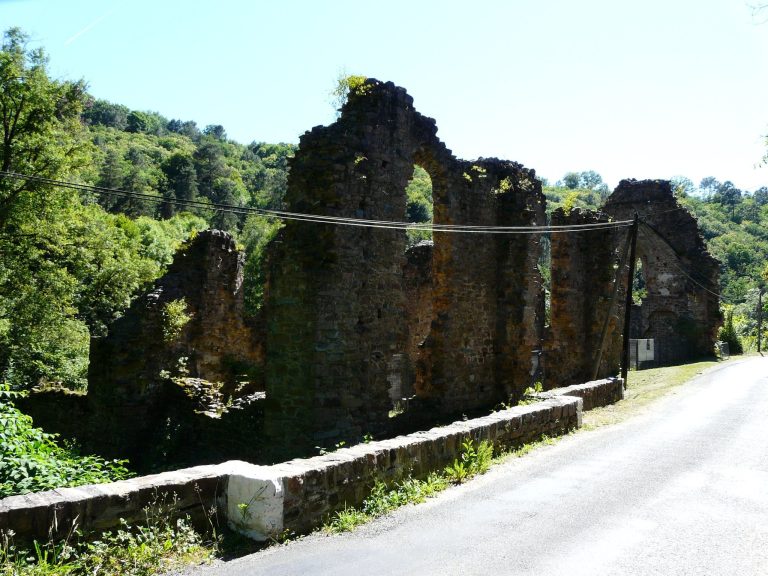
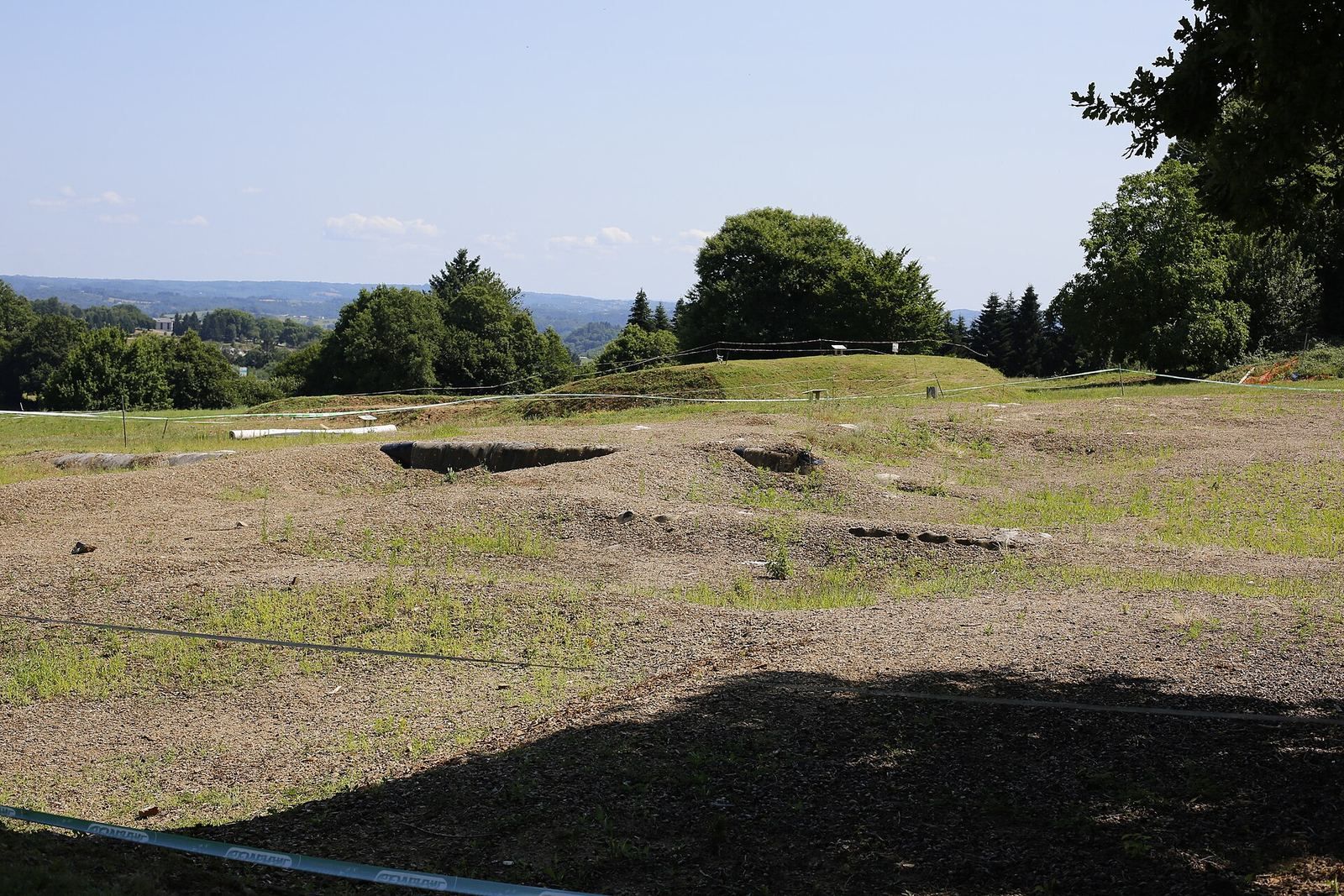
The complex lies north of the Naves plateau, at an elevation of about 490 metres on the eastern slope of Puy de l’Aiguille, which reaches 509 metres. It sits between that peak and Peuch Redon, at 501 metres, with a broad outlook across the Monédières massif and the Vimbelle and Corrèze valleys. The surviving remains represent a sequence from a Gallic sacred enclosure to a group of Gallo-Roman religious and public buildings. The archaeological area is estimated to cover nearly 60 hectares, and at least four further buildings have been identified beyond the excavated areas.
The sanctuary
Gallic enclosure
The Gallic sacred area was enclosed by a substantial palisade with an opening on its eastern side. Traces at its centre belong to a wooden building that was rebuilt several times. Evidence also points to a fire that was maintained continuously within the enclosure.
Gallo-Roman temple
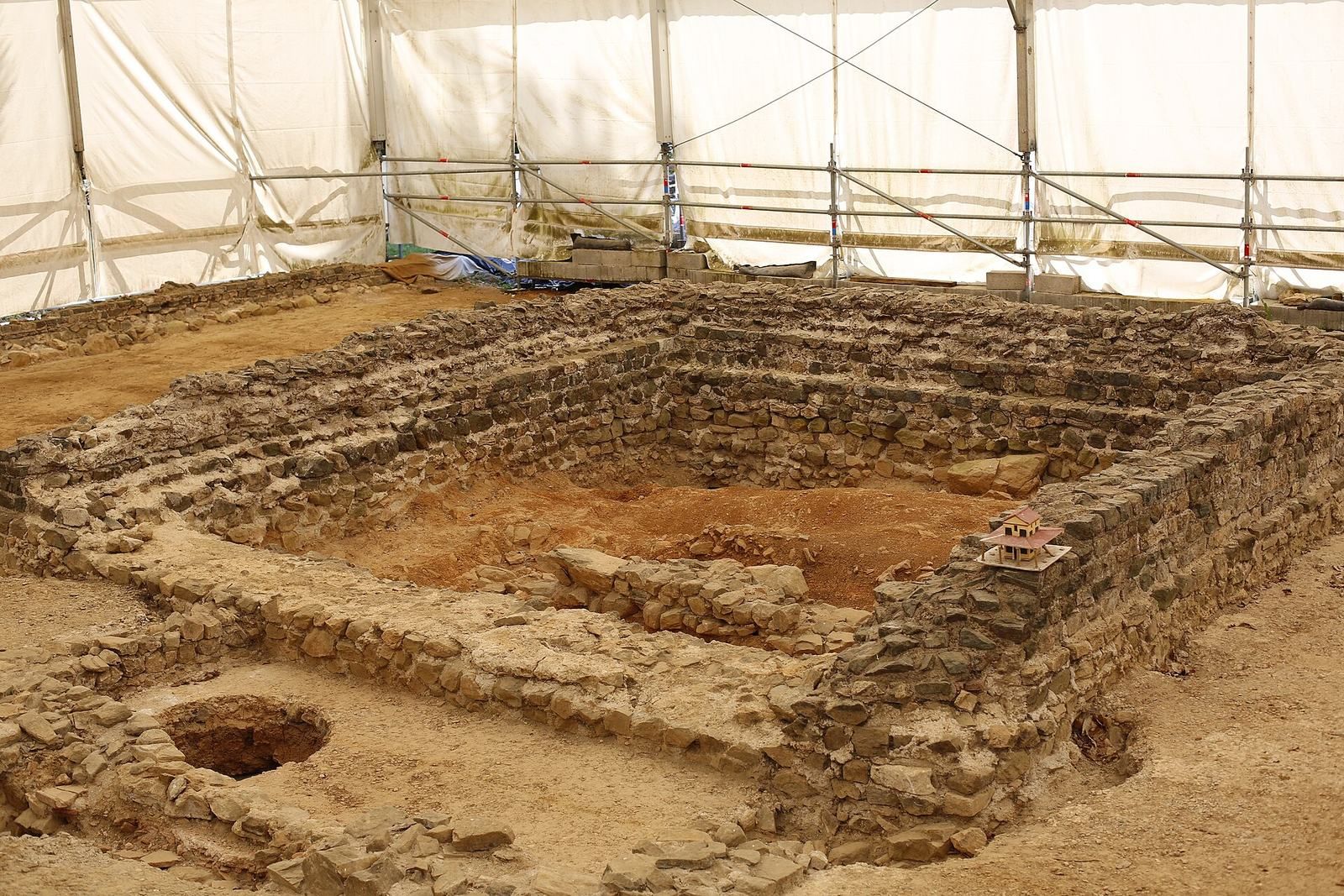
Two Gallo-Roman temples were built over the earlier sanctuary and developed into a large, richly appointed temple with two enclosed sacred chambers. This temple is the only building visible above ground and the only structure excavated in its entirety.
Public buildings and water supply
Portico
One of the additional buildings, dating from the first half of the second century AD, was long described as a tribunal with two basilicas. It is now thought to have been a portico, a covered structure often supported by columns. One of its two flanking structures, traditionally called a basilica, has been excavated.
Semicircular building
A second structure added from the first half of the second century AD is distinguished by its semicircular shape and scale. About half of it has been excavated.
Theatre
A Gallo-Roman theatre was attached to the eastern side of the semicircular building. It is estimated to have held as many as 2,500 people during major religious ceremonies. The grouping of these buildings at a rural centre appears unusual in the Roman world.
Aqueduct
An investigation in 2009 followed a well 13 metres deep and exposed an aqueduct. The water channel is 2 metres high and could be traced for 10 metres eastward from the well.
Gallic metal finds
Objects from the pit
A Gallic pit contained about 500 fragments of iron and bronze objects. Among the finds were roughly a dozen swords and iron scabbards, iron spearheads, and a shield boss, the raised central fitting on a shield. The assemblage also included about ten helmets made of bronze and iron, one shaped like a bird that may represent a crane or swan; two animal heads, one depicting a horse; an animal body with two hind legs and a foreleg; a cauldron; and seven carnyces (Celtic war trumpets), one nearly complete. The discovery in 2004 was the first of this kind of material in an archaeological context at a Gallic sanctuary. Archaeologist Christophe Maniquet, the site’s scientific director, led a team studying the finds.
Conservation and display
After restoration by the Materia Viva laboratory in Toulouse, the finds were exhibited in Tulle and toured internationally, beginning in Bern. They appeared in the 2012 exhibition Les Gaulois, une expo renversante and at the President Jacques Chirac Museum in Sarran in 2020 and 2021. After a period in museum storage, the objects returned to Naves. By April 2022, four prominent pieces had been placed in dedicated display cases in a building reserved for them.