Tulle Cathedral: A Medieval Cathedral in France


Site at a Glance
- Rating
- 4.5
- Popularity
- Low
- Country
- France
- Primary era
- Medieval
- External website
- Open
- Eras represented
- Medieval
- Civilizations
- Duchy of Aquitaine
- Site type
- Religious
- Remains
- Cathedral
On this page9 sections
History
Tulle Cathedral is a cathedral in Tulle, France, whose origins lie in a monastery founded in the seventh century. Its church was destroyed by the Normans in 846 and rebuilt during the second half of the ninth century, by which time the monastery’s holders had acquired episcopal dignity. The church later became the seat of the Diocese of Tulle and is dedicated to the Virgin Mary. It was originally dedicated to Saint Martin of Tours, a fourth-century bishop widely venerated in western Christianity, and later also to Mary.
From monastery to abbey church
The abbey prospered during the eleventh century and adopted the Benedictine rule, the monastic code traditionally associated with Saint Benedict of Nursia. Its church and conventual buildings eventually became outdated and too small for the community. Reconstruction began in 1103 under Abbot Guillaume de Carbonnières, with support from powerful families of Lower Limousin. The work continued into the fourteenth century and may have extended into the fifteenth, allowing the building’s design to develop over time.
The project began according to a conventional Benedictine plan, but its long construction period brought together Romanesque and Gothic forms. Romanesque architecture is associated with massive masonry, rounded arches, and heavy proportions, while Gothic building commonly uses pointed arches, rib vaults, and larger windows. This gradual transition shaped the cathedral that survives.
Creation of the diocese
In 1317, the Diocese of Tulle was created from territory that had previously belonged to the Diocese of Limoges. Pope John XXII established the new diocese during a pontificate based in Avignon, and the abbey church was raised to cathedral status. A diocese is an ecclesiastical district governed by a bishop. The cathedral remains the seat of the Diocese of Tulle.
Revolutionary damage and reconstruction
During the French Revolution, the cathedral was used on 27 November 1793 for worship of the goddess Reason. It was then closed for Catholic worship, looted, and damaged. The building was used to store forage and was converted into a cannon factory, changing its function and contributing to the disruption of its religious interior.
In 1796, the dome over the crossing, the space where the nave and transept meet, collapsed. The collapse damaged the choir and transept, which were subsequently removed. A wall was built at the eastern end of the surviving church, and the nave returned to Catholic worship in 1805. The damaged portions were rebuilt during the nineteenth century, when the cathedral and its cloister also underwent major restoration. The building was listed as a French historic monument in 1862.
Further work concentrated on the bell tower from 2013 to 2015. Bells 2 through 6 were removed in September 2013 for retuning and returned to Tulle in August 2014. In 2015, five bells were restored and then harmonized.
Remains
Church structure
The surviving church is a six-bay basilical structure with three aisles. A central nave is flanked by side aisles, and the nave ends at the east in a straight wall created after the choir and transept were removed. The pillars and side aisles retain their Romanesque character. Groin vaults cover the side aisles, while the nave has Gothic rib vaulting arranged on two levels. A rib vault is supported by intersecting stone ribs, whereas a groin vault is formed by the intersection of two barrel vaults. Large windows illuminate the relatively sober interior.
Western entrance and bell tower
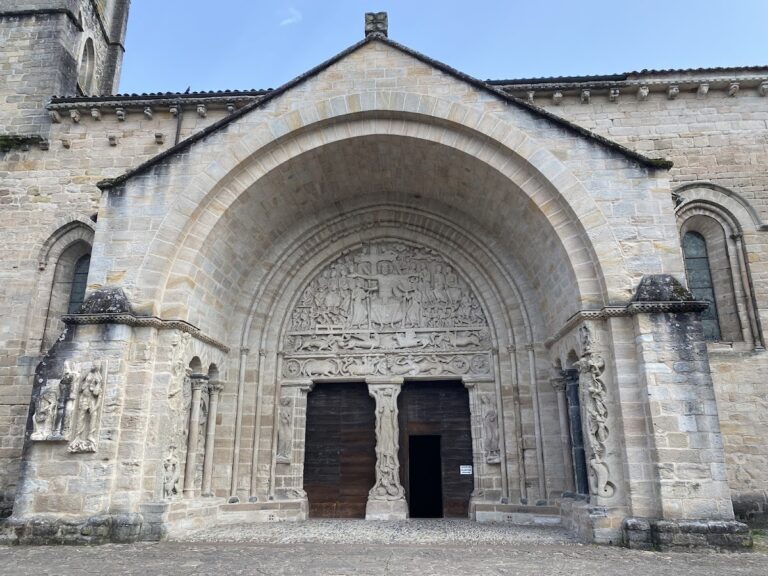
The western portal follows the Limousin Romanesque style. Its archivolt, a band of molding that follows the curve of an arch, ends in an inner multilobed arch. Above the church rises a bell tower approximately 75 metres high. Its ground floor dates from the twelfth century, its three upper levels from the thirteenth century, and its spire from the early fourteenth century. The spire has eight sides and is surrounded by four small turrets. Lightning struck it in 1645, after which it was restored in its original style.
The tower contains six swinging bells. The 2,000-kilogram bourdon, the largest and lowest-pitched bell in the peal, was cast in 1632 as a recasting of a bell from 1465. The bell named Notre-Dame de Tulle weighs 834 kilograms and was cast in 1938 by the Paccard foundry of Annecy. Notre-Dame de la Victoire, Marie-Marguerite, Jeanne d’Arc, and the Sacred Heart bell were cast in 1920 by Louis Bollée of Orléans. The Sacred Heart bell weighs 99 kilograms, and the four bells cast in 1920 were baptized on 24 October.
Cloister and interior furnishings
The two-storey cloister belonged to the abbey and was later used by the canons. A cloister is a covered walkway enclosing an open courtyard in a monastic or canonical complex. It now houses a museum of popular arts and traditions. Its chapter house, the meeting room for the monastery or cathedral community, contains two square clustered pillars with eight-part plans and a central vault decorated with zigzag ornament.
The interior contains two large reliquary shrines from the twelfth or thirteenth century. These monumental receptacles held sacred relics and are known as “transept” shrines. A painted chestnut-wood statue of Saint John the Baptist dates from the sixteenth century. The statue was formerly carried at the head of the Lunade, a local religious procession held on 23 June.
Organ
The neo-Classical organ was built by Abbey in 1839. Haerpfer and Hermann restored it in 1975, and Bertrand Cattiaux carried out another restoration with complete re-harmonization between 1998 and 2002. The instrument has 44 stops, meaning individual ranks or sets of pipes controlled through the organ’s stop mechanism, distributed across three manuals and a pedal division.