Tomb of King Wang Geon: A Goryeo Royal Tomb in North Korea
Site at a Glance
- Popularity
- Medium
- Country
- North Korea
- Primary era
- Classical
- External website
- Open
- Eras represented
- Classical, Modern
- Civilizations
- Goryeo
- Site type
- Religious
- Remains
- Tomb
On this page12 sections
History
The Tomb of King Wang Geon, a Goryeo royal tomb built about a month after the king’s death in 943, lies in Haeson-ri, Kaesong, North Korea. Its Goguryeo-style stone-chamber tomb combines a stone burial room with an earthen mound. The site commemorates the founder of Goryeo, the kingdom that he established and ruled as its first king.
The foundation of Goryeo
Wang Geon lived from 877 to 943. In 918, amid political division and calls for unification, he and his supporters overthrew Gungye, ruler of Taebong, and founded Goryeo. Wang Geon brought Silla under his rule in 935 and Baekje in 936. After his death, he received the temple name Taejo, a posthumous honorific for a ruler commonly translated as “Great Founder.”
A protected royal burial
Wang Geon was regarded as having a divine role as the dynasty’s founder. During invasions in 1010, 1018, 1217, and 1231, his remains were moved to safety, while the remains of other kings stayed in their tombs.
Later care and modern recognition
The succeeding Joseon dynasty maintained and restored the tomb several times. During Japanese rule in Korea, it fell into neglect and suffered deterioration, illicit excavation, and looting. Some subsidiary buildings were restored between 1967 and 1979. An official excavation in 1992 examined the burial chamber and murals. In 1994, restoration enlarged the mound and repaired surrounding stone features and the memorial shrine. The chamber and murals were left intact, with glass installed to protect the paintings.
The tomb is North Korea’s National Treasure No. 179 and has belonged to the UNESCO World Heritage property Historic Monuments and Sites of Kaesong since 2013. The property’s 214.6-hectare protected area also includes ten Goryeo mound tombs: seven in the Seven Tombs Cluster, dated from the 12th to 14th centuries, and three in the Myongrung Cluster, dated to the mid-14th century.
Remains
The complex measures about 140 by 50 metres on the wooded southern slope of Mansu Mountain. Its grounds extend up the hillside, about 3 kilometres west of the former royal palace of Manwoldae. The Tomb of King Gongmin lies about 3 kilometres farther west.
The ceremonial approach
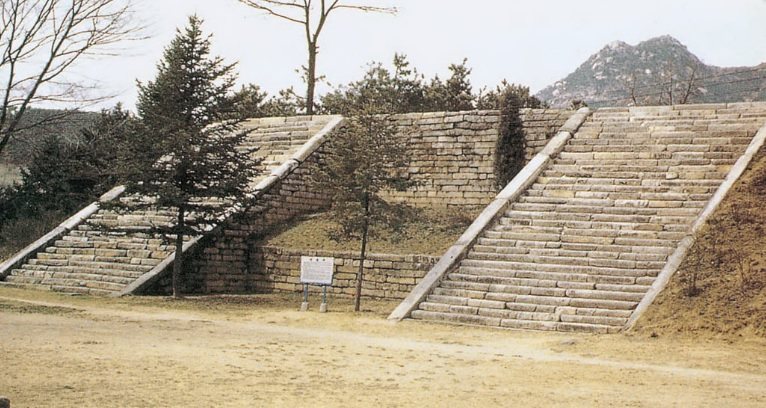
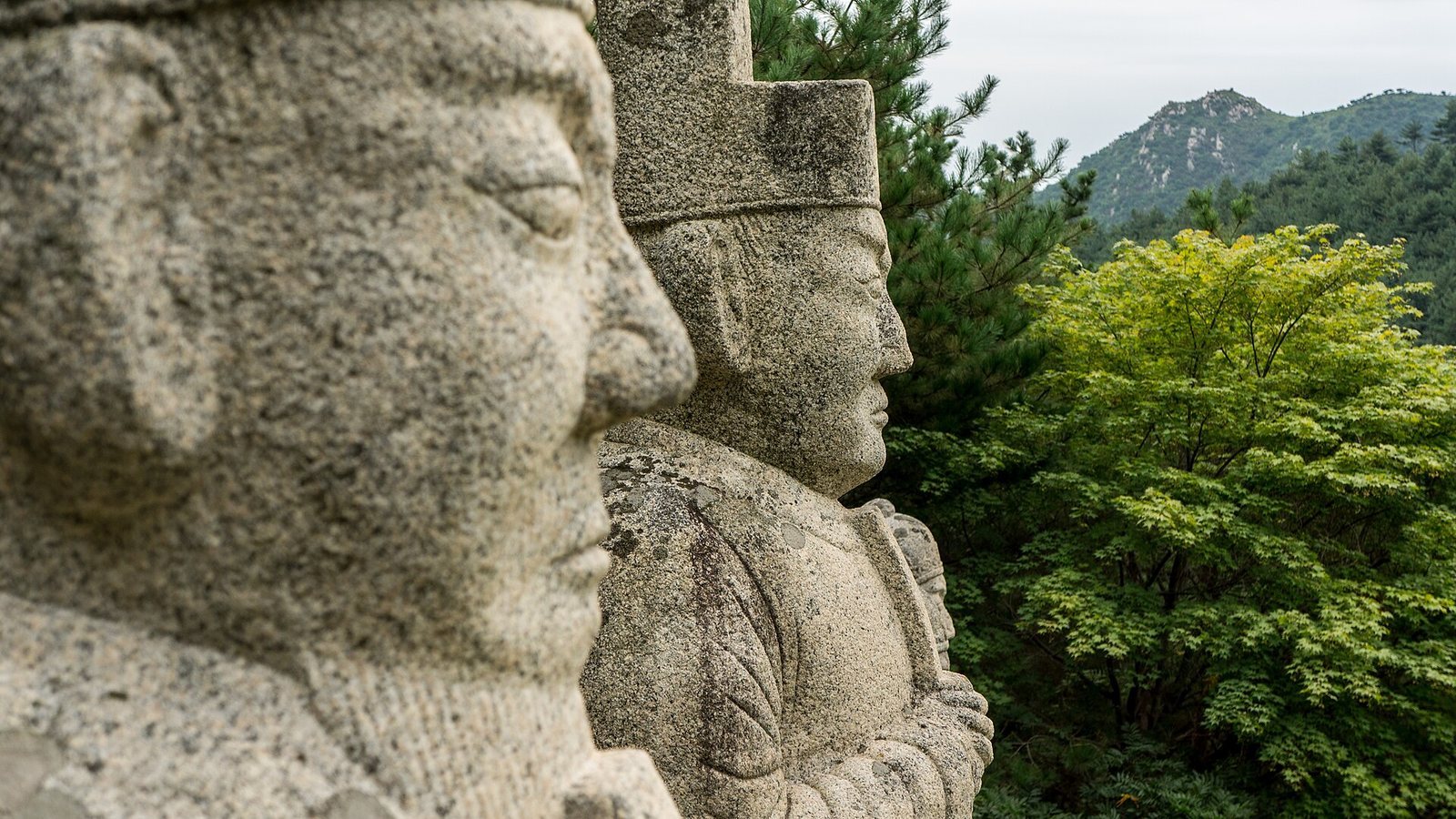
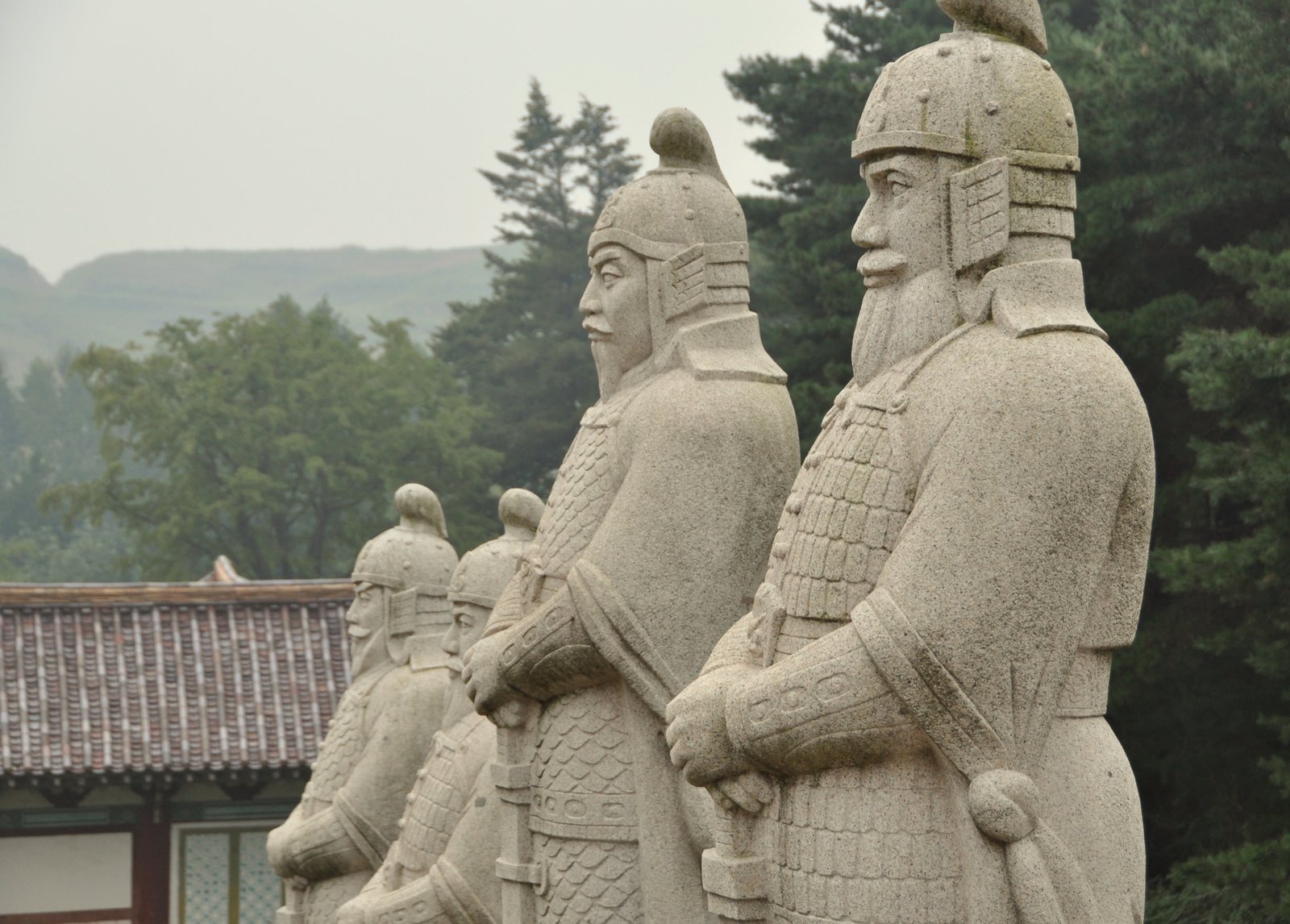
A gatehouse opens onto a straight path leading to a terrace. A T-shaped memorial shrine stands on its left, with two smaller stele pavilions on the right. Stairs rise across three more terraces toward the mound. The shrine contains a portrait of Wang Geon and paintings of episodes from his life; the pavilions hold steles describing the tomb’s history, construction, and repairs. Large stone figures of civil and military officials flank the two lower terraces, arranged in two rows of four. The civil figures stand about 3.6 metres tall and the military figures about 3.7 metres tall. A stone lantern stands before the stairs to the highest terrace.
The burial mound and chamber
Mound and stone enclosure
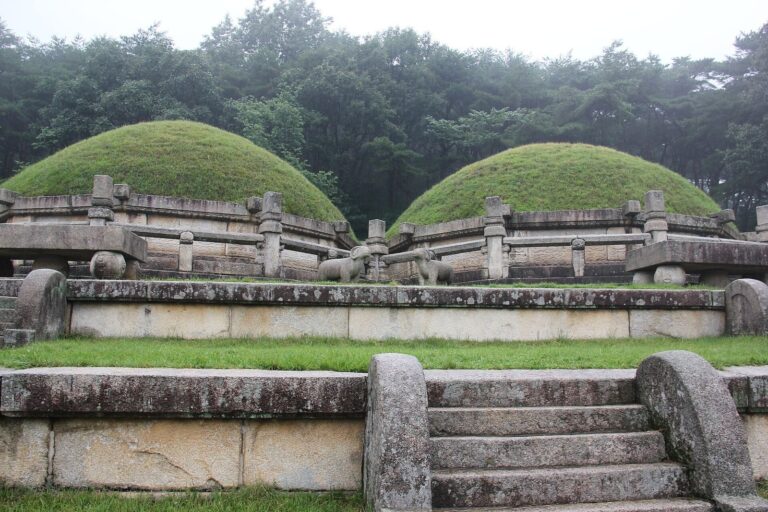
The grassy earthen mound is about 8 metres high and 20 metres in diameter. Twelve stone slabs carved with zodiac signs surround it within a twelve-sided stone railing; the signs belong to a traditional cycle used to represent time and direction. The slabs span about 19 metres diagonally. Four stone tigers stand around the mound, while a stone offering table sits in front, flanked by a stone column on either side.
Burial chamber and murals
The chamber measures 3.18 by 3.45 metres and is 2.20 metres high. A single stone slab forms its ceiling, and plaster covers the painted walls. The east wall shows a blue dragon with an apricot tree and bamboo; the west wall depicts a white dragon, a pine, and an apricot tree. A snake and a turtle appear on the less well-preserved north wall. A passage that bends several times connects the south entrance to the chamber, where a long platform held grave goods.
Inscriptions and excavated objects
Memorial inscription
A stele beside the tomb carries an inscription in Chinese characters handwritten by Kim Il Sung, North Korea’s founding leader. The text commemorates reconstruction of the royal tomb of Wang Geon, Taejo of Goryeo.
Objects from the tomb
Finds from the tomb and its surroundings include a jade belt hook, chrysanthemum-patterned celadon, a bronze jar, a gilt-bronze seated statue, and gilt-bronze ornaments. Wang Geon’s belt reportedly had 62 jade hooks. The seated statue is identified as his likeness, with the face of a man just over 40. Its crown has a shorter outer section and a taller inner one. A band about 2.5 centimetres wide, marked by four lines, circles the outer crown; its front bears a mountain design, with clouds and small horn-like projections at the sides. Tassels hang from the inner crown. Eight circular ornaments once set around the rim depict the sun and moon; six survive. Sun, moon, and water designs on the crowns represented kingship.