Cabana de Perauba Megalithic Tomb: A Bronze Age Collective Burial Site
Site at a Glance
- Popularity
- Very Low
- Country
- Spain
- Primary era
- Bronze Age
- Eras represented
- Bronze Age
- Civilizations
- Unclassified
- Site type
- Burial
- Remains
- Burial Mound
On this page9 sections
History
Bronze Age Burial and Regional Society
The Cabana de Perauba Megalithic Tomb is a Bronze Age collective burial monument in the Pla de Corts of Lleida, Spain. The Bronze Age was a prehistoric period marked by widespread use of bronze. The recovered material is consistent with the Middle Bronze Age, a subdivision of that period, and relative dating places it in the first half of the second millennium BCE. Later fires complicated attempts at carbon-14 dating, which estimates the age of organic remains, so no absolute date was obtained.
The tomb appears to have been used for successive primary inhumations, meaning bodies were initially buried in their original positions. Earlier burials were moved aside to make room for later ones. No apparent distinction in access to burial was found by sex or age. This pattern has been interpreted to suggest that inequalities in access to the products of work were absent, or at least were not expressed in funerary practice.
Communities associated with megalithic tombs in the region relied mainly on cultivation and livestock. Hunting was known but did not provide a major part of their subsistence. The work invested in tomb construction and its repeated use have been taken to suggest relatively stable settlement, although the political organization of these groups remains debated.
Discovery and Archaeological Investigation
Geologist Luis Mariano Vidal i Carreras first recorded the monument in 1894. In 1922, a University of Barcelona prehistory seminar directed by Pere Bosch i Gimpera, with Josep de C. Serra Ràfols, excavated the tomb. The team judged that looting and visits by shepherds had disturbed it extensively. In 1950, archaeologist Luis Pericot Garcia likewise described it as completely looted.
During a survey of Pallars Sobirà in the early 1990s, Albert Roig found a vessel with a small, button-shaped handle. The find led to a new excavation in 1992, directed by Xavier Clop and Josep Miquel Faura. The team worked in one-metre squares and recorded finds in three dimensions, revising the earlier view that the burial chamber had been entirely emptied.
Remains
Setting, Mound, and Approach
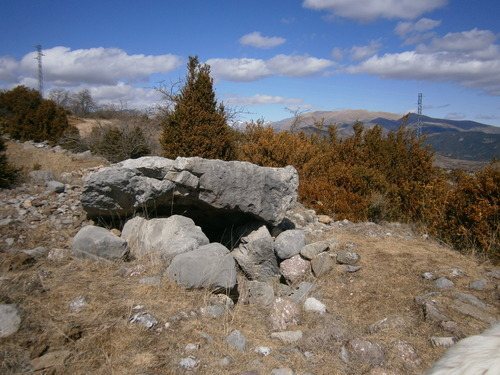
The monument is arranged around a burial chamber projecting from the centre of a stone mound about 14 metres in diameter. It stands at roughly 1,305 metres above sea level, at the northern end of a spur of the Serra de Peracalç, beneath the rock of Perauba and at the beginning of the Pla de Corts. The tomb is beside a forest track at the edge of a cultivated field. The Pla de Corts is a karst landscape, shaped by the dissolution of soluble rock, commonly limestone, and forms an east-to-west corridor between the Noguera Pallaresa and Flamicell valleys. The surrounding plateau lies at approximately 1,100 to 1,300 metres, while the Serra de Peracalç reaches 1,478 metres.
The mound is largely intact, although its surface has been disturbed. Excavation revealed a prepared base of small stones, mainly limestone, beneath a body of medium and large blocks, mostly limestone with some conglomerate. A perimeter row of large conglomerate stones appears to brace the structure. A gently sloping ramp leads through the mound to the chamber entrance, with two lines of medium or large stones marking the approach and continuing to the mound’s upper level. Stones dumped during work on the adjoining field also altered the surface.
Burial Chamber
The chamber opening faces southeast, at 155 degrees from magnetic north. Two irregular rectangular side slabs lean slightly inward, with a roughly triangular slab at the rear and a smaller slab at the entrance. A large semicircular capstone covers the chamber; its underside is flat, and it slopes markedly toward the rear. The slabs are limestone from the local Upper Triassic geological formation. The northeast side slab measures 130 centimetres high by 160 long, and the southwest slab 115 high by 180 long. The rear slab is 100 centimetres high and 95 wide; the entrance slab is 45 high and 75 wide. The capstone measures 190 centimetres long, 225 wide, and 45 thick.
The slabs extend about 20 centimetres into the ground and are stabilized by a compact layer of small stones roughly 15 centimetres thick. The rectangular chamber interior is about 120 centimetres wide and 120 high. The entrance slab also supports the mound.
Burial Evidence
Human Remains
The upper chamber deposit, about 20 centimetres thick, contained human remains, pottery fragments, two necklace beads, and modern material. Beneath it lay an original floor of compact small stones and earth, about 15 centimetres thick. An approximately square cut made by illicit digging penetrated the floor and was later refilled with small and medium stones. A strip about 20 centimetres wide remained beside the chamber slabs, where some human remains were found in place. Analysis covered 501 human remains, including 81 teeth, and identified a minimum of 11 people: four children and six or seven adults. Most of the remains were small, disturbed fragments mixed with modern material.
Recovered Objects
Excavation recovered 94 pieces of pottery, including one complete vessel with a button-shaped lug handle, a small knob-like projection used as a handle. Fourteen other fragments had shaped or decorated features. Additional finds included an unworked quartz crystal measuring 20 by 7 by 3 millimetres, two limestone necklace beads, a bone needle point with 13 millimetres surviving, and part of a flat-section bronze ring.