Holy Cross Church: A Medieval Church in Ronneby, Sweden
Site at a Glance
- Popularity
- Medium
- Country
- Sweden
- Primary era
- Medieval
- Eras represented
- Medieval, Early Modern, Modern
- Civilizations
- Danish, Swedish
- Site type
- Religious
- Remains
- Church
On this page15 sections
History
Medieval construction and expansion
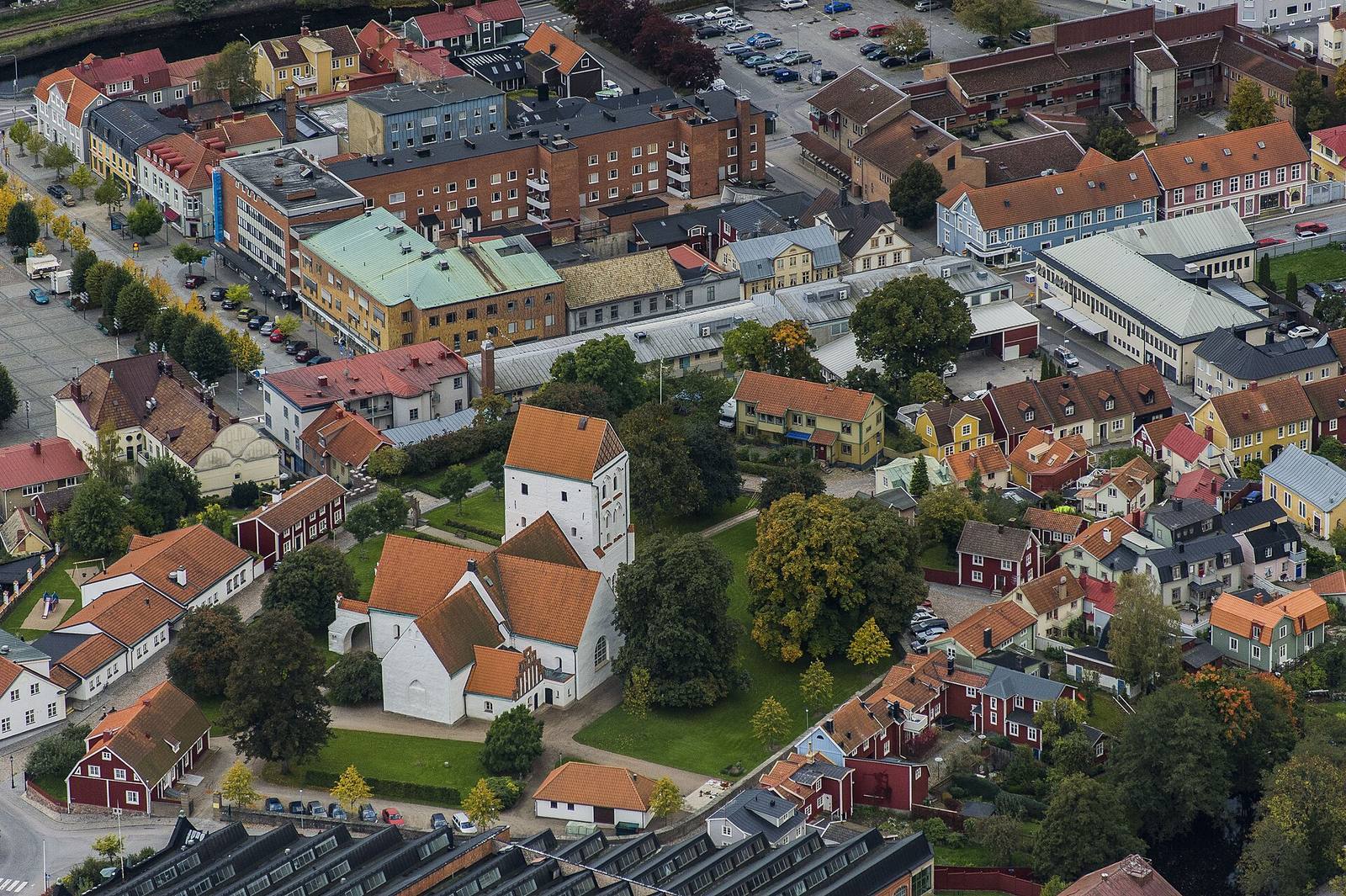
Holy Cross Church is a medieval church in Ronneby, Sweden, begun in the second half of the 12th century in the Romanesque style, a form of medieval European architecture. It belongs to Ronneby Parish in the Diocese of Lund, a regional church district within Sweden’s national Lutheran Church.
During the first half of the 13th century, as Ronneby developed into a town, the church gained north and south transepts. In the 14th century it took on a Gothic character, a medieval architectural style: the chancel, the area around the altar, was extended, and a sacristy was added. Further alterations and enlargement continued through the 15th century.
War and later changes
The church was severely damaged during the Northern Seven Years’ War (1563–1570), a conflict involving Sweden and Denmark, among other powers. On 4 September 1564, Swedish troops serving King Erik XIV entered Ronneby, then a Danish town. They killed at least 2,000 people, looted the town, and set it on fire. People seeking refuge in the church were killed after the troops forced their way inside.
The church stands in Bergslagen, Ronneby’s oldest surviving district. Bergslagen escaped the major fire that destroyed other parts of the town in 1864.
An altar was reconstructed between 1973 and 1983. The church’s organ history includes an instrument noted in the north transept in 1636, which may have remained in use until 1843. That year, Andreas Åbergh of Hjortsberga built a 20-stop organ, with a façade designed by C. G. Blom Carlsson, for the gallery. A new organ by Åkerman & Lund of Stockholm replaced Jönsson’s instrument in 1893. In 1937, Mårtensson’s organ factory in Lund enlarged the façade and case for a 38-stop instrument; the firm rebuilt it in 1969 and 2010. Mårtensson also built a separate eight-stop choir organ in 1986.
Remains
Plan and construction
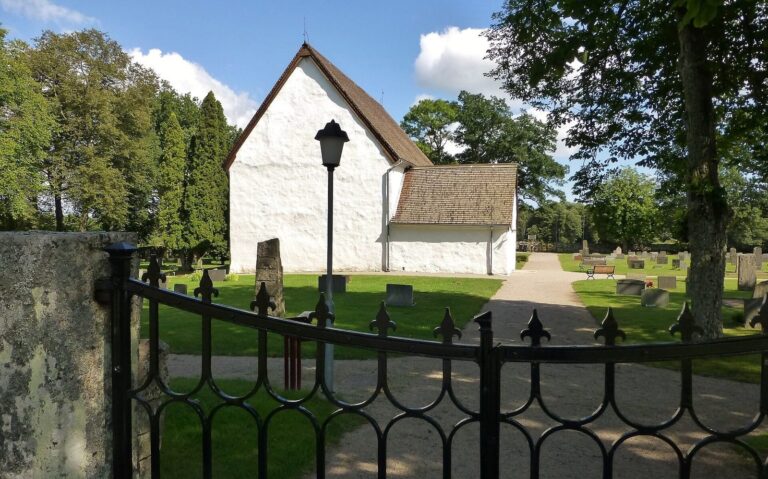
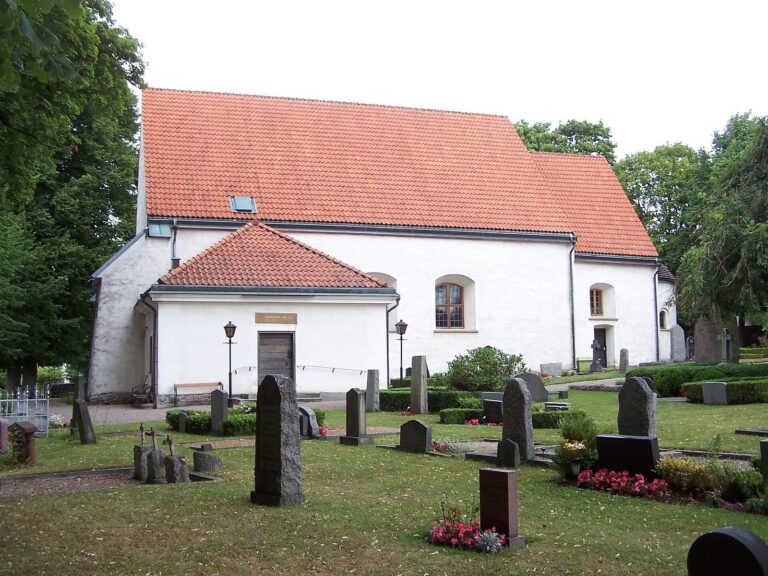
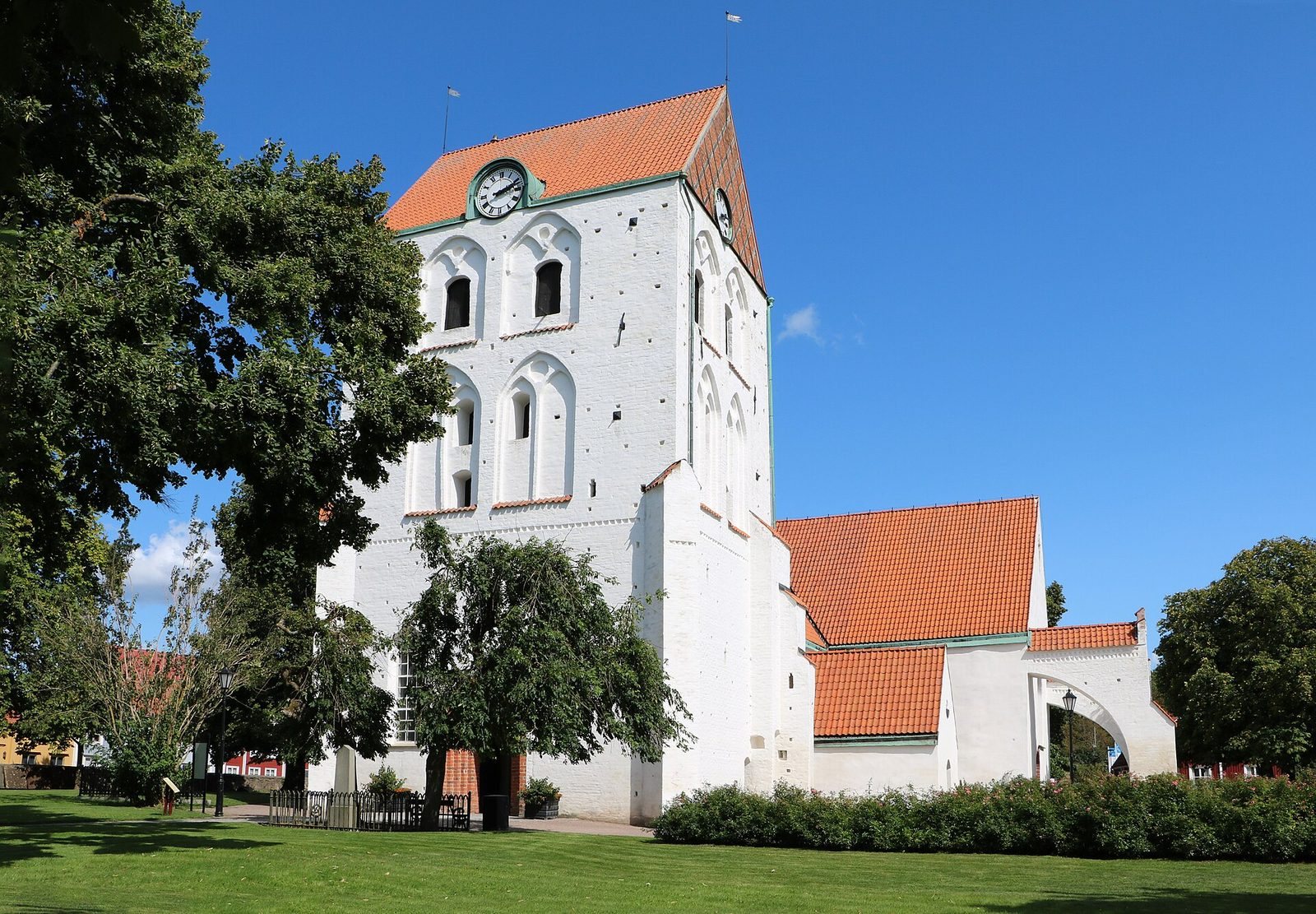
The church lies about 100 metres north of Ronneby’s town square. Its oldest surviving fabric is the nave, the main body of the church, and the western half of the chancel. These parts belong to the original Romanesque building and are made of split grey stone. The first church ended in a rounded chancel end, or apse. In the 14th century, builders replaced it with a straight east end and installed vaults throughout the church. The north and south transepts, the crosswise arms of the building, are also grey stone, with brick surrounds around their wall openings. The sacristy dates from the same period.
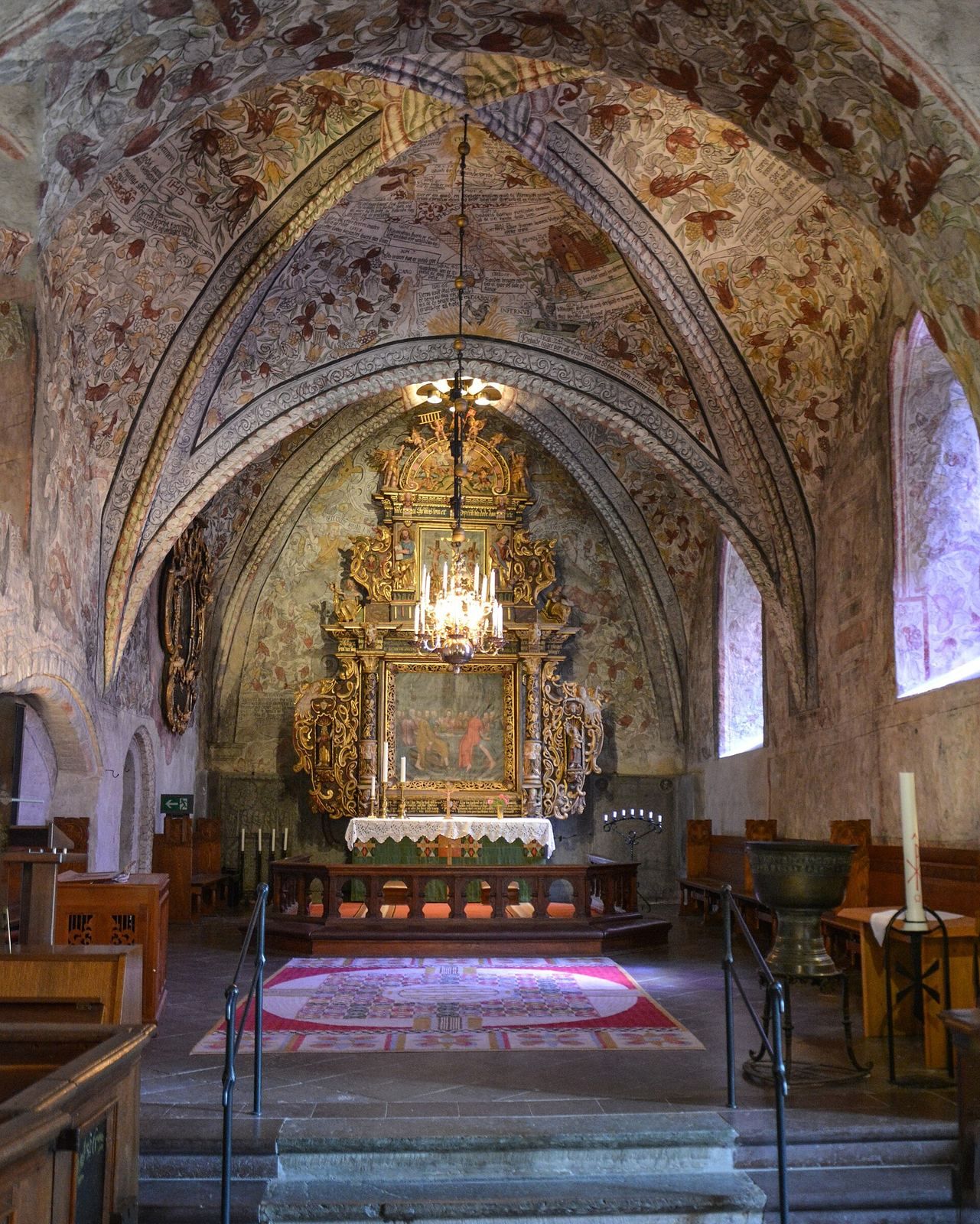
Eight brick vaults cover the interior. Seven are groin vaults, formed where two curved ceilings intersect; the north transept has a star vault, whose ribs form a star-like pattern. Two supporting projections were added to the south transept walls around 1500. A porch outside the nave’s old south entrance dates from the late 18th century.
West tower and door
A substantial brick tower rises at the west end. Dating from the late 15th century, it has supports at all four corners and shallow wall recesses that do not open through the masonry. Remains of a stairway and balcony survive on its southeast side. The balcony was designed as an outdoor pulpit but served only defensive purposes. Three bells hang in the tower: the largest was cast in Lübeck in 1593, while the middle bell dates from 1675 and the smallest from 1667. The largest and middle bells have since been recast.
The heavy oak door is set in the north wall. Deep cuts in its surface are associated with the 1564 attack on Ronneby.
Interior decoration and furnishings
Vault paintings
Painted decoration covers parts of the vaults. The oldest paintings date from the late 14th century and show Saint George fighting a dragon and Peter as pope. Other paintings date from the 16th century, while extensive decoration was added in the late 16th and early 17th centuries.
Altar and pulpit
The wooden altar dates from the 17th century. Its 1652 altarpiece, a decorated structure above or behind an altar, is richly ornamented in the Renaissance style, a European cultural and artistic movement. It has three principal sections: a large panel showing the institution of the Last Supper, a Crucifixion relief flanked by the four evangelists, the traditional authors of the Gospels, and a top section with the risen Christ holding a victory banner. Further decoration includes a depiction of the creed, angels around Christ, and a white altar covering that recalls the Nativity. The German master who made it was closely associated with a master from Stralsund.
The carved wooden pulpit dates from 1640 and is considered to be either Scanian or German in origin. Its panels depict the evangelists and the apostle Paul.
Baptismal font, cross, and windows
A bronze baptismal font made in Germany in 1604 bears an inscription identifying Knut Jute and his wife as its donors, giving it in honour of God and the church at Ronneby. The 16th-century triumphal cross, a large crucifix associated with the entrance to the chancel, carries symbols of the four evangelists. During restoration in 1842 it was moved from its former place hanging from a vault to the north side of the church.
Two brightly coloured chancel windows were made in 1955 by Erik Olsson of the Halmstad Group, a Swedish modernist artists’ collective. Their subject is Psalm 84, which is also associated with hymn 404, “How lovely and sweet is your dwelling, dear Lord,” by Swedish archbishop and hymnwriter Haqvin Spegel.
Paintings and other interior fittings
The interior also contains epitaphs, chandeliers, and wall-mounted lamps. Four paintings of the evangelists, John, Mark, Matthew, and Luke, were given by Knut Hahn, a bishop who had previously served as Ronneby’s parish priest. Each painting measures 106 by 75 centimetres.
Grave slabs and epitaphs
Grave slabs
The church’s grave slabs include reddish and grey limestone memorials. Laurits Pedersön’s reddish slab identifies him as a councilman and names his wife, Maren Jochimsdatter; its inscription says he died on 15 February aged 61. Another inscription identifies the burial of Svend Laurits. Mathias Skou’s slab preserves his name and the date 1696, while a medieval grave bears a personal ownership mark. Other named memorials include those for Klawes Gertsen, Elias Schlyter, Johannes Hoflin, and Anders Thörn. Several stones preserve only fragments of their inscriptions.
Abraham Bladh’s grey limestone slab, dated 1705, identifies him as a merchant in Karlskrona and quotes from Genesis 18. It names his wife Cristina Bladh and gives her death date as 28 September 1717; the inscription also claims the grave and stone for Abraham Bladh and his heirs.
Sacristy slabs
One grey limestone slab in the sacristy has rounded corners, a central shield marked with the initials NT/KAD, and the date 1674. Another memorial names Margarete Hansdatter, Lavris Hanson, Niels Hanson, and Niels’s brother. Its inscription gives Margarete’s death as 9 November 1620 and Lavris’s as 9 December 1619. It states that Niels and his brother were born and died on 14 June 1617, and that Margarete and Lavris died in their fifth year. A further slab commemorates Catharina Laurentia.
Wall epitaphs
The epitaphs, memorials for the dead, include a 1651 monument to chief judge Caspar Petersson Schow, with the divine name JHWH set within a circular sun. A 1636 memorial for mayor Herman Schlüter and his family has Christ’s entombment at its centre. The 1637 epitaph for mayor Knut Petersson commemorates his first wife, Ingeborg Svensdotter, who died in 1635 aged 33; it was made in conjunction with his second wife, Helviga Johansdotter. Its inscription describes the memorial as honouring God and adorning the church, and credits the painter Zach. Maus of Stralsund.
Other epitaphs commemorate Anna Lawensdotter Skoug (1726), Voltar Hindriksson (16th century), Johan Kleinborg (1587), Christer Findorphius (1703), Claus Fibiger (1569), and Harmen Wilke Karzman (1599). Kleinborg’s inscription reflects on Christian love through references to the lost sheep, the prodigal son, Mary Magdalene, and God’s love.