San Pietro Apostolo: Fondi’s Former Cathedral and Principal Church
Site at a Glance
- Popularity
- Medium
- Country
- Italy
- Primary era
- Medieval
- Eras represented
- Medieval, Early Modern, Modern
- Civilizations
- Italian, Kingdom of Naples, Kingdom of Sicily
- Site type
- Religious
- Remains
- Cathedral
On this page19 sections
History
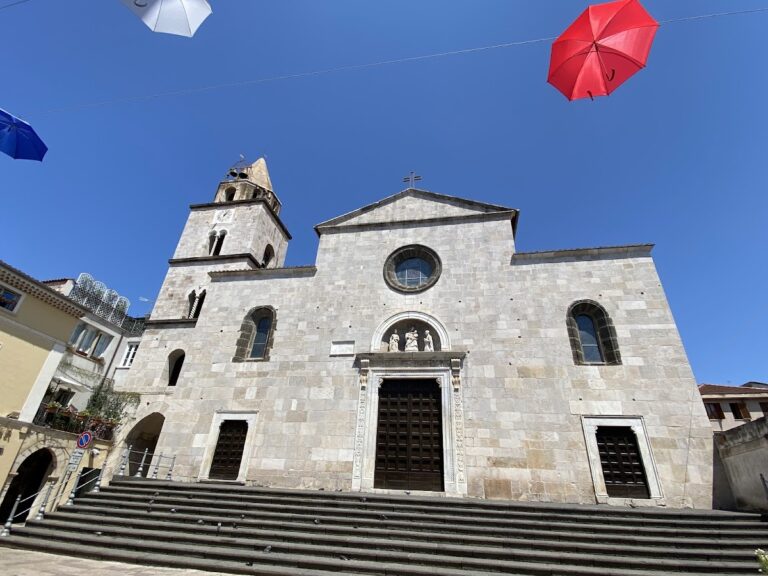
San Pietro Apostolo is a Gothic-Baroque Roman Catholic church in Piazza Duomo, Fondi, Italy, dedicated to Saint Peter and formerly the cathedral of the Diocese of Fondi. Consecrated on 12 December 1638, it remains Fondi’s principal Catholic place of worship and belongs to the Archdiocese of Gaeta.
Foundation tradition
A tradition says the church was first dedicated to the Mother of God, a title for Mary, and built over a temple of Jupiter, the chief god of ancient Roman religion. In this account, people in the surrounding area converted from paganism after Saints Peter and Paul preached there, and founded the church.
Destruction and rebuilding
The church was destroyed at an unknown date and later rebuilt under its present dedication. The chronology of this work is uncertain: a commission by Leone Caetani, Count of Fondi, is dated to 12 December 1138, while rebuilding over an earlier church and its completion are also dated to 1638. Bishop Maurizio Rogano, whose episcopate lasted from 1636 to 1640, consecrated the church on 12 December 1638.
Remains
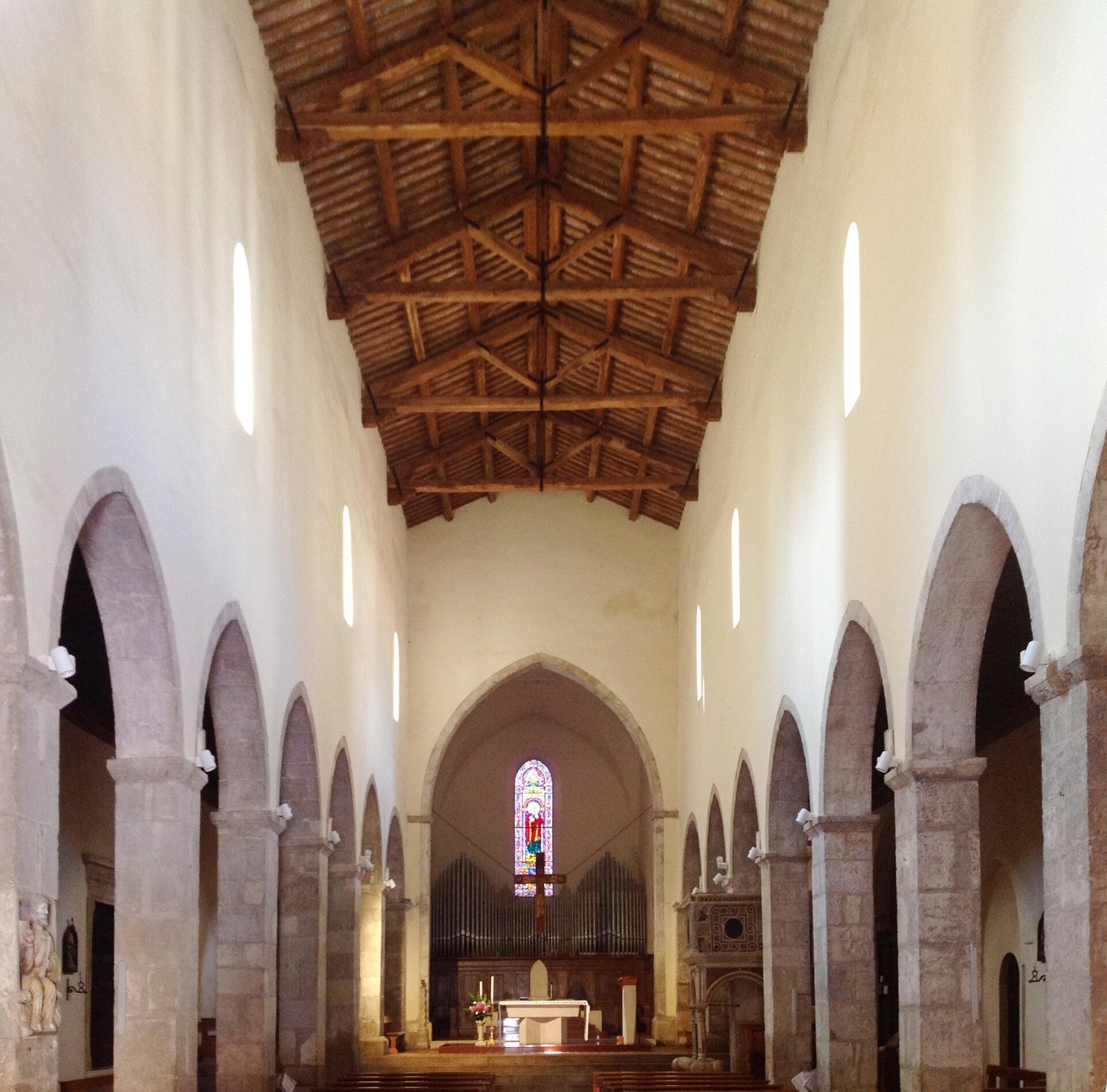
The church has three lengthwise divisions, or aisles, ending at a raised sanctuary. Its surviving features bring together medieval fabric, later Renaissance alterations, and Baroque furnishings. The front is centered on a sculpted doorway, while the bell tower stands behind it.
Exterior
Façade and doorway
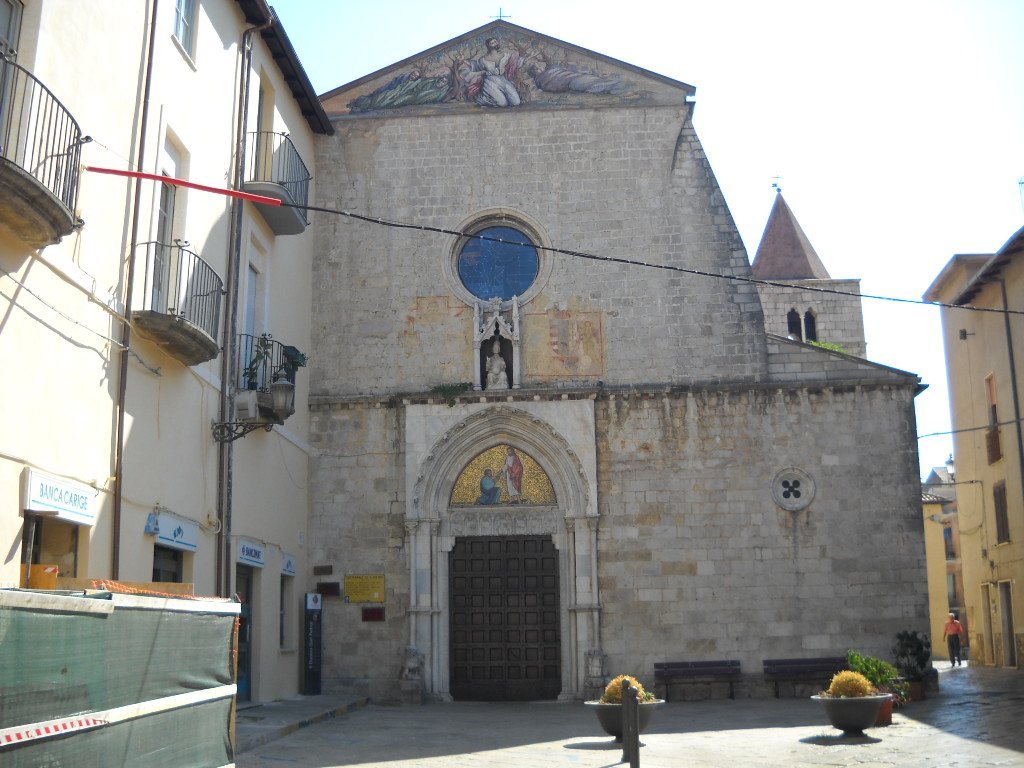
The central doorway has a Gothic design. Its flanking columns rest on the horizontal band above the entrance and on animal supports: a lion on the right, and a ram topped by a lion on the left. The band bears a central relief of Jesus. To the left are Saints Paul and Honoratus and a cherub holding a candlestick; to the right are Saints Peter and John the Evangelist and a cherub holding a censer. A small circular window sits above.
The curved panel within the doorway contains a mosaic of Christ giving the keys to Saint Peter, made in 1970 by Fondi artist Domenico Purificato. Above the doorway’s arches is a statue of Saint Peter seated on a throne in pontifical vestments and blessing with his right hand. The statue is attributed to Arnolfo di Cambio and dated to 1302.
Bell tower
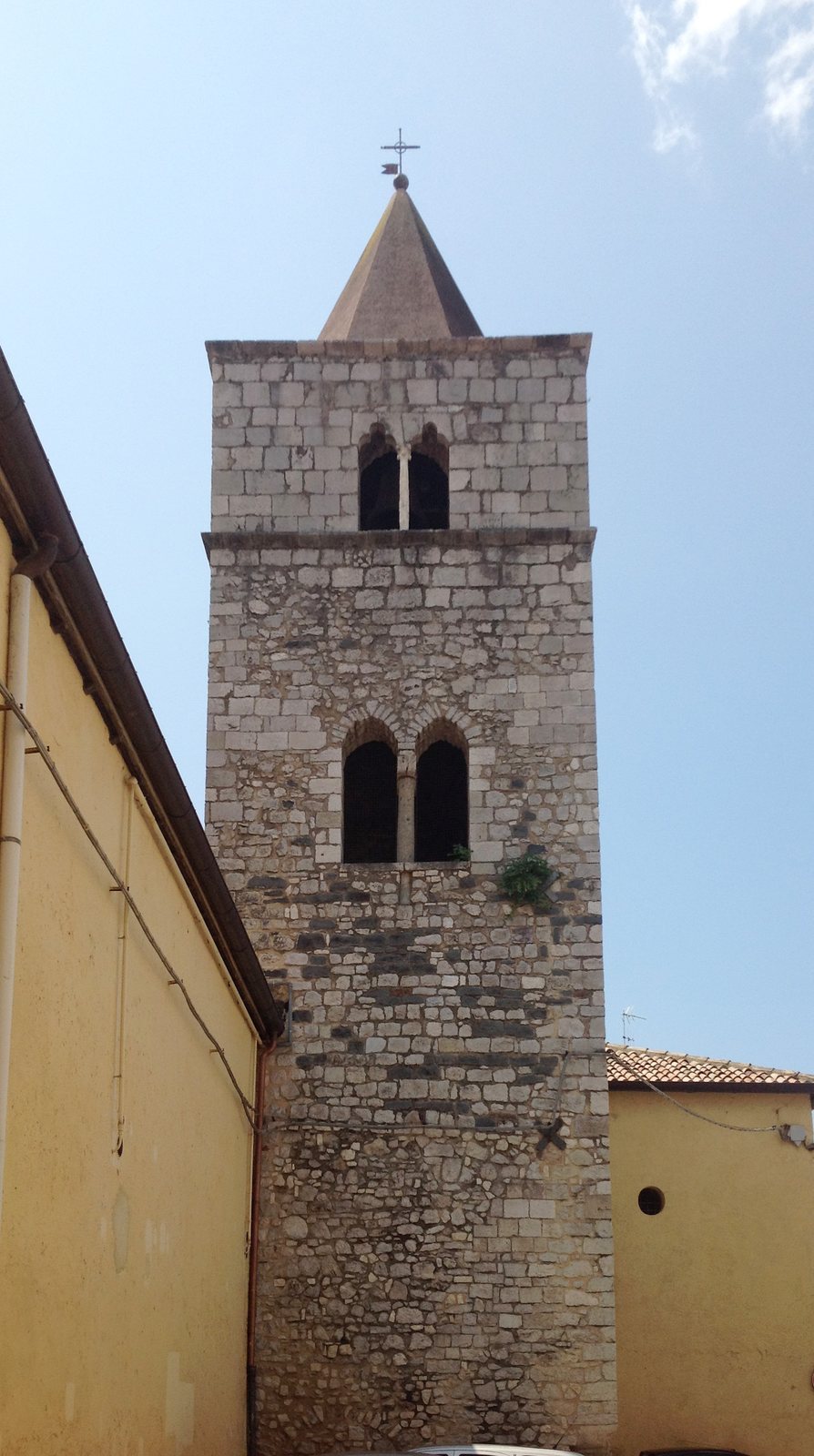
Set back from the façade, the bell tower dates to the mid-13th century. Its openings include single windows in the central sections, paired windows with pointed arches, and paired windows with three-lobed tops.
Interior and chapels
Nave
The three aisles were originally Gothic and were later altered in Renaissance style. A relief of Saint Peter blessing while seated on two lions is built into the third pillar on the left side of the main nave.
Chapel of Our Lady of Loreto
To the right of the inner façade, the Chapel of Our Lady of Loreto served as a burial place for the counts of Fondi, including Marcantonio Prospero Colonna. The chapel contains 15th-century wall paintings.
Baptistery
Opposite the Loreto chapel, the baptistery retains fragments of Cosmatesque inlay, a medieval geometric decoration using colored stone and glass. It also contains a 13th-century baptismal font.
Chapel of the Cross
The right nave’s Chapel of the Cross contains the 15th-century funerary monument of Count Cristoforo Caetani, erected by his son Onorato II. Three lions support the base, above which stand female figures representing Fortitude, Charity, and Prudence. The sarcophagus front shows the Madonna with Saints John the Baptist, John the Evangelist, Catherine of Alexandria, and Lucy. Above it, the count appears in military dress and a crown between two angels; higher still, Jesus is crucified between the Madonna and Saint John the Evangelist.
The chapel also holds two 15th-century paintings with gold backgrounds, each arranged in three panels. The one on the right, by Antoniazzo Romano, depicts the Madonna and Child with Count Onorato Caetani between Saints Peter and Paul. The one on the left, by Cristoforo Scacco, shows the Annunciation between Saints Honoratus and Benedict and is dated 1499. A marble episcopal throne with Cosmatesque inlay is associated with Clement VII, an antipope during the Western Schism, when rival claimants contested the papacy.
Chapel of the Blessed Sacrament
At the end of the right aisle, the Chapel of the Blessed Sacrament has a Baroque altar and a polychrome marble balustrade, or low railing.
Pulpit and sanctuary
Pulpit
The medieval pulpit is decorated with mosaics and geometric patterns in light-colored enamel. Four columns support it, set on two lions and two ram-shaped supports. Saint Jerome appears at the center of its front panel, while the corners bear the symbols of the Evangelists: a bull, an eagle, a lion, and an angel. Three verses above the arches name Master Giovanni di Nicola, whose period is given as the 12th to 13th century.
Apse and raised sanctuary
The central nave ends in a four-sided apse, a recess at the sanctuary end, covered by a pointed, cross-shaped vaulted ceiling. A narrow window in its rear wall contains a 20th-century stained-glass image of Saint Peter. Beneath the apse arch hangs a painted wooden crucifix from the 12th century. The sanctuary is raised above the rest of the church and has modern marble furnishings. Behind it stands a pipe organ built by the Ruffatti brothers in 1950.
Relics and entrance inscriptions
Relics
The church holds the body of Saint Mauro in a silver casket and the bodies of Saints Paterno and Libertino in gilded wooden urns. The head of Saint Honoratus is kept in a silver bust-shaped container for a relic.
Inscriptions
An inscription on the left side of the entrance records the consecration. Another, on the right, recalls the passage of Pope Pius IX, who led the Roman Catholic Church from 1846 to 1878.