Puente Viejo: The Medieval Bridge over the Tagus at Talavera de la Reina
Site at a Glance
- Popularity
- Very High
- Country
- Spain
- Primary era
- Medieval
- Eras represented
- Medieval, Early Modern, Modern
- Civilizations
- Crown of Castile, Spanish
- Site type
- Infrastructure
- Remains
- Bridge
On this page10 sections
History
Puente Viejo is a medieval stone bridge across the Tagus at Talavera de la Reina, Spain, dating to the thirteenth century. It is also known as Santa Catalina Bridge and, popularly, the Bridge of a Thousand Repairs. Roman Bridge is another name, although a Roman predecessor is disputed.
Medieval bridge and repairs
A Roman crossing has been proposed, with material from it possibly reused in the foundations of the first supports on the north bank. The idea is contested, and Isaac Moreno rejects it. The earliest known written reference to Puente Viejo dates to 1227, when Ferdinand III, king of Castile, ordered controls on commercial traffic using bridges over the Tagus. Medieval records also name the River Gate, Puerta del Río, as Talavera’s principal southern entrance, connected to the bridge.
By the first half of the fifteenth century, the bridge had fallen into poor condition. The town council organized repairs, first paying for them with bridge tolls, a charge on people crossing, and later using local taxes and special levies. Two such levies are recorded between 1450 and 1459. Pedro González de Mendoza, the town’s lord and archbishop of Toledo, was almost certainly involved in works dated to either 1483 or 1490.
Flood damage and repeated rebuilding
Floods in the winters of 1625 and 1626 appear to have badly damaged the bridge and prompted municipal reconstruction measures. Further repairs followed in the middle of the seventeenth century.
Flood damage and structural problems continued into the nineteenth century. Repairs are recorded in 1815, 1829, 1835, 1841 and 1850, amid disagreements over who should pay. Where spans had collapsed, timber planks were regularly used to maintain a crossing, and boats also helped people get across.
Decline and modern intervention
In the twentieth century, construction of an iron bridge and inadequate maintenance contributed to Puente Viejo’s decline. By about the 1970s, deterioration had led to the closure of its northern half to traffic. Part of the bridge at its bend collapsed in June 1994 and was later rebuilt in brick. Subsequent work associated with hydraulic improvements on the Tagus between Bolarque and Talavera helped adapt the bridge for pedestrian and cycle use.
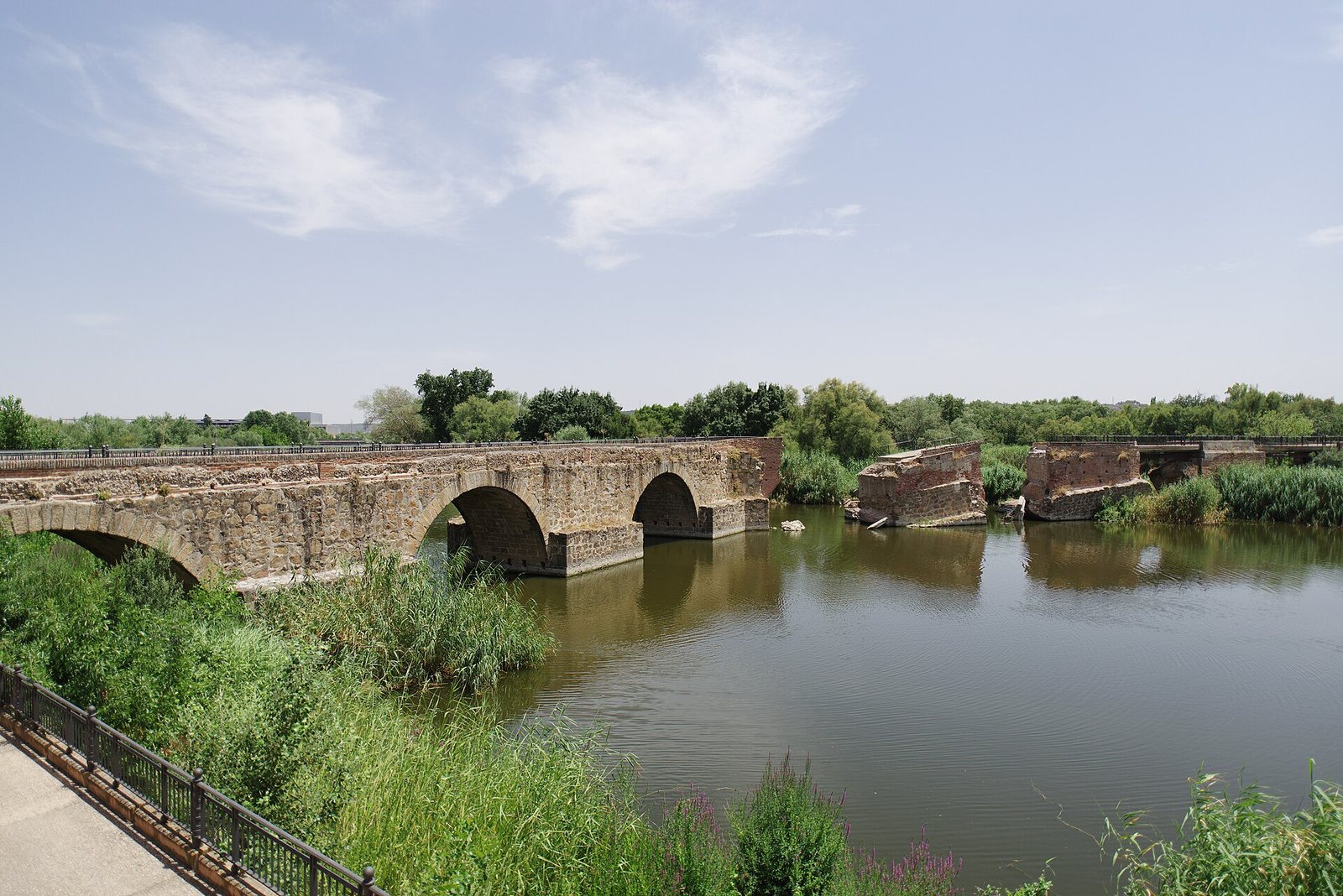
Spain designated Puente Viejo an Asset of Cultural Interest in the Monument category on 25 May 2021. On 23 March 2025, flooding caused by storm Martinho demolished part of the rebuilt section, leaving the bridge partially destroyed.
Remains
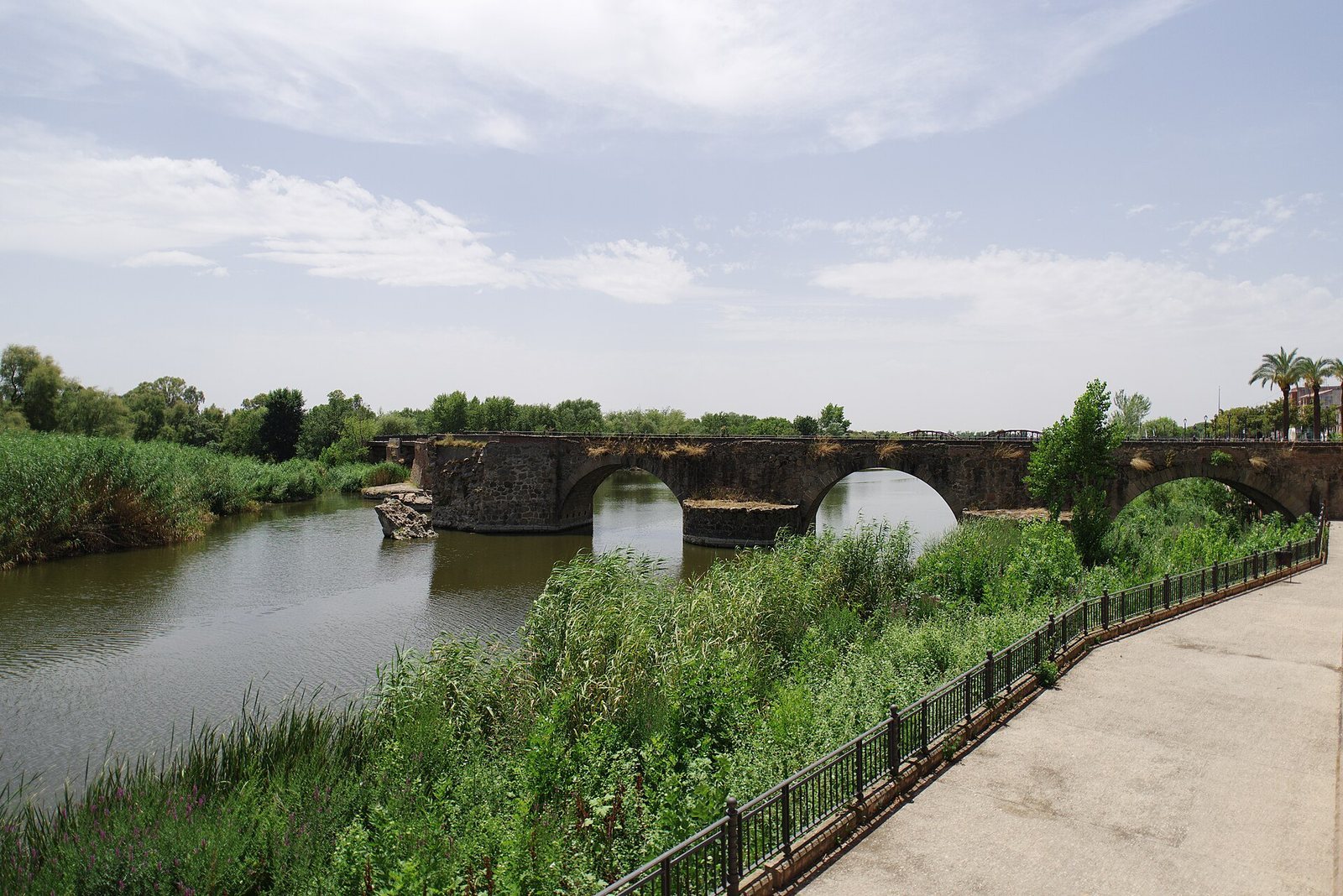
The stone bridge extends for about 520 metres and averages approximately 4.6 metres in width. Successive repair campaigns have left it with an irregular form, and its spans vary considerably.
Arches and changing spans
The bridge includes semicircular arches, arches with a curve shallower than a semicircle, pointed arches and stilted arches, whose curves begin above short vertical sections. Pointed forms have been associated with mature Gothic work, semicircular ones with late medieval and Renaissance interventions, and shallow arches with late medieval or early modern work. The total number of arches is uncertain. J. Münzer, a German traveler, counted 22 in 1493; García Fernández counted 23, while César Pacheco proposed 30 openings overall. Pacheco suggested that some earlier totals may have included small openings that let floodwater pass or gaps bridged with timber. The number of masonry arches may also have changed as the bridge was repaired.
Medieval masonry
The oldest surviving medieval fabric lies around the former light factory. There, ashlar, stone cut into regular blocks, forms the curved masonry around arches and the vaults. Smaller, roughly dressed stones fill the spandrels, the wall areas between an arch and the structure above it, with irregular joints. The masonry includes pointed arches formed from two curves, smaller arches above the supports, and triangular cutwaters and spurs. A cutwater is a projection on a bridge support that deflects water; a spur projects from the structure’s base.
Later repairs and deck
Brick became common in repair work from the seventeenth century onward. The southern section includes later supports with walkways. Timber bridges and wooden decking were used to cross openings at different times from the fifteenth through the twentieth century. Twentieth-century work also introduced perforated brick, cement mortar and metal beams between the supports to carry the deck, along with metal parapets, or low protective walls, and handrails.
Later rehabilitation included cleaning and demolition, as well as building or consolidating supports and cutwaters. Reinforced-concrete deck panels were placed across collapsed openings and carried by adjoining supports. An inner railing was fitted beside surviving parapets, with lighting incorporated into the handrail. The work also removed perforated-brick masonry and the old asphalt-based paving.
Arch of Arms
The arch at the bridge’s bend bears a commemorative inscription and heraldic shield associated with Pedro González de Mendoza, giving it the name Arch of Arms. In 1773, the Spanish writer Antonio Ponz noted that the inscription could still be read.
Stone markings
Stone markings appear across the bridge, mostly on the undersides of arches and also on some of its end supports. Some are interpreted as stonecutters’ marks, while others served practical purposes.