Dampsmesnil Gallery Grave: A Neolithic Tomb in France
Site at a Glance
- Popularity
- Low
- Country
- France
- Primary era
- Stone Age
- Eras represented
- Stone Age
- Civilizations
- Unclassified
- Site type
- Burial
- Remains
- Tomb
On this page12 sections
History
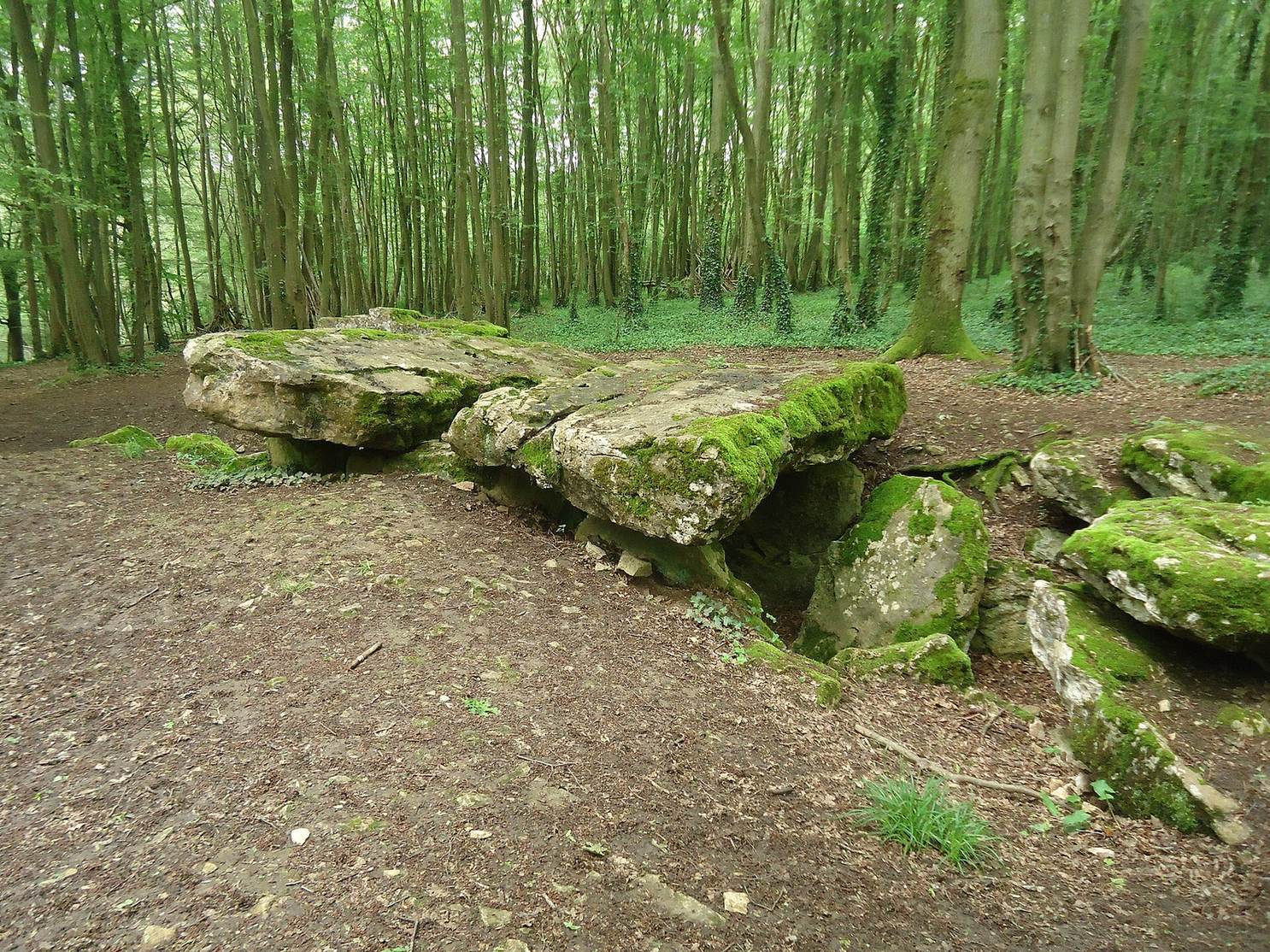
The Dampsmesnil gallery grave is a long, covered stone tomb in Vexin-sur-Epte, France. Settled farmers associated with the Seine-Oise-Marne culture, an archaeological culture of northern France, built it between about 2500 and 2000 BC, during the Late Neolithic, or later New Stone Age.
Reuse and damage
The tomb was reused in the Roman period, after bones and grave goods from an earlier burial had been cleared away. Its funerary use continued. Before the French Revolution, people dug into it in search of treasure. In the early nineteenth century, quarrymen broke many of its limestone slabs for building material and threw others down the hillside.
Nineteenth-century descriptions and interpretations
An early nineteenth-century description gives the gallery’s length as about 17 metres and says that roof slabs still covered it, with enough headroom to stand upright. The antiquarian de Pulligny described the monument in print in 1879. From scattered stones and excavation, he proposed that it had originally extended 20 to 24 metres and that quarrying might also have destroyed parallel galleries. A quarry worker told him that an underground passage had linked two galleries no longer visible.
Local residents called the carving the Devil’s claw. De Pulligny considered it either decoration or a deliberate inscription, while Adrien de Mortillet published the first accurate description of it as a female figure in 1893. Later interpretations proposed a goddess associated with burial, perhaps reflecting Mediterranean influence, or a deity associated with fertility. Other archaeologists suggested that the vestibule may have had a ceremonial role during burials.
Excavations and protection
Martial Imbert excavated the tomb from 27 to 30 August 1894, seeking the broken partition slab between its entrance and burial chamber. Its lower half was found about a metre below ground, still in place but tilted by roughly 20 degrees. Tree roots impeded the work, and only half the monument was cleared in four days. Excavations resumed in August 1896 under Imbert and Émile Collin. The excavators removed and sifted the soil and made a plan of the tomb.
A fallen entrance slab was set above the carved support for protection. When the excavations ended, soil was returned over the perforated partition and its opening was covered with a stone. The recovered objects went to the Society of Anthropology of Paris. On 28 January 1907, the grave was classified as a legally protected French historic monument.
Remains
Structure and internal divisions
Gallery and chamber
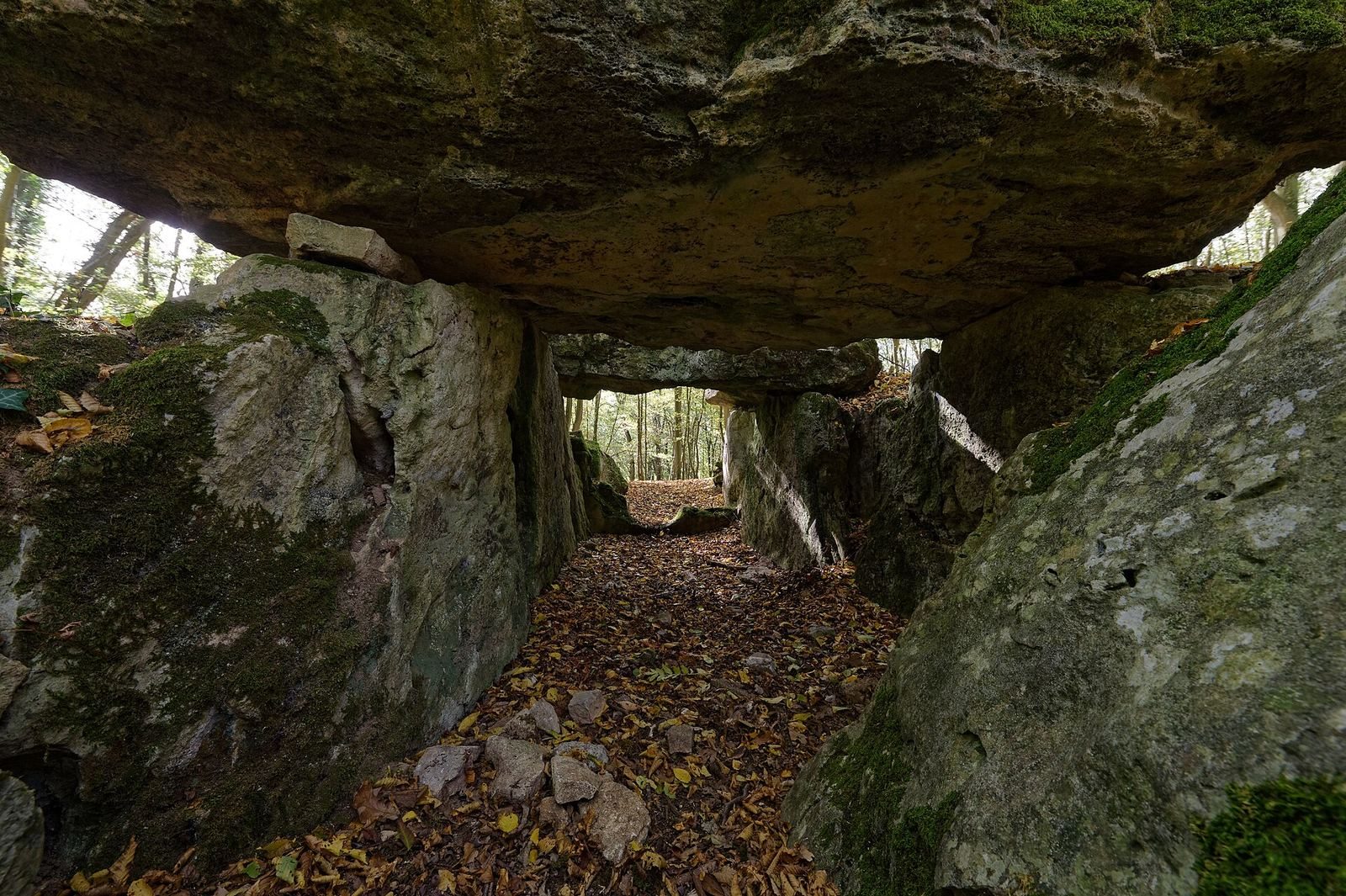
The limestone tomb lies in the Garenne woods, slightly below the crest of a dry valley’s southwest slope, about 1.6 kilometres northeast of Dampsmesnil. Oriented southwest, it is 10.5 metres long, averages 1.67 metres in width, and has a clear height of 2 metres, rising to 2.25 metres at the entrance. Rough, flat stone slabs pave the floor. The 5.81-metre chamber is formed by eight upright supports that carried three roof slabs. Two roof slabs remain in place; the rear one is broken, with fragments scattered nearby. A limestone block, 2 metres wide, 1.80 metres high, and 0.40 metres thick, closes the rear of the gallery.
Vestibule and partition slab
The entrance vestibule, an antechamber leading into the burial space, is about 3 metres long, though damage makes its original length uncertain. The roofed portion of the tomb is about 9 metres long. The vestibule is now open overhead, and a section of roof has been displaced. A recovered roof slab was placed above the carved support as protection. The tomb may originally have been covered by an earthen mound.
A partly destroyed perforated slab divides the vestibule from the chamber. It is 2.92 metres long and 0.23 metres thick, and extends beyond the width of the passage because its ends fit into the dividing supports. Its opening is about 0.60 metres across, with its lower edge 0.76 metres above the paved floor. A recessed ledge around the opening is about 75 millimetres deep and 70 millimetres wide. A stone plug once closed the opening; a beam wedged between the walls probably held it in place, while the ledge helped seal the chamber from the vestibule.
Carved support
The first support on the left inside the gallery, beside the perforated slab, bears a relief of a female figure. An oval shape is framed by three concentric ridges, with two projecting forms below that resemble breasts. The carving is the only carved decoration on a megalith, a large stone used in a monument, in Normandy, and the oldest known representation of its kind in the region. A resin cast was made in July 1985, and copies are displayed in five museums.
Excavated finds
Stone and bone objects
Finds included a barbed arrowhead with a tang, made of gray flint, and a 2-centimetre bone cylinder pierced lengthwise, probably a necklace piece. The 1896 excavation produced three more tanged, triangular gray-flint arrowheads, each 35 millimetres long, and a small stone tool with a transverse edge measuring 37 by 22 millimetres. Other objects included a 20-millimetre bone bead, a large flint axe whose edge had been reshaped for repolishing, a broken axe, a hammerstone, a small cutting blade, three or four large flint blades, and half of a small geode that may have been a toy or container. A hammerstone is a stone used to strike or shape other materials.
Human, animal, and pottery remains
Human remains included several hundred teeth and substantial fragments of jaws and skulls. Fragments from about ten Neolithic vessels were recovered. Animal remains included a bear tooth, a canine from a wolf or dog, and a horse tooth. Other finds comprised human bones, pottery debris, roof-tile fragments with raised edges, and a bronze coin of Roman appearance.