St. Mary’s Church, Holme-next-the-Sea: A Parish Church in Norfolk
Site at a Glance
- Popularity
- Very Low
- Country
- United Kingdom
- Primary era
- Medieval
- Eras represented
- Medieval, Early Modern, Modern
- Civilizations
- British, English
- Site type
- Religious
- Remains
- Church
On this page15 sections
History
St. Mary’s Church, Holme-next-the-Sea, is a parish church in Norfolk, England, dedicated to Mary, the mother of Jesus in Christian belief. A church at Holme-next-the-Sea is first recorded in 1188. Henry of Nottingham rebuilt it in the early 15th century in the Perpendicular style of English Gothic, known for its strong vertical lines. Henry was an assize judge, an official who presided over periodic county courts, during the reign of Henry IV, king of England from 1399 to 1413. The church is Grade I listed, the highest category of listed-building designation in England.
Medieval church and parish
Records of clergy at the parish survive from 1241. In 1398, Henry le Despenser, Bishop of Norwich, assigned the rectory, the parish benefice and office of rector, to Lilleshall Abbey, a medieval religious house in Shropshire. The parish was served by a rector until the 17th century, by vicars until 1995, and by a rector again from that year.
Rebuilding and later history
By the late 18th century, the church had deteriorated. A vestry meeting in 1777 decided to demolish the remains of the nave and aisles. The following year, builders reconstructed the three-bay nave and repaired the chancel, reusing materials from the aisles. The chancel was restored again in the 1880s.
Remains
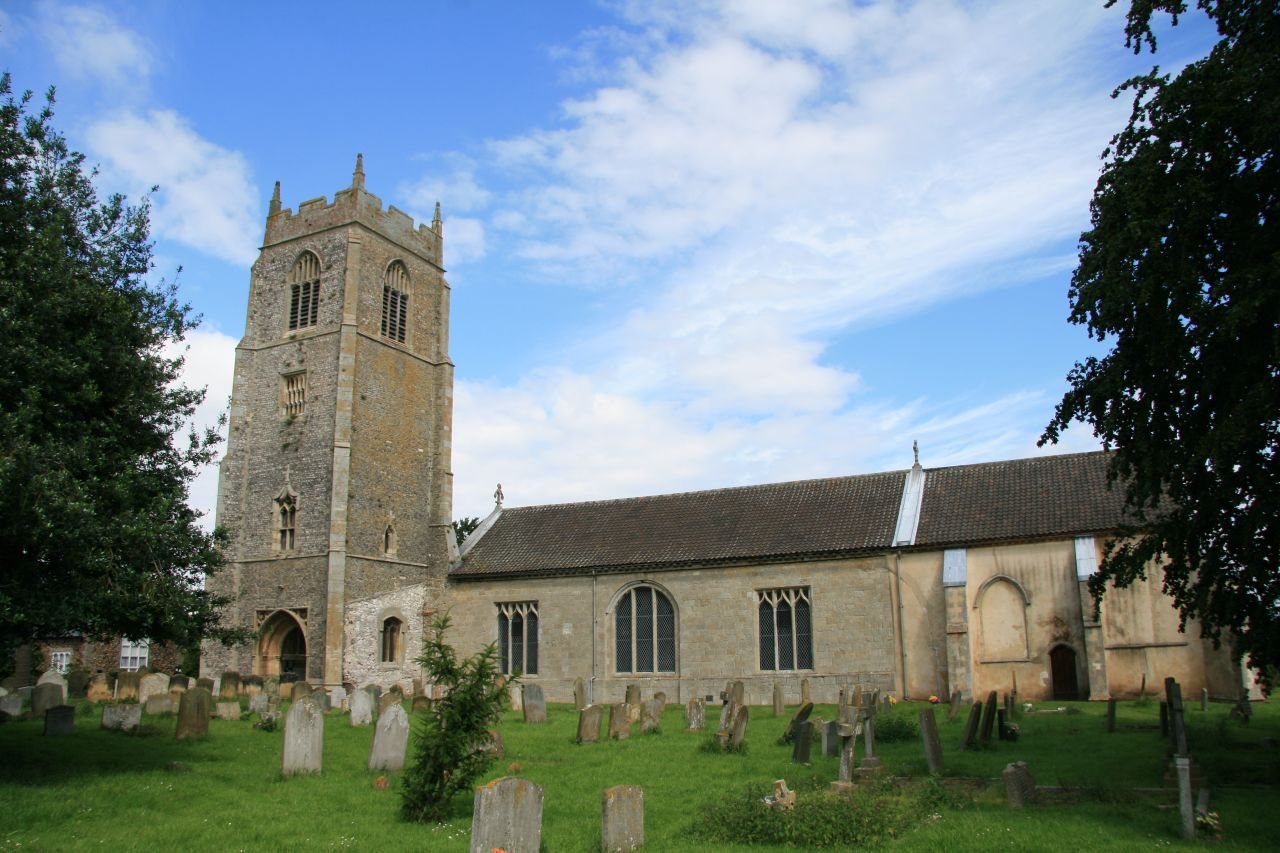
The church’s surviving fabric includes a four-storey flint tower, a three-bay nave, and a chancel with features in Perpendicular and Decorated Gothic styles. The tower and chancel preserve parts of Henry of Nottingham’s church; the nave reflects the later rebuilding. The earlier church also had north and south aisles, and its nave extended west to the tower’s western end.
Church fabric
Tower
The tower rises 76 ft 6 in and is built from squared, knapped flint with stone dressings. Four stone spirelet finials crown it, and the tower stands at the church entrance.
Nave and chancel
The present nave has three bays, and its chancel arch is Perpendicular. In the chancel, a three-arched Decorated sedilia, or clergy seating, has columns. On the south side, a double-arched piscina, a basin with a drain for liturgical use, dates to 1300.
Interior memorials and furnishings
Monuments and furnishings
An alabaster wall monument commemorates Richard and Clemens Stone. It dates from 1607, has kneeling figures, and was moved to its present position in 1778. A brass in the chancel commemorates Henry of Nottingham and his wife. The stone pulpit and font date from the late Victorian period, the reign of Queen Victoria from 1837 to 1901. A statue of Our Lady, carved by Esmond Burton in 1961, is also inside the church.
West window
The church’s stained glass is in a three-part west window made by Jane Nelson in 1888 in memory of her husband, Matthew. Its panels depict Faith, Charity, and Hope.
Hanoverian arms
Two sets of coats of arms associated with the House of Hanover, the dynasty that ruled Britain from 1714 to 1901, are present. One is painted and the other is made of wood.
Bells and organ
Bells
Five bells hang in a frame made in 1868 by John Taylor of Loughborough. The bells were cast by Edward Tooke in 1677, Joseph Mallows in 1754, Thomas Newman in 1720 and 1740, and John Taylor in 1868.
Organ
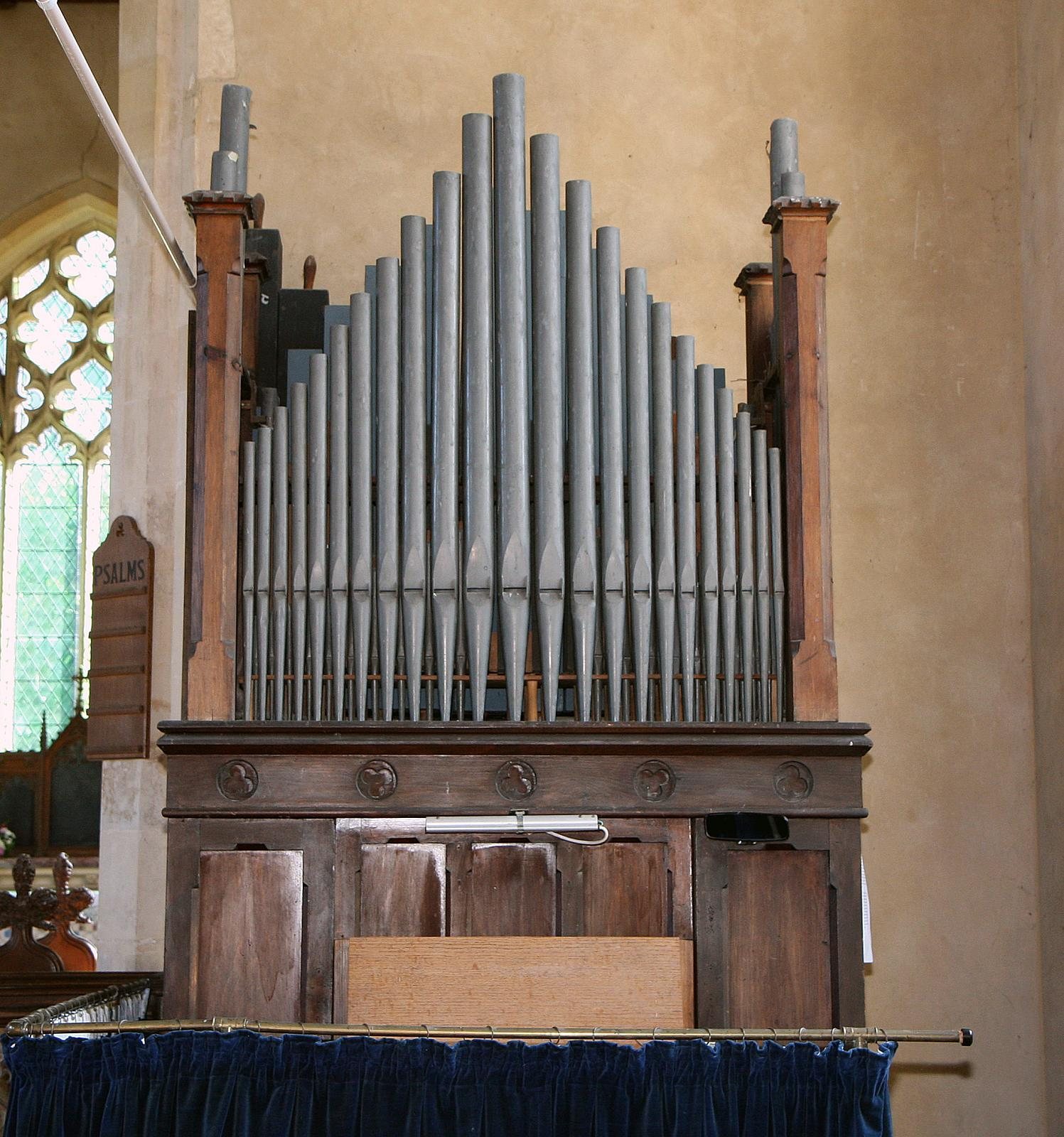
The organ now in the church was built in 1894 by J. W. Walker & Sons Ltd for Holme House. It stands on the north side of the chancel, and an electric blower was installed in 1946. The first noted instrument was a reed organ, later replaced by an organ made by Samuel Street, active from 1840 to 1883. In 1937, that instrument was moved to St Peter’s Church, Smallburgh, where it remains.
Churchyard memorial
The village war memorial in the churchyard is a stone Latin cross with flower-shaped terminals, a tall shaft, and a moulded foot. A roll of honour is kept inside the church.