Walsingham Priory: A Medieval Augustinian Pilgrimage Centre in England
Site at a Glance
- Rating
- 4.6
- Popularity
- Low
- Country
- United Kingdom
- Primary era
- Medieval
- External website
- Open
- Eras represented
- Medieval
- Civilizations
- English
- Site type
- Religious
- Remains
- Monastery
On this page13 sections
History
Walsingham Priory is a medieval religious house in the United Kingdom, founded for Augustinian Canons regular between 1146 and 1174, probably around 1153. Its canons followed the Rule of Saint Augustine while serving as a clerical religious community. Dedicated to the Annunciation, the Christian event in which the angel Gabriel announced to Mary that she would bear Jesus, the priory developed around an older Marian shrine and became one of medieval England’s major centres of pilgrimage.
The Marian shrine and Augustinian foundation
The shrine was traditionally associated with Lady Richeldis de Faverches, an Anglo-Saxon noblewoman and widow. According to the tradition, she experienced visions of the Virgin Mary in 1061 and was instructed to build a replica of the Holy House at Nazareth. The Holy House was understood as the house associated with the Annunciation and the childhood of Jesus. The resulting shrine became a place of prayer and pilgrimage.
An earlier Anglo-Saxon chapel and the Holy House were incorporated into the priory after the site was granted to Augustinian canons in the twelfth century. The foundation was also associated with Geoffrey de Faverches, identified as Richeldis’s son. The canons developed the religious complex around the existing shrine, which remained the focus of devotion.
A major medieval pilgrimage centre
Walsingham attracted worshippers from across the British Isles and continental Europe. Royal and aristocratic patronage, reported miracles, and the visits of rulers and ordinary pilgrims all reinforced its religious importance. Pilgrims travelled along a route through Newmarket, Brandon, and Fakenham known as the Palmers’ Way, the Way of the Shepherds, or the Way of the Palm.
The priory received land, rents, churches, tithes, and other offerings. In 1291 it held property in 86 Norfolk parishes and drew an annual income of £79 from these sources. By 1535, its annual income had risen to almost £400. Royal visitors included Henry III in 1241, Edward I in 1280 and 1296, Edward II in 1315, Henry VI in 1455, Henry VII in 1487, and Henry VIII in 1513. Robert Bruce of Scotland also made the pilgrimage, while Catherine of Aragon visited regularly.
Erasmus of Rotterdam, the Christian humanist and scholar, visited Walsingham in 1511 to fulfil a vow. He left Greek verses as an offering and later described the wealth and magnificence of the shrine, together with some of its reputed miracles. His account provides a contemporary impression of the priory during the final decades of its medieval prominence.
Reform and dissolution
Late-fifteenth- and early-sixteenth-century episcopal visitations found serious disorder within the priory. In 1514, Bishop Richard Nykke reported misconduct by the prior and disorder among the approximately thirty canons. Reforms followed, including the election of a new prior, and by 1526 the community’s discipline was regarded as broadly restored.
The political situation changed under Henry VIII, the Tudor king whose break with papal authority led to the English Reformation and the suppression of England’s religious houses. In 1530, Prior Richard Vowell accepted the king’s supremacy over religious institutions. In 1537, the sub-prior Nicholas Milcham was convicted of high treason for allegedly conspiring against the suppression of the lesser monasteries. He was hanged outside the priory walls, and eleven men were executed after a related plot.
In July 1538, the priory and shrine were suppressed and destroyed during the Dissolution of the Monasteries, Henry VIII’s confiscation and suppression of monasteries, priories, and other religious houses. Vowell assisted the royal commissioners in removing the image of the Virgin Mary and the shrine’s gold and silver ornaments. The wooden Holy House was burned. Vowell received an annual pension of £100, while the fifteen remaining canons received pensions of between £4 and £6.
The dismantled site was sold by royal order to Thomas Sidney for £90 in 1538. The priory was later demolished and a residence was established on the site. The destruction of Walsingham became a powerful symbol of the English Reformation and was lamented in Elizabethan and later literary works, including A Lament for Walsingham, Walsingham, A Lover’s Complaint, and The Wreck of Walsingham. The mid-fifteenth-century Pynson Ballad also preserves an account of the shrine’s foundation.
Revival and archaeological investigation
The Marian tradition associated with Walsingham revived from the late nineteenth century. Anglican authorities began reconstructing a new Walsingham sanctuary in 1921 near the medieval shrine. The Catholic Church restored the Slipper Chapel, about one mile from the priory, and it became the centre of a renewed Catholic sanctuary in 1934. Both sanctuaries continued the older Marian tradition.
Archaeological excavations in 1961 identified the former locations of the Holy House and its associated chapel. Their positions are marked within the present grounds by a plaque and marker stone. The priory ruins have Grade I heritage protection, the highest category of legal protection for buildings and structures of exceptional architectural or historic interest in England.
Remains
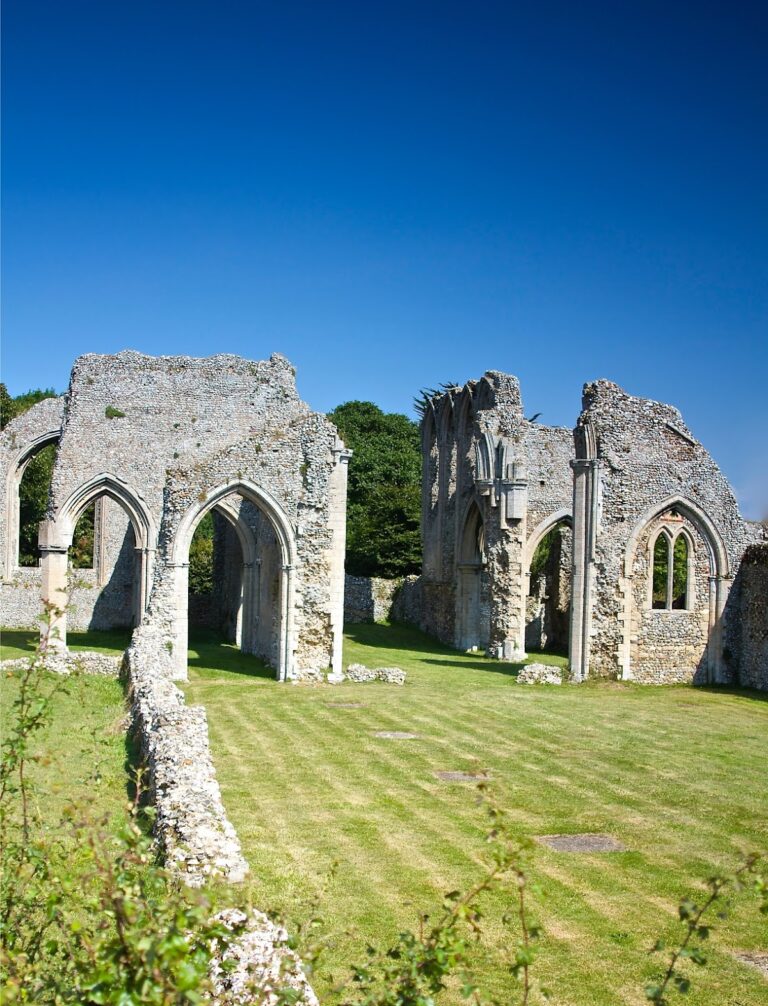
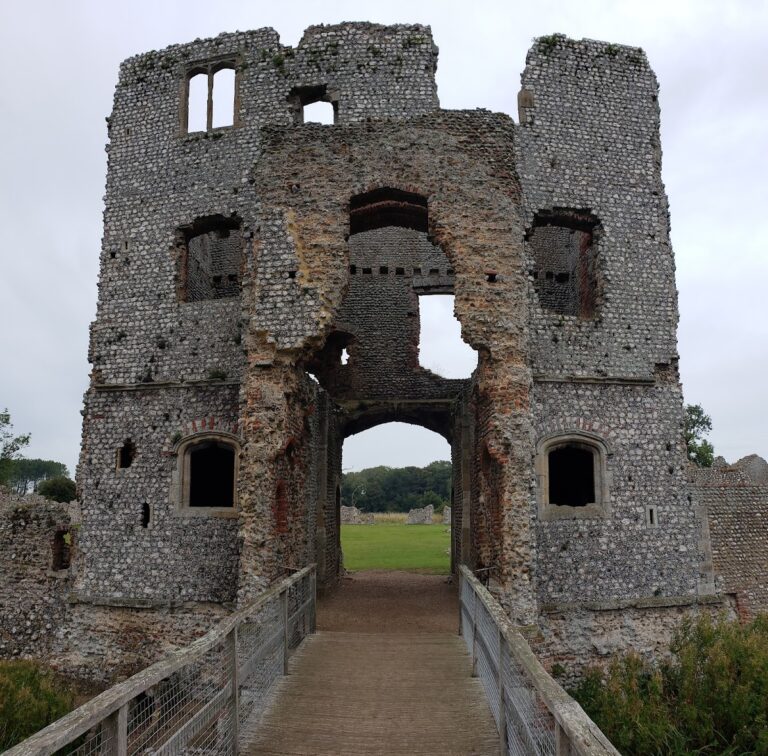
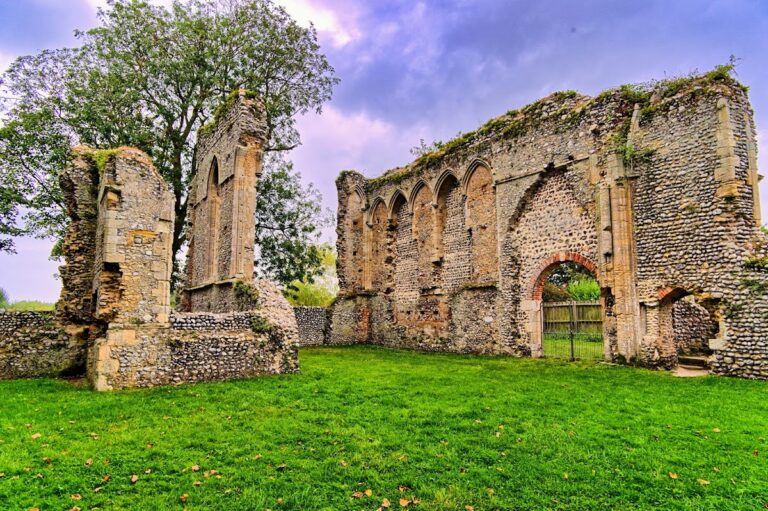
The surviving remains represent only part of a larger medieval complex that included the priory church, shrine enclosure, cemetery, gardens, gatehouse, choir arch, and subsidiary buildings. After the sixteenth-century destruction, the gatehouse, choir arch, and a few dependencies remained, together with sections of the church and other stonework. The architecture has been described both as Norman and as predominantly Gothic, reflecting different classifications applied to the surviving and former structures.
Church and principal ruins
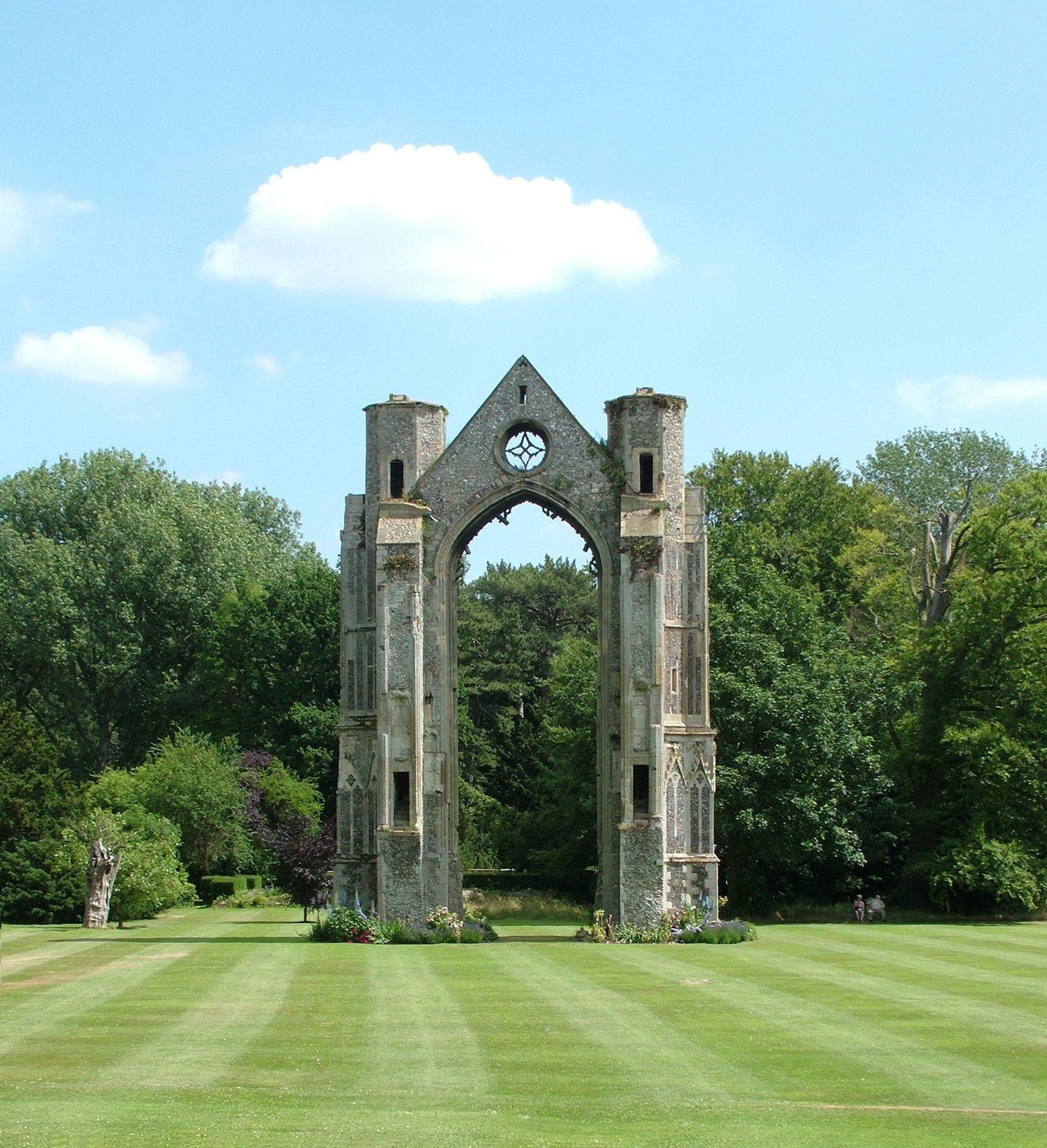
West facade and East Window
Part of the priory church’s west facade survives among the ruins. The complex also retains the fourteenth-century East Window, a substantial surviving element of the church. Together with other stone fragments, these remains indicate the scale and architectural character of the priory’s principal ecclesiastical building.
Choir arch and gatehouse
The choir arch and gatehouse are among the structures that remained after the priory’s destruction. They formed part of the complex’s principal architectural arrangement, alongside the church and shrine enclosure. Their survival provides physical evidence of the buildings that organized movement and religious activity within the medieval priory.
Chapter house and associated buildings
Chapter house or crypt
A partly subterranean chapter house or crypt survives within the ruins. A chapter house was the room where a religious community met for formal business, discipline, and the reading of its rule, while a crypt is a partly underground chamber often placed beneath or near a church. The surviving chamber belongs to the priory’s group of stone buildings and preserves part of its institutional and architectural layout.
The Abbey
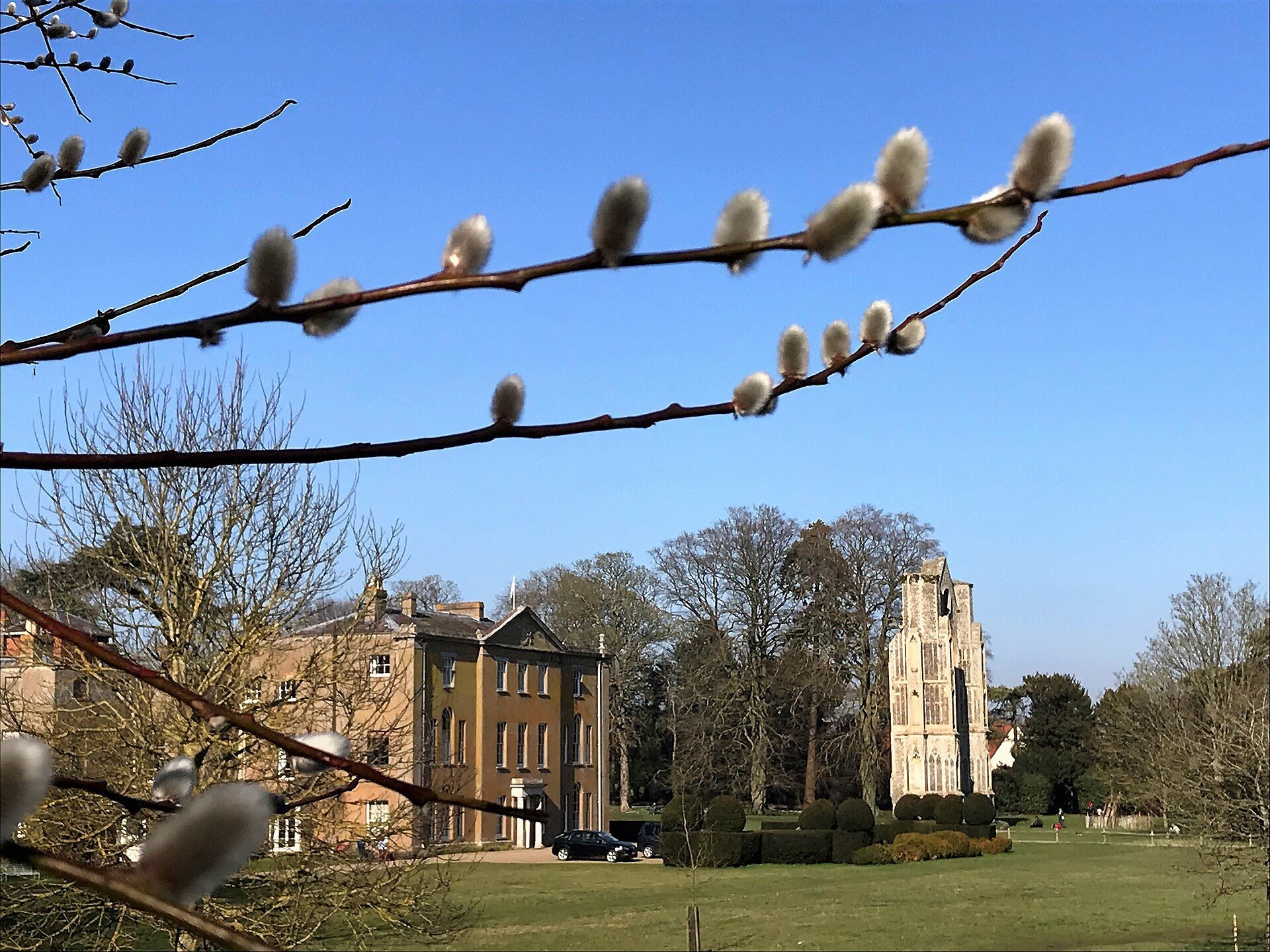
The former prior’s lodging was expanded between the late seventeenth and early nineteenth centuries. It eventually became a private mansion known as The Abbey, preserving a later residential phase of the site after the medieval priory had been dissolved and demolished.
Archaeological markers of the shrine
The Holy House and the earlier Anglo-Saxon chapel no longer survive as standing structures, but their former positions were identified by the 1961 excavations. A plaque and marker stone within the grounds indicate these locations. The archaeological markers therefore connect the surviving ruins with the earlier shrine around which the Augustinian priory developed.