Neschwitz Church: An Evangelical Lutheran Church in Germany
Site at a Glance
- Popularity
- Very Low
- Country
- Germany
- Primary era
- Early Modern
- Eras represented
- Medieval, Early Modern, Modern
- Civilizations
- Electorate of Saxony, Holy Roman Empire, Kingdom of Bohemia
- Site type
- Religious
- Remains
- Church
On this page17 sections
History
Medieval chapel and Catholic worship
A chapel stood at Neschwitz by the beginning of the 14th century and was administered from Hodźij. In 1324, Theodoricus Plebanus was named as a priest in the village of Neschwarz.
Peter Pelck was probably the last Catholic preacher at Neschwitz before the Reformation, the 16th-century movement that established Protestant churches across much of Europe, reached the village in 1559. The church had three altars during its Catholic period. Sorbian was used in preaching for centuries, predominantly until the early 20th century and continuing until 1979.
Parish and church development
The present church was built at the beginning of the 17th century, incorporating parts of an older building. Its choir was altered and its tower erected in 1693. Further changes followed in 1796, and the church underwent restoration in 1834.
Until 1872, the parish also covered the northern villages of Komorow, Jitk, and Niža Wjes. They were transferred to the Rakecy parish for practical reasons. Neschwitz also served predominantly Evangelical villages including Banecy, Bóšicy, Holešow, Holešowska Dubrawka, Chasow, Łahow, Miłkecy, Łomsk, Łuh, Šešow, Wbohow, Wětrow, Wutołčicy, and Zarěč. Łahow and Miłkecy joined the parish in 1809. Its congregation also included Evangelical residents of the predominantly Catholic villages of Baćoń, Dobrošicy, Haslow, Hora, Jaseńca, Koslow, and Łusč.
War damage and reconstruction
At the start of the Second World War, the church’s three bronze bells, cast in 1844 at the Gruhle foundry in Mały Wjelkow, were surrendered for wartime use. The middle bell was recovered after the war from a warehouse in Hamburg. During the fighting around Bautzen in late April 1945, the church burned down to its enclosing walls.
The nave was rebuilt from 1947 to 1951 to designs by Dresden architect Oswin Hempel. The tower initially received a temporary tent roof, and its earlier hood and lantern were restored in 2009. Sorbian Evangelical Church Days took place at Neschwitz in 1949, 1968, and 1976. The church belongs to the Neschwitz Evangelical Lutheran parish, within the Upper Lusatian Heath and Pond Landscape parish union of the Evangelical Lutheran Church of Saxony. Since 2022, that union has included the parishes of Neschwitz, Rakecy, Minakał, Chwaćicy, and Klukš.
Remains
Building and interior
Exterior and setting
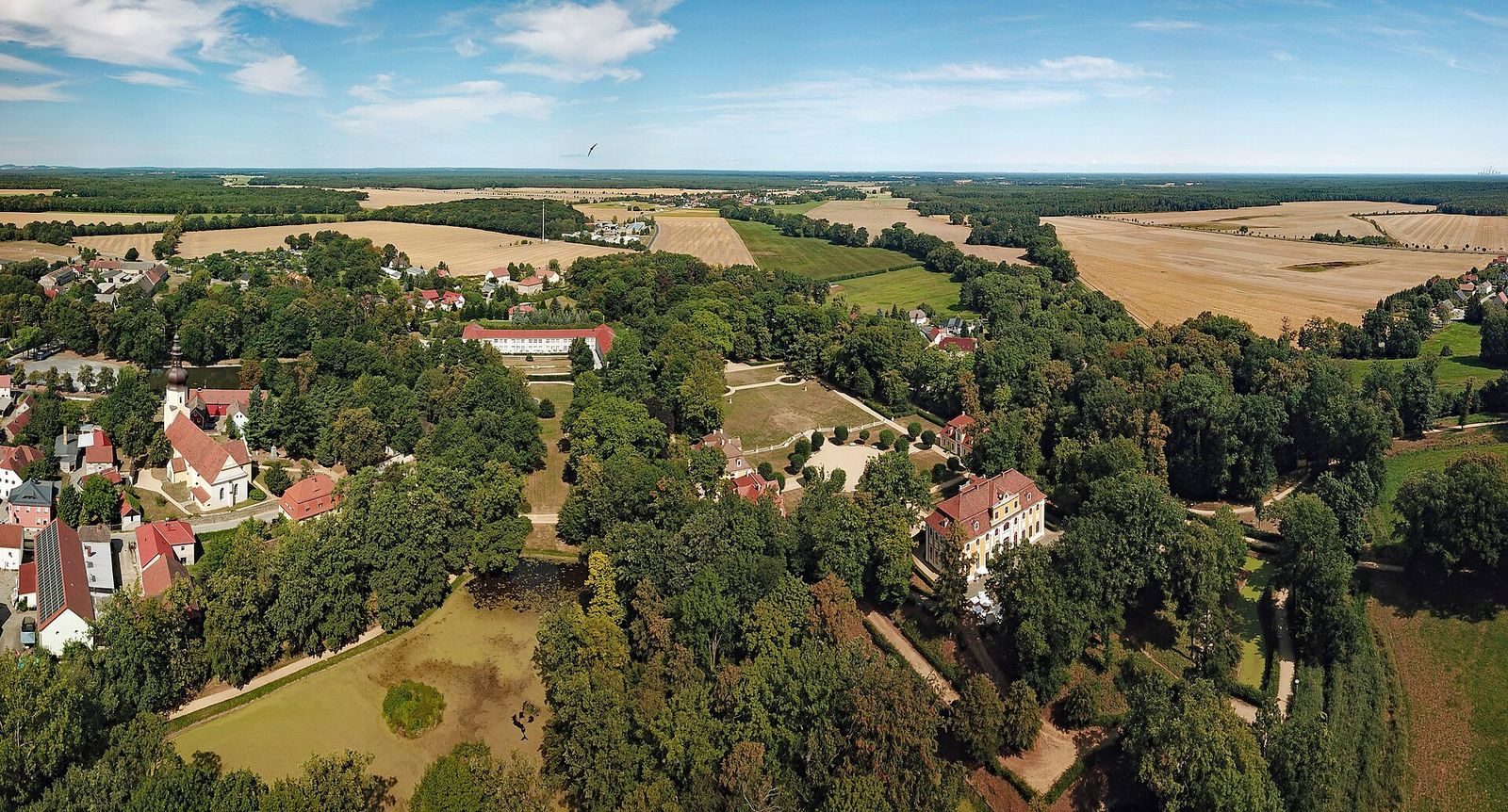
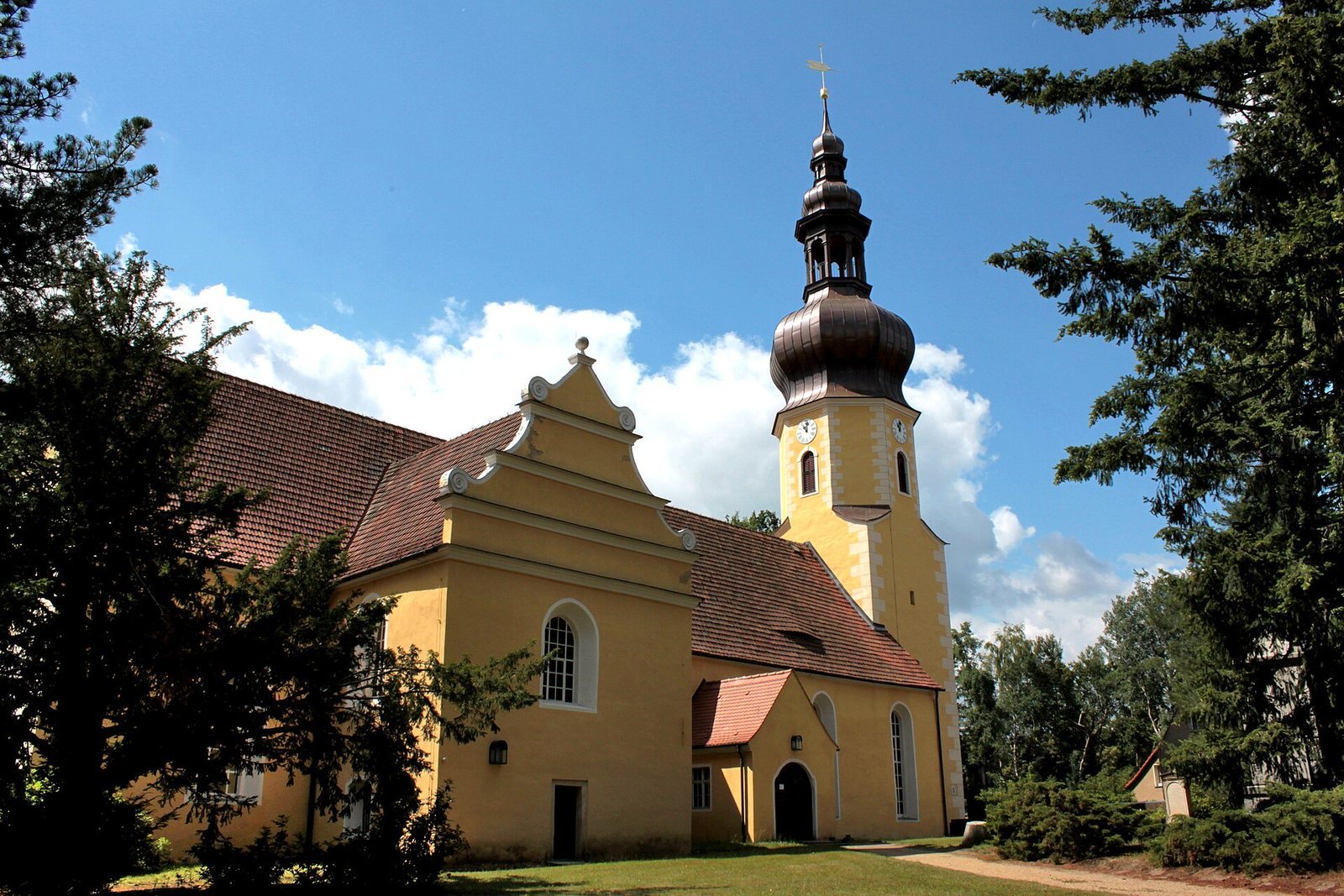
The church stands in central Neschwitz, north of the market square and southwest of the castle, beside Parkowa Road. The Bóšičanska stream runs to its west, past the parsonage and castle ponds. The building is a plain, plastered single-nave church, with one main worship space and no side aisles, a choir with a straight end, and several additions. A two-storey extension on the north side has a curved gable marked by several horizontal mouldings.
At the west end, the tower rises from a massive square base to an octagonal bell stage. Following the wartime destruction, it had a low tent roof; its hood and lantern, the earlier form, were restored in 2009.
Nave and choir
Inside, wooden beams divide the plastered, flat ceiling, and plain, unpainted galleries run along three sides of the nave. A broad triumphal arch, the arch separating the nave from the choir, opens into the latter. The choir has a cross-rib vault, a ceiling supported by intersecting ribs. A built-in private box on its north side once served the lords of Neschwitz. Beneath it is a round-arched doorway with a Renaissance-style moulded surround. During rebuilding, the choir’s former second bay was separated and fitted out as a winter church, a space arranged for worship in colder months, with a flat ceiling of wooden beams.
Altars and baptismal font
Main altar
The four-tiered sandstone altar was made by Michael Schwenke of Pirna in the early 17th century and restored in 1969 and 1970. Its inscribed base supports a relief of the Last Supper, with lively figures set within a niche beneath a wave-shaped gable. A draped, fringed motif forms the background. Free-standing columns and ornamented side supports frame figures representing Hope and Faith. Higher up, decorated supports enclose an inscription panel, with the Evangelists Matthew and Mark beside it and the Nostitz and Ponickau coats of arms above. Luke and John flank this arrangement. At the top, Christ holding a victory banner stands between two small child figures.
Smaller altar
A smaller sandstone altar by David Schwenke dates to around 1600. Its inscription panel is bordered with scrolling ornament and flanked by supports bearing lion heads. Above a moulded ledge, a relief of Christ and the children appears between two free-standing columns and spiral ornaments with heads. The upper tier combines a decorated inscription panel, the Nostitz and Löben coats of arms, and small child figures.
Baptismal font
A sandstone baptismal font, probably also made by Michael Schwenke, has a strongly shaped base. Four panels bearing inscriptions divide the outside of its bowl, each framed by scrolling decoration.
Artwork, memorials, and other furnishings
Crucifixion and surviving objects
A painted wooden group depicting the Crucifixion, made around 1520, is mounted in the triumphal arch. It survived the 1945 fire, along with the main sandstone altar, a wrought-iron door to the church’s clergy preparation room, sandstone gravestones beside the altar, and a sandstone memorial inscription dating to around 1600.
Memorials and former cemetery
The sandstone memorial to Dorothea Elisabeth, who died in 1704, shows her bust within a laurel wreath and coat of arms. Beneath it, foliage and a scroll frame three small children. The memorial to Donat Großmann, who died in 1713, has an ornamented lower panel with symbols of life’s transience and a larger inscription panel above, decorated with hanging garlands. Two slanted, shell-like ornaments at the top contain a chalice and a Bible.
The former cemetery extended around the church, and some older gravestones remain, including stones with Sorbian inscriptions. A memorial plaque to pastor Jurij Menj is fixed to the cemetery wall. In front of the north entrance stands a bilingual First World War memorial that includes a Sorbian verse. The Bakers’ Gate is on the south side of the church.
Organ and bells
The organ was made in 1950 by the Hermann Eule firm of Bautzen. It has 20 stops, which control sets of pipes, two hand keyboards, and a pedal keyboard played by foot. The present set of four cast-metal bells was made in the early 1960s. The bells sound E-flat, G, B-flat, and C; three carry German inscriptions and one bears a verse in Sorbian.
Neschwitz Madonna
The statue known as the Neschwitz Madonna, a depiction of Mary, the mother of Jesus, is now in the parish church at Radwor.