Dolmen D41: A Funnel Beaker Passage Grave in Emmen
Site at a Glance
- Popularity
- Very Low
- Country
- Netherlands
- Primary era
- Stone Age
- Eras represented
- Stone Age
- Civilizations
- Unclassified
- Site type
- Burial
- Remains
- Tomb
On this page6 sections
History
Dolmen D41 is a prehistoric passage grave in Emmen, in the Netherlands. The tomb dates to 3470–2760 BCE and belongs to the Western Group of the Funnel Beaker culture, a Neolithic culture named for a characteristic pottery form. The Western Group is a regional division of that culture.
Discovery and early investigation
In 1809, smith Geert Jansen came upon the tomb while searching for stone. He broke into the mound and probed the chamber floor with an iron rod while looking for treasure, an act for which he was fined. D41 was the last megalithic tomb discovered in Drenthe. Its late discovery is credited with helping it remain comparatively well preserved.
After the discovery, the local magistrate and regional administrator Petrus Hofstede visited the site. Petrus’s brother Johannes investigated the tomb and wrote up his findings. That report resurfaced in 2014 in the Royal Library of Belgium.
Ownership, restoration, and archaeological study
The tomb was restored around 1818. In 1847, the Province of Drenthe received it from members of the local common-land communities of Emmen and Westenesch, then purchased it on 28 May 1869. Leonhardt Johannes Friedrich Janssen visited in 1847 and included D41 in his 1848 overview of Dutch megalithic tombs. In 1874, Willem Pleyte arranged systematic photography of Drenthe’s tombs and produced lithographs from the photographs.
Concern in England that restoration might obscure the tombs’ original forms led British antiquarians William Collings Lukis and Henry Dryden to survey Drenthe’s megalithic monuments in 1878. Their work included D41, but their report was not printed at the time; Wijnand van der Sanden published it in 2015. Willem Johannes de Wilde recorded Dutch megalithic tombs between 1904 and 1906, though his notes on D41 are lost. Albert Egges van Giffen included the tomb in his 1918 atlas and examined it in 1920, assigning it the designation D41.
Van Giffen and Poul Kjaerum examined the tomb in 1960, when further restoration took place. D41 has been a National Monument since 1983, a status that formally protects it as national heritage. In 2017, the Province of Drenthe and the University of Groningen included it in a photogrammetric 3D atlas of the country’s surviving megalithic tombs.
Remains
Chamber and mound
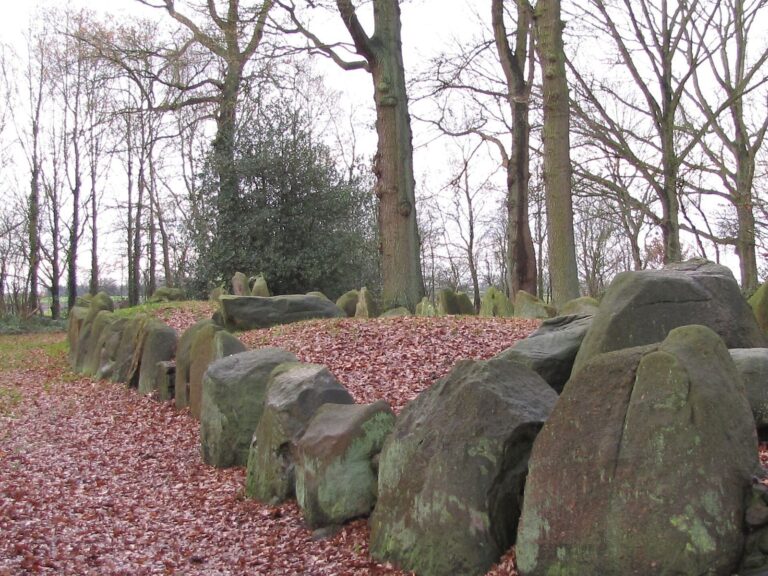
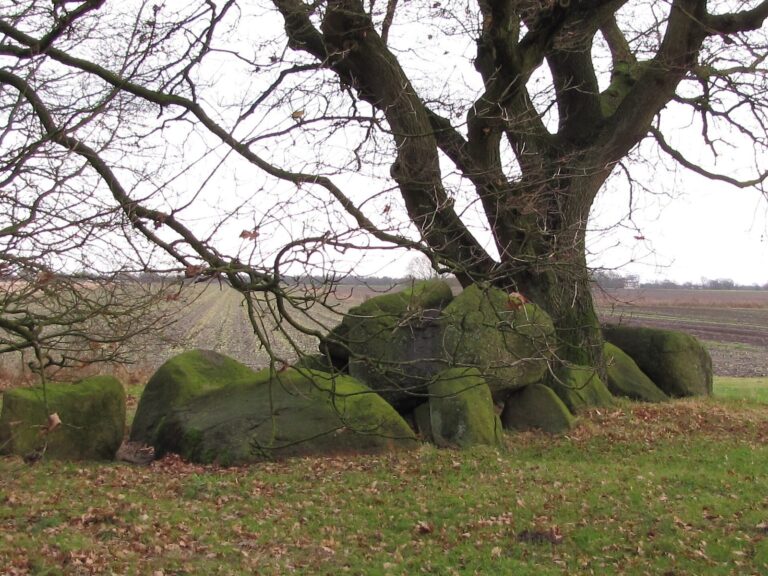
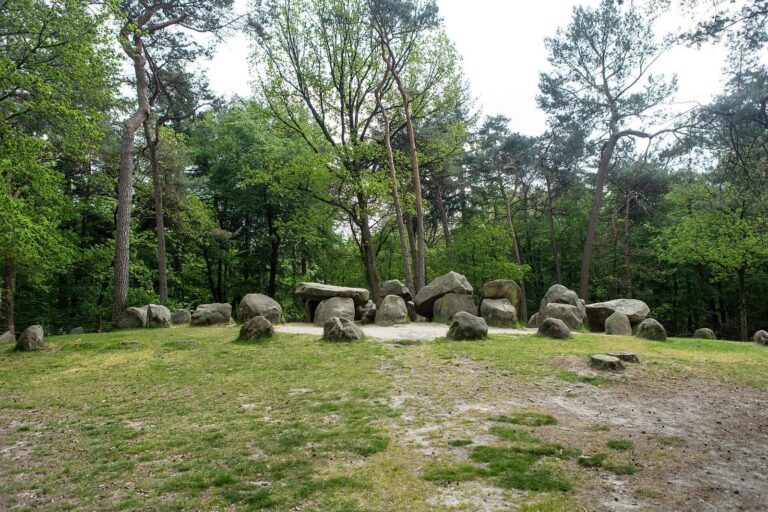
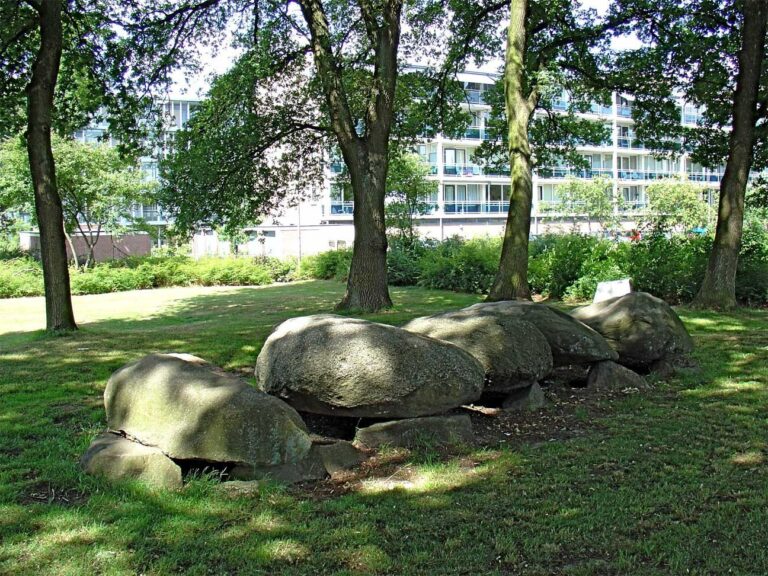
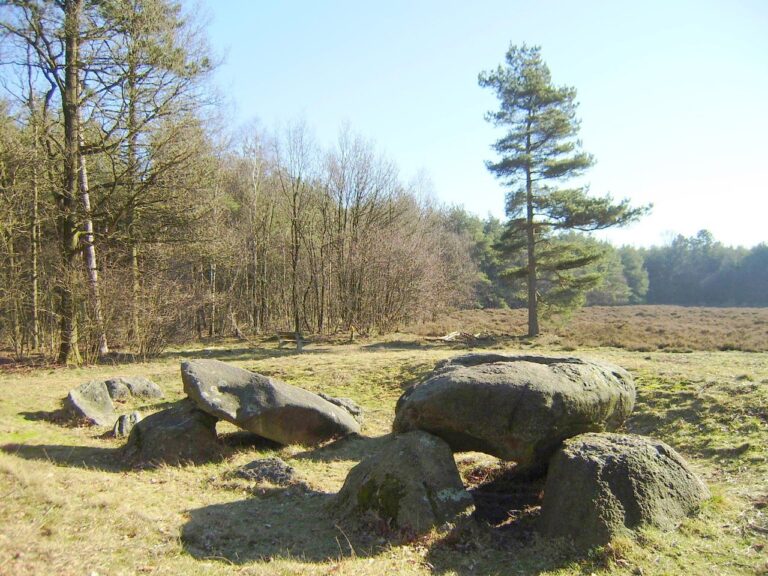
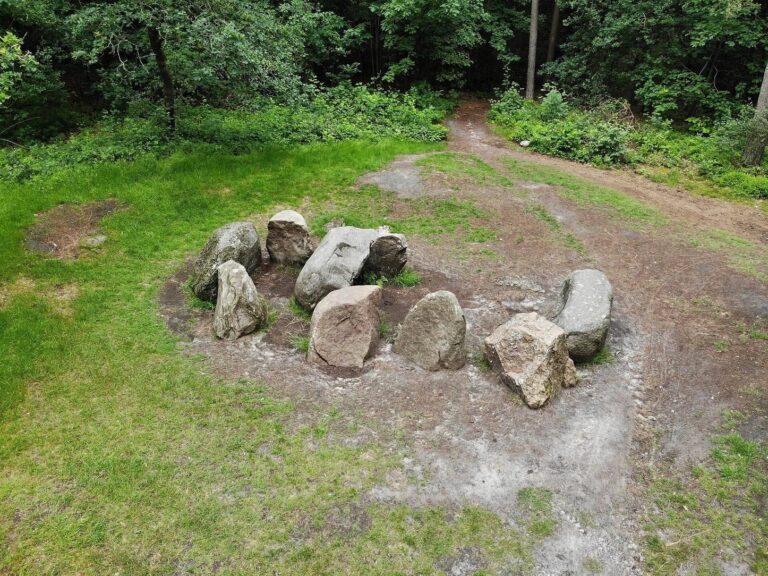
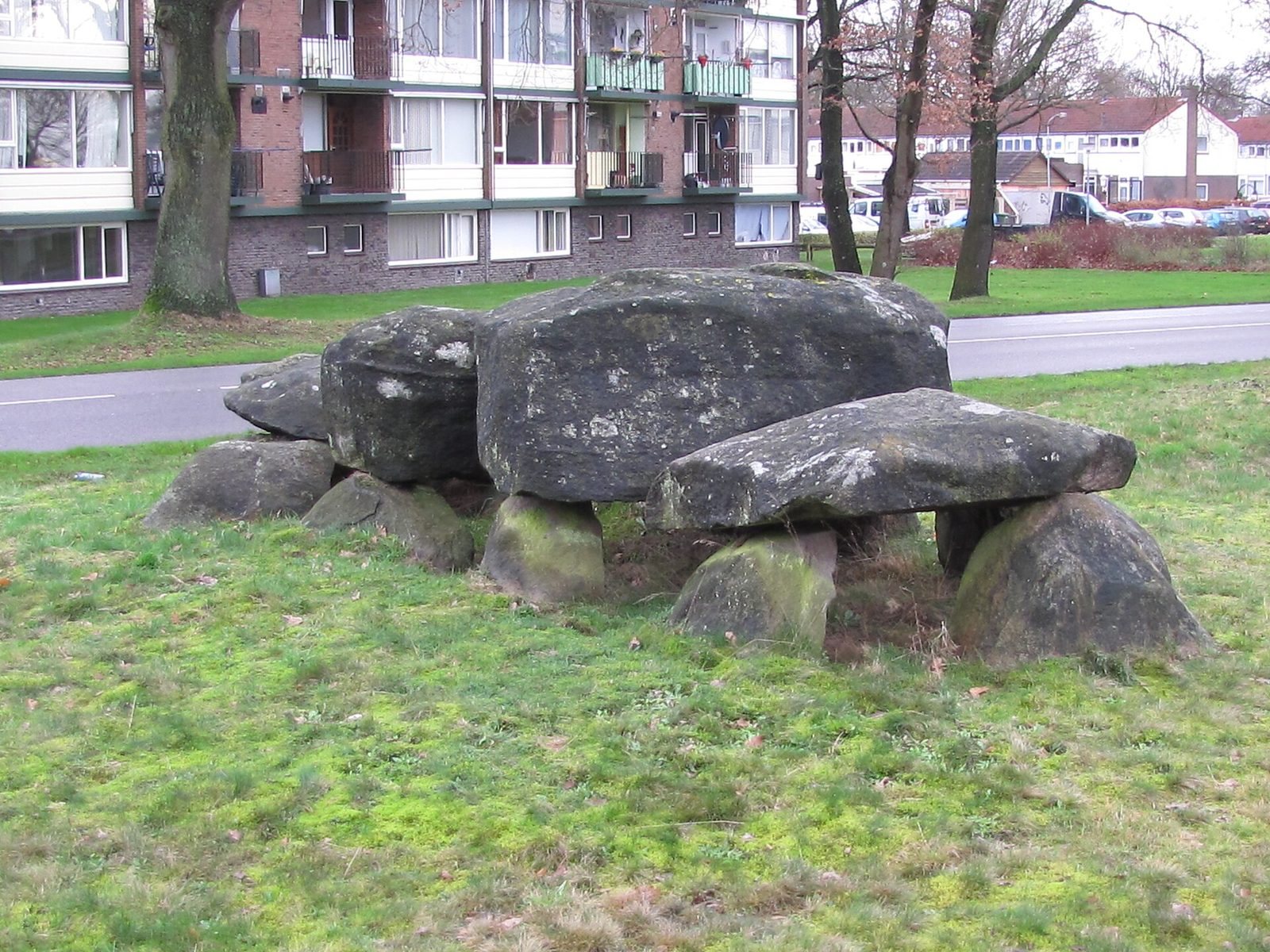
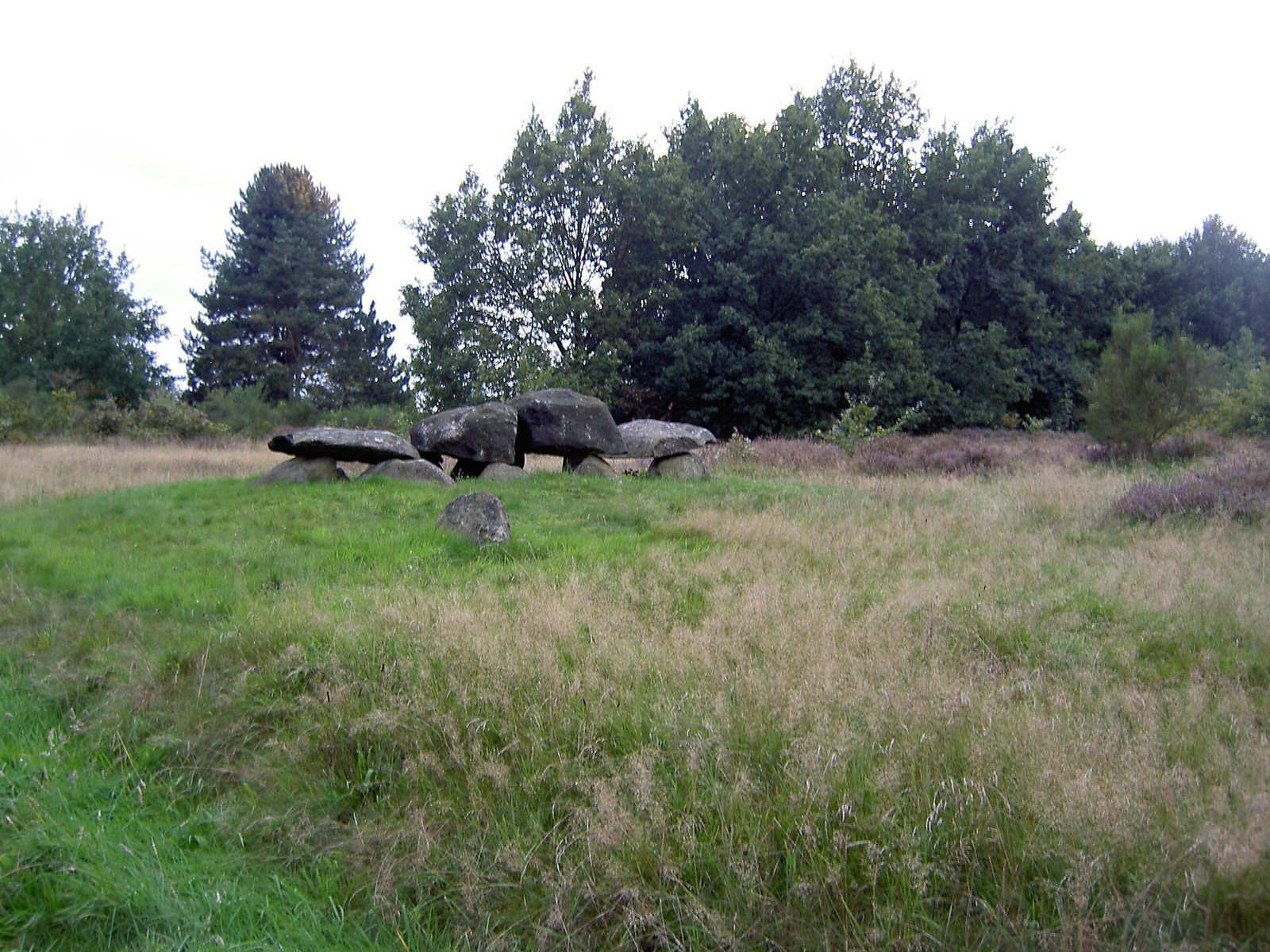
D41 is an east-northeast–west-southwest-oriented passage grave, a megalithic tomb whose burial chamber is reached through an entrance passage. The chamber measures 5.9 metres long by 2.8 metres wide. Four pairs of long-side support stones and an end stone at each short end support four capstones. The gaps between the supports were originally packed with dry masonry, stonework laid without mortar. The entrance is on the south side, between the first and second support stones counted from the west; a threshold stone was identified there in 1960.
Two layers of stone paving covered the chamber floor, with a layer containing finds between them. In 1822, Nicolaas Westendorp described the inner faces of the support stones as flat-dressed. An earth mound encased in cobbles originally covered the tomb. At the time of its discovery, the mound stood about 10 feet high and measured roughly 60 feet around. A separate mound of stone and earth lay to the west and may have served as a pyre.
Lukis and Dryden’s 1878 survey depicted four capstones and ten support stones, and described the tomb as relatively complete and in good condition. Their record noted that the capstones had recently been put back in place and that the mound had recently been reduced.
Pottery finds
An urn was recovered among the support stones, and pottery was found especially in the layer between the two floor pavements. Three vessels from the chamber’s centre were complete: a terrine, a collared bottle, and a small bowl. Fragments from about 14 or 15 other vessels, described as urns, were also recovered and were probably broken by Jansen’s iron probe. Only the three complete vessels were retained. They are now in the Rijksmuseum van Oudheden, the Dutch National Museum of Antiquities in Leiden.