Keck Chapel: Kempten’s Romanesque Church of Saint Stephen
Site at a Glance
- Popularity
- Low
- Country
- Germany
- Primary era
- Medieval
- Eras represented
- Medieval, Early Modern, Modern
- Civilizations
- German, Holy Roman Empire, Kingdom of Bavaria
- Site type
- Religious
- Remains
- Chapel
On this page10 sections
History
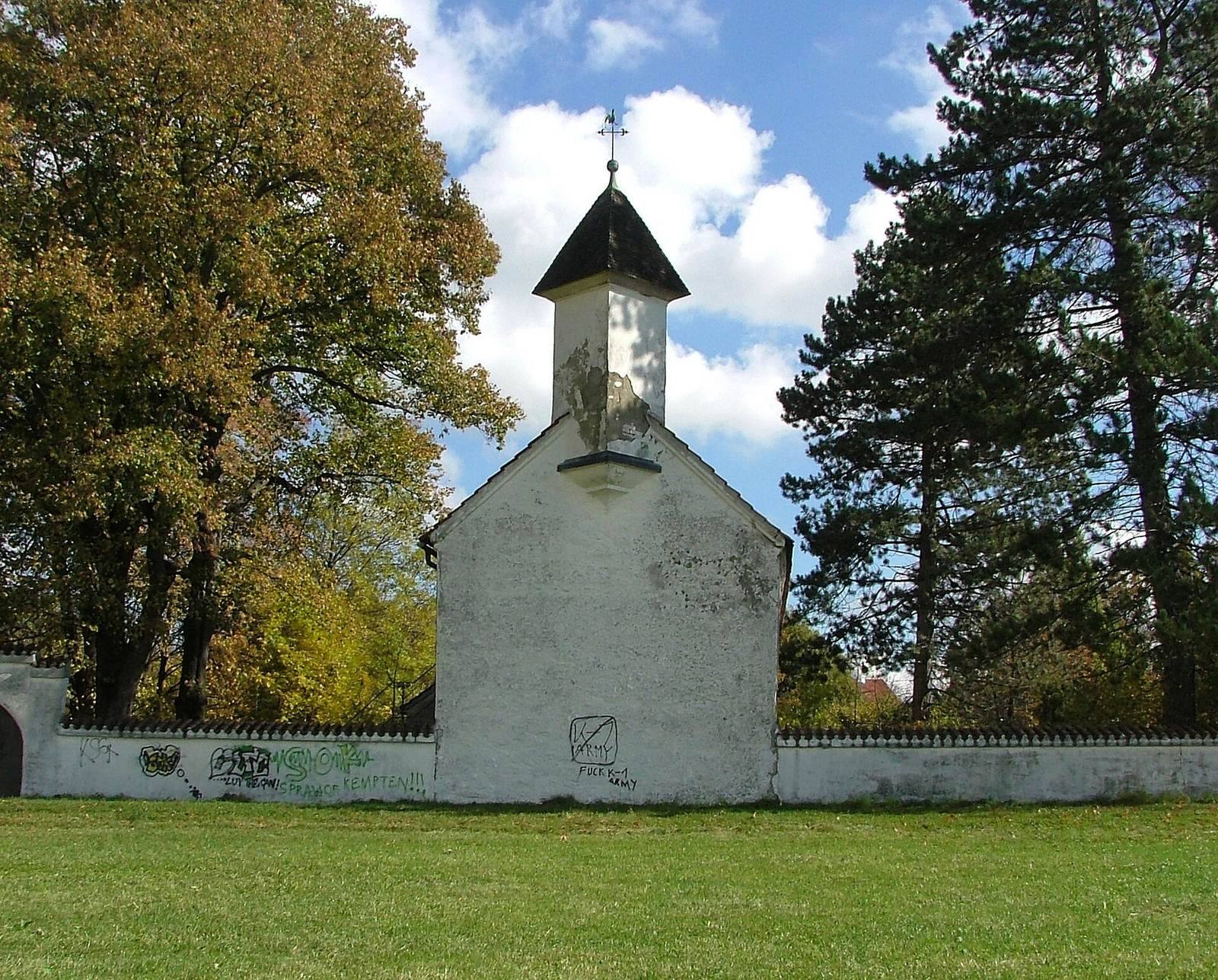
Keck Chapel (Keckkapelle) is a church of Romanesque origin dedicated to Saint Stephen, an early Christian martyr, in Kempten, Germany. It is Kempten’s oldest church. The chapel was built beyond the medieval town, on sparsely developed land above a Roman cemetery associated with Cambodunum, the Roman settlement at Kempten.
Romanesque origins and medieval use
The chapel’s Romanesque beginnings are followed by alterations in the later Gothic style, including an enlarged choir. After 1451, the choir was extended and a house for the chaplain was built, identified with the leprosy house. In 1521, the leprosy house was moved from the town to St Stephen’s Chapel. Its cemetery was enclosed by a wall around the chapel, and the building east of the road remained connected to it by footbridges into the eighteenth century.
Early modern alterations and ownership
The leprosy house was renovated in 1665, and the chapel followed in 1668, with Johann Auchter paying for the work. In 1769, a man known as Keck acquired the estate and chapel. The chapel’s commonly used name comes from a former owner who also owned and operated the neighboring inn Zum Keck.
Restoration and later use
The chapel passed to Consul Leonhard Kluftinger in 1898, the year of a restoration. Further restoration took place in 1940. Work in 1898 and 1940 brought extensive Gothic paintings in the choir to light, while a separate restoration in the 1930s exposed Romanesque masonry and windows. Bomb strikes destroyed the leprosy house in 1944. The choir paintings were cleaned and consolidated in 1976, and restoration in 2010 and 2011 addressed the danger of the chapel’s ceiling collapsing. Protestant services and devotions are held in the chapel several times a year.
Remains
The surviving complex combines Romanesque church fabric with a later Gothic choir and a walled enclosure around the chapel. The site of the former leprosy house lies east of the road, while the Roman cemetery at Keckwiese is southwest of the chapel.
Chapel structure
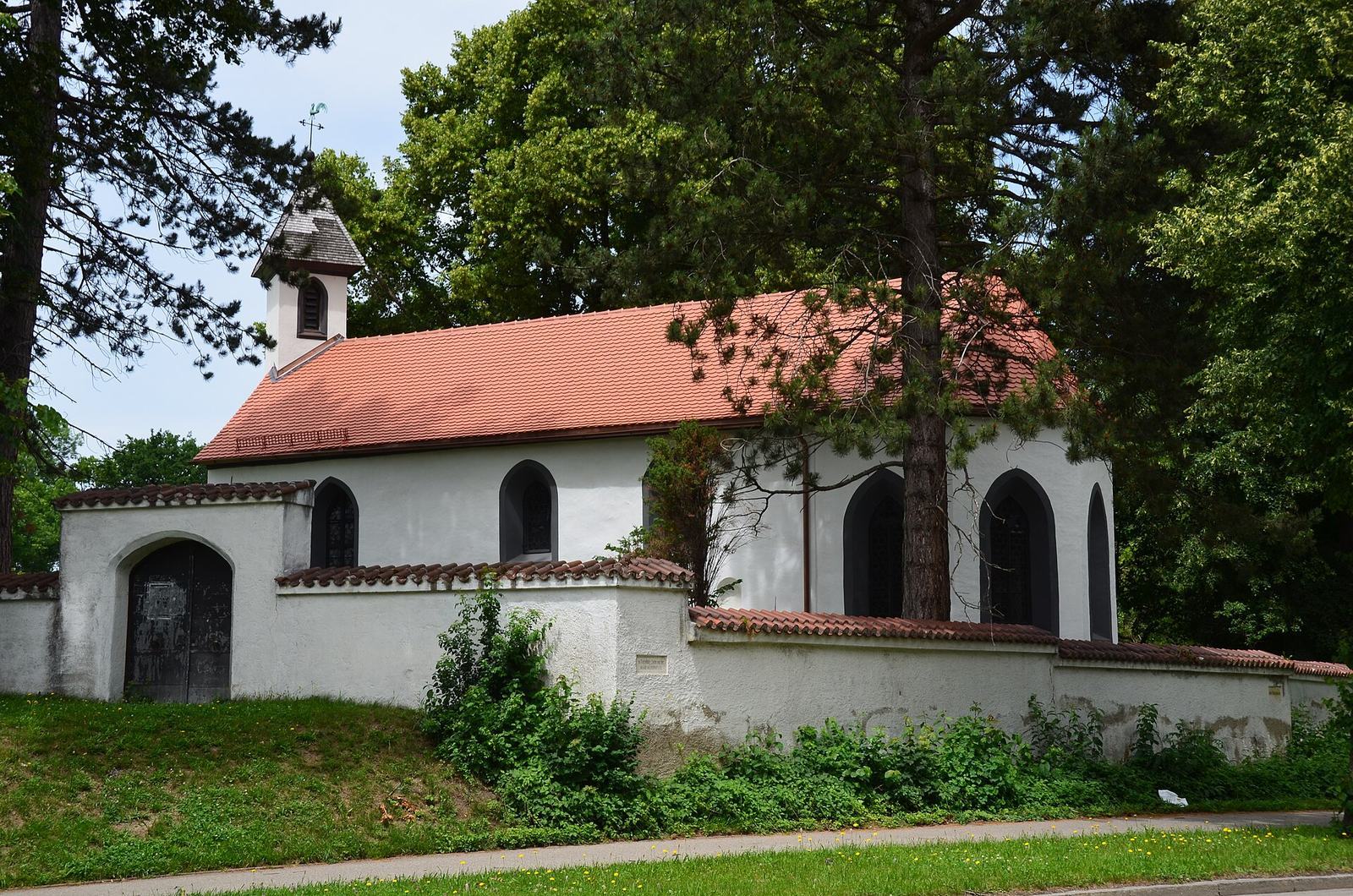
The chapel stands on the eastern high bank of the Iller, above Kempten’s old town. Its long side walls date from the thirteenth century at the latest. One round-arched window remains on the north side and two on the south, and the masonry and window forms reflect the building’s Romanesque origins. Foundations of a semicircular apse, a curved sanctuary end, were exposed beneath the Gothic choir in 1940. The choir terminates in a five-eighths polygon, formed by five sides of an eight-sided shape, and has a cross-rib vault supported by intersecting ribs. The square roof turret probably dates from the seventeenth-century renovations.
Choir paintings
The choir’s paintings date to about 1460 and are attributed either to an artist associated with the regional Memmingen school or to a less-known painter from Kempten. They were painted on dry plaster. Their scenes include saints and Church Fathers, influential early Christian theologians and writers, as well as the wise and foolish virgins above the entrance to the choir. Beside a sacrament house, a structure for the consecrated Eucharist, the Last Supper appears within painted architectural forms that create an illusion of depth. Christ on the cross is shown between two keystones, the central stones at the top of the vault. Uncovering the paintings cost them many details, leaving much of the underpainting; their colors consequently appear duller than they once did. Later restoration also altered the original fabric. Cleaning and consolidation in 1976 found that about one-third of the original paint remained.
Altar and other artworks
An altar made in 1908 stands in the center of the choir. It was long thought to have come from Tyrol; its central shrine was supplemented in modern times and has an ornamental upper structure. Two older painted panels show Saint Anne, traditionally regarded as Mary’s mother, and Saint Alexius, revered as an ascetic holy man. In the sacristy, a room for storing church objects and vestments, are two wooden kneeling angels from the mid-eighteenth century. A panel made in 1495 depicts Saint Magnus of Füssen, revered as the Allgäu’s Apostle, fighting dragons and vermin. A series of paintings by Grönenbach artist Ludwig Eberle, displayed at the gallery, depicts the chapel’s history and its surroundings.
Enclosure and former leprosy house
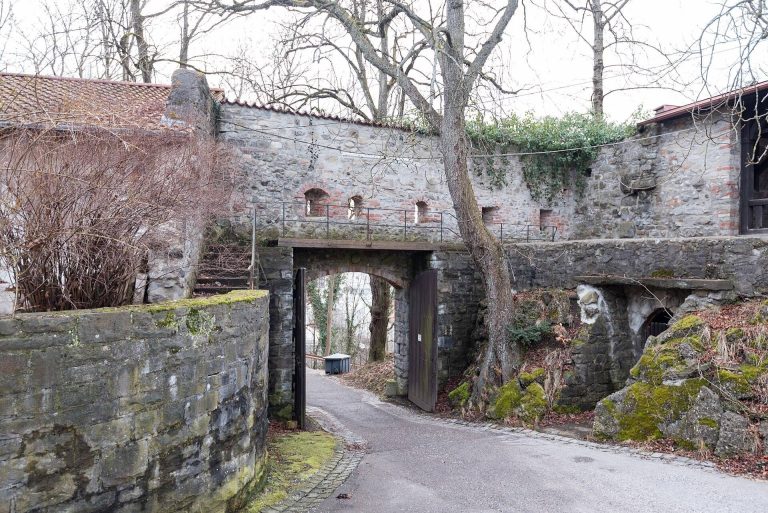
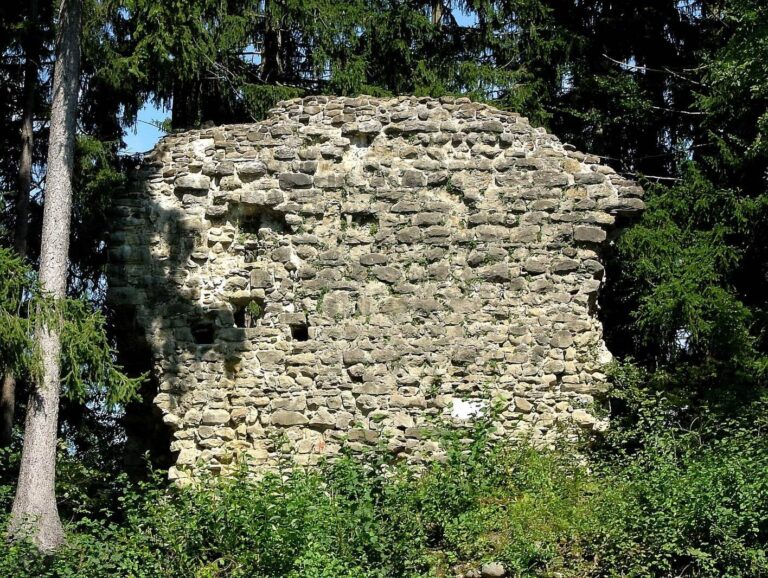
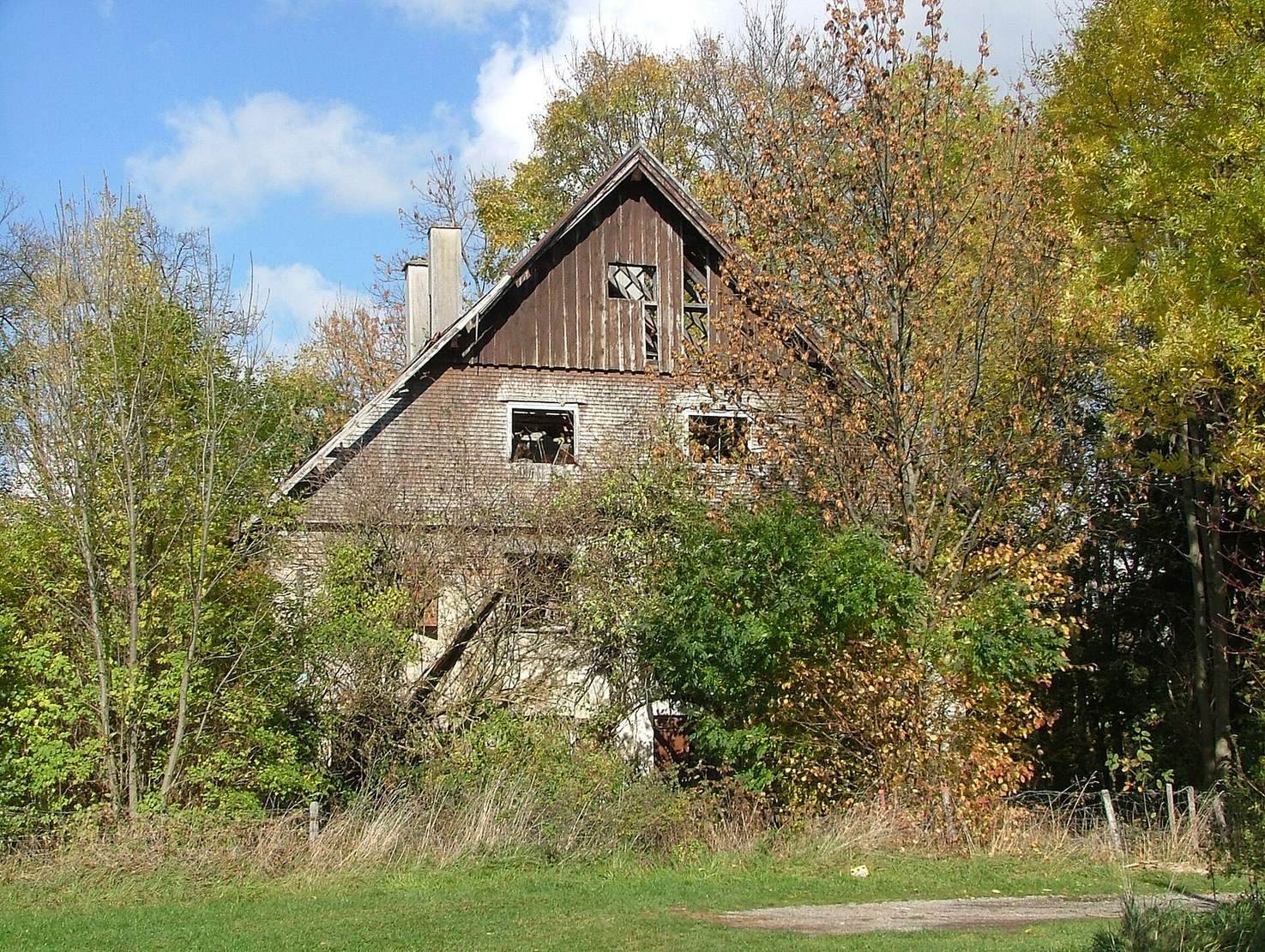
The wall around the chapel once bounded the leprosy house’s cemetery. It has a low-arched entrance on the south side and a rectangular gate to the north. Fifty-two wrought-iron grave crosses now stand within the enclosure; they came originally from cemeteries across the Allgäu. East of the road, a few wall remains survive at the former leprosy house site. The nearby two-storey inn Zum Keck has a projecting section with a cross-gabled roof.
Roman cemetery at Keckwiese
The cemetery southwest of the chapel is the largest known burial ground of ancient Cambodunum. It extended for 290 metres and contained more than 400 burials dating to the first and second centuries AD; the site was also used for burials in Late Antiquity. Kaufbeurer Straße now cuts diagonally across it. Road construction and slope regulation left much of its eastern extent outside archaeological investigation. The cemetery may have extended considerably farther north, where scattered monumental tombs may also have continued. One such tomb was found at the artillery barracks on Kaufbeurer Straße. In the cemetery’s northern part, some of 38 largely grave-good-free burials of uncremated bodies from Late Antiquity overlay cremation burials from the early and middle Roman imperial periods. Archaeological excavations began in the 1960s.