Church of Saints Jerome and Bernardino and the Former Augustinian Convent in Monte Carasso
Site at a Glance
- Popularity
- Very Low
- Country
- Switzerland
- Primary era
- Medieval
- Eras represented
- Medieval, Early Modern, Modern
- Civilizations
- Duchy of Milan, Holy Roman Empire, Swiss
- Site type
- Religious
- Remains
- Church
On this page13 sections
History
The Church of Saints Jerome and Bernardino and former Augustinian convent stands in Orenno, Monte Carasso, Switzerland. The Catholic church, part of the Diocese of Lugano, originated in the eleventh or twelfth century and is classified in Romanesque, Late Gothic, and Baroque styles.
Origins and the Augustinian community
Around 1450, an oratory dedicated to Saint Jerome, the late-antique Christian scholar known for translating the Bible into Latin, also received a dedication to Saint Bernardino of Siena, a fifteenth-century Franciscan preacher. A twentieth-century inscription on the façade records the change.
The Augustinian convent was built in 1450. Augustinian religious communities follow a tradition shaped by the Rule of Saint Augustine. In 1516, Bellinzona’s municipality granted economic benefits to Augustinian nuns of Saint Elizabeth, whose community depended on the church of Saint Blaise at Ravecchia. The grant formally established the nuns’ presence in the area.
The church was enlarged during the fifteenth century, with further building work in the sixteenth. A choir was added between 1658 and 1660.
Suppression and restoration
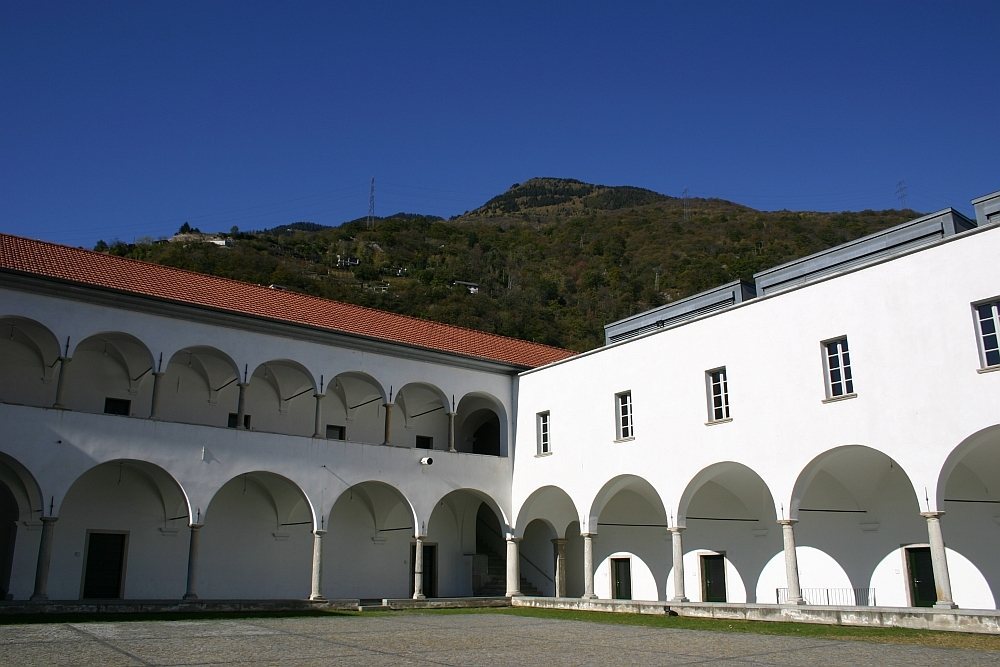
The convent was suppressed in 1859. The church had formed one wing of a larger convent building, which was demolished in 1952.
Restoration in 1905–1906 concentrated on the interior and renewed the sixteenth-century façade frescoes. Further campaigns took place under Guido Tallone in 1965–1967, under architect Luigi Snozzi in 1987–1993, and under Alberto Julio Fresco, Anita Lara Bulloni Fresco, and Andrea Skory in 2009–2010.
Remains
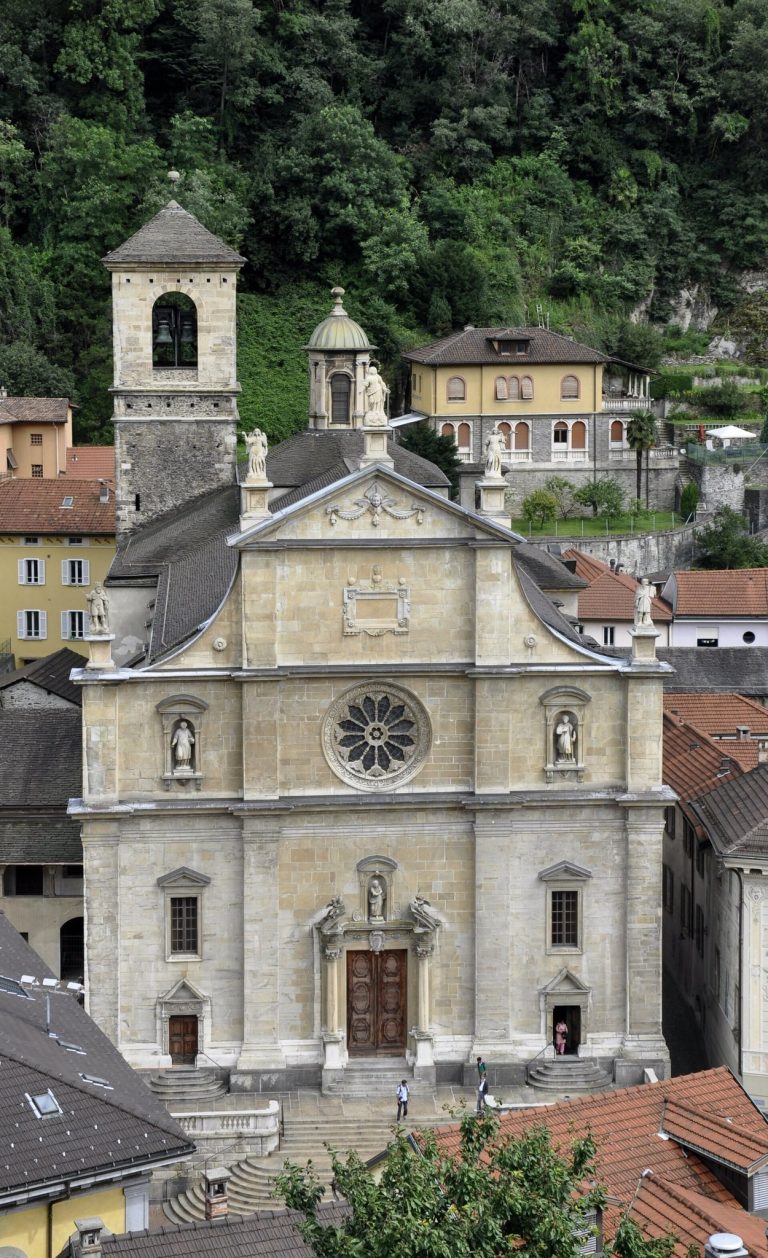
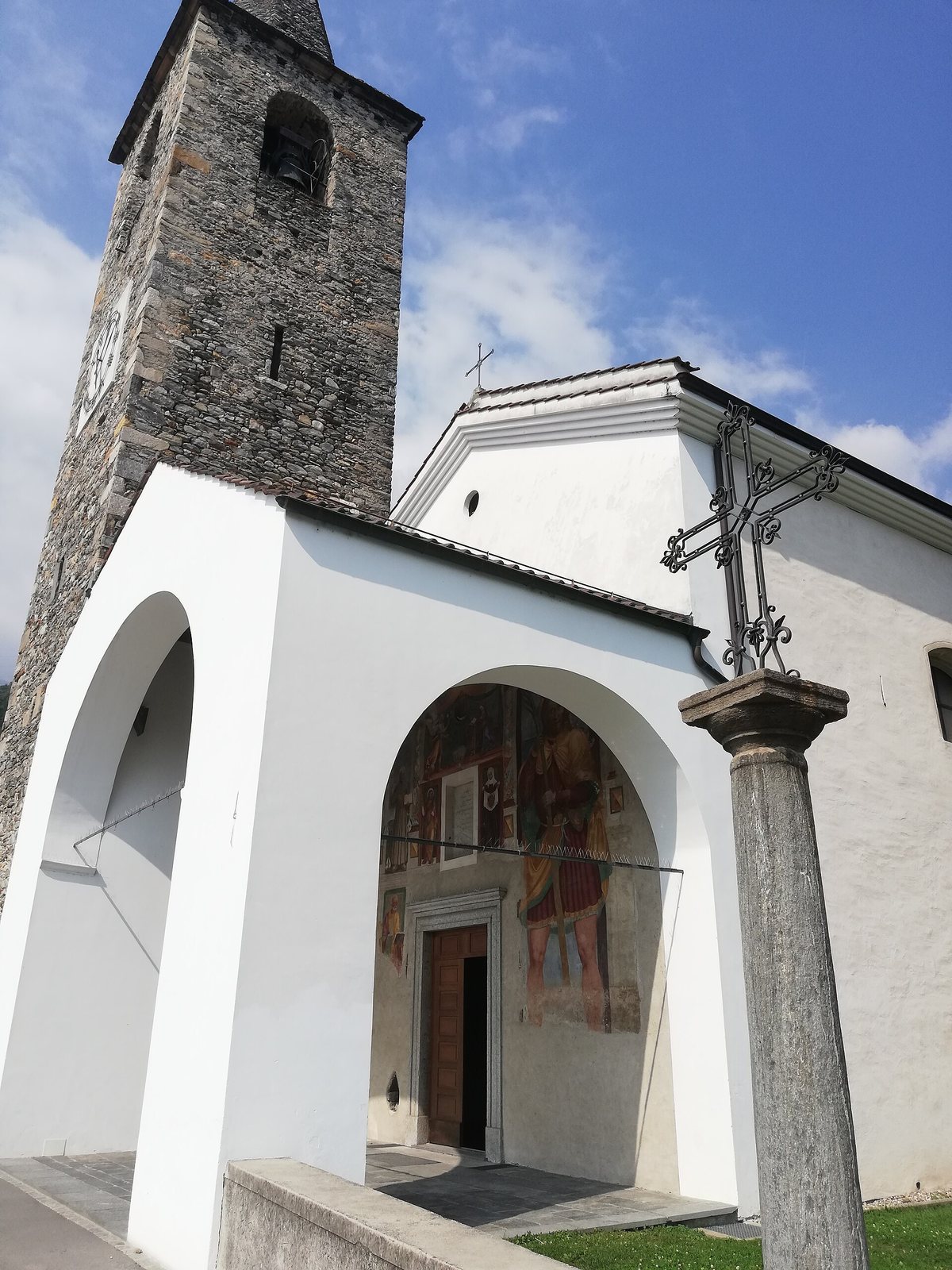
The church has a single nave ending in a rectangular choir, within a building classified in Romanesque, Late Gothic, and Baroque styles. Its exterior includes a roof, two porticoes, and a bell tower; the interior retains painted decoration, altars, statues, and an eighteenth-century organ.
Exterior
Porticoes and bell tower
One portico stands before the façade, while another is behind the choir and provides access to the winter chapel. A bell tower rises beside the façade.
Façade frescoes
The sixteenth-century façade paintings are attributed to Domenico Pezzi of Puria. Their subjects include Saints Christopher, Peter, and Bernardino of Siena; Saints Apollonia and Veronica; the Annunciation; and God the Father with two angels.
Interior
Nave and choir
The nave is covered by a barrel vault with lunettes, curved vault sections formed where smaller vaults intersect a larger one. It leads to a rectangular choir, whose final section now serves as a winter chapel and formerly housed the nuns’ choir. The apse has a low barrel vault.
Main altar and choir decoration
A painted and gilded wooden tabernacle stands on the main altar. Behind it, a seventeenth-century wooden crucifix with gilded inlays is mounted on a wooden grille. A cornice decorates the choir’s rear wall, and seventeenth- and eighteenth-century canvases hang on its left wall. A stucco group of the Annunciation, made around 1650, was moved from the choir to the main arch during the 2009 restoration.
Nave paintings and organ gallery
Canvas Stations of the Cross from the seventeenth and eighteenth centuries hang in the nave. Other paintings from those centuries include The Adoration of the Shepherds (1752), signed “D. Mantello,” a Nativity of the Virgin Mary, an image of the convent’s origin, and an Immaculate Conception. The last two paintings came from the church of the Holy Trinity, as did Giosuè Oggioni’s Holy Trinity, now in the right chapel.
A wooden gallery in the main body holds an organ made by Giuseppe Reina in 1746. Its recovered front decorations are paintings on wood and canvas showing Augustine of Hippo, a late-antique Christian theologian and bishop, and his mother Monica before the Madonna of the Girdle. This devotional subject reflects a tradition that Mary gave her girdle to the apostle Thomas.
Side chapels
The left chapel contains an eighteenth-century painted wooden Madonna of the Rosary and a statue of Saint Bernardino of Siena. In the right chapel, Oggioni’s Holy Trinity dates to 1784. Its altar front, made in 1750 by Giuseppe Maria Pancaldi of Ascona, uses decorative plaster shaped to imitate stone.
Former altarpiece
A sixteenth-century altarpiece in the Swabian style, associated with art from southwestern Germany, remained in the church until 1905 and is now held by the Swiss National Museum in Zurich. Its five statues represented the Madonna and Child, Saint Bernard of Clairvaux, a twelfth-century Cistercian abbot and theologian, Saint Bernardino of Siena, Saint Nicholas of Bari, and Saint Jerome. The doors carried raised carvings of Saint Catherine of Alexandria, Saint Anthony Abbot, Saint Benedict of Norcia, and Saint Barbara. An inscription describes the work as gilded, with numerous gilded wooden figures and doors made using the same technique. Its predella, the lower part of an altarpiece, showed Christ among the apostles and was later stolen.