General Ryes Skanse: Danish Fortifications at Dragsmur
Site at a Glance
- Popularity
- Medium
- Country
- Denmark
- Primary era
- Modern
- Eras represented
- Modern
- Civilizations
- Danish
- Site type
- Military
- Remains
- Fort
On this page9 sections
History
General Ryes Skanse is a Danish defensive position at Dragsmur in Denmark, with fortifications completed in 1848 during the Three Years’ War (1848–1850), the conflict between Denmark and forces seeking to separate Schleswig-Holstein from the Danish monarchy. The works were intended to protect a Danish troop transfer to Fredericia and block the passage to Helgenæs.
Construction and naming
General Olaf Rye, a Norwegian-born officer who served in the Danish army and rose to the rank of general, expanded the fortifications as part of preparations for a Danish withdrawal to Helgenæs. King Frederik VII inspected the works on 19 September 1848 and named them Frederiksskansen. After the war, they became commonly known as Ryes Skanser.
Rye’s 1849 maneuver
After the Battle of Kolding on 23 April 1849, Schleswig-Holstein forces advanced into Jutland and besieged Danish troops at Fredericia. Rye was ordered to draw enemy forces north, away from the besieged town. His brigade kept one to two days’ march from the enemy, maintaining contact particularly through its cavalry, with a possible retreat to the Limfjord if needed. In late May, north of Aarhus, Rye had 6,000 to 7,000 men and 1,500 horses, while about 13,000 German troops pursued him.
Rye moved toward Djursland while creating the impression that his troops were continuing north. This allowed them to turn east across Djursland and Mols toward the Helgenæs fortifications. The German advance stopped at Egå after Rye destroyed a recently built bridge, preventing heavy artillery from crossing. In late May and June, his troops were stationed around Vosnæsgaard, Hornslet, Mørke, Rodskov and Kalø. Røndebakken was strengthened with trenches and gun positions, the ground between Knubbro Bæk and Følle Mølleå was flooded, and bridges were readied for demolition. A steamship and two gunboats in Kalø Vig were positioned to fire on an advancing enemy.
Roads through Mols were improved for the troop movement. On 28 June, the withdrawal across Mols was completed in a single day. Because the roads could not carry the whole force together, Rye divided it into three groups. One travelled via Bjødstrup, Kejlstrup and Basballe; another went through Agri and Mols Bjerge; the third passed west of Vrinners and south of Mols Bjerge. A detachment from Vosnæsgaard remained at Rønde to cover the withdrawal and, if necessary, destroy the bridges. Piers at Borup, south of Vænge Lake, and Kongsgårde were built for embarking the troops. They boarded at Kongsgårde as planned.
The Dragsmur fortifications themselves were never put to use. On 6 July 1849, Rye and his troops took part in a successful Danish attack launched from Fredericia, an action that helped decide the war in Denmark’s favor. Rye was killed while attacking the German Treldeskanse, which threatened the sea route to Funen. He was remembered after the war as one of its great heroes. A memorial stone was erected at Dragsmur in 1924, and the fortification is protected.
Remains
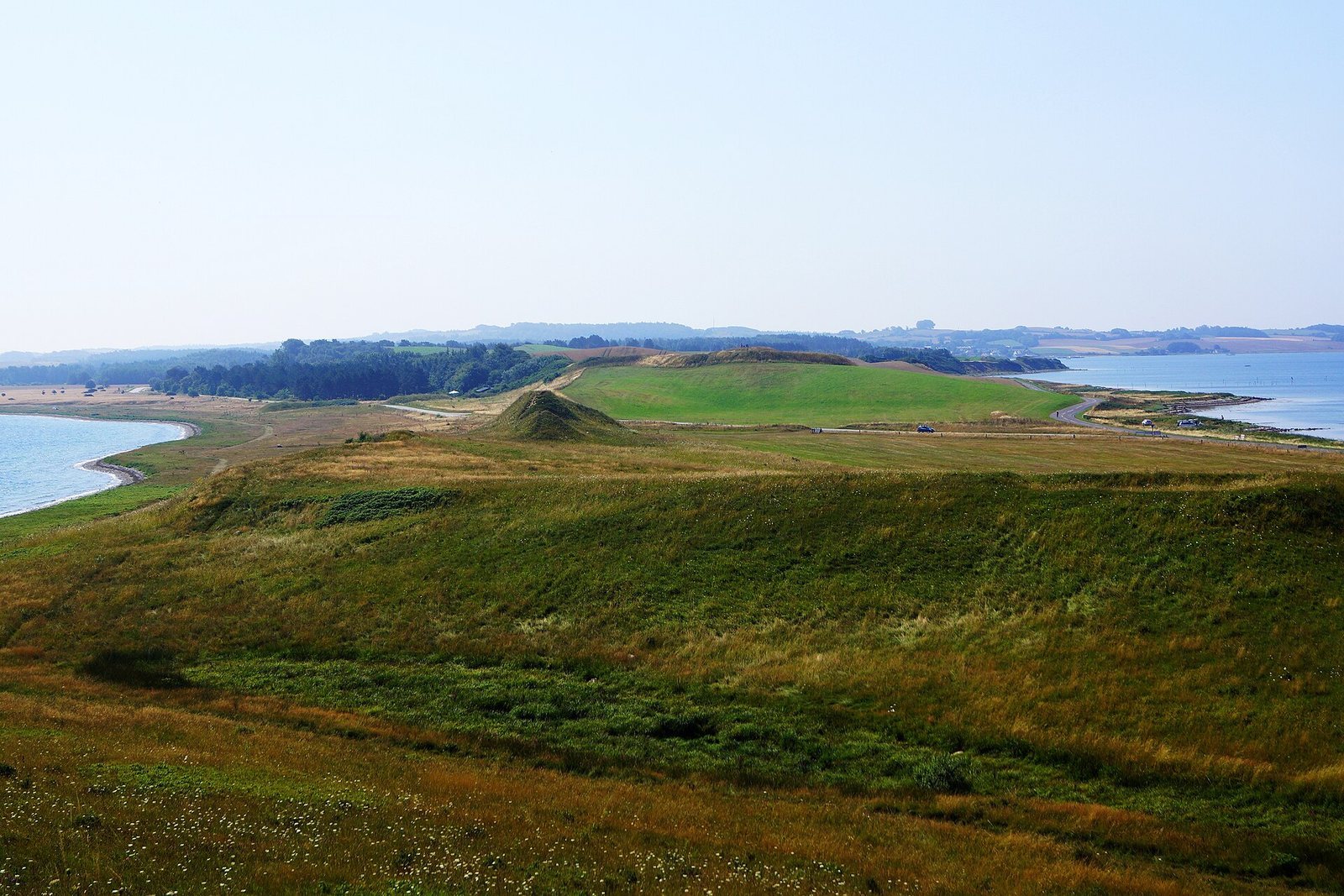
The fortifications occupy a narrow isthmus about 400 metres wide between Mols and the Helgenæs peninsula, blocking the approach to Helgenæs. Their layout combined an elevated open gun position with earthworks, a palisade and supporting gun positions. Visible remains survive at the site. The landing piers were located at Borup, south of Vænge Lake, and at Kongsgårde, and a memorial stone stands at Dragsmur.
Earthworks and gun positions
Central fortification
An open fortification with six guns stood at the highest point. It could fire across low ground to the west, and its position provided a wide view over the terrain an advancing enemy would have to cross.
Western breastwork
On the western side, a breastwork, a low protective wall or earthwork, ran down toward the beach and carried two guns.
Eastern barrier
To the east, a zigzag earthwork and palisade, a defensive fence of upright stakes, blocked the approach to Helgenæs. Gates were set into the barrier, while four guns guarded the shore.
Southern gun positions and barracks
About 100 metres south of the palisade, two supporting gun positions held four additional guns. Three barracks provided accommodation for the 600 men assigned to the fortification.