Les Trois Pierres Dolmen: A Neolithic Monument in Saint-Nazaire
Site at a Glance
- Popularity
- Low
- Country
- France
- Primary era
- Stone Age
- Eras represented
- Stone Age
- Civilizations
- Unclassified
- Site type
- Burial
- Remains
- Tomb
On this page9 sections
History
Les Trois Pierres dolmen is a dolmen, a prehistoric monument made of large stones, in central Saint-Nazaire, France. It is assigned to the Neolithic, a later prehistoric period associated with farming and settled communities.
Early records and names
The earliest known reference to the monument appears in a 1679 declaration by the lord of Marsaint. It required the prior of Saint-Nazaire to present dues on Christmas night, half on a stone in Marsaint’s courtyard and half on other raised stones on the island of Bois-Savary. The monument originally stood within the enclosed grounds of the Priory of Saint-Jean-Baptiste of Saint-Nazaire, a religious house governed by a prior. Its location gave rise to the name Priory Dolmen.
A brief description appeared in 1778, followed by Jean-Baptiste Huet’s fuller account of the dolmen and a menhir, or standing stone, in 1801. The monument appeared in numerous publications during the first half of the nineteenth century and on the 1829 cadastral map, which records land parcels and boundaries. It was also called the Métairie Dolmen and Bois-Savary Dolmen. Alain de Bizeul is credited with the first recorded use of Dolmen des Trois Pierres; another name was Trilithic Dolmen.
Nineteenth-century accounts and authenticity
Repeated damage and alteration changed the monument’s appearance, leading some writers to question whether it was authentic. Yet early texts and engravings already show its arrangement of three slabs, before urban expansion reached the area. In 1851 it was described as one of the region’s most remarkable trilithons, an arrangement of two upright stones supporting a horizontal slab. In 1883, René Kerviler regarded it as an authentic dolmen preserved in a square and suggested that Saint-Nazaire might be the only French city with such a monument within its walls.
Jean L’Helgouach also defended its authenticity, pointing to drawings made by Bachelot de la Pylaie in 1848 and arguing that the city’s officials had consistently respected the monument. It was classified as a French Historic Monument in 1889, a form of legal protection for historic property.
Twentieth-century changes
After lying on the ground for a long period, the menhir was raised again on the site in May 1928 by Marcel Baudouin. During the Second World War, the German army reused one of the other blocks in masonry work at Villès-Martin.
Remains
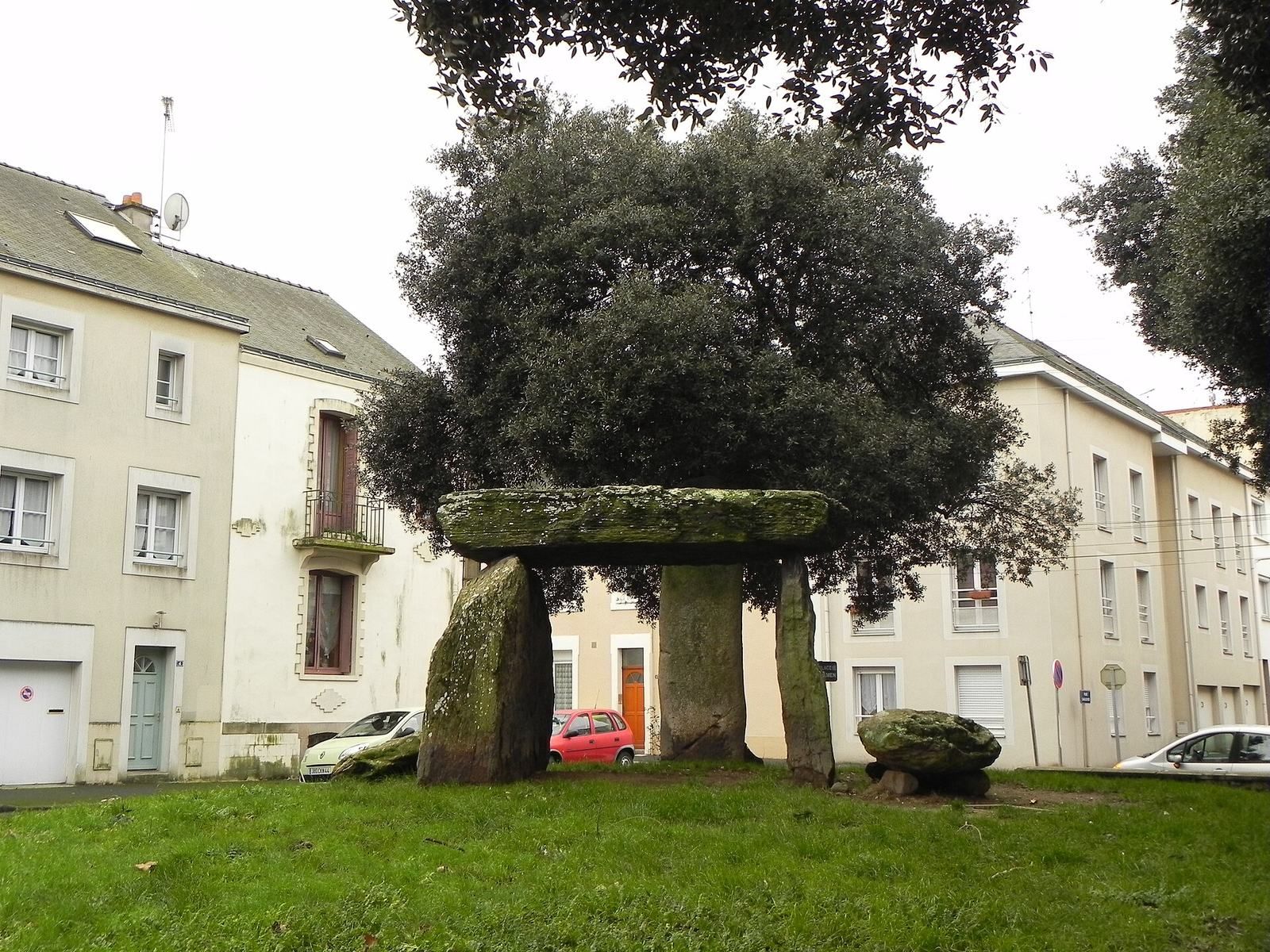
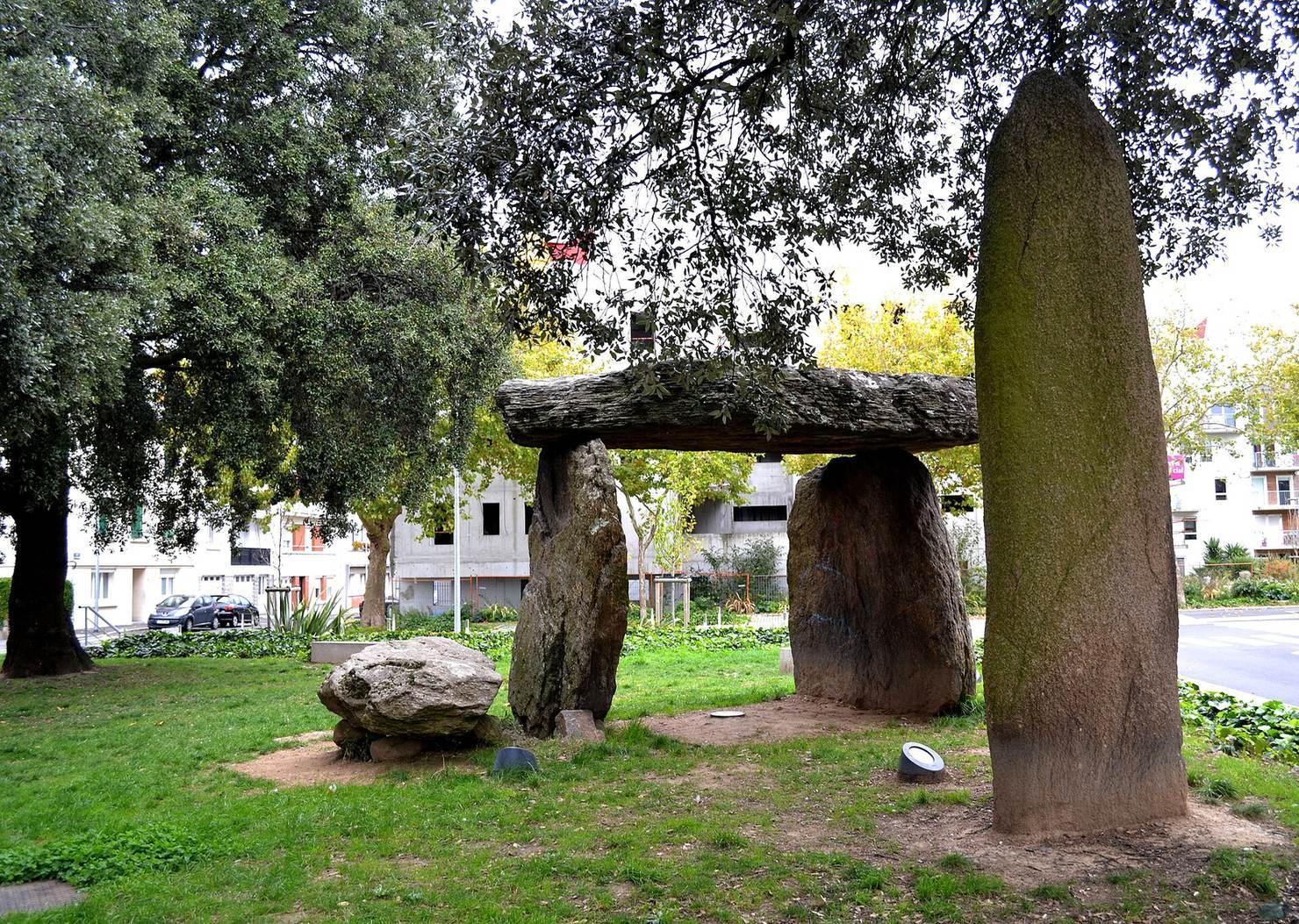
The group stands in the southwestern part of a small square at the intersection of Rue du Dolmen and Rue du Menhir. Its central feature is a three-stone dolmen, with a menhir to the west and two further blocks beside the dolmen’s supports.
Stone structures
The dolmen
Two upright supports carry a horizontal capstone. The north support is 1.94 m high and up to 1.62 m wide; the south is 1.90 m high and up to 2.60 m wide. The capstone measures 3.45 by 1.80 m and is made of mica-bearing gneiss. Baudouin estimated its weight at 7.5 tonnes. Kerviler’s 1883 description gave the monument’s height as about 2 m and the capstone’s length as 3.40 m, and noted fallen gallery fragments behind it.
The proportions of the supports have been compared with dolmens in Anjou, a historic region of western France. The structure may preserve part of an earlier covered gallery tomb, a long burial chamber roofed with stone slabs. Bizeul’s 1856 description noted traces of a mound on its western side.
The menhir
Made of granulite, the menhir stands west of the dolmen. It is a little over 4 m long, with 3.30 m above ground, and measures 0.95 m across. Baudouin estimated its weight at 5 tonnes. Small cup-shaped depressions and notches mark its east-facing side.
Additional blocks
Two other blocks remain near the dolmen’s supports. Beside the north support is a block about 2.20 m long, 1.80 m wide, and 0.50 m thick, which may have served as an earlier support. The block beside the south support measures 1.30 m long, 1 m wide, and 0.30 m thick.