Ponte Gobbo: The Historic Bridge over the Trebbia at Bobbio
Site at a Glance
- Popularity
- High
- Country
- Italy
- Primary era
- Early Modern
- Eras represented
- Medieval, Early Modern, Modern
- Civilizations
- Duchy of Milan, Italian, Lombard, Spanish
- Site type
- Infrastructure
- Remains
- Bridge
On this page8 sections
History
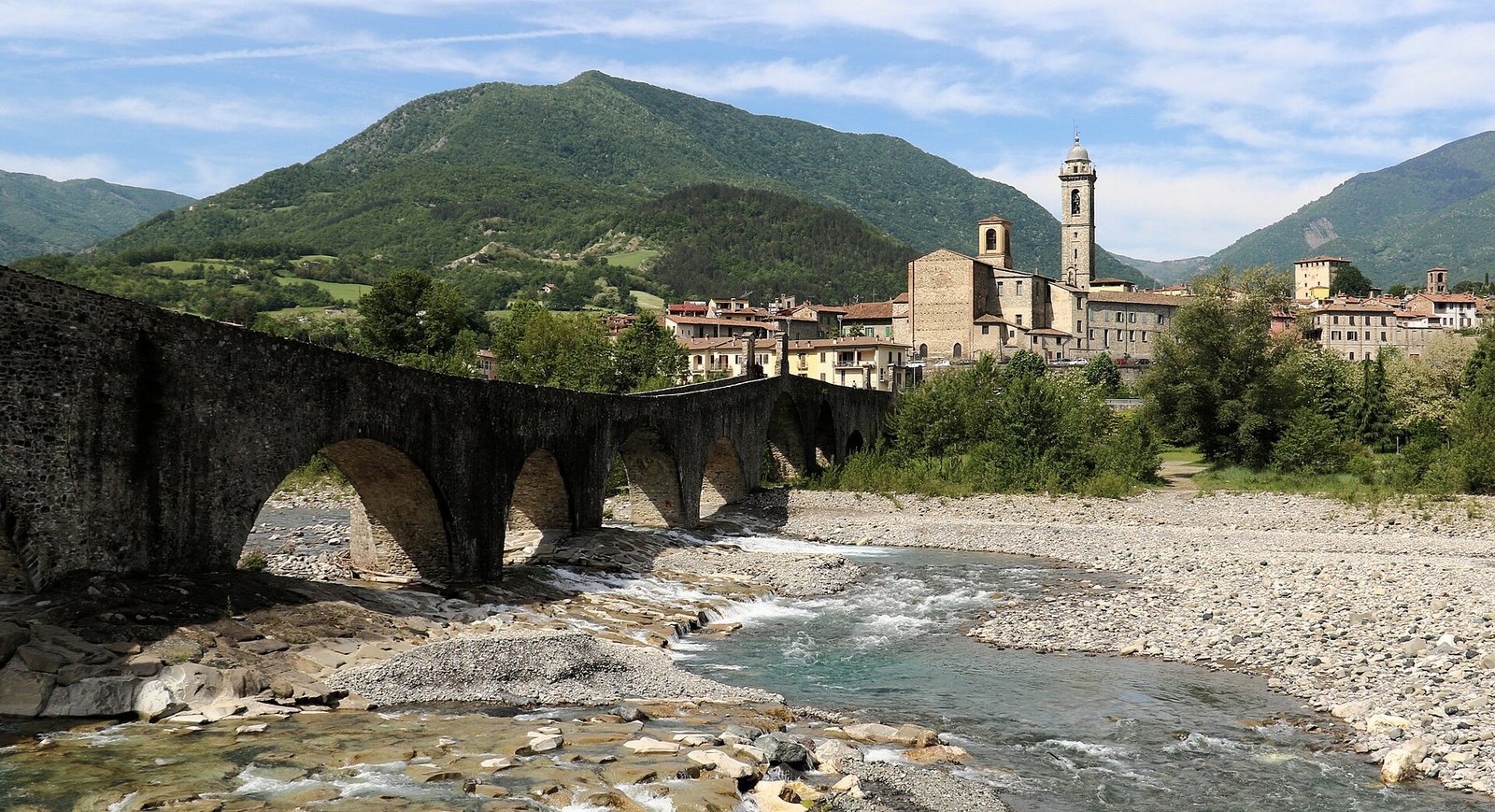
Ponte Gobbo is a stone arch bridge across the Trebbia at Bobbio, Italy. In the seventh century, monks of the Abbey of St Columbanus built a bridge above an earlier crossing. Columbanus was an Irish missionary and monastic leader active in continental Europe around this period.
Early crossing and regional connections
The first construction cannot be dated securely, though it is attributed to Roman times and may have followed Rome’s conquest of the settlement, then inhabited by Ligurian-Celtic people. Separate traces of an earlier bridge are assigned to the Early Middle Ages and predate Columbanus’s arrival.
A dependable crossing connected Bobbio with important activities on the Trebbia’s right bank. These included saltworks, baths dating to Roman and Lombard periods, and a kiln beside the Gambado stream. The Lombard period refers to the era when Lombards ruled much of Italy, from the sixth to the eighth century. A road toward Genoa and Lunigiana, a historic region in northwestern Italy where the monastery held many properties, also crossed the river here. Sudden floods and a shifting gravel bed made the Trebbia especially difficult to ford in winter. A document dated 6 April 1196 records maintenance work on the bridge.
Flood damage and rebuilding
Floods repeatedly damaged the bridge and prompted repairs and changes intended to strengthen the crossing. Several arches collapsed on 26 September 1452. In 1472, the river destroyed upstream embankments, swept away the Hospital of St Lazarus, and damaged the bridge. Some arches that had fallen were rebuilt in 1533.
Work to extend the bridge toward the left bank began around 1590 under a master builder from Parma. As erosion altered the riverbed, further changes followed. The large Spessa arch collapsed in 1611, then fell again on 7 January 1655. Reconstruction began in 1672, when the two small arches toward the town were joined into one.
In 1719, the river destroyed the sixth, seventh, and eighth arches. Their rebuilding continued until 1759, followed by defensive and strengthening work in 1763 and 1764. The sixth arch collapsed in 1789 and was temporarily replaced in wood. The eighth failed in 1814, and rebuilding began four years later.
Religious traditions, names, and legends
For centuries, pilgrims and religious processions gathered at the bridge, where blessings were also performed. Medieval folklore linked its uneven arches to the Devil, who was said to have built the crossing in a single night in exchange for the first soul to use it. St Columbanus agreed to the bargain, then sent a small dog across instead of a person. The Devil’s helpers had raised the arches to different heights, and, cheated of a human soul, the Devil kicked the bridge as he departed. Other versions substitute a bear or donkey for the dog; in one telling, the Devil falls into the river and his impact bends the bridge.
Another legend makes an innkeeper’s soul the price of the crossing. In an expanded version, the Devil appears as a hunchback with a staff and offers to divert the route toward Genoa and Chiavari, hoping to help the innkeeper attract more trade. The road was built only later. When a bridge appears through the fog, the innkeeper’s wife recognizes the stranger as a demon and seeks help from a bishop. The bishop, clergy, and parishioners bless the bridge and establish places for votive crosses and statues. The awakened Devil curses the crossing and vows that floods will destroy it whenever religious devotion weakens. This story places the inn on the opposite bank, where a public establishment still stands.
The bridge is also known as Ponte Vecchio, meaning “Old Bridge,” and Ponte del Diavolo, or “Devil’s Bridge.” The name Ponte Gobbo, “Hunchback Bridge,” became established after Valente Faustini’s 1907 dialect poem reworked an older Devil legend.
Modern damage and interpretation
On 17 May 1874, a rumor that Austrian forces were approaching from the Trebbia’s right bank led to the bridge being prepared with explosives. The reported threat proved unfounded. The Spessa arch collapsed at 6:15 p.m. on 28 January 1971 and was later rebuilt to its former appearance. Subsequent consolidation work has included measures to slow the river and small embankments upstream to help protect the bridge from floods.
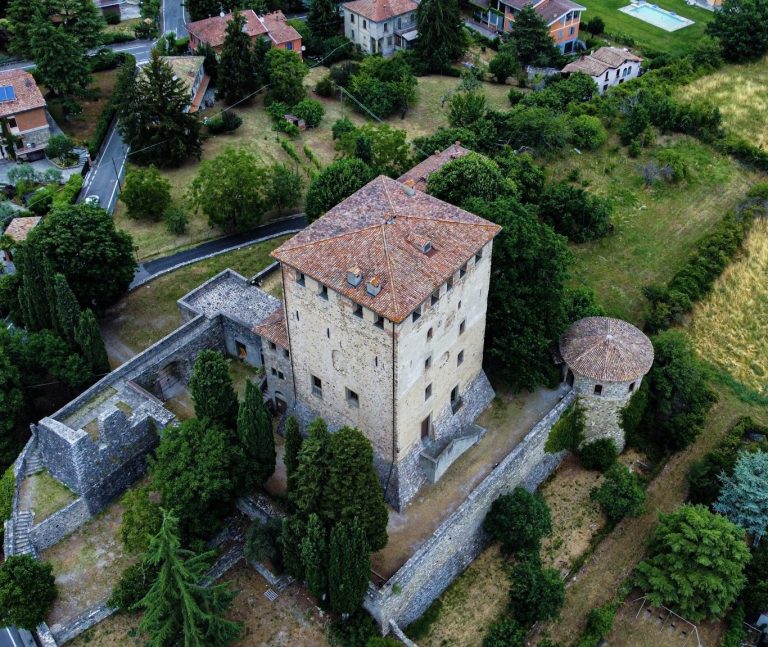
A separate modern proposal concerns the landscape in Leonardo da Vinci’s Mona Lisa. In 2011, scholar Carla Glori proposed that the sitter was Bianca Giovanna Sforza, daughter of Ludovico Sforza, Duke of Milan, wife of Galeazzo Sanseverino, and lady of Bobbio, Voghera, and Castel San Giovanni. A 2015 landscape study by the Piacenza-based Bellocchi studio used a three-dimensional reconstruction and other checks to support the proposal that Ponte Gobbo appears in the painting. The suggested viewpoint is a window on the northeast face of Malaspina-Dal Verme Castle; the bridge would appear to the viewer’s right and the sitter’s left.
Remains
Bridge structure
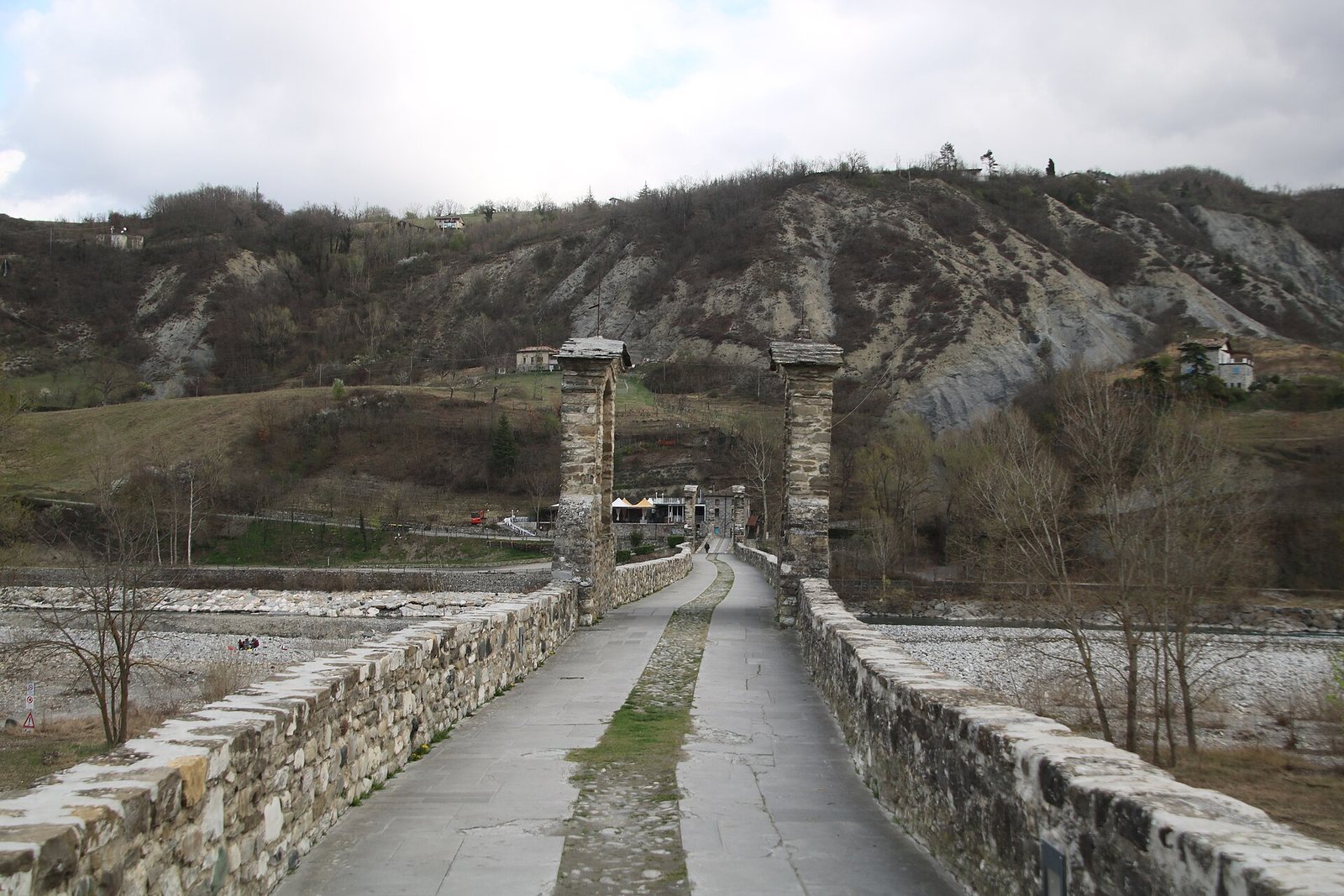
The stone bridge extends for 273 metres and has eleven arches of unequal size, set at different heights. Its roadway rises and falls with the arches, producing an irregular, humped outline. The original arrangement consisted of one large arch at the right bank and three smaller arches; extension toward the left bank and later rebuilding shaped the present layout. Traces of an earlier bridge lie beneath the structure. The roadway is narrow and is no longer open to motor vehicles.
Shrines and votive features
Three pairs of small shrine-like structures or crosses stand above the larger spans. Two structures above the largest span, the Spessa arch, contain statues of St Columbanus and Madonna dell’Aiuto, a devotional title meaning “Our Lady of Help.” Votive crosses and images were also placed near the riverbanks, and some remain visible.