Bobbio Abbey: A Medieval Monastic Centre in Italy


Site at a Glance
- Rating
- 4.6
- Popularity
- Medium
- Country
- Italy
- Primary era
- Medieval
- External website
- Open
- Eras represented
- Medieval, Early Modern
- Civilizations
- Carolingian, Duchy of Milan
- Site type
- Religious
- Remains
- Monastery
On this page12 sections
History
Bobbio Abbey, formally the Abbey of San Colombano, is a historic monastic complex in Bobbio, Italy, founded in 614 by the Irish missionary Saint Columbanus. It developed from a secluded Christian settlement into a major medieval centre of Catholic Christianity, learning, and manuscript production.
Foundation and Columbanian beginnings
On 24 July 613, the Lombard king Agilulf granted Columbanus a ruined church and devastated lands called Ebovium. The territory had previously belonged to the papacy. Columbanus selected the secluded site for a community that combined missionary activity with the solitude of monastic life. The first monastery was established beside an older church dedicated to Saint Peter and followed Columbanus’s demanding rule, which was based on Irish Christian practice.
Columbanus died at Bobbio on 23 November 615. Saint Attala, who served as abbot from 615 to 627, and Saint Bertulf, abbot from 627 to 639 or about 640, guided the community through a period of religious conflict. Bobbio became a centre of resistance to Arianism, a Christian position that rejected the full equality of Christ with God the Father, and supported the conversion of Lombards to Catholic Christianity. A tradition connected with the monastery tells how Attala revived the monk Bladulf after his murder by Arioald and cured Arioald of demonic possession, leading to the ruler’s conversion.
Benedictine transformation and royal patronage
During the seventh century, Bobbio changed from a Columbanian to a Benedictine institution. Under Abbot Bobolen, the Rule of Saint Benedict was introduced from 643 and gradually replaced the stricter earlier rule. This rule, associated with Saint Benedict of Nursia, emphasized communal discipline, prayer, and work, and eventually became the dominant tradition at Bobbio.
In 628, while Bertulf was on pilgrimage to Rome, Pope Honorius I exempted Bobbio from the authority of the local bishop and placed it directly under the Holy See, the jurisdictional institution of the pope. In 643, at the request of King Rothari and Queen Gundeberga, Pope Theodore I permitted the abbot to use the mitre and other pontifical insignia. Under King Liutprand, the monastery was extensively redeveloped, with the work completed around 747 under Abbot Anastasius. The dedication to Saint Columbanus was then added to the earlier dedication to Saints Peter and Paul.
Bobbio’s lands were restored to the papacy by King Aripert I and confirmed again by Aripert II to Pope John VII in 707. In 756, King Aistulf was compelled by Pepin the Younger to surrender lands connected with the monastery. Charlemagne later made substantial grants to Bobbio, and in 1153 Frederick Barbarossa confirmed various rights and possessions in two charters.
Medieval expansion and learning
By the late ninth century, Bobbio was among Europe’s important monastic centres. Its scriptorium, the area where manuscripts were copied, and its library contained theological and secular learning. The monastery’s possessions extended across territories corresponding to the provinces of Alessandria, Pavia, Piacenza, Parma, Reggio Emilia, Genoa, La Spezia, Massa-Carrara, Lucca, and Pisa.
Abbot Agilulf, who held office from 883 to 896, initiated the complete rebuilding and enlargement of the abbey church. The project removed the earlier Lombard basilica associated with Liutprand and reorganized the ancient monastic crypt. Bobbio also administered property around Lake Garda and Monte Baldo through the dependent priory of San Colombano at Bardolino. Medieval records connect the monastery with lands at Marciaga, Castion Veronese, Montagna, Pesina, Bondi, Valle Tesina, Albisano, and other settlements, including fields used for olives, vines, and madder.
The abbey’s intellectual reputation drew religious figures and scholars. Saint Dungal, an Irish monk who died after 827, left about 27 volumes to the library. Cumianus, formerly an Irish bishop, became a monk at Bobbio and died there around 730 or 736. Gerbert of Aurillac, later Pope Sylvester II, served as abbot in 982 and used the monastery’s ancient treatises while composing his work on geometry.
The library’s late-ninth-century catalogue listed more than 600 volumes and covered the principal branches of theological and secular knowledge. By 982, the collection was described as containing more than 700 manuscripts. Its holdings included the Antiphonary of Bangor, the Bobbio Orosius, the Bobbio Jerome, and a Gothic biblical text associated with Ulfilas. The Bobbio Jerome is a palimpsest, a manuscript whose earlier writing was erased for reuse, while the Gothic material preserves part of a Bible translation. Bobbio also preserved the Appendix Probi, an anonymous list of 227 entries contrasting contemporary spoken forms with literary spellings, important for the study of Latin and the Romance languages.
Bishopric and changing authority
In 1014, Emperor Henry II obtained the creation of the Bishopric of Bobbio from Pope Benedict VIII. Peter Aldus, abbot since 999, became the first bishop. Many later bishops had previously been monks and continued to live at the abbey. Bobbio became subordinate to the archdiocese of Genoa in 1133 or 1161.
Relations between the bishops and monks became contentious. In 1199, Pope Innocent III issued two bulls that restored the abbey’s spiritual and temporal powers while allowing the bishop to depose an abbot who disobeyed him. After 1200, however, the abbot increasingly depended on the local bishop.
Renaissance rebuilding and suppression
Pope Nicholas V dissolved the original Columbanian community on 30 September 1448. Benedictine monks from the Congregation of Santa Giustina of Padua then took responsibility for the abbey and basilica. The present church was built between 1456 and 1522 over the earlier structure. Bernardino Lanzani and an assistant painted its extensive fresco cycle around 1527–1530, a programme associated with spiritual renewal and Renaissance interpretations of Christian doctrine.
French occupying forces confiscated the abbey’s property and removed the monks from the abbey and church in 1803, suppressing the monastic institution. The former complex subsequently acquired other uses. Today, the basilica serves as a parish church of the Diocese of Piacenza-Bobbio under secular clergy, while the surviving buildings accommodate museums and a state middle school. The basilica contains the relics of Columbanus, Attala, Bertulf, Cumianus, and others. The patronal celebration takes place on 23 November, the feast of Saint Columbanus.
Remains
The surviving complex brings together the Basilica of San Colombano, Piazza San Colombano, the former abbatial residence, an internal court and corridor, the inner cloister and gardens, the former scriptorium, the portico and garden of Piazza Santa Fara, the former Church of the Grazie, and former public and private buildings that included prisons and a court. Its present fabric combines the Renaissance basilica with earlier medieval elements and later museum spaces.
The basilica and its medieval fabric
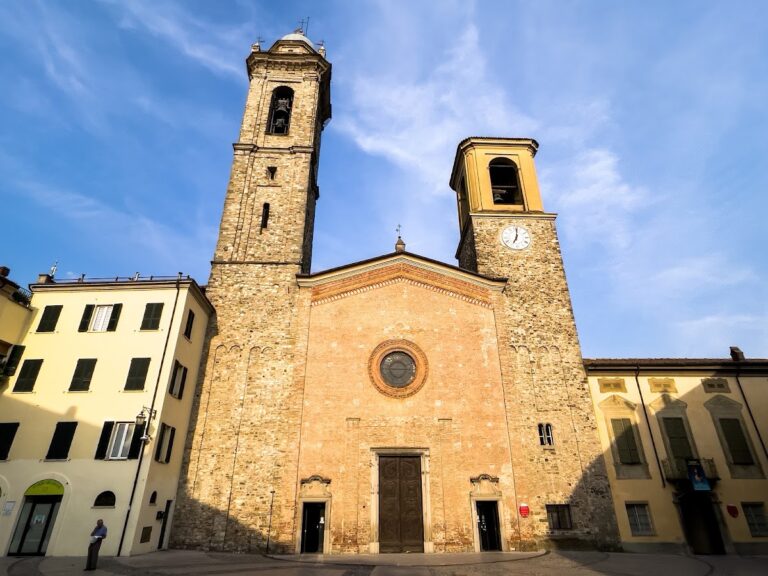
The basilica is a Renaissance church with a Latin-cross plan, a central nave, two aisles, a transept, and a rectangular apse set asymmetrically at the eastern end. Built between 1456 and 1522 over a conventual church dating from before 1000, it retains a late-ninth-century square bell tower on the left side of the presbytery. The tower is built of exposed stone and belonged to the earlier Romanesque complex before being heightened during the rebuilding of the late fifteenth century.
The apse was constructed between 1456 and 1485, replacing an oval predecessor, and is structurally distinct from the rest of the church. Inside, the nave, aisles, and transept carry frescoes painted by Bernardino Lanzani and an assistant around 1527–1530. Biblical quotations form an important part of the decoration, with John 6:63 receiving particular emphasis. The central vault includes a Noli me tangere scene showing Mary Magdalene at the feet of the risen Christ, drawing in part on works by Albrecht Dürer.
The choir and lectern are Gothic wooden works with coloured inlay, made in 1488 by the friar Domenico of Piacenza. A modern altar stands with the old choir and organ. Above the entrance portal, beneath the portico known as the Paradiso, the inscription Terribilis est locus iste presents the church as a sacred place that must not be profaned. A baptismal basin stands just inside the church on the left. Tradition attributes it to Queen Theodelinda’s gift to Columbanus, while its date is placed either in the seventh or ninth century; it was formerly kept in the crypt.
Crypt, burials, and earlier church
The fifteenth-century crypt lies beneath the presbyteral area. At its centre is the marble sarcophagus of Saint Columbanus, made in 1480 by Giovanni dei Patriarchis of Argegno. The sarcophagi of Saint Attala and Saint Bertulf stand against the walls. Columbanus’s coffin was commissioned by the Benedictines when they transferred the relics and bodies after taking responsibility for the basilica in 1448. A rear section added in 1909 bears inscriptions and the arms of Bobbio and Ireland. Twentieth-century work removed the former polychromy from the reliefs.
The sarcophagus shows Columbanus reclining in episcopal vestments, with a mitre and pastoral staff. His feet rest on a book bearing a Latin inscription. Longobard marble chancel screens were reused as slabs over the burials of abbots. The crypt also contains a wrought-iron screen dated between the ninth and twelfth centuries, originally dividing the area for the faithful from that reserved for the monks. The chapel of Saint Stephen includes a life-sized white statue of the saint and an old fresco of the Madonna of Help.
The earlier Carolingian-Romanesque basilica had three aisles and a transept no wider than the main body of the church. Its raised central presbytery contained a lowered stone-and-brick arch and a blocked rose window, with the crypt beneath. A circular apse closed the church, and part of its outer masonry survives beside the present rectangular apse. The shorter side aisles ended in two smaller, irregular apses.
Archaeological remains and pavement mosaic
Excavation and restoration after 1910, with work in the presbyteral area directed by Cecilio Arpesani, recovered and repaired the crypt, the Longobard tombs, and Columbanus’s marble sarcophagus. Excavation from the transept toward the earlier Romanesque structure revealed a medieval pavement mosaic. The visible mosaic belongs to a twelfth-century cycle from the Romanesque church and is arranged in four superimposed registers.
The registers represent episodes from the Second and Third Books of the Maccabees, battles involving fantastic creatures such as a centaur, chimera, dragon, and monstrous man, and cycles of the months with the occupations associated with them. The Torre del Comune, recorded as built in 1341, was demolished in 1532.
Monastic rooms and collections
The Abbey Museum occupies the former scriptorium and library area and contains archaeological remains from the first centuries of Christianity through the mid-sixteenth century. Its displays include Roman-period tombs, altars, and sculptures, as well as Lombard capitals and tombstones. The museum also houses a polyptych by Bernardino Luini and sixth-century Monza ampullae, small pilgrimage flasks used for holy water or consecrated oil.
The Museum of the City occupies original ninth-century monastic rooms, including the refectory, kitchens, lavatory, internal court, and underground spaces. A large Crucifixion fresco attributed to Bernardino Lanzani occupies the former refectory. The cellars contain a large barrel-vaulted wine cellar and an icehouse.
Above the old library and scriptorium, the former monastic rooms display the Mazzolini Collection. It contains nearly 900 modern and contemporary works, including approximately 872 paintings and 27 sculptures, donated to the Diocese of Piacenza-Bobbio by Domenica Rosa Mazzolini. The surviving monastic spaces therefore preserve both the physical organization of the abbey and later uses of its rooms.
Library and manuscript heritage
The library probably began with a small group of manuscripts brought by Columbanus from Ireland and with his own writings. Its catalogue and surviving works reflect the breadth of learning developed at Bobbio, from theology to secular scholarship. The collection was progressively dispersed: Cardinal Federico Borromeo transferred 86 volumes to the Ambrosian Library in Milan in 1616, 26 went to Pope Paul V for the Vatican Library in 1618, and many others were sent to Turin. Seventy-one volumes remained in the University Library there until the fire of 26 January 1904.
Bobbio’s medieval library later contributed to the setting of the monastery in Umberto Eco’s novel The Name of the Rose. The former scriptorium area, now occupied by the Abbey Museum, preserves the connection between the surviving architecture and the intellectual activities that once made the monastery an important centre of European learning.
Nearby sites