Dolmen D12: A Funnel Beaker Passage Grave in Drenthe, Netherlands
Site at a Glance
- Popularity
- Very Low
- Country
- Netherlands
- Primary era
- Stone Age
- Eras represented
- Stone Age
- Civilizations
- Unclassified
- Site type
- Burial
- Remains
- Tomb
On this page8 sections
History
Dolmen D12 is a megalithic tomb near Eext in Drenthe, the Netherlands, associated with the Western Group of the Funnel Beaker culture and dated to 3470–2760 BC. The Funnel Beaker culture was a Neolithic archaeological culture named for its distinctive pottery; the Western Group is a regional classification within it.
Early Records
Johannes van Lier, an eighteenth-century Dutch antiquarian, first mentioned and investigated the tomb in 1756. In 1874, Willem Pleyte and photographer Jan Goedeljee travelled through Drenthe, systematically photographing its megalithic tombs. Pleyte later made lithographs from their photographs.
Conrad Leemans made a separate journey through Drenthe in 1877. Jan Ernst Henric Hooft van Iddekinge, who had earlier travelled there with Pleyte, prepared plans of the tombs for Leemans, whose report was not published. Between 1904 and 1906, physician and amateur archaeologist Willem Johannes de Wilde created plans, photographs, and detailed descriptions of the Netherlands’ surviving megalithic tombs, including D12.
Archaeological Study and Protection
Albert Egges van Giffen recorded D12 in 1918 and undertook an archaeological investigation and restoration in 1952. The tomb became a Dutch National Monument in 1978, a status that provides national heritage protection. In 2017, the Gratama Foundation, the Province of Drenthe, and the University of Groningen created a 3D photographic record of the tomb for an atlas.
Remains
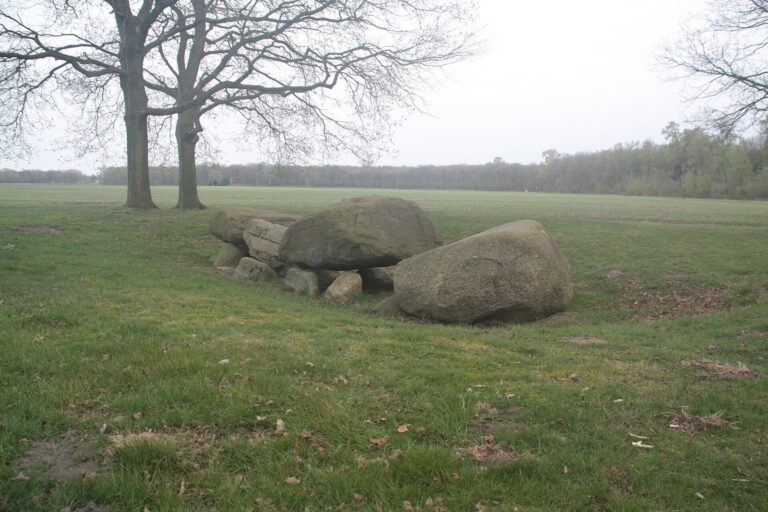
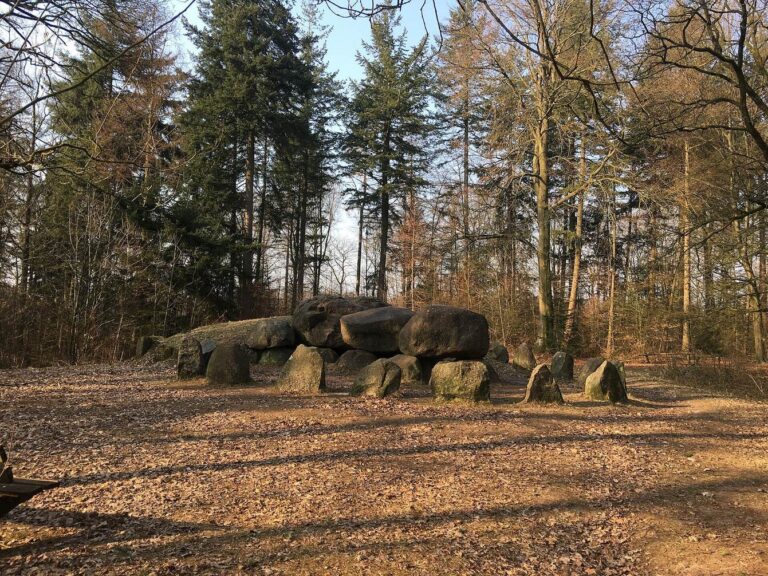
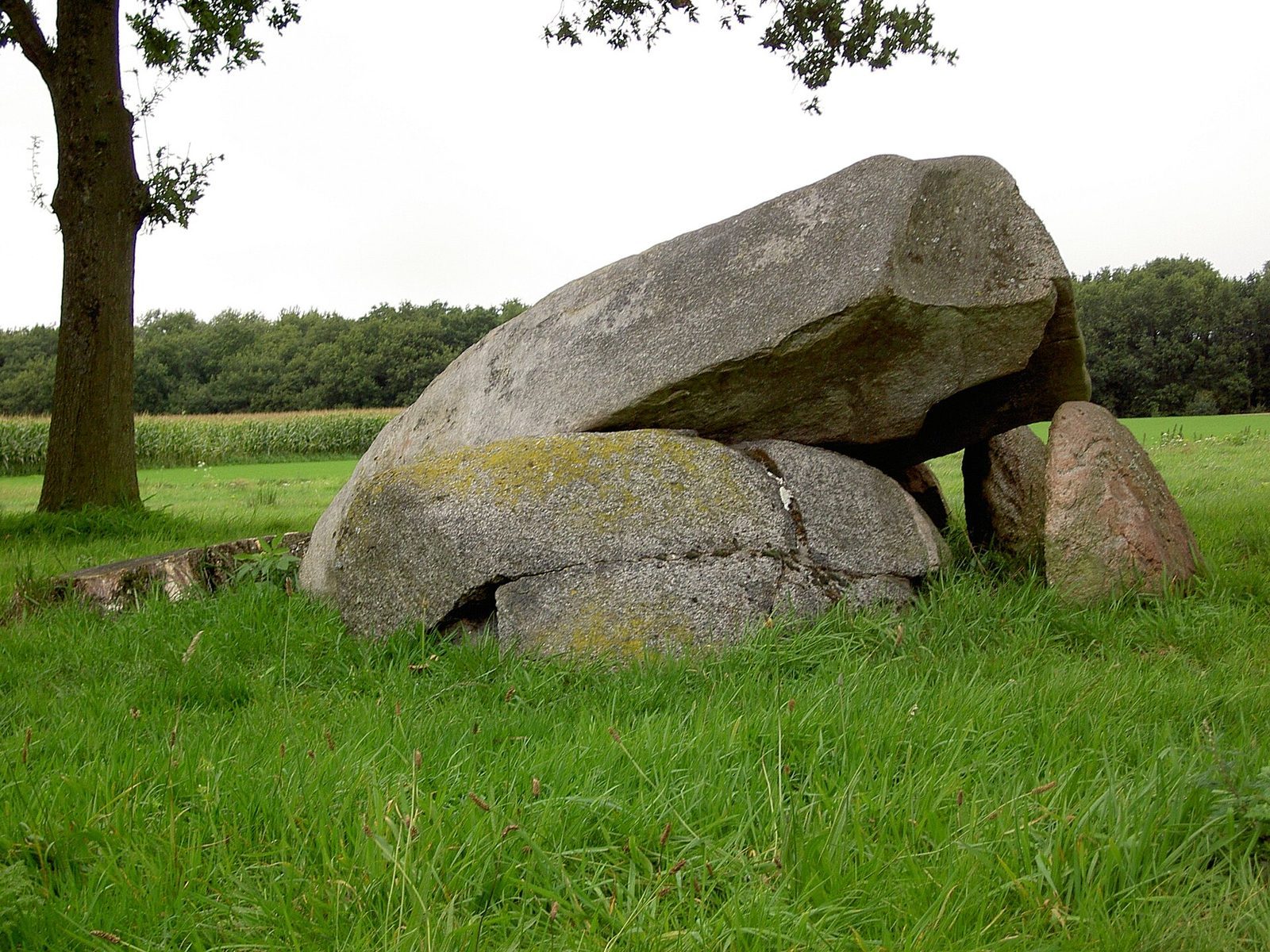
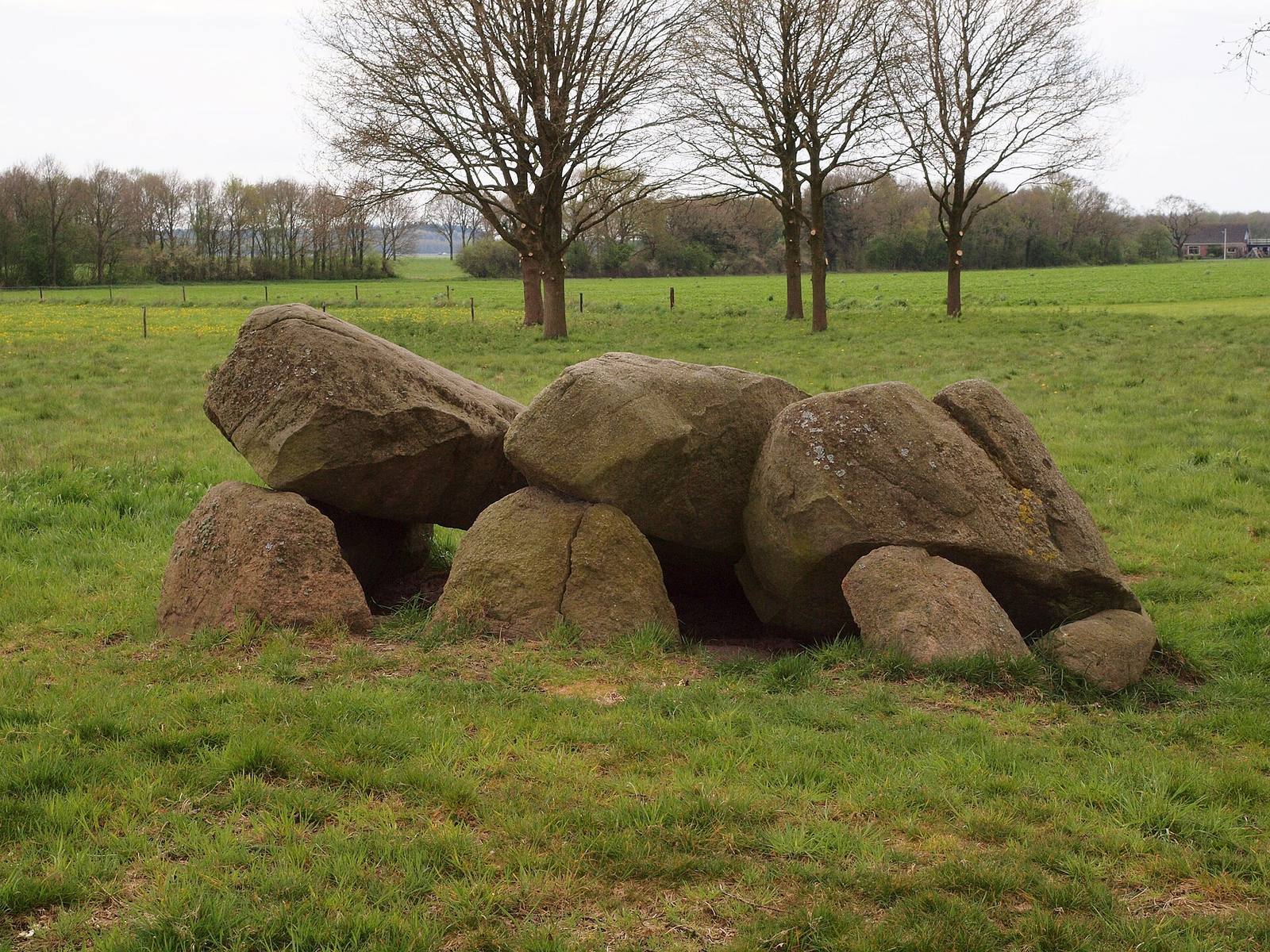
D12 is a poorly preserved passage grave, a megalithic tomb in which a passage leads to a burial chamber. It lies on the Kamp Akkers agricultural field and is aligned from south-southeast to west-northwest.
Tomb Structure and Finds
Burial Chamber
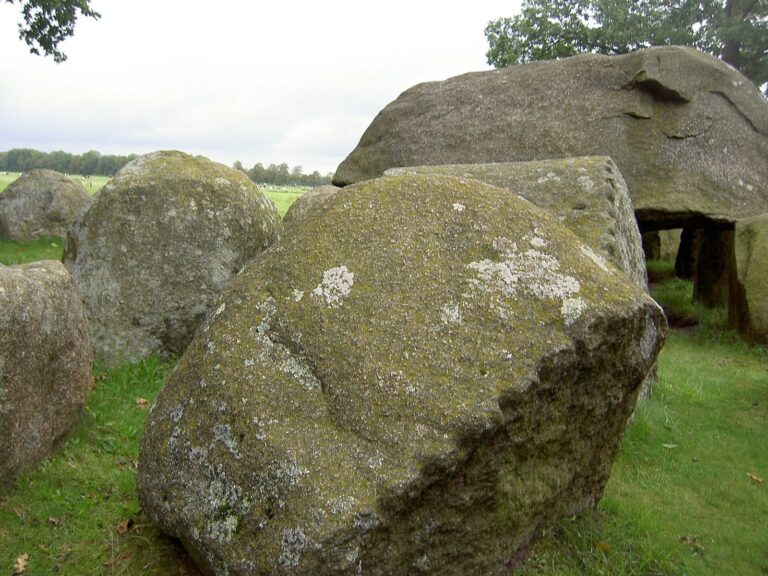
The chamber measures 6.8 metres long and 2.8 metres wide. Its original arrangement comprised four pairs of wall stones along the long sides, an end stone at each short end, and four capstones. The southern end stone and three adjoining stones on the eastern side remain, with three capstones resting on the eastern stones. Several stones are broken. Seven cup marks appear on one capstone, five in a row.
Entrance and Passage
The entrance was on the western side, between the first and second wall stones from the south. Two wall stones formed a passage extending from it, and concrete now fills the ground traces left by the wall and passage stones.
Objects and Site Features
Van Lier found several ceramic vessels, which he described as urns placed upside down. A drawing he made of a collar-neck bottle appears in illustrations dated 1760. A bottle of this type from D12, dating to the Funnel Beaker period, is held at the Rijksmuseum van Oudheden, the Netherlands’ national antiquities museum in Leiden. A flint axe and a medieval ceramic cup in the same collection may come from D12 or the nearby tomb D13. A tree once stood against the tomb and was cut down at ground level.