Lammi Church: A Late-Medieval Stone Church in Finland
Site at a Glance
- Popularity
- Medium
- Country
- Finland
- Primary era
- Medieval
- Eras represented
- Medieval, Modern
- Civilizations
- Swedish
- Site type
- Religious
- Remains
- Church
On this page12 sections
History
Lammi Church, also known as the Church of St. Catherine, is a medieval stone church in Lammi, Finland, built in the 1510s in a late-medieval transitional style. Dedicated to Catherine of Alexandria, a Christian saint and martyr, it belongs to the Evangelical Lutheran Church of Finland and the Diocese of Tampere, an administrative district within the church hierarchy. The church is recognized as a nationally valuable cultural environment.
Construction and the Reformation
The church’s design is attributed to an unidentified master, based on strong similarities to the churches at Hollola and Vanaja. During the Reformation, a 16th-century movement that reshaped Western Christianity, the Crown, meaning the monarch’s governing authority, confiscated church property. This prevented the planned ceiling vaults from being completed.
Disaster and fire
During Christmas services in 1813, a candle fell and caused panic, but no fire broke out. As people pressed toward doors that opened inward, ten were trampled to death. The disaster was later considered one reason public-building doors came to open outward, a practice that continues in Finland.
On 29 April 1918, near the end of the Finnish Civil War, fought that year between Red and White forces, the church and its adjacent bell tower burned. Red forces had stored weapons in the tower. As the German Baltic Sea Division, a German military formation that intervened in Finland, advanced, the defenders began burying the weapons. With too little time to finish, they set the tower alight, and the fire spread to the church. It destroyed a pulpit carved in the 1690s, a medieval bell and part of the parish archive.
Rebuilding and later changes
Architect Usko Nyström designed the rebuilding, and the church returned to use at midsummer 1920. In the 1920s, someone painted the date 1444 on an interior wall. It came from pastoral notes published by Bishop Otto Immanuel Colliander and is not the church’s construction date. Art historian Eija Ruske later described the rebuilt interior as one of Finland’s most original, contrasting it with the relatively unremarkable hall that had preceded the fire.
The Kangasala Organ Factory organ was installed in 1967. Architect Virpi Tervonen designed a renovation completed in 2002.
Remains
Medieval fabric and setting
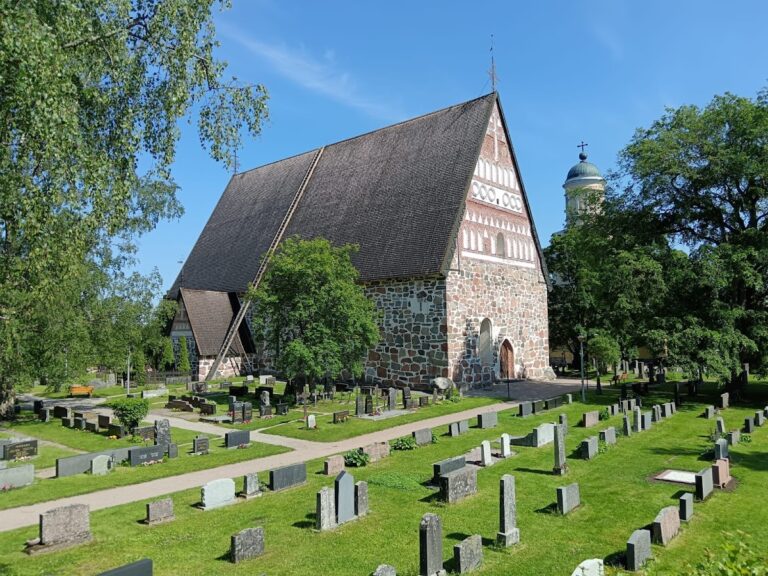
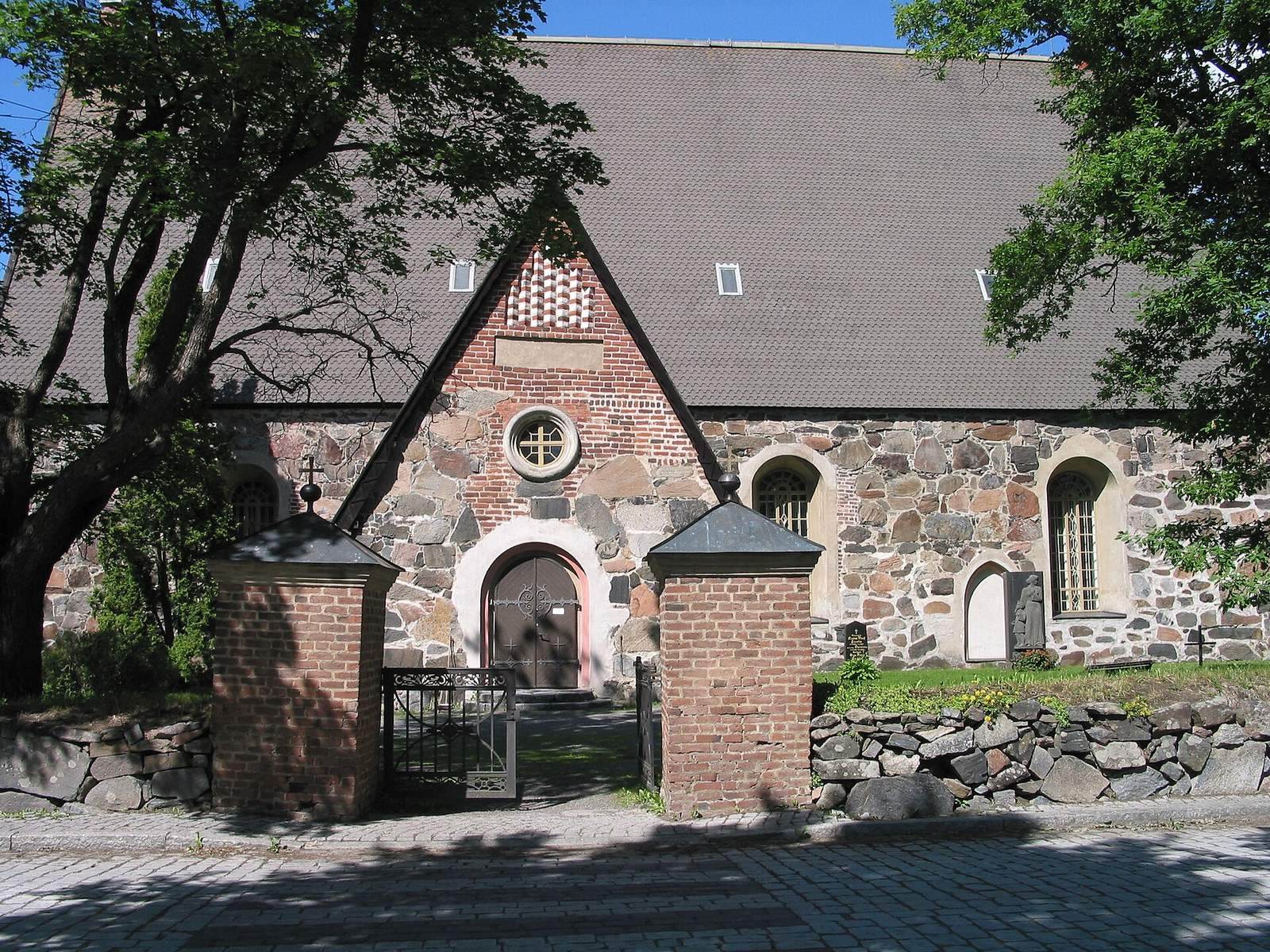
The grey-stone church stands in the centre of Lammi’s church village and seats about 500 people. Its exterior retains a medieval character, while the interior reflects 1920s design. The gables have varied decorative brickwork, and a large round Gothic window occupies the west gable. Two millstones are embedded in its wall. Local tradition says giants stole them from travellers who had stopped to rest and water their horses while the church was being built. A more likely explanation is that someone brought the stones to the site as part of a day’s work. A sacristy, a room where clergy prepare for services, forms part of the church, and its gable is another feature of the building.
Interior and furnishings
Before the 1918 fire
The earlier interior had a decorative wooden barrel vault, a continuous, tunnel-shaped ceiling, and raised galleries along both long sides. In the 1890 remodelling, galleries were added along the north and south walls and rested on numerous pillars. The crowded supports drew criticism as a “forest of pillars,” while the dark colour scheme made the interior seem gloomy and cramped. The main altar stood at the east end, with side altars also inside the church.
Rebuilt interior
The rebuilt church has four concrete ceiling structures that rise higher than the earlier vaulting and extend down to the floor. Its concrete gallery has no supporting pillars. Bruno Tuukkanen designed and partly painted the wall and ceiling decoration, with assistance from B. Liukko and I. Grönvall; the scheme uses vivid colours. Sculptor Johan Friedl carved the crucifix, wooden altar decorations, a three-part artwork, seven-branched candlesticks and the pulpit. The local Nyberg workshop made the pulpit as well as the wooden altar, altar rail, benches and hymn board.
The wooden furnishings include a rare modern altar cabinet carved in a medieval style. It was probably first intended for St. John’s Church in Helsinki, but the Lammi congregation was able to buy it.
Bell tower and organ
Bell tower
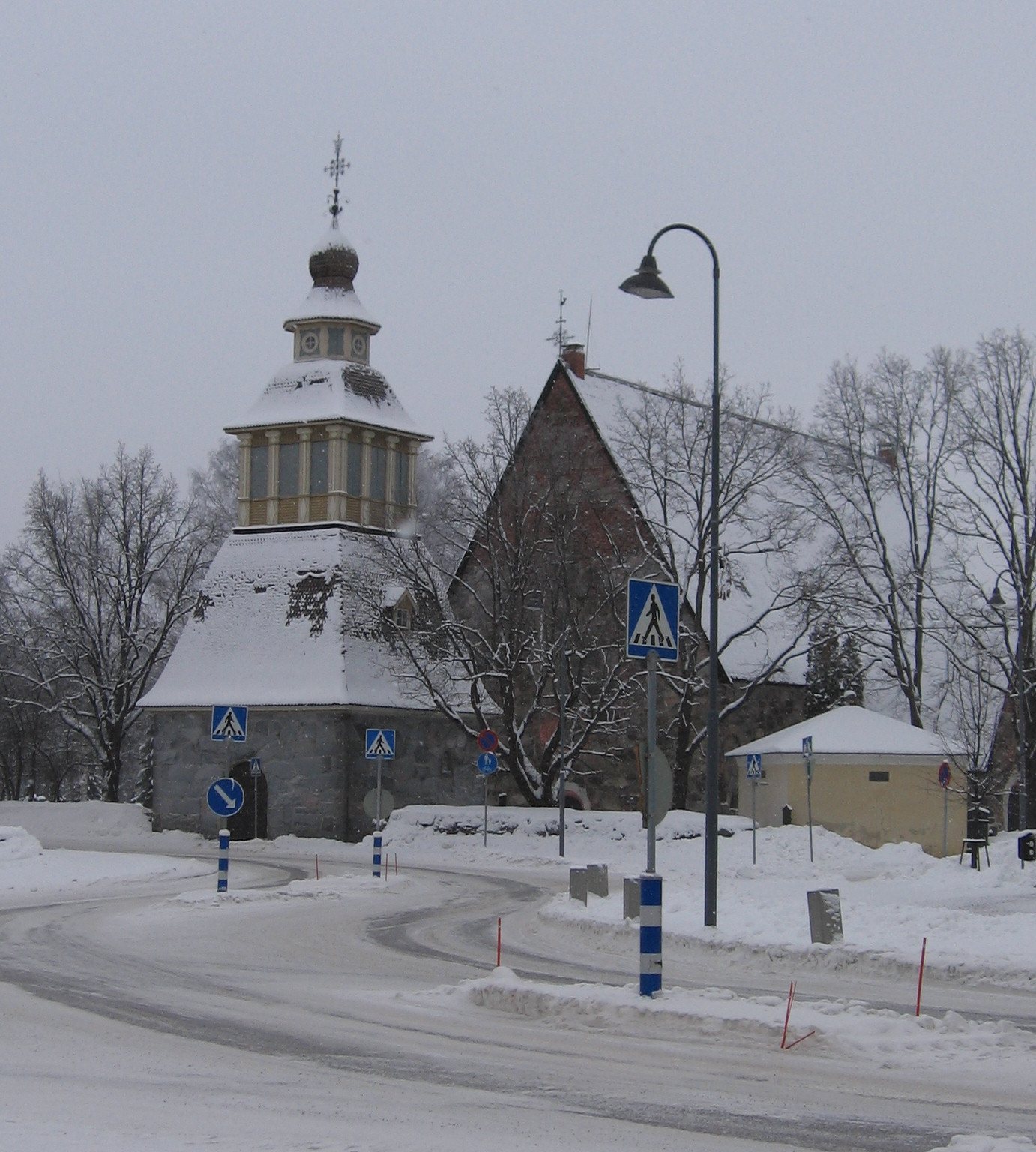
The replacement bell tower is built entirely of stone and has a wooden-shingle roof. The replacement bells were donated by the Finnish state and came from the military church at Papula Barracks in Viipuri.
Organ
The church organ has 28 stops, each controlling a set of pipes with a particular tone.