Tomb of Züschen: A Late Neolithic Gallery Grave in Germany
Site at a Glance
- Popularity
- Medium
- Country
- Germany
- Primary era
- Stone Age
- Eras represented
- Stone Age, Modern
- Civilizations
- Unclassified
- Site type
- Burial
- Remains
- Tomb
On this page13 sections
History
The Tomb of Züschen is a gallery grave, a long stone burial chamber, in a field between the Fritzlar districts of Züschen and Lohne in Germany. Communities of the Wartberg culture, a central German culture of the Late Neolithic (the later phase of the New Stone Age), built it. The tomb is dated broadly to 3500–2800 BCE, with an approximate date of 3250 BCE; it may have remained in use into the early third millennium BCE. It is also classified as a Hessian-Westphalian stone cist, a regional term for this kind of stone-built tomb, and is regarded as one of Central Europe’s most important examples of the type. Its engraved imagery is exceptional among Wartberg tombs, with comparable carvings also known at Warburg I.
Use and later disturbance
A burial from the later Urnfield period, named for cemeteries where cremated remains were placed in urns, lay above the tomb’s earlier deposits. This indicates that the chamber had been disturbed, its contents displaced and its roof removed before the tenth or ninth century BCE. That later burial belongs to a separate phase, not to the tomb’s original use.
The surrounding tomb group
The Tomb of Züschen belongs to a local cluster of four gallery graves named for Züschen. Züschen II, 150 metres northwest, was smaller and undecorated; it was already destroyed when found in 1894. Züschen III, 2.5 kilometres east, had been destroyed by about 1900. Züschen IV, 400 metres east, was discovered in 1966 and excavated. All except Züschen II lie within the Lohne district. The four graves, together with those at Altendorf, Gleichen and Lautarius, form the Züschener group.
Discovery and excavation
The tomb came to light by chance in 1894. For years, sandstone slabs had hindered the local miller Schmalz as he ploughed. He moved them and had the upper edges of some slabs cut down. When further removal was proposed, Rudolf Gelpke, an inspector at Garvensburg, recognized that the parallel rows of stone might be prehistoric. He first, mistakenly, attributed them to the Chatti, an Iron Age people associated with central Germany. After Gelpke persuaded the field’s owner to expose only the ends of the rows, workers found bones and pottery fragments.
Wilhelm Garvens, the owner of Garvensburg, notified the antiquarian Baron Felix von und zu Gilsa. After Gilsa inspected the site, Johannes Boehlau, formerly director of the State Museums in Kassel, supervised its excavation. The nearby remains of Züschen II were also investigated in 1894.
Further study and conservation
Otto Uenze began new investigations of Züschen I and II in 1939. The Second World War halted the work, which he resumed in 1949, concentrating particularly on material discarded during the first excavation. He published his findings in 1958. Hans Heintel identified further engraved stones in the 1960s. In 1974, Emmanuel Anati led a project to record the carvings comprehensively; he later published a study with Mário Varela Gomes in 2013. Kerstin Schierhold’s 2012 dissertation brought together finds from the tomb.
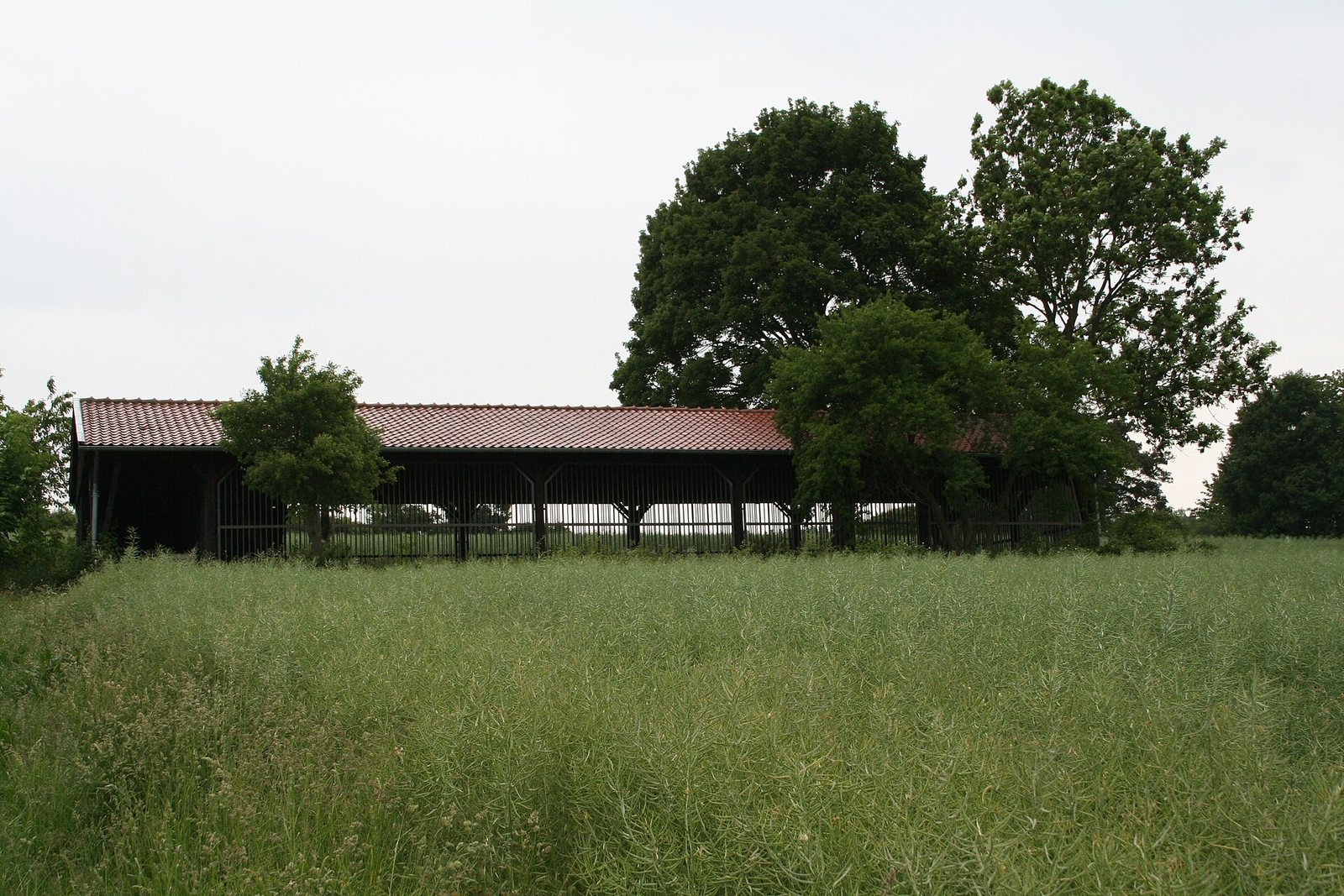
Renovation and the construction of a protective structure followed in 1986. Later projects created detailed three-dimensional records: all the slabs were scanned using projected light in 2005; a ground-based laser survey and further scans of individual stones followed in 2015. In 2020, a drone survey produced a digital elevation map, while laser scanning and photographs were used to record the tomb and its individual slabs. The resulting scans were published in 2021.
Remains
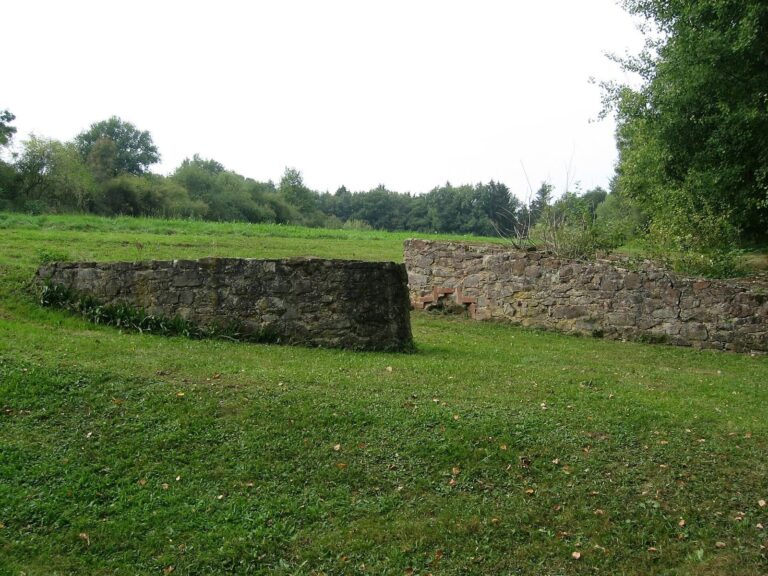
The surviving structure consists of a long, sunken chamber and a smaller antechamber at one end. Rectangular sandstone slabs form its walls. The tomb stands across the gentle southeast slope of the field, and its long axis points roughly toward the Wartberg landscape.
Chamber and stonework
Burial chamber
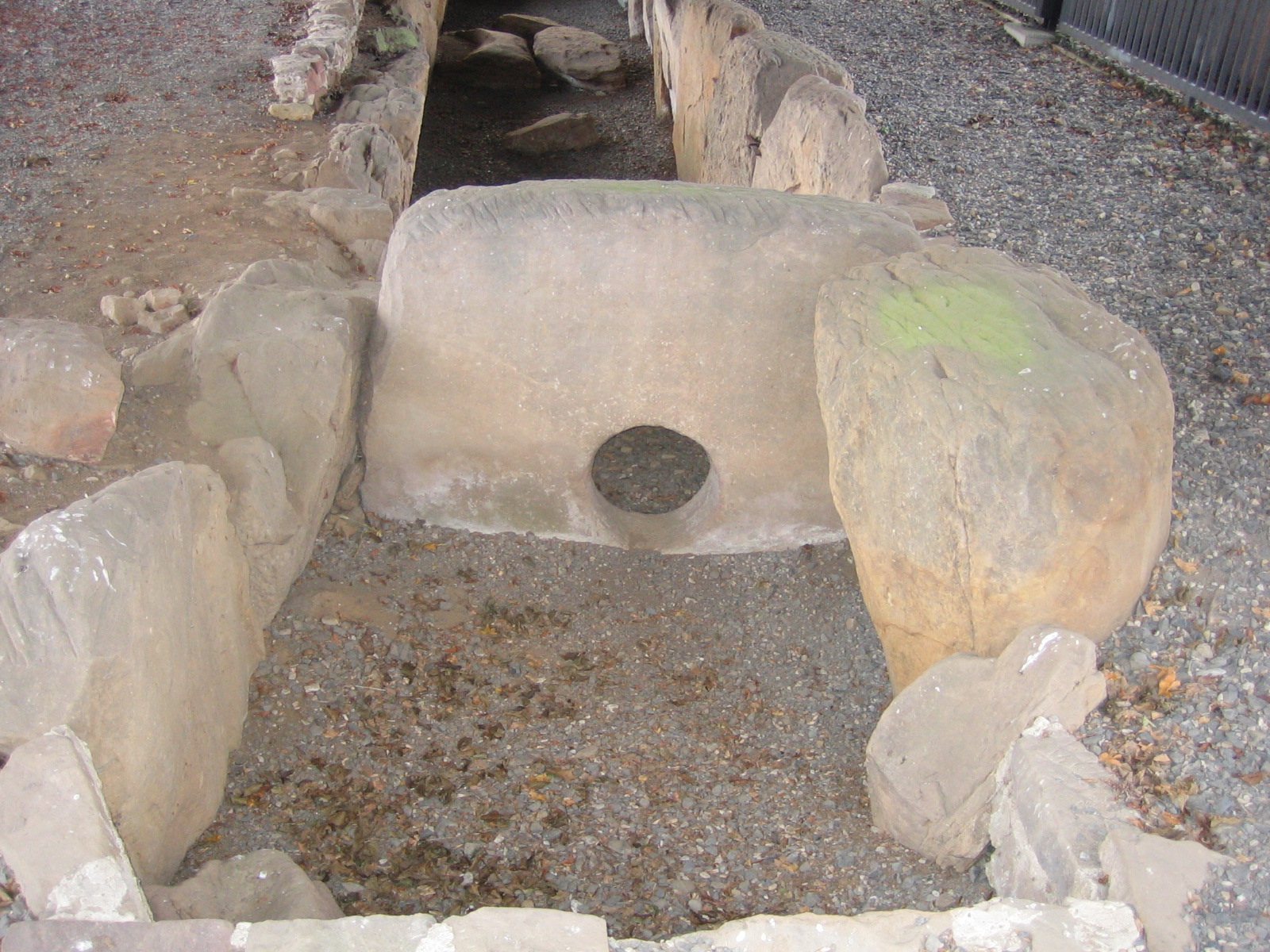
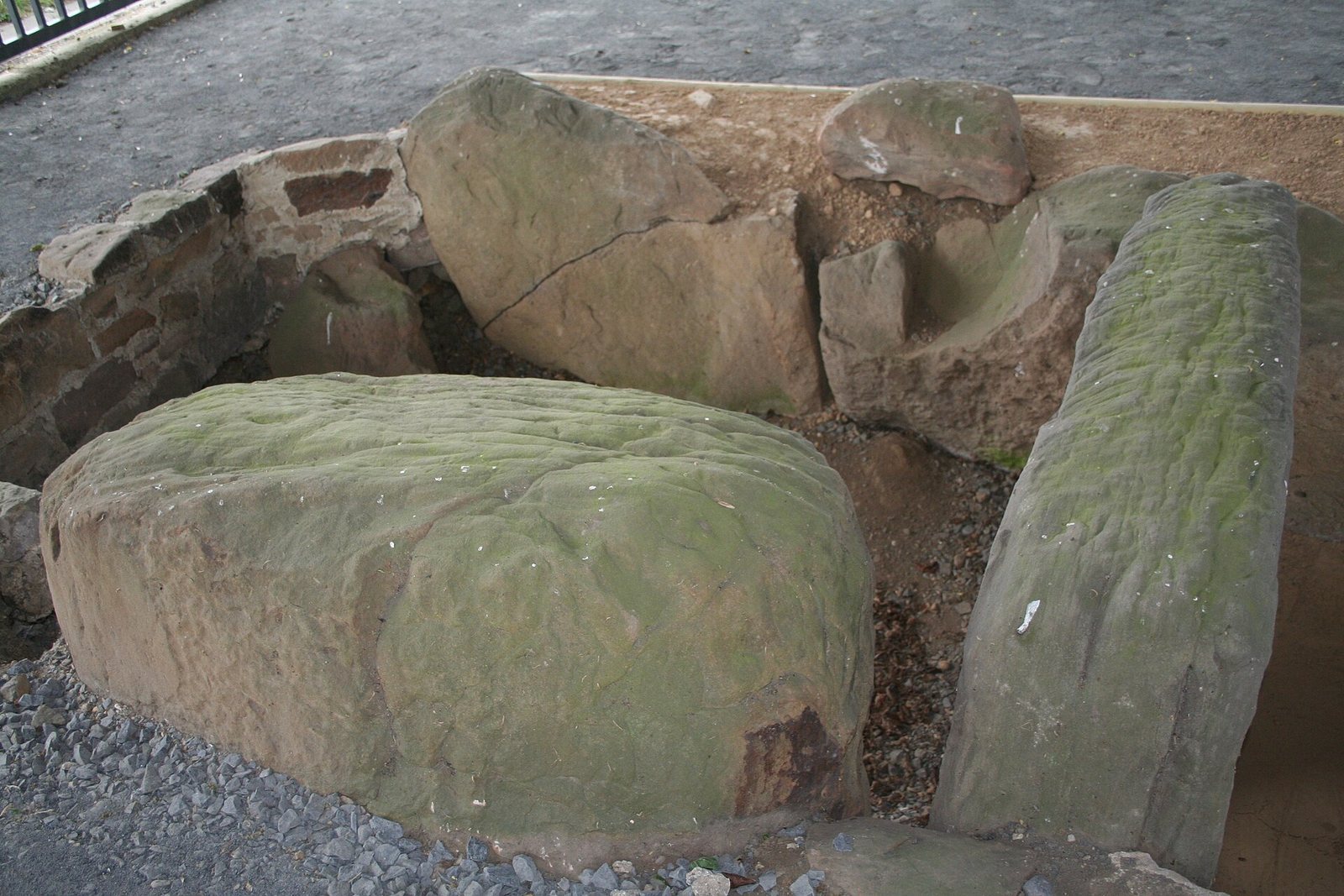
The rectangular chamber measures 20 metres long and 3.5 metres wide. Each long wall was made from a row of twelve slabs, with one slab missing; a single slab formed each short end. Twenty-five slabs were examined. The sandstone came from the Wilhelmshausen beds, geological layers exposed about 1.3 kilometres north and one kilometre south of the tomb. The northern outcrop is considered the likelier source, despite being farther away, because the route from it is less steep. The stone splits naturally along vertical and horizontal joints, and its relatively soft, sandy surface could be shaped with Neolithic tools.
Antechamber and opening
An end slab divides the main chamber from an antechamber 2.5 metres long. Its central circular opening, 50 centimetres across, is known as a “soul hole.” It may have served as an entrance and as a symbolic boundary between the dead in the chamber and living participants making offerings or carrying out other rites in the antechamber. The antechamber floor is made of firmly trampled clay. A slab fragment found inside indicates that the tomb once had an overhead covering, though its material is uncertain. Non-local stones outside the chamber suggest that an artificial mound may have covered the structure.
Burials and associated finds
Human remains and deposits
Disarticulated human bones were mixed through the chamber fill, while 27 skeletal remains were identified at the base. They were not in anatomical order, so the original number of burials may have been considerably greater. Charcoal and ash occurred at several points, especially beside bones near the end slabs. A continuous ash layer lay in the centre of the antechamber.
Objects from the tomb
Finds include cattle bones, flint blades used as knives, flint inserts for sickles and small trapezoidal axes made from Wieda slate. Bone tools comprised a chisel, a point and an arrowhead. Pottery included a clay cup, a cup fragment comparable to one from the Lohra tomb and a collared bottle associated with the northern Funnel Beaker culture, a Neolithic cultural complex named for its characteristic pottery. The bottle may have held vegetable oils or sulphur used for healing. A vessel known as a Giant Beaker probably belonged to a later burial.
Engraved imagery
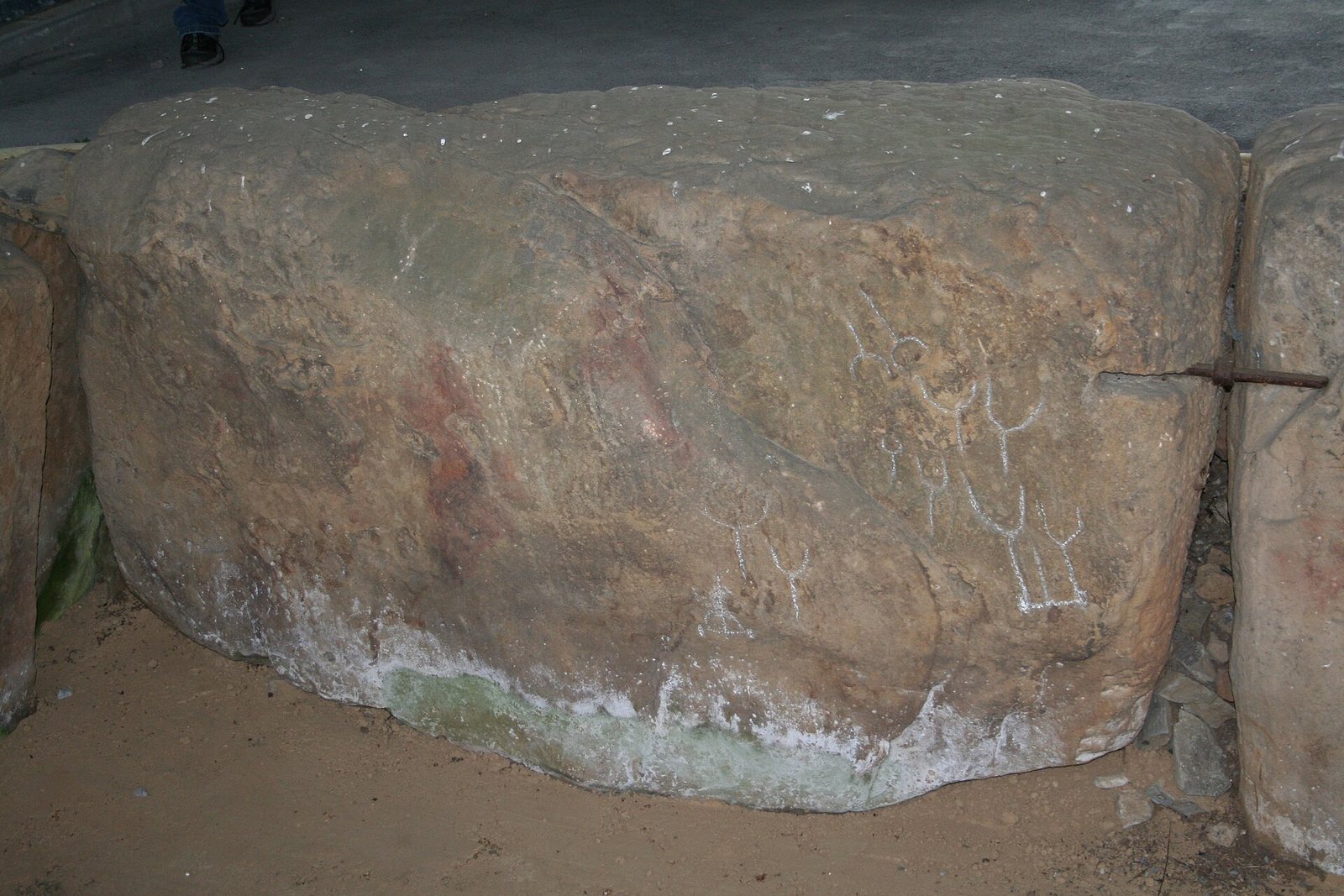
Signs on slabs inside the chamber were made by punching lines of dots into the stone, possibly with an early metal tool. A recurring design, a line joined to an open semicircle, is usually interpreted as cattle. In some cases, two such designs are linked by a line with emphasized ends, possibly representing a plough. Rarer signs showing a yoke and pole may depict carts. Overlapping marks suggest that at least some images were added separately rather than planned as one composition. If the cart interpretation is correct, the carvings may include one of the earliest depictions of a wheeled vehicle.
A face carved on slab B2 has been interpreted, by comparison with French images, as a “Great Goddess” or “Dolmen Goddess” associated with a cattle-drawn wagon. More broadly, the engravings have been linked to Neolithic religious ideas. Depictions of cattle teams from much later periods are known at Valcamonica in northern Italy and at Mont Bégo in the French Ligurian Alps. A reconstruction of the tomb is displayed at the Hessian State Museum in Kassel.