Dolmen D42: A Neolithic Passage Tomb in the Netherlands
Site at a Glance
- Popularity
- Very Low
- Country
- Netherlands
- Primary era
- Stone Age
- Eras represented
- Stone Age
- Civilizations
- Unclassified
- Site type
- Burial
- Remains
- Tomb
On this page6 sections
History
Dolmen D42 is a passage grave, a burial chamber reached through a passage, near Emmen in the Netherlands. Its construction dates to approximately 3470–2760 BC, and it is attributed to the western group of the Funnel Beaker culture, a Neolithic culture named for pottery with funnel-shaped necks.
Early records and surveys
The tomb appears on the Hottinger map of 1788–1792. In 1847, Leonhardt Johannes Friedrich Janssen, curator of the National Museum of Antiquities, visited it and included a description and schematic plan in his 1848 overview of Dutch megalithic tombs. The Dutch state purchased D42 from K. Ensink and associates in 1871.
In 1874, Willem Pleyte and photographer Jan Goedeljee made the first systematic photographs of Drenthe’s megalithic tombs; Pleyte used the images to prepare lithographs. Museum director Conrad Leemans visited Drenthe in 1877, and Hooft van Iddekinge drew plans for him. At the suggestion of British antiquarian Augustus Wollaston Franks, William Collings Lukis and Henry Dryden surveyed 40 tombs in 1878, recording measurements, plans, sections, and watercolours. Their report was published much later, in 2015, by archaeologist Wijnand van der Sanden.
Investigation and protection
Albert Egges van Giffen documented D42 in 1918 for an atlas of Dutch megalithic tombs, then investigated and restored it in 1960. The tomb became a Dutch national monument in 1983, a status recognizing its national heritage value. In 2017, it was recorded using photogrammetry, a method of measuring from photographs, for a three-dimensional atlas of surviving Dutch megalithic tombs.
Remains
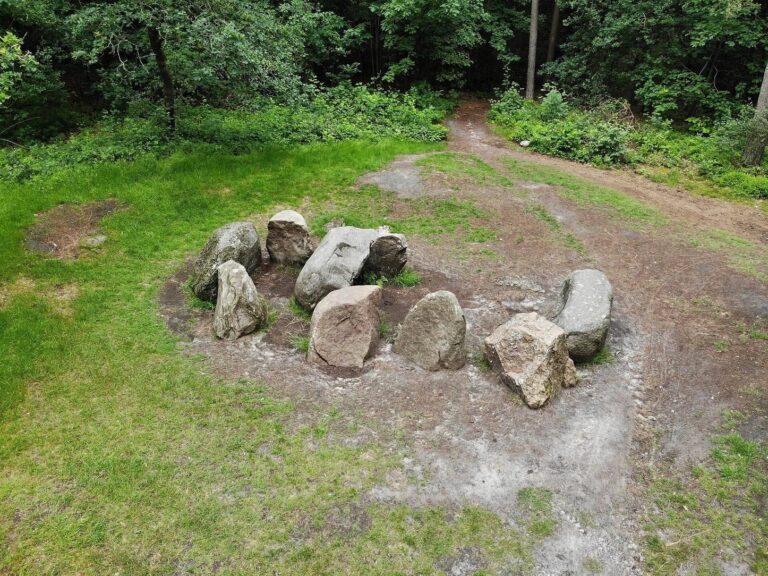
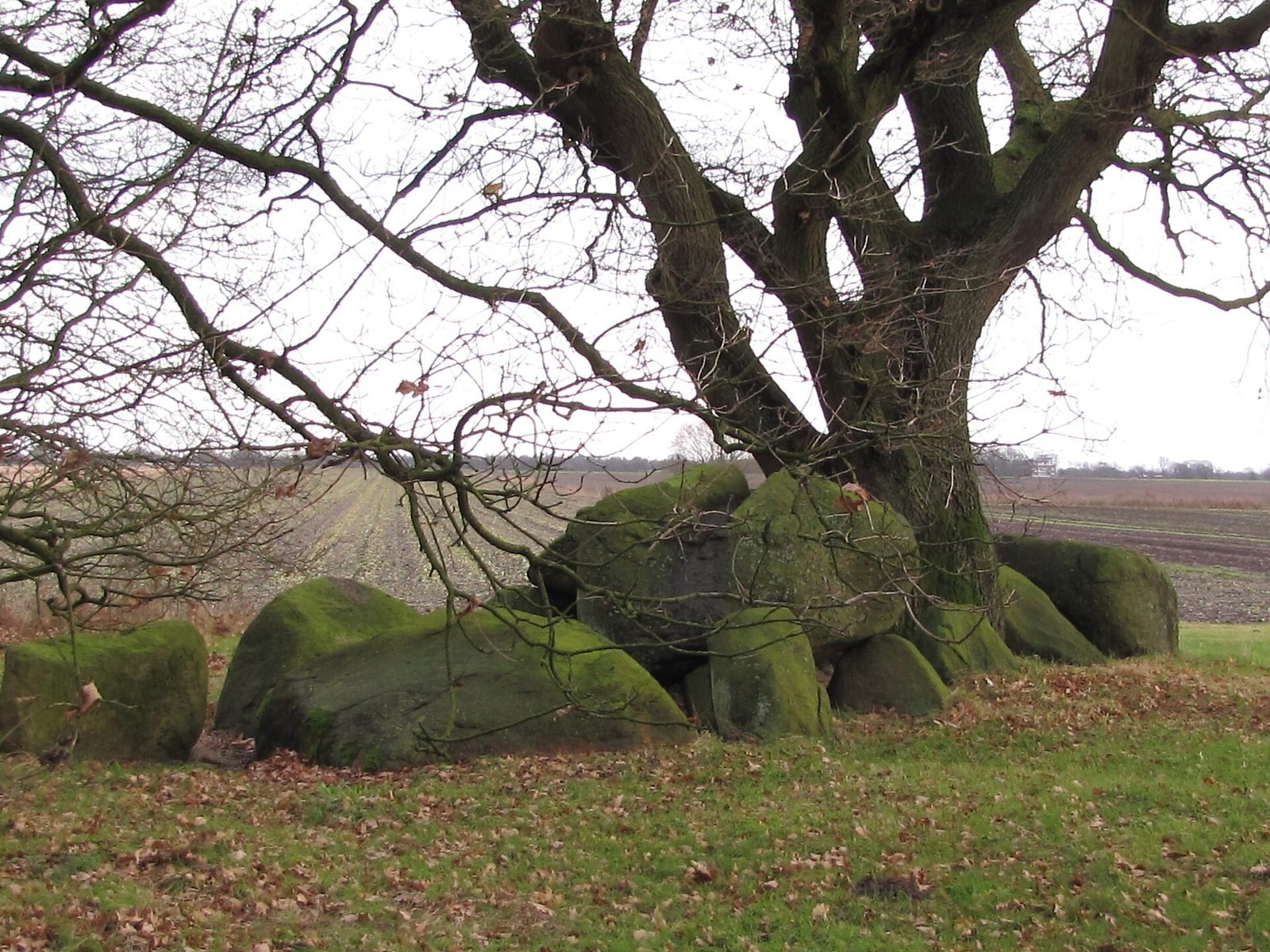
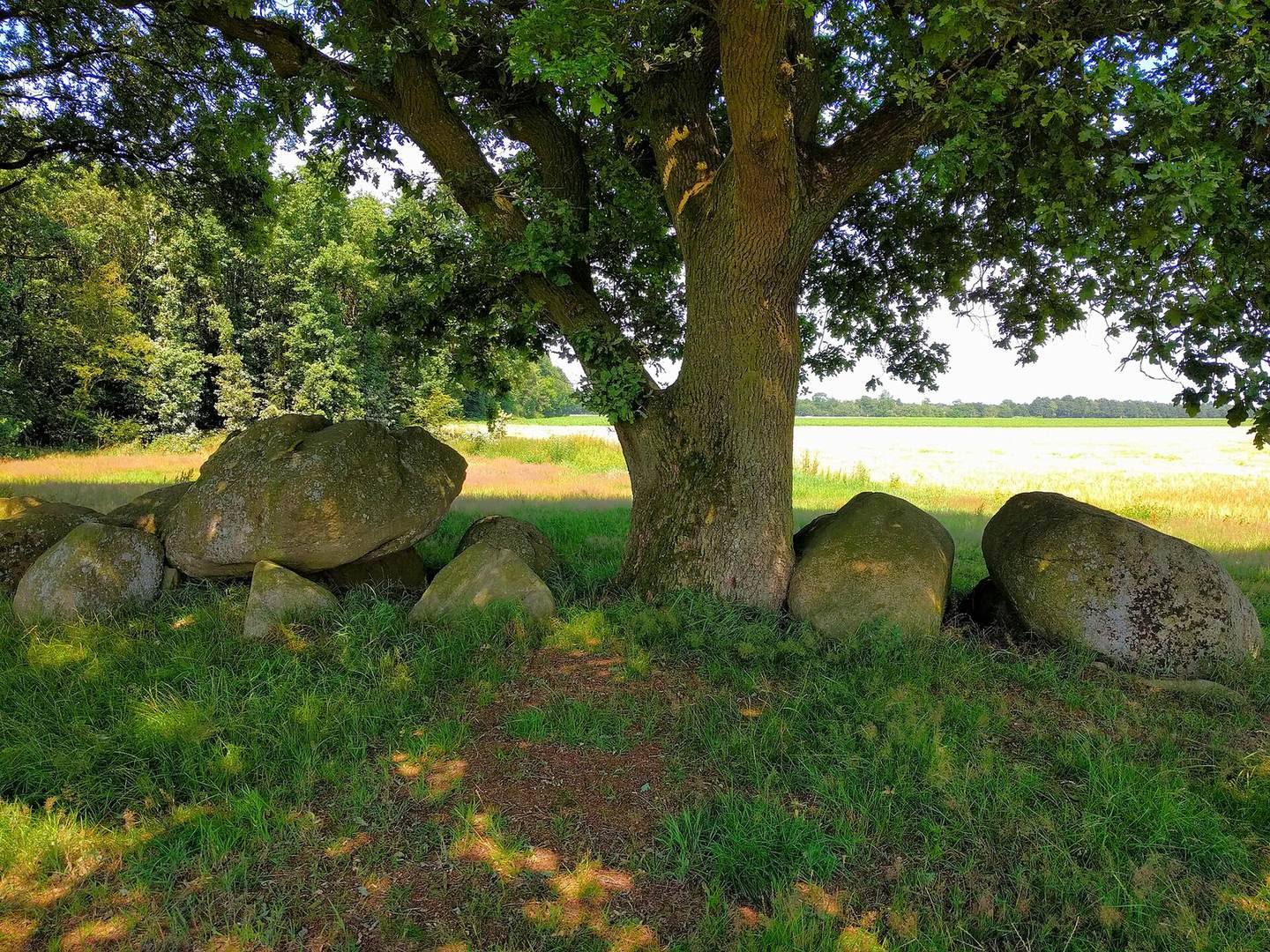
D42 stands north of Westenesch, on the western side of the Emmer or Schimmer esch, a traditional cultivated field, near Emmen. The site lies at the southeastern edge of Schietbaanbos, on a plot called Stien Camp, meaning “stone field.” The poorly preserved tomb is oriented southeast to northwest and has a stone burial chamber about 17 m long and 5 m wide. It is among the largest megalithic tombs in the Netherlands.
Burial chamber
The chamber originally had 21 wall stones along its long sides, an end stone at each short end, and capstones. A survey in 1878 recorded four capstones, one still resting on supporting stones and three fallen, as well as other displaced capstones. It also noted 11 supporting stones, traces of the covering mound, and vegetation obscuring parts of the tomb. The original number of capstones is uncertain. A heavy oak tree now grows in the middle of the tomb.
Entrance and archaeological finds
In 1965, Van Giffen examined the entrance area and exposed sockets for three pairs of entrance-side stones. This arrangement is unique among Dutch megalithic tombs. D42 yielded 2.3 g of cremated bone from one individual, whose age at death and sex could not be determined. A double-edged bronze razor, dating to the Middle Bronze Age, a subdivision of the Bronze Age, was found in soil removed during the investigation. It dates to 1400–1200 BC.