Rochlitzer Berg: A Saxon Porphyry Quarrying Landscape
Site at a Glance
- Popularity
- Medium
- Country
- Germany
- Primary era
- Modern
- Eras represented
- Modern
- Civilizations
- Kingdom of Saxony
- Site type
- Economic
- Remains
- Quarry
On this page9 sections
History
Rochlitzer Berg is a volcanic mountain southwest of Rochlitz in Saxony, Germany. Its tuff has supplied building stone across the region for nearly a thousand years, linking the mountain to local quarrying and to buildings farther afield.
Quarrying and Regional Use
As many as ten quarries operated on the mountain over time. Renaissance master builders Arnold von Westphalen and Hieronymus Lotter used its stone; Lotter employed it in Leipzig’s Old Town Hall and Augustusburg Castle. Later, it served as facing stone for Chemnitz’s Stadthalle and the Peasants’ War Panorama near Bad Frankenhausen. In the late nineteenth century, the United Porphyry Quarries took responsibility for quarrying on Rochlitzer Berg.
One quarry remains in operation, and blasting has been used there since 1991. Extraction is limited to protect nature and the landscape.
Memorials and Surveying
In 1815, quarry owner Seidel and other sponsors erected a memorial stone to mark King Frederick Augustus I of Saxony’s return from Prussian captivity. He had been captured after the Battle of Nations, a major 1813 battle at Leipzig during the Napoleonic Wars.
The Friedrich-August-Turm was built in 1860 to a design by Eduard Heuchler, a drawing teacher in Freiberg. It was dedicated to King Frederick Augustus II, who had died in an accident in 1854. During the 1860s, the tower served as Station No. 17 in the Royal Saxon triangulation network. Triangulation determines positions by measuring angles across a network of triangles; a first-order station served as a primary surveying control point.
Geological Recognition
In May 2006, the Academy of Geosciences in Hannover designated Rochlitzer Berg tuff as one of Germany’s 77 most important national geotopes. A geotope is a geological site recognized for its scientific or educational value.
Remains
Mountain and Quarries
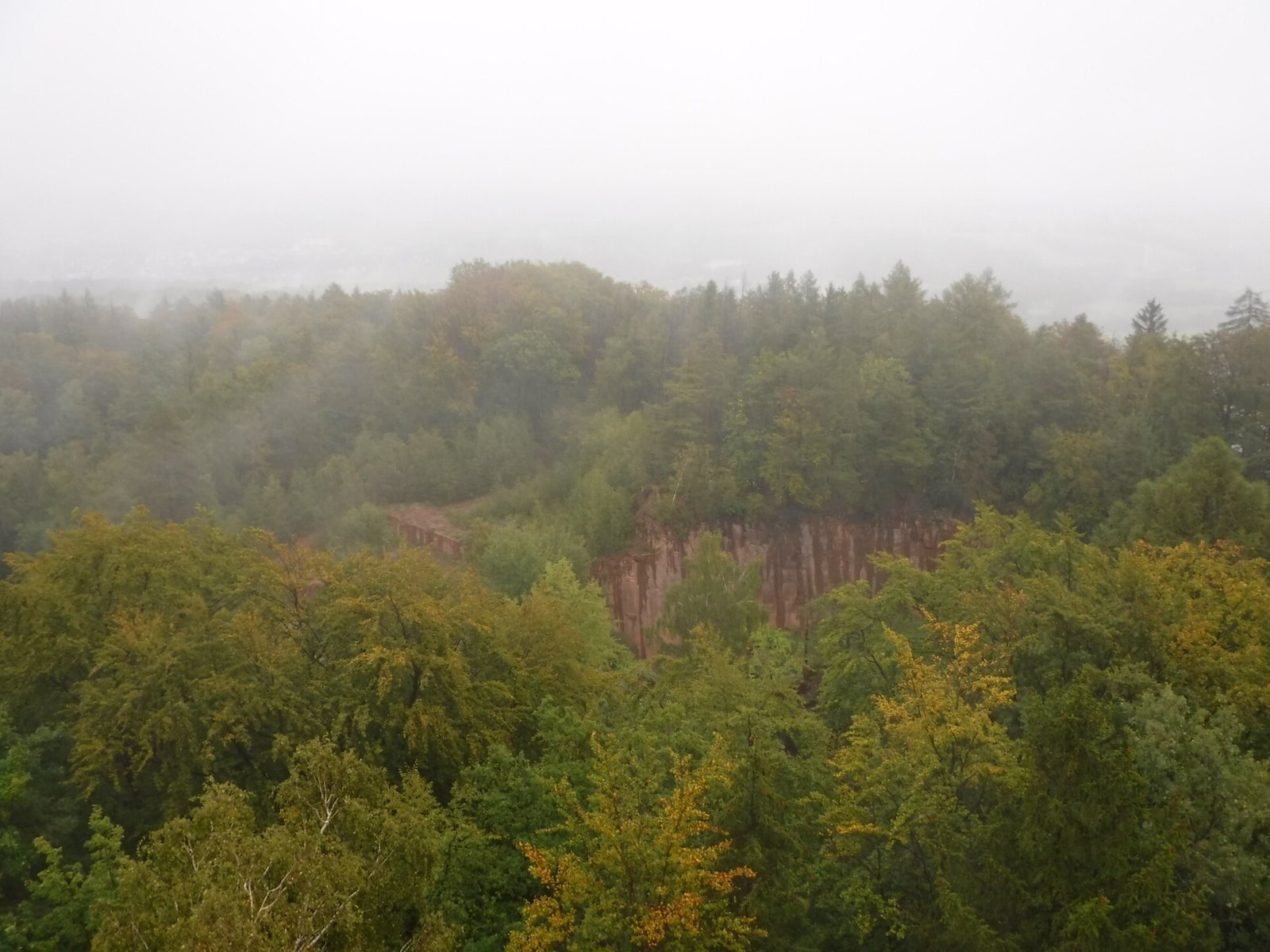
Rochlitzer Berg lies beside the Zwickauer Mulde in the Central Saxon Hills. Its reported elevation ranges from 348 to 353 metres, depending on the German height reference system used; another listing gives 349 metres. The mountain formed through volcanic activity. Its tuff developed from ash deposits and rock fragments during explosive eruptions about 250 million years ago, in the Triassic, a geological period before the Jurassic.
The stone, commonly called Rochlitzer Porphyr, is a tuff containing rhyolitic fragments. Rhyolite is a volcanic rock, while tuff forms when volcanic ash and fragments consolidate. The stone is usually reddish to red-violet, though it can also be reddish brown or beige. Its grainy surface contains numerous small, pore-like cavities.
A circular educational trail on and around the mountain presents the history of quarrying and passes former quarries, some as much as 50 metres deep.
Commemorative and Surveying Structures
Königshöhe Memorial Stone
The memorial stone at Königshöhe commemorates Frederick Augustus I’s return from captivity. It stands as a physical reminder of the commemoration described above.
Friedrich-August-Turm
The Friedrich-August-Turm rises 27 metres. A surveying pillar installed on its viewing platform survives as a feature of its former use in the Royal Saxon surveying network.