Schloss Helfenberg: A Manor House and Historic Estate in Germany
Site at a Glance
- Popularity
- Medium
- Country
- Germany
- Primary era
- Early Modern
- Eras represented
- Medieval, Early Modern, Modern
- Civilizations
- Electorate of Saxony, Holy Roman Empire, Margraviate of Meissen
- Site type
- Domestic
- Remains
- Manor House
On this page11 sections
History
Schloss Helfenberg is a manor-house estate in Germany, developed beside an older castle first recorded in 1350. The castle originated during the German eastward settlement, the medieval movement of German-speaking people and institutions into territories farther east. It first served as a lookout and refuge, then became the center of a small lordship and a knightly seat.
The medieval castle and lordship
In the fourteenth century, the lordship belonged to the Dohna family, a noble house whose authority centered on the castle and territory of Dohna. The Ziegler family held it from 1397. Around 1400, it passed to Margrave Friedrich IV of Meissen and became a crown estate, meaning land held by a sovereign. The Dresden family Kundig received the knightly estate in 1445, the Karras family exercised manorial lordship from 1510, and the Carlowitz family became its owners in 1535. Local legend also places a robber knight named Barbaricy at the castle for a time.
The manor and the Dehn-Rothfelsers
An estate farm, first recorded in 1420, became the site of a manor house built around 1535, east of the older castle. The name Schloss Helfenberg, once used for the castle, came to refer to the manor after its construction. The castle remained habitable for a time, but by the mid-sixteenth century the manor had become the estate’s main residence.
The Dehn-Rothfelser family established its principal residence at the enlarged manor in 1547. In the early 1550s, Elector Moritz, ruler of Saxony’s electorate, transferred the lordship to Hans von Dehn-Rothfelser. His heirs retained the right to collect dues there until 1760. Hans’s son Ernst Abraham, an official responsible for the elector’s stables, later lived at Helfenberg. Ernst Abraham’s only son, Hans Dippold, died at the manor in 1665.
Decline and changes to the estate
During the Thirty Years’ War, a major European conflict fought from 1618 to 1648, the estate’s lords took refuge in the old castle in 1631 to escape attacks by Croats. The castle was still mentioned around 1700, but saw little use and fell into ruin during the eighteenth century. In 1775, much of it was dismantled for building material as the manor was rebuilt.
The park was probably laid out in the early seventeenth century and altered several times. Its present form took shape in the early nineteenth century, including a redesign in the English style by James Ogilvy, 7th Earl of Findlater, between 1806 and 1811. After Ogilvy’s death in 1811, the estate passed to his life partner and private secretary, Johann Georg Christian Fischer, who lived at Helfenberg until his death in 1860.
Royal ownership and modern use
In 1878, the Albertine branch of the Saxon royal family took over the Helfenberg and neighboring Gönnsdorf estates, which successive tenants managed. After the monarchy ended, the Wettin family association, representing the Saxon ruling dynasty, administered the estate. The Wettins remained its manorial lords until their property was expropriated in the postwar land reform.
A plan to demolish the manor house for new farms was stopped in 1948. The building later served as a school, an office for an agricultural production cooperative, and a repair workshop. In 1970, that cooperative joined the Bühlau cooperative Neues Leben. Most of the estate continued in agricultural use until 1990. After the estate was sold in 2006, gradual restoration for residential use began. Two hanging beeches in the park were protected as natural monument ND 78 in 1958 because of their size and form.
Remains
The ensemble brings together the site of the former castle, the manor house and its associated buildings, and a park to the south. Surviving features include earthworks, sections of wall, farm buildings, and retaining walls. The manor house has a classical exterior, while the older castle site preserves traces of its fortified layout.
The former castle
The castle stood on a spur at the edge of Helfenberger Grund, west of the present settlement. Ditches and ramparts defended its landward side toward Gönnsdorf, enclosing a fortified area of only a few hundred square metres. Ruined wall sections and stretches of rampart remain. A Gothic gateway arch was noted in 1878 as a reminder of the castle, and medieval pottery has been recovered from the site.
The manor and estate buildings
Manor house
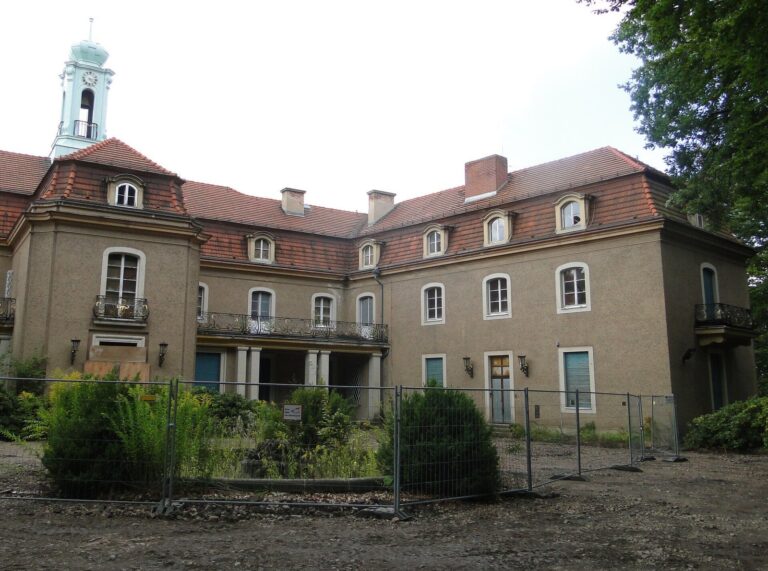
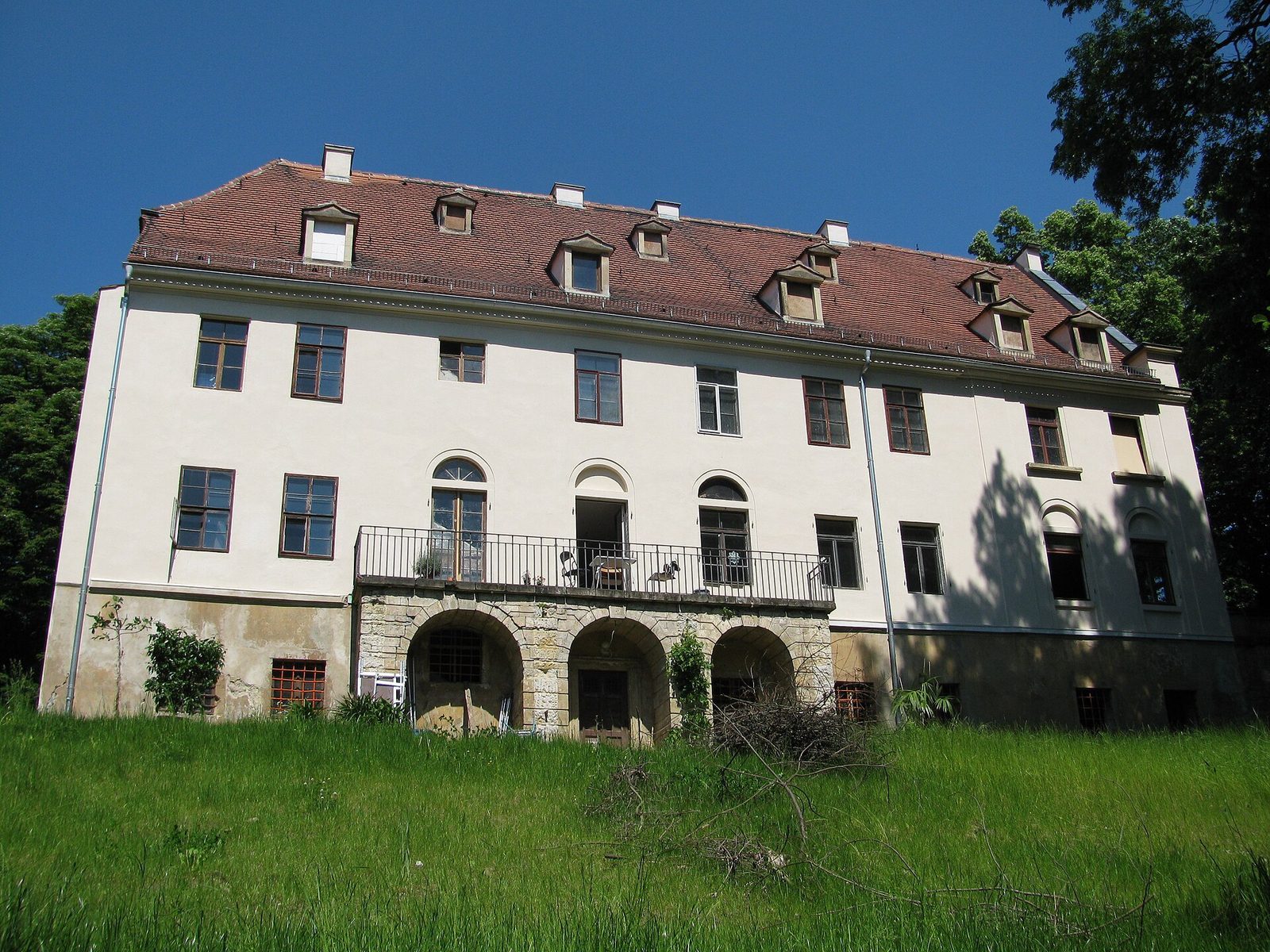
Built in 1775 and remodeled around 1800 in a classical style, the two-storey manor house was designed initially with a half-hipped roof, whose sloping ends partly cut off the gables. Its later exterior has a gabled roof and an entrance on the east side reached by broad steps. Three gable windows share a circular surround. The façade has nine vertical bays, divisions marked by windows and other architectural elements, compared with seven previously.
Three façade reliefs made by sculptor Thaddäus Ignatius Wiskotschill before 1789 depict “Painting,” “Sculpture,” and “Apollo and the Muses.” They had previously adorned Camillo Marcolini’s residence in Wilsdruffer Gasse in Dresden’s Old Town.
Courtyard and estate buildings
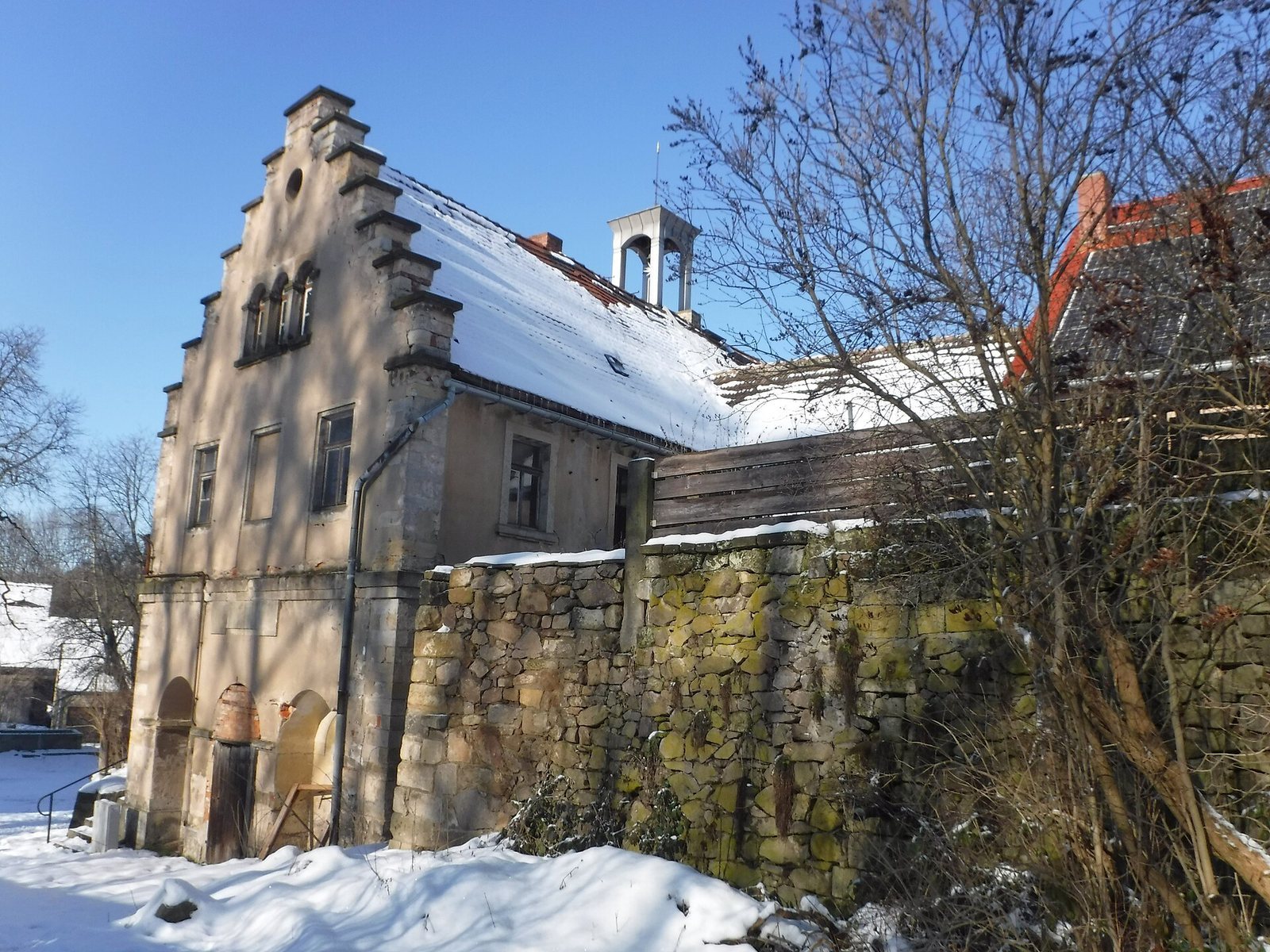
The ensemble also includes farm buildings and an estate building with a courtyard entrance. Sandstone urns decorate the pillars at the courtyard entrance, while wall remnants and retaining walls form part of the surviving complex.
Park
The park lies south of the manor house and contains several false cypresses, a tulip tree, and hanging beeches among contrasting groups of large deciduous and coniferous trees. Storm Niklas uprooted the larger of the two protected beeches in 2015. It was left in the park as deadwood, and a replacement tree was planted at its root ball.