Guildhall: The Civic Hall of the City of London
Site at a Glance
- Popularity
- Very High
- Country
- United Kingdom
- Primary era
- Medieval
- Eras represented
- Classical, Medieval, Early Modern, Modern
- Civilizations
- British, English, Roman
- Site type
- Civic
- Remains
- Town Hall
On this page17 sections
History
Guildhall is the historic civic hall and headquarters of the City of London Corporation, in the City of London, United Kingdom. The Corporation governs this distinct municipal area within Greater London. Construction of the present building began in 1411 and was completed in 1440 under John Croxton’s supervision. Guildhall served as the City’s town hall for centuries and remains a centre for its civic and administrative life.
Roman and medieval origins
A Roman amphitheatre, an arena for public spectacles, once stood on the site. A Guildhall probably occupied the same location during the Anglo-Saxon period, which followed Roman rule in Britain and preceded the Norman Conquest. The amphitheatre’s remains may have influenced the choice of site.
Foundations dating to around 1128 have been found, while the earliest written reference to a London Guildhall dates to 1127 or 1128. One possible explanation of the name links it to the Anglo-Saxon word gild, meaning payment, and to a hall where citizens paid taxes. A 1396 reference to John Parker as sergeant of Camera Guyhalde may support this interpretation.
Medieval tradition also placed the palace of Brutus of Troy at Guildhall. Brutus was a legendary figure, not a historically verified founder. In 1136, Geoffrey of Monmouth wrote that Brutus had founded a city called Troia Nova on the Thames. Another legend held that Brutus defeated the giants Gog and Magog and chained them to his palace gates on this site.
The medieval hall and civic life
Guildhall played a part in Jack Cade’s Rebellion of 1450, an uprising against the government of Henry VI. Trials held there included those of Protestant martyr Anne Askew; Thomas Cranmer, Archbishop of Canterbury; Lady Jane Grey and her husband, Guildford Dudley; Henry Howard, Earl of Surrey; diplomat Sir Nicholas Throckmorton; John Felton; and Rodrigo Lopes, a physician to Elizabeth I. Jesuit priest Henry Garnet was also tried at Guildhall and was executed for complicity in the Gunpowder Plot of 1605, a conspiracy to destroy the Houses of Parliament.
Fire, restoration and continuing use
The Great Fire of London damaged the Great Hall in 1666. A partial restoration was completed in 1670, when the hall was given a flat roof. In 1866, City architect Sir Horace Jones led a more extensive restoration and added a timber roof intended to echo the earlier hammerbeam ceiling, a timber structure supported by projecting beams. A German air raid on the night of 29 to 30 December 1940 destroyed that roof; a replacement was installed in 1954.
The Zong case, an 18th-century legal case connected with the transatlantic slave trade, was heard at Guildhall in 1783. Its outcome helped focus public outrage over the trade. George Dance added the building’s grand entrance in 1788, and it was restored in 1910. On 16 November 1848, Frédéric Chopin gave his last public concert appearance at Guildhall.
Early carvings of Gog and Magog were destroyed in the Great Fire. Captain Richard Saunders carved wooden replacements in 1708, but these were lost in the 1940 raid. David Evans carved a new pair in 1953, given to the City by Alderman Sir George Wilkinson, who had been Lord Mayor in 1940. Guildhall was listed as Grade I in 1950, England’s highest listed-building category for buildings of exceptional architectural or historic interest.
Guildhall remains the headquarters of the City of London Corporation, and its older rooms host official functions. A lunch there in 1992 marked the 40th year of Elizabeth II’s reign. After the Windsor Castle fire and the separation of two of her children, the Queen delivered her annus horribilis, or “horrible year,” speech. The complex has also grown to include modern office wings and Guildhall Art Gallery.
Guildhall continues to host civic ceremonies. At the annual Lord Mayor’s Banquet, the incoming Lord Mayor, the City’s civic leader, honours the immediate predecessor; by tradition, the Prime Minister gives a major speech on world affairs. The outgoing Lord Mayor also presents prizes at City of London School prize day there. Each July, the Worshipful Company of Carmen, a historic City livery company associated with cartage and transport, holds a cart-marking ceremony in the courtyard. Gog and Magog are carried in procession at the annual Lord Mayor’s Show.
Remains
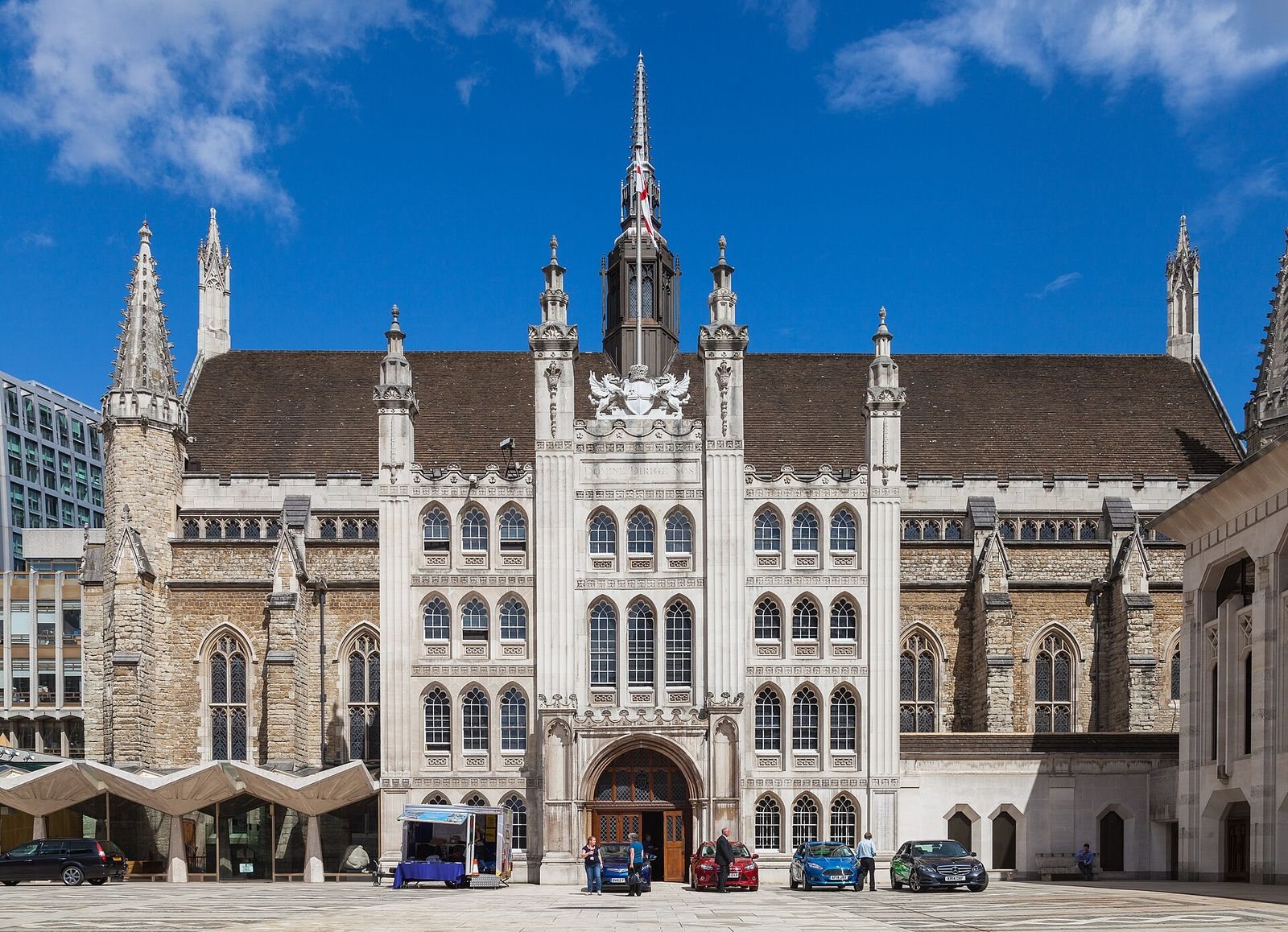
The Guildhall complex stands off Gresham and Basinghall Streets, in the City wards of Bassishaw and Cheap. Its architecture includes Gothic and Georgian elements, while the Great Hall is medieval in style. The historic building is accompanied by later wings to the north and west, and the remains of a Roman amphitheatre lie beneath the site.
Roman remains and medieval archaeology
The Roman amphitheatre
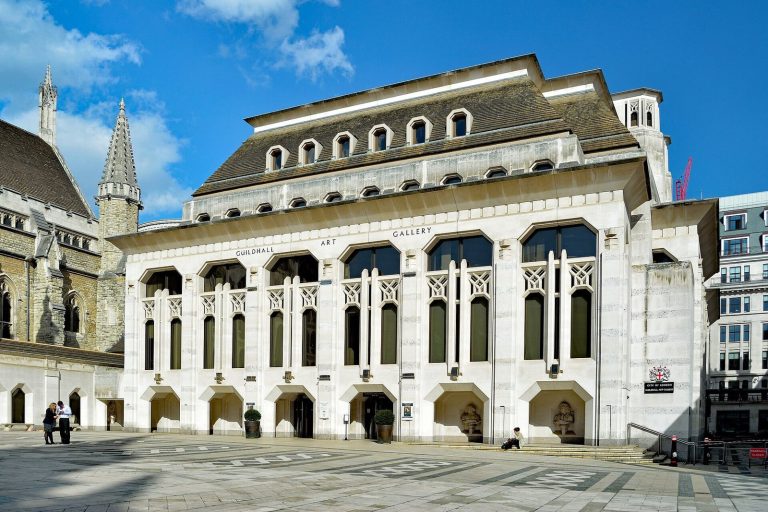
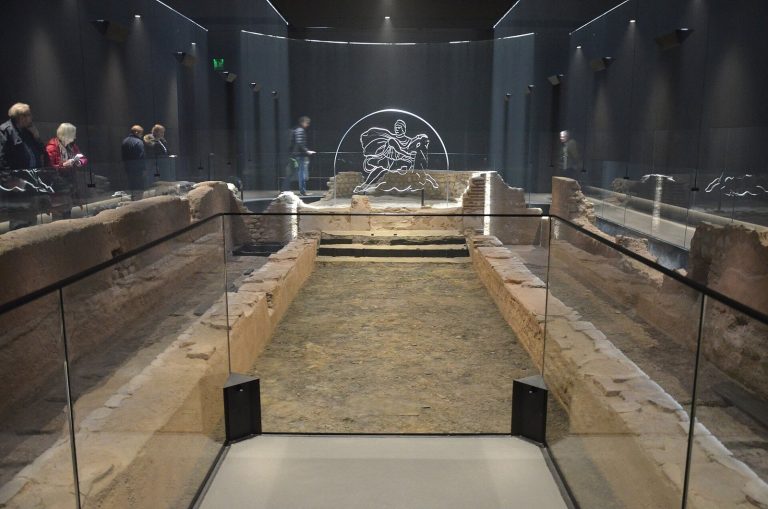
The amphitheatre beneath Guildhall was the largest in Roman Britain, the period of Roman rule in Britain. Rediscovered in 1988, some of its remains are displayed in Guildhall Art Gallery. A black circle in the courtyard paving marks the outline of the arena.
The gatehouse and surrounding remains
Excavations at the entrance to Guildhall Yard exposed remains of a large 13th-century gatehouse built directly above the amphitheatre’s southern entrance. The church of St Lawrence Jewry has an unusual alignment that may reflect the amphitheatre’s elliptical form. The Roman remains may also have influenced the siting of the gatehouse and Guildhall.
The Great Hall and historic interiors
The Great Hall
The medieval Great Hall gives Guildhall its best-known historic interior. It is medieval in style and has been compared with the halls of Oxford colleges. Its timber roof does not reproduce the earlier hammerbeam design.
Crypts and lower rooms
Large crypts, chambers beneath a building, form part of Guildhall’s historic interior. The western part of the present crypt may incorporate part of a late 13th-century building. An old library and a printing room are also among the historic rooms used for events.
Entrances and later wings
Grand entrance
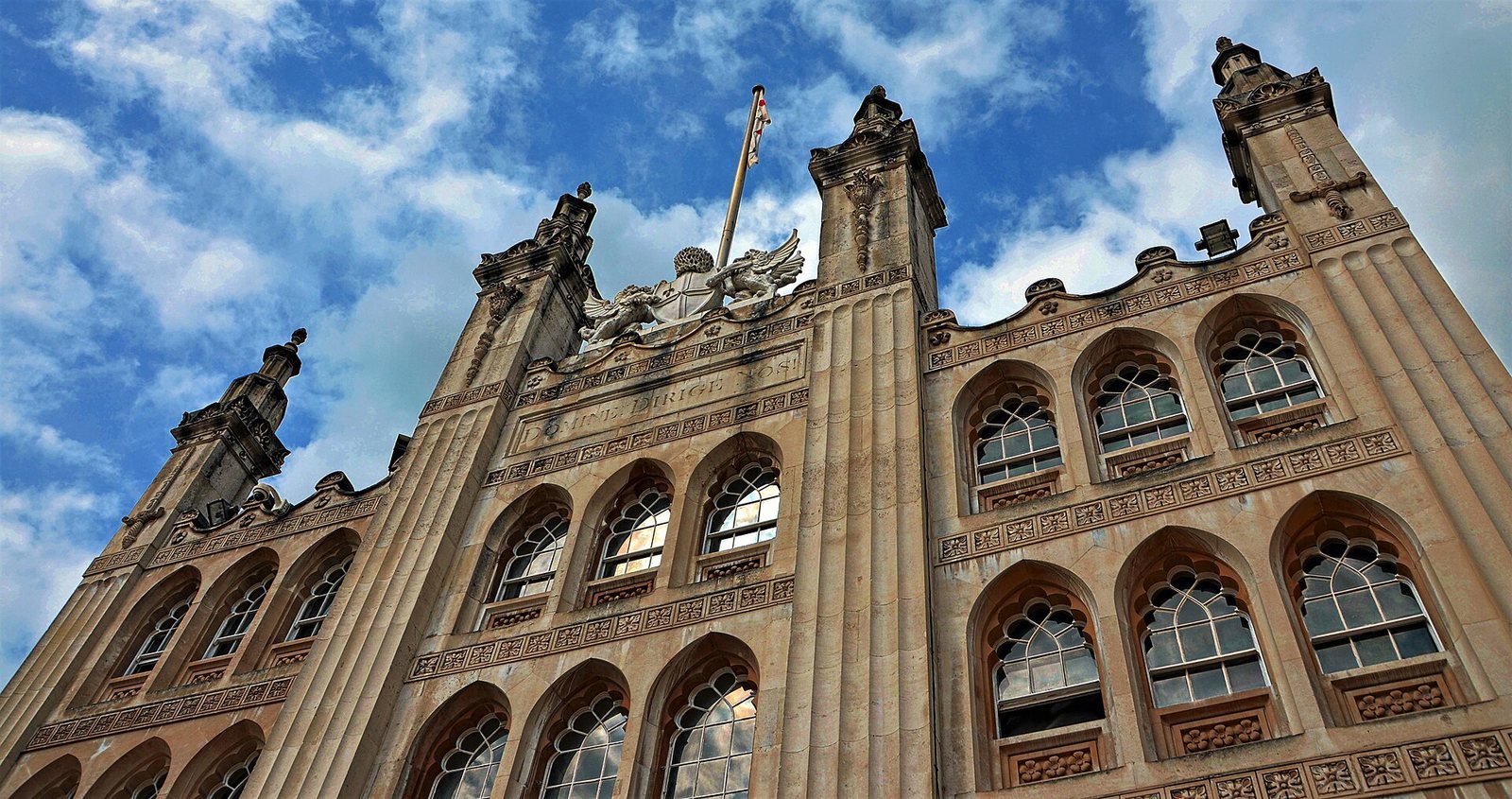
The grand entrance occupies the east wing of Guildhall’s south front. Its Gothic design incorporates Indian-inspired forms.
North and west wings
Designed by Giles Gilbert Scott, the North Wing was built from 1955 to 1958 and faces a public square between Aldermanbury and Basinghall Street. Richard Gilbert Scott designed the West Wing, built from 1970 to 1975 in a modernist style. Corporation offices occupy extensions to the north and west of the original building.
Collections and commemorative works
Library, gallery and museum
Guildhall Library is a public reference library with collections on London, including material from the 11th century onward. Guildhall Art Gallery was added in the 1990s, and the complex also houses the Clockmakers’ Museum.
Statues and plaques
Wooden statues of Gog and Magog stand in Guildhall. Plaques in the hall commemorate Anne Askew, Henry Howard, Earl of Surrey, Sir Nicholas Throckmorton, Lady Jane Grey, Guildford Dudley, Thomas Cranmer and John Felton. Other plaques honor William Pitt the Elder, William Pitt the Younger, Admiral Horatio Nelson, the Duke of Wellington and Winston Churchill. A large seated sculpture of Churchill, by Oscar Nemon and cast by H. H. Martyn & Co., was unveiled by Churchill in 1955.