La Roche-sur-Foron Castle: A Medieval Stronghold in France
Site at a Glance
- Popularity
- Medium
- Country
- France
- Primary era
- Medieval
- Eras represented
- Medieval
- Civilizations
- Holy Roman Empire
- Site type
- Military
- Remains
- Castle
On this page9 sections
History
Early stronghold and Genevan rule
La Roche-sur-Foron Castle stands on a rocky summit in France above the Foron valley. A fortified settlement may have occupied the site in prehistoric times, and the castle may have been built by the Burgundians in the 10th century. The Burgundians were present in the surrounding area from the 5th to 7th centuries. The Counts of Geneva, a medieval ruling house, later used the castle as a regular residence until the early 12th century, when Annecy became their principal residence.
The castle was in the hands of Count Robert of Geneva in the early 11th century. A large tower was probably built there by Aymon I, Count of Geneva, in the late 11th century. The stronghold gave its name to the La Roche noble family. Pierre de La Roche, mentioned in the early 12th century, went on a crusade and died there. The town also had many noble residents. La Roche first appears in a written reference dated 1120, among ten fortified settlements associated with Geneva.
The castle served as the center of a castellany, an administrative district governed from a castle, and was directly subject to the Count of Geneva. Its vidomne, a medieval official later known as the grand castellan, administered the district and the Bornes area. In the County and later Duchy of Savoy, castellans served fixed terms, though their appointments could be revoked. Their duties included collecting revenues and maintaining the castle; a receiver could assist with the accounts. Several Genevan noble families held the office, with the Menthon family prominent in the 14th and 15th centuries.
In 1178, the Counts of Geneva paid homage, a formal recognition of feudal ties, to Borcard, abbot of Agaune, for La Roche, Chaumont, and half of Hauteville. The vidomne’s office may originally have depended on the abbey, and La Roche may once have been a royal estate belonging to the kings of Burgundy before it passed to the monastery.
In 1179, conflict arose between the count and vassals supporting the Bishop of Geneva. After William I of Geneva failed in an attempt to seize Geneva, his wife, Countess Béatrice of Faucigny, and two of their sons took refuge at La Roche and were besieged there. William prevailed and retook the stronghold with financial help from the Carthusian monks of Pomier, members of a contemplative Catholic order.
Sieges, succession, and destruction
In the 13th century, Count Pierre II of Savoy besieged the castle, forcing Rudolf of Geneva, William I’s grandson, to surrender. The Counts of Geneva later regained control and retained the castle until Pierre of Geneva bequeathed it to his wife, Marguerite of Joinville, in his will of 24 March 1392. Marguerite subsequently married Ferry I of Vaudémont. By 1411, the castle belonged to Amadeus VIII, Count of Savoy.
During the 1589–1593 war between the Duke of Savoy on one side and Geneva and the King of France on the other, La Roche was besieged and ravaged by Savoy’s enemies. A Genevan incursion destroyed the fortress on the night of 29 March 1590. In 1595, the La Roche district was alienated.
Later ownership and heritage status
In her will of 6 October 1675, Marie, the last heiress of the Geneva-Lullin line, left her rights and possessions, including La Roche, to Christine of France, Duchess of Savoy. The lands were later granted to Thomas Graneri, Count of Mercenasque and Savoy’s minister and superintendent general of finances. Duke Victor-Amadeus II raised them to a marquisate on 21 February 1682; the act is dated 10 March 1682.
By an order dated 24 January 1944, the surviving keep alone was listed as a French historic monument.
Remains
Summit and surviving defenses
Rocky summit and fortifications
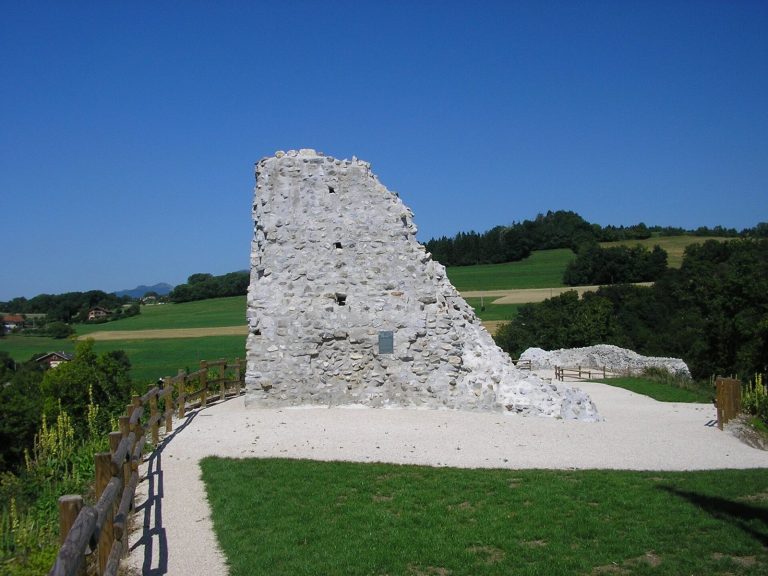
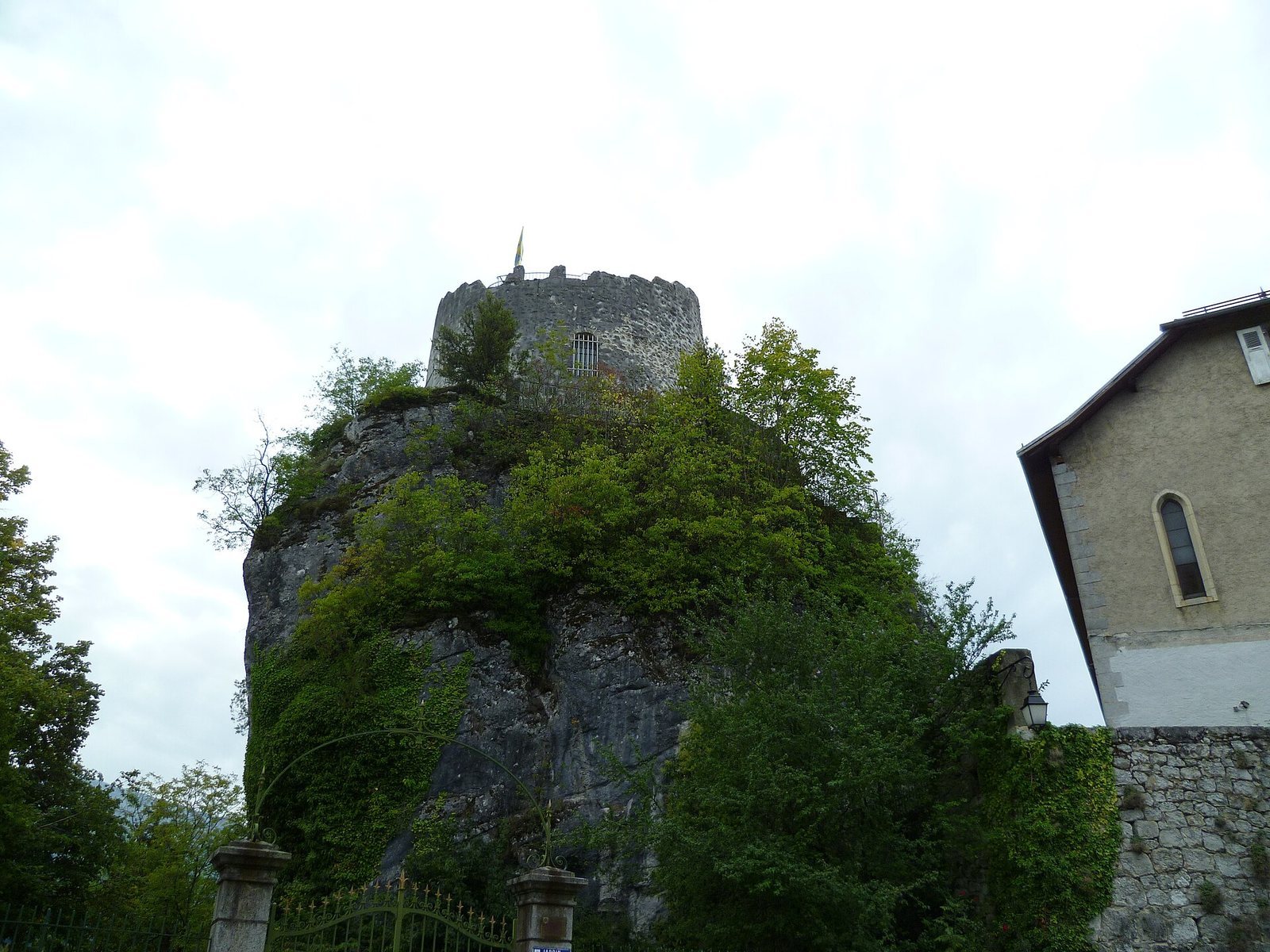
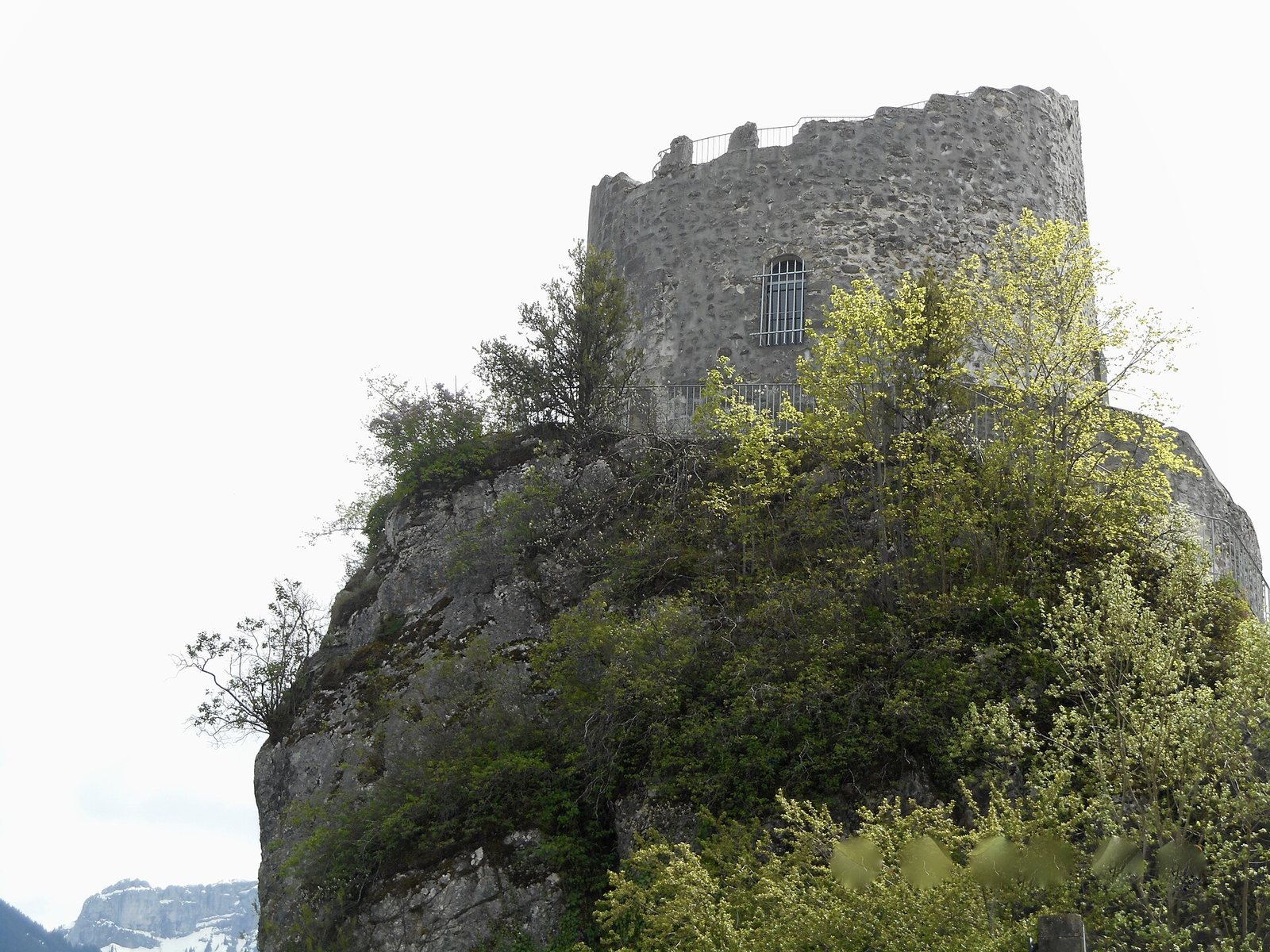
The castle occupies a rocky spur on the northern slope of the Bornes massif, east of the medieval town. It overlooks the Foron valley and defended access through it. The surviving remains consist of a circular keep and a few wall sections. The town’s fortified enclosure had towers, and the fortress also included a shield wall arranged at an angle of 140 degrees.
Circular keep
The keep, also called the Tower of the Counts of Geneva, dates to the 13th century and was among the earliest circular towers built in Savoy. Its round plan reduced blind spots. The rock beneath it rises about 17 metres, while the tower now stands about 11 metres high and probably once reached around 20 metres. Its walls are nearly 4 metres thick. The keep had three floors, and a residential building was later attached to it without changing its elevated entrance.
Fissure and passage through the rock
The tower straddles a natural fissure in a large erratic block carried and deposited by the Mont Blanc glacier as the ice melted around 10,000 years ago. The fissure was enclosed from the outside and divided into four natural caves stacked one above another. Since the late 19th century, a passage made through the rock by the Capuchin monks of La Roche, who then owned the tower, has allowed people to pass from one side to the other. The apparent split into two rocks is an effect of the opening: the structure is a single block.