Abbaye d’Entremont: A Medieval Augustinian Abbey in France
Site at a Glance
- Popularity
- Low
- Country
- France
- Primary era
- Medieval
- Eras represented
- Medieval, Early Modern
- Civilizations
- Duchy of Savoy
- Site type
- Religious
- Remains
- Monastery
On this page13 sections
History
Abbaye d’Entremont is a former Augustinian abbey in Entremont, France, founded around 1115 by canons from the Abbey of Abondance. The community became an independent abbey in 1154 and developed into a religious house, charitable institution, and regional lordship in the Borne Valley.
Foundation and growth
The canons established their priory in a valley that was already inhabited. Burcard became its prior, while a local lordly family, possibly the Pontverre, gave the community land extending from the Antérieux narrows to the Pas de l’Échelle. Count Amadeus I of Geneva later confirmed the donation in the presence of Peter II, Archbishop of Tarentaise.
Girold, the first abbot, organized a strict communal life under the Rule of Saint Augustine, a guide to religious life attributed to Augustine of Hippo. The canons also followed the constitutions used at Abondance, written around 1130 by Ponce de Faucigny, the first abbot of Sixt. Gifts from the Counts of Geneva and local lords helped the priory seek independence. With Abbot Burcard’s approval, it was raised to abbey status by a charter dated 12 February 1154, when twelve canons lived there. In 1160, Pope Alexander III placed the abbey and its dependencies under papal protection.
The abbey also cared for clergy and laypeople. Between 1175 and 1250, its canons established a hospital for local residents, travelers, poor people, and the sick. Care centered on prayer and medicinal plants gathered in the mountains or cultivated in the abbey gardens. Girold witnessed an agreement between the abbeys of Sixt and Abondance in 1161 and became abbot of Abondance in 1180. His successor Jacques, abbot from 1184 to 1188, helped resolve a dispute between William I of Geneva and Bishop Arducius of Faucigny.
In 1225, Count William II of Geneva granted the abbey the rights of a lordship, and its abbot took the title Lord of Entremont. The territory covered about 1,835 hectares. The abbey held lands, forests, water sources, mountain pastures, mills, and vineyards across the region, as well as the right to nominate clergy in six parishes. Its church also served as Entremont’s parish church, a dual role noted during a pastoral visitation in 1445.
The community cleared and cultivated land with help from allies and vassals, including the lords of Clets. Its holdings and influence extended into the Bouchet Valley and nearby settlements. Feudal claims there overlapped with those of secular lords, the Count of Geneva, and the Carthusian monastery of Le Reposoir. Around 1160, the abbey’s records used Bornan for the whole Borne Valley; by about 1260, they distinguished its lower basin from the upper Grand-Bornand basin. More than thirty notarial acts issued under the abbots between 1220 and 1450 concern activity in the upper valley.
Reform, lordship, and local crises
On 8 November 1279, Robert of Geneva, Bishop of Geneva, removed Entremont from Abondance’s authority after identifying failures in observance of the Augustinian rule and upkeep of the buildings. He placed the abbey under Saint-Ruf, a congregation of Augustinian canons associated with an abbey in Valence. Saint-Ruf’s abbot thereafter chose Entremont’s abbot, subject to the Bishop of Geneva’s approval. Anselme, the first abbot from Saint-Ruf, took office in 1281 and brought twelve canons whose discipline helped restore monastic order.
Abbot Aymar, who served from 1292 to 1302, strengthened the abbey’s rights and resources through territorial exchanges and feudal claims. Entremont gained the lordship of Petit-Bornand in exchange for giving Pers to Count Amadeus II of Geneva. Amadeus confirmed the abbey’s titles and possessions in 1292 and made further donations in 1303. Hugues of Geneva reaffirmed its lordships, rights, and jurisdictions in 1340.
Entremont continued to assert authority in the Borne Valley. In 1347, the abbot, the lord of Clets, and the representative of La Forclaz agreed on local boundaries and affirmed that residents owed taxes to the abbey and were subject to its judicial authority. The Count of Geneva had granted judicial powers to the Clets family in 1334; in 1386, Albert of Clets recognized the abbey’s full jurisdiction. The abbey also faced financial pressure after loans contracted in 1341 and 1342. Its feudatories later guaranteed 400 florins against their persons and property to secure its debts.
The Black Death reached the Borne Valley around 1361, and an epidemic in 1418 killed about 240 people. From 1408, the canons organized charitable confraternities, voluntary religious associations that included mutual aid. The Holy Spirit confraternity assisted poor people through donations and bequests. Members of the Verboux family held the abbacy successively from 1395 to 1462. A fire destroyed a large part of the abbey and forced rebuilding; during this period, the priory of Poisy was united with Entremont, while both remained under Saint-Ruf’s authority. Disputes over the Cenise pastures continued, and in 1468 Janus of Savoy granted Entremont the mountain of Cenise, Planex, the combe of Biolland, and Tumelley.
Commendatory abbots
From 1486, Entremont had commendatory abbots, who held the title and revenues without necessarily living at the abbey or governing its religious community. The first, Philippe de Luxembourg, reduced the number of canons to six at Entremont and three at Poisy, leaving them with limited income. During the 22-year occupation of the Duchy of Savoy by the forces and administration of Francis I of France, the abbacy passed to Jacques of Savoy, who was chiefly concerned with its revenues.
Religious tensions during the Reformation also shaped the abbey’s administration. In 1543, Entremont’s chapter reduced the income, tithes, and donations assigned to the canons of Poisy, beginning a dispute that lasted a decade. Cardinal Jean du Bellay held the commendatory abbacy from 1557 to 1559 but did not visit the monastery; Janus de Regard, a canon of Geneva, administered it in his place.
Thomas Pobel became commendatory abbot in 1595 and worked with Francis de Sales to ease feudal obligations on the abbey’s subjects. Pope Clement VIII authorized the release of Entremont’s and Peillonnex’s vassals and subjects from certain forms of servitude. On 8 October 1607, Francis de Sales visited Entremont and blessed a bell bearing Pobel’s name. At that time, the community comprised three canons and three novices. Pierre de Roncas, then eleven, was named commendatory abbot; the sacristan also served as parish priest.
Restoration and dissolution
Marc-Antoine de Granery, commendatory abbot from 1645 to 1703, lived at Entremont and restored order and financial stability. He aided the poor and paid for restoration and embellishment of the church and monastic buildings. Work began in 1680 and ended on the buildings in 1682; the church altarpiece was completed in 1685. Granery also supported the abbey’s intellectual life, and an inventory lists a library containing many historical works.
The abbatial seat remained vacant from 1703 to 1728. During this period, the abbey was heavily taxed under the occupation of Savoy, and in 1709 Louis XIV’s council appointed Abbot Carpinel to the commendams of Entremont and Poisy. Jean-Louis Piochet de Salins became abbot in 1728 and lived at Entremont. A 1730 inventory lists the abbey’s buildings, lands, mills, and other holdings. After another vacancy lasting fourteen years, Louis de Montfalcon became the final abbot. By then, five canons remained at Entremont, including the parish priest, and the canons had stopped reciting the Divine Office, their regular cycle of communal prayers, together in 1738.
In 1772, the Duke of Savoy issued emancipation edicts for Entremont and neighboring communities. That year, after the canons had sought secularization for more than fourteen years, Pope Clement XIV authorized the change from a religious institution to secular status. The abbey and its dependent priory at Poisy were dissolved in 1776, and their assets and revenues were transferred to bishops to support seminaries, hospitals, and parish churches. Claude Maistre remained Entremont’s parish priest until Savoy was annexed by revolutionary France in 1792.
Part of the former abbey later served as the presbytery, town hall, and local school until the late nineteenth century.
Remains
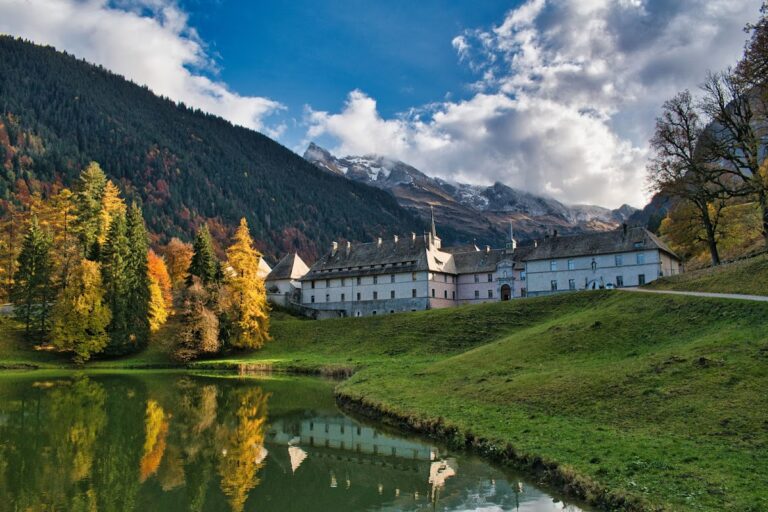
The abbey stood on raised ground on the left bank of the Borne Valley, near the former boundary between Faucigny and the County of Geneva; the Borne torrent marked the boundary between their territories. A 1730 inventory describes a complex containing a church, tower, garden, courtyard, and two barns. Excavations have revealed parts of the cloister, a covered passage around the monastery’s open courtyard, and its galleries.
Buildings and surviving fabric
Former convent building
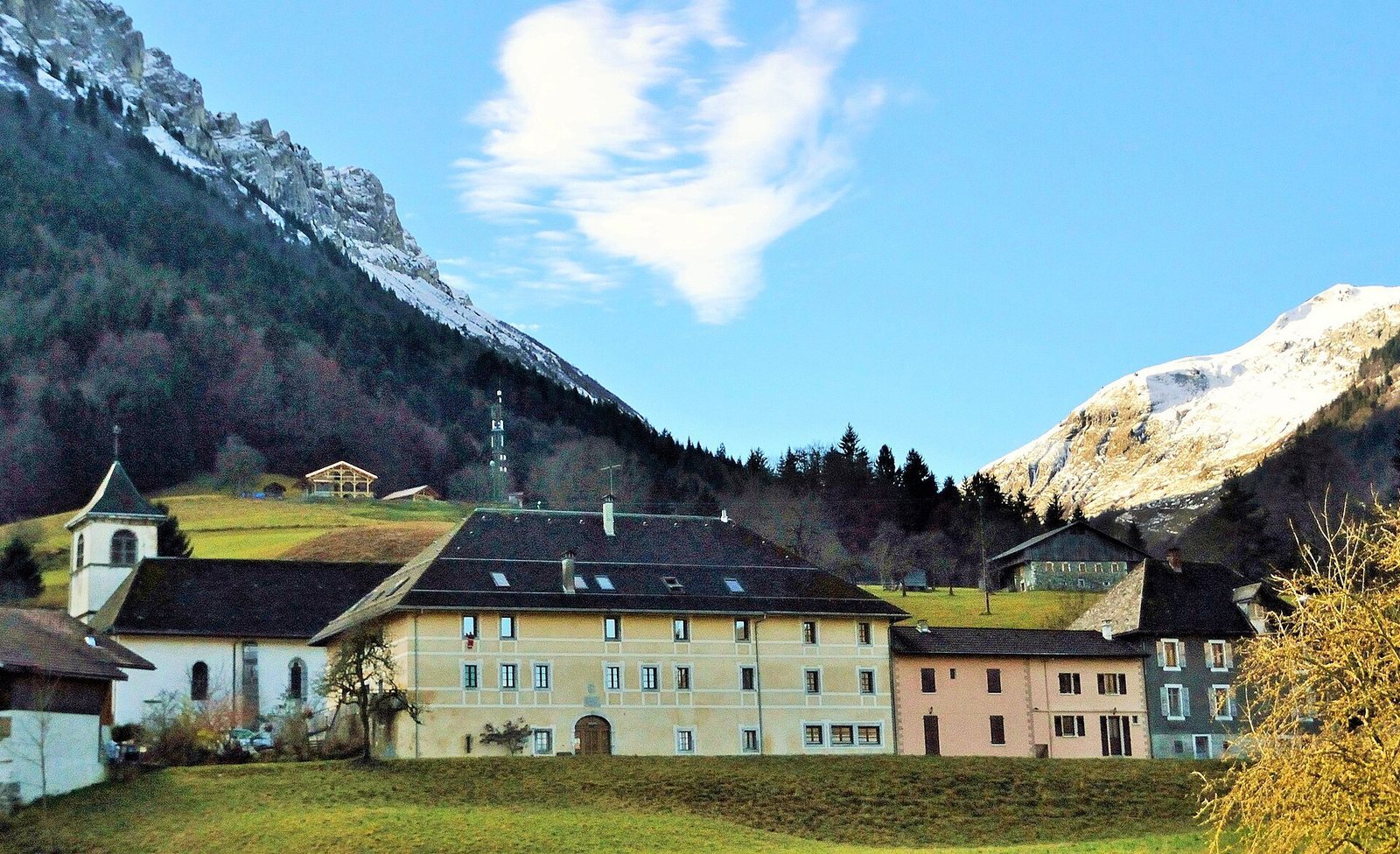
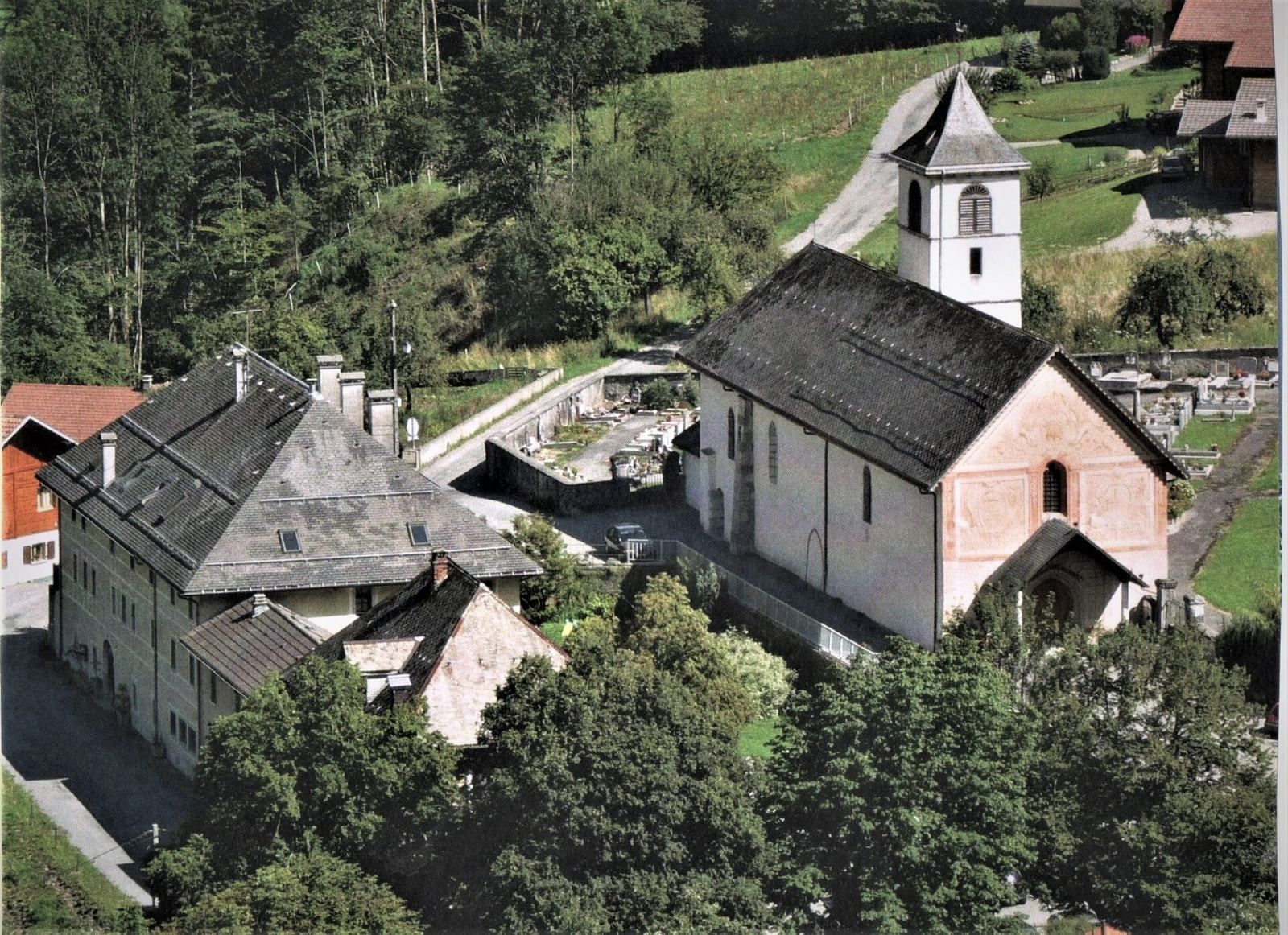
The convent was partly destroyed, but one large building survives on raised ground. It measures 22.50 by 13.40 metres and has ochre-toned lime plaster with window surrounds in a neoclassical style described as Sardinian. The building was restored in 1998. After serving as the presbytery, town hall, and school, it now contains apartments and the Priory Museum.
Church and Miléna gallery
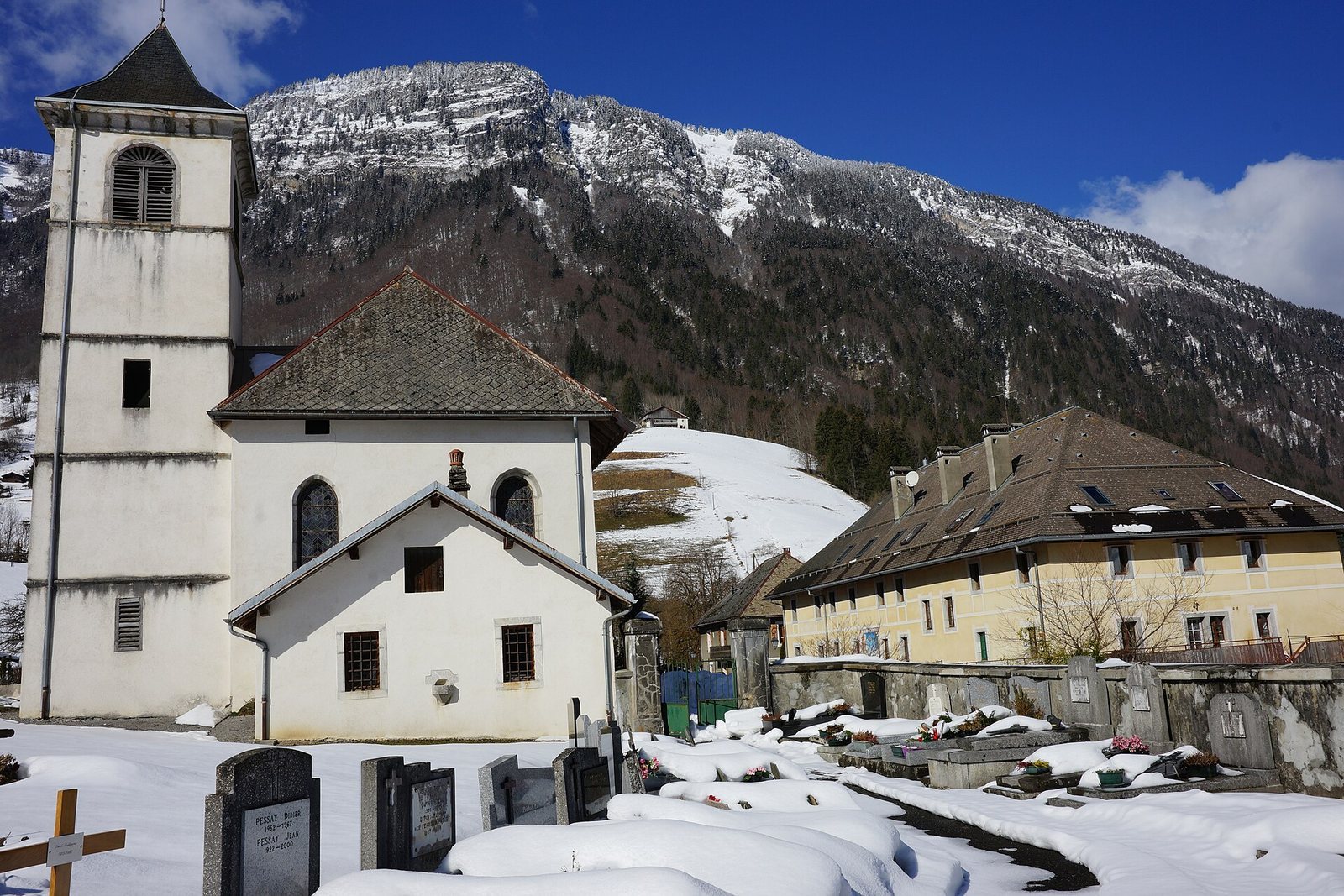
The abbey church is identified as Notre-Dame-de-tous-les-Saints. The Miléna gallery is identified beside the church. The 1730 inventory also lists four chapels held by the canons and a barn belonging to the parish priest.
Architectural fragments and Granery’s marks
In 1863, torus mouldings, capitals bearing heraldic shields, and other architectural fragments remained near the church. Granery’s coat of arms appeared inside and outside the abbey. It showed a crenellated castle with three towers above three uprooted ears of wheat, accompanied by a ducal crown, an abbatial crozier and mitre, and the motto Ut seres metes, meaning “As you sow, so shall you reap.” An inscription on the presbytery wall facing the Borne stated that Granery had restored the buildings at his own expense. Entremont later adopted his arms as the village coat of arms.
Excavated monastic remains
Cloister and galleries
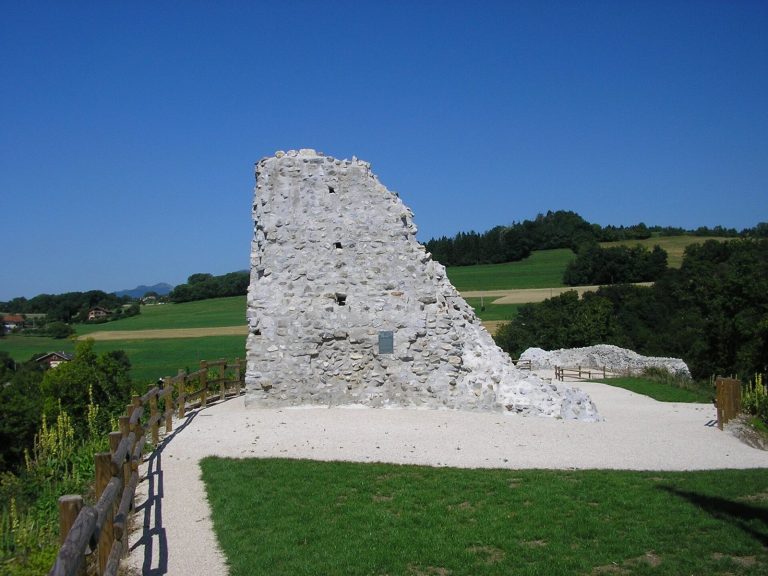
A geophysical survey of two plots beside the surviving buildings, conducted on 15 and 16 July 2020, indicated vanished structures arranged in a layout characteristic of monasteries of Canons Regular, comparable to those at Abondance and Sixt. Excavations in 2021 exposed the northeast corner of the cloister courtyard and a former gallery along its northern side. These remains were attributed to the thirteenth century. Work begun in 2022 uncovered the eastern gallery and the trace left by the inner face of the original eastern wing. Excavation in 2024 identified a different arrangement of the cloister dating to the modern period.
Burials and other finds
A burial in the northern gallery contained two skeletons, one of which was radiocarbon-dated. Excavations in the eastern gallery revealed a dense burial area, where two skeletons were dated to the late Middle Ages or early modern period. A basin dating to the seventeenth century was recovered during the 2021–2023 campaigns, and a well dating to the abbey’s foundation was uncovered in 2023. Volunteers also carried out restoration work at the site between 2016 and 2018.