Fort Saint Elmo: Valletta’s Harbour-Defence Fort
Site at a Glance
- Popularity
- Very High
- Country
- Malta
- Primary era
- Early Modern
- Eras represented
- Medieval, Early Modern, Modern
- Civilizations
- British, Kingdom of Sicily, Knights Hospitaller
- Site type
- Military
- Remains
- Fort
On this page20 sections
History
Fort Saint Elmo is a coastal fort at the seaward tip of the Sciberras Peninsula in Valletta, Malta. The Order of Saint John, a Catholic religious and military order that governed Malta, began building the star-shaped fort in 1552. Its position allowed it to command the entrances to both Marsamxett Harbour and Grand Harbour.
Watchtower and Great Siege
A permanent militia watch post occupied the peninsula’s tip by 1417. In 1488, the Aragonese built a watchtower at Saint Elmo Point and dedicated it to Erasmus of Formia, an early Christian bishop and martyr also known as Saint Elmo. The Order reinforced the tower in 1533, but work on a small fort begun around that time was soon suspended.
In 1551, an Ottoman fleet entered Marsamxett Harbour without opposition, prompting the Order to build a stronger fortification. The watchtower was demolished in 1552, and construction of a new fort began to a design proposed by Spanish military engineer Pietro Prato. Its low position left it vulnerable to fire from higher ground. The seaward guns could not effectively cover the harbour entrances, and the ditch could not be defended by fire from the sides. A raised gun platform, or cavalier, was built from 1554 to address some of these weaknesses. In 1565, Spanish commander Don Garcia de Toledo ordered an outer work to provide flanking fire along the western and northern ditches. Though described as a ravelin, it was closer in form to a counterguard, an outwork placed in front of a fortification.
During the Great Siege of Malta in 1565, Ottoman forces bombarded the fort from Mount Sciberras, Dragut Point, and batteries north of Marsamxett Harbour, near the present site of Fort Tigné. Its initial garrison comprised about 150 knights, 600 soldiers, most of them Spanish, and 60 enslaved rowers from galleys. Boats carried reinforcements and supplies across Grand Harbour from Birgu and Senglea. These deliveries continued at night, although the Ottomans could interrupt them during periods of full moon.
A cannon misfired and struck the top of the fort’s parapet, killing the gunner and mortally wounding Ottoman admiral and corsair Dragut, also known as Turgut Reis. After 28 days under siege, the fort fell on 23 June 1565. None of its defending knights survived, while nine Maltese defenders escaped by swimming across Grand Harbour to Fort Saint Angelo. The fort was almost entirely destroyed.
The defense delayed the Ottoman advance, giving Malta’s other fortresses time to prepare and allowing reinforcements from Spain to arrive. Fort Saint Elmo and Fort Saint Angelo helped block Grand Harbour, but Saint Elmo did not prevent Ottoman ships from entering Marsamxett Harbour.
Rebuilding and the Order’s fortifications
After the siege, Grand Master Jean Parisot de Valette decided to establish a new city on the peninsula. Work on Valletta began in 1566, with military architect Francesco Laparelli sent by the Pope to design its fortifications. The Order rebuilt Saint Elmo and incorporated it into the city walls, following the earlier fort’s basic plan but not restoring the outer work.
The Order altered the fortifications repeatedly in the seventeenth and eighteenth centuries. Vendôme Bastion was built in 1614, following proposals by Laparelli, to strengthen the area between the fort and Marsamxett Harbour. After Flemish engineer Carlos de Grunenberg arrived in Malta in 1681 at the invitation of Grand Master Gregorio Carafa, he designed the Carafa Enceinte, an enclosing line of fortifications. Construction began in 1687 and was completed in 1689. Late in the seventeenth century, the cavalier was connected directly to the fort and part of the ditch was filled, covering some earlier ramparts.
A bastion linking the fortifications to Valletta’s St Lazarus Bastion was added in 1730. An additional powder store was built at Vendôme in 1745, and stores erected between the main fort and the Carafa Enceinte became known as the Pinto Stores.
On 8 September 1775, thirteen rebel priests seized Fort Saint Elmo and Saint James Cavalier during the Revolt of the Priests. They lowered the Order’s flag and raised a banner of Saint Paul. The Order recaptured Saint Elmo, after which the rebels at Saint James surrendered. Three men were executed and the others exiled or imprisoned. The executed men’s heads were displayed at the corners of Saint James Cavalier until November, when Emmanuel de Rohan-Polduc became Grand Master.
British artillery and changing defenses
Under British rule, a protective wall for riflemen was added in the early nineteenth century. In 1855, the powder store at Vendôme Bastion became an armoury, receiving small arms from the Palace Armoury. The fort was a major artillery position and, by about 1860, held Malta’s largest concentration of artillery. After British military engineer William Jervois reviewed Malta’s defenses in 1866, major changes began. Three 11-inch rifled muzzle-loading guns, loaded through the barrel, were placed on the cavalier, and ammunition and propellant stores were built inside the fort.
By 1877, the armament included a 12.5-inch, 38-ton gun on St Gregory Bastion; two 10-inch, 18-ton guns on Ball’s Bastion; a 9-inch, 12-ton gun on Ball’s Curtain; and two 10-inch and two 9-inch guns on Abercrombie’s Bastion. The three guns on the cavalier were removed in 1884 because its height exposed them to enemy fire and there were doubts that the older structure could withstand their recoil. Around 1889, muzzle-loading guns gave way to guns loaded from the rear, placed in protected, vaulted positions and in open positions firing over protective walls. Older fortifications were reinforced with concrete.
A coastal-defense plan drawn up in 1906 assigned six-inch naval guns to St Gregory and Ball’s Bastions to counter torpedo boats and destroyers approaching merchant ships in Marsamxett Harbour. Two more guns on Abercrombie’s Bastion, supported by one at St Lazarus Bastion, were intended to defend Grand Harbour’s entrance. Four rapid-firing 12-pounder naval guns were planned for Abercrombie’s Curtain. A sea-mine field lay in front of the fort, and a shore station for wire-guided Brennan torpedoes had been built there. A searchlight installed below Abercrombie’s Curtain in May 1898 enabled night use of the torpedoes and remote detonation of mines. A mast carried four movable lights to illuminate targets for the six-inch guns.
In 1917, the first heart operation performed on a soldier took place at Saint Elmo. During the period between the world wars, gun positions were built for twin quick-firing six-pounder guns.
World wars and the end of military use
Fort Saint Elmo was the site of Malta’s first aerial bombardment on 11 June 1940. Six people were killed. Ċensu Tabone, a military doctor who later became President of Malta, was present and survived. That month, the fort’s garrison also helped repel an Italian motorboat attack on the harbour barriers.
At the start of the Second World War, the outer bastions carried six six-inch naval guns, and the Royal Malta Artillery’s 3rd Heavy Battery was based at the fort. The Brennan torpedo installation had been removed as obsolete. On 26 July 1941, Italian forces attacked Grand Harbour with two manned underwater craft, four Italian motor torpedo boats, and six explosive motorboats. British radar detected the attack early, and Saint Elmo’s coastal guns opened fire as the boats approached. Fifteen attackers were killed and 18 captured; all the manned craft and explosive boats, as well as two of the motor torpedo boats, were lost. One explosive boat struck Saint Elmo Bridge, which connected the breakwater to the peninsula, and the bridge collapsed.
Parts of the fort were severely damaged during the war, and bombing scars remain. The Royal Malta Artillery left on 26 March 1972, ending the fort’s long military use. Some areas later fell out of use, while the site also housed Malta’s police academy from the mid-twentieth century. The lower fort became home to the National War Museum in 1975. Its collection included military equipment and other objects relating to the two world wars, as well as a replica of the George Cross awarded to Malta by King George VI in April 1942. The museum closed in September 2014 and moved to the upper fort with a larger collection, becoming the Fort St Elmo and the National War Museum.
The fort forms part of the City of Valletta World Heritage Site, inscribed in 1980. Deterioration linked to poor maintenance and security, age, and exposure led to its inclusion in the World Monuments Fund’s 2008 Watch List of 100 endangered sites. Major restoration began in 2009. Work on Upper Saint Elmo and the Carafa Enceinte was nearly complete by 2014, and restoration of the fort was completed in 2015.
Remains
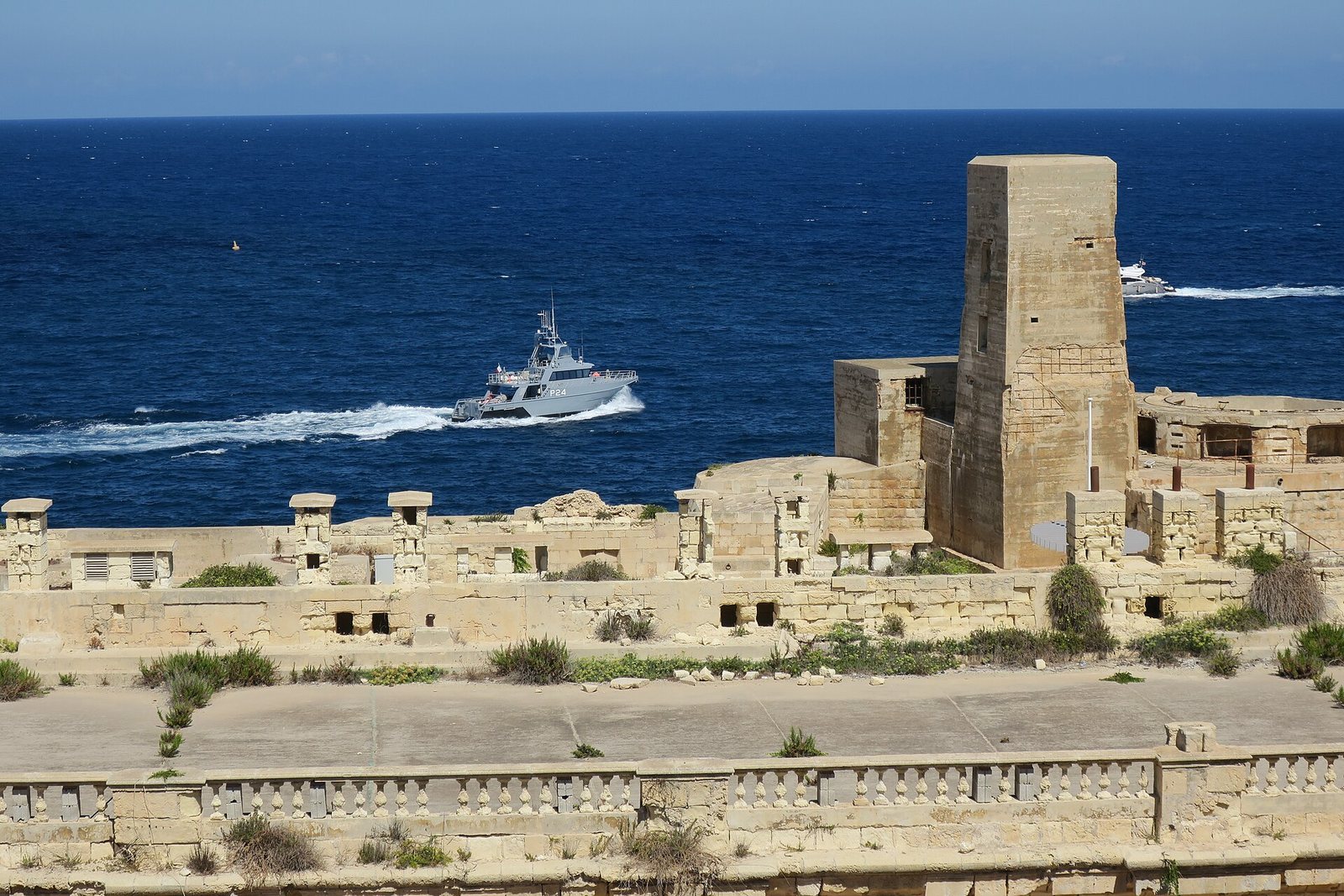
Built of limestone, the star fort occupies 50,400 square metres at the rocky seaward end of the Sciberras Peninsula, between Marsamxett Harbour and Grand Harbour. The tip stands about 23 metres above sea level. Inland, the ground drops to a saddle about 17 to 20 metres high before rising to about 30 metres. The fort, together with Fort Tigné and Fort Ricasoli, commands the entrances to both harbours. Its surviving defenses combine the original upper fort with later works that extend around it and connect to Valletta’s city walls.
Upper Saint Elmo
Main fort and cavalier
The original fort, sometimes called Upper Saint Elmo, has two demi-bastions, each with a forward face and a side flank, as well as a parade ground, barracks, and a large cavalier. Its first defenses also included a protected passage along the outer edge of the ditch and a low outwork within the ditch. The seaward cavalier rises above the main fort and is separated from it by a dry ditch.
Entrances and chapels
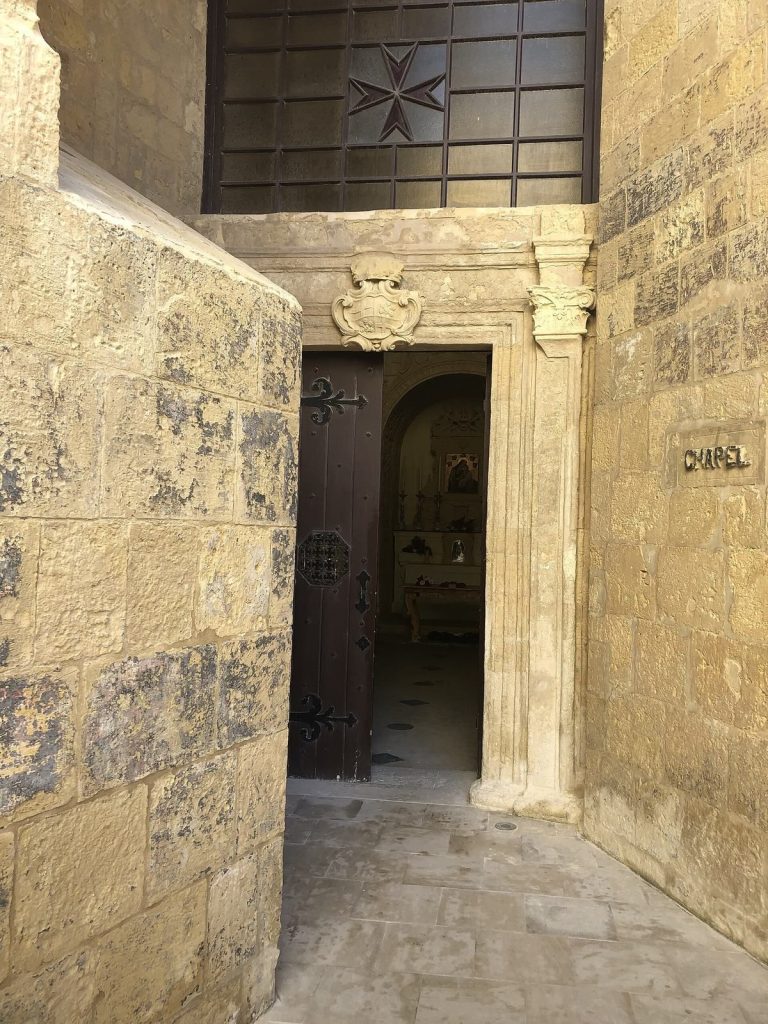
Victoria Gate, at the lower right corner of the fort, is its main entrance. Porta del Soccorso gives access to Upper Saint Elmo. The fifteenth-century Chapel of St Anne stands within the walls near that entrance, while a separate, eighteenth-century Church of St Anne occupies part of the parade ground.
Carafa Enceinte and connecting works
The Carafa Enceinte surrounds the original fort and Vendôme Bastion. Three bastions follow the coastline and are joined by curtain walls, the sections of wall between defensive works. Barrack blocks occupy the area between Upper Saint Elmo and this outer line of defenses.
Vendôme Bastion and Pinto Stores
Vendôme Bastion links the French Curtain with the fort. It contains a small projecting turret or guard post and was adapted first as a magazine for military supplies, then as an armoury. It is now part of the National War Museum. The Pinto Stores stand between the main fort and the Carafa Enceinte, in the area known as Lower Saint Elmo.
St Gregory Bastion and its curtain
St Gregory Bastion is asymmetrical, with a long left face, and was altered to accommodate later gun positions. The wall connecting it to Conception Bastion was first called the Toscana Curtain and later the St Gregory Curtain; it contains British gun positions.
Conception Bastion and Sta. Scholastica Curtain
Conception Bastion, also known as Ball’s Bastion, is a small, five-sided work with gun positions, magazines, and accommodation for gun crews. Sir Alexander Ball was buried at its projecting angle. The curtain between Conception and St John Bastions is called the Sta. Scholastica Curtain and was also known as Ball’s Curtain. It contains an emplacement for a 12.5-inch, 38-ton gun and other British alterations.
St John Bastion and St Ubaldesca Curtain
St John Bastion, also called Abercrombie’s Bastion, is a large, asymmetrical work at St Elmo Point, the end of the peninsula. It contains British gun positions and magazines; Sir Ralph Abercromby was buried there. St Ubaldesca Curtain, also known as Abercrombie’s Curtain, is a long wall connecting St John Bastion to St Lazarus Bastion in Valletta’s defenses. It also contains British gun positions. St Lazarus completes the connection to the city’s fortifications.
British defenses and wartime fabric
Artillery positions
British changes included the musketry parapet and successive artillery positions. St Ann’s Battery retained a 64/32-pounder gun, two 13-inch Blomefield mortars, and two 80-pounder rifled muzzle-loading guns in the 1880s. Later installations included guns loaded from the rear in protected, vaulted positions and open positions above parapets on the curtains and bastions. Concrete was added to strengthen older fortifications.
Fire-control towers and damage
High reinforced-concrete fire-control towers built shortly before the Second World War remain a defining feature of the fort’s silhouette. The surviving fabric also bears visible scars from wartime bombing.
Bridge and early remains
Saint Elmo Bridge
Saint Elmo Bridge connected the breakwater to the peninsula near the fort. The original bridge collapsed after it was struck in 1941. A replacement, built in 2012, has a design similar to but different from the earlier bridge. Work to restore the bridge and breakwater began in 2020.
Traces of the first fort
Archaeological work during the modern restoration exposed elements of the fort that stood before the Great Siege. These early remains survive in fragments following the rebuilding of 1566 and later alterations between the seventeenth and nineteenth centuries. Lower Saint Elmo, including the area around the Pinto Stores, was cleared of accumulated waste in 2015, but later deteriorated again and fell into disuse.