Schlössli Aarau: Medieval Castle and City Museum
Site at a Glance
- Rating
- 5
- Popularity
- Very Low
- Country
- Switzerland
- Primary era
- Medieval
- Eras represented
- Medieval, Early Modern, Modern
- Civilizations
- Holy Roman Empire, Swiss
- Site type
- Military
- Remains
- Castle
On this page11 sections
History
Schlössli Aarau is a medieval castle in Switzerland whose origins date to the late thirteenth century, when the Counts of Kyburg were founding Aarau. It is the city’s oldest surviving building, and its fortifications may have been intended as a citadel for the new town. Some earlier interpretations placed fortifications on the site as early as the eleventh century, but tree-ring dating places the castle’s origins in the late thirteenth century.
Kyburg and Habsburg Rule
After the Kyburg line died out in 1263, Aarau and the castle passed to the Habsburgs, a European ruling dynasty. The first known reference to the building, from 1334, calls it the “old tower,” distinguishing it from the somewhat newer Rore Tower, now incorporated into the town hall.
Until the mid-sixteenth century, noble families held the castle, among them the lords of Kienberg and Heidegg, the Sumer family, and the lords of Luternau. This pattern continued after the Swiss Confederates, members of the Old Swiss Confederacy, conquered Aargau in 1415. Later, Aarau’s bourgeois families, including the Schmuziger and Hunziker families, used the castle as a residence.
Residence and Civic Use
In the early seventeenth century, the upper part of the residential hall was renewed, and the tower received a roof sloping on all four sides. In 1624, Valentin Friderich, a fortress builder from Bern, altered the interior and arranged repairs to the stonework.
Silk-ribbon manufacturer Johann Rudolf Meyer acquired the castle in 1790 and made substantial changes. He also financed a cartographic office that operated in the building. After the cantonal school opened in the neighboring Amthaus, an administrative building, in 1802, the castle housed a boarding establishment for its pupils.
The castle passed to the Herosé family in 1808. Colonel Emil Rothpletz acquired it in 1862, and in 1930 it was donated from his estate to the municipality of Aarau. A major renovation followed in 1931–32, and the city museum opened in the castle in 1939. Later work renewed the façades in 1978–80, repaired the roof in 2000, and restored the window surrounds in 2003. A study for expanding the museum took place in 2006–07.
Remains
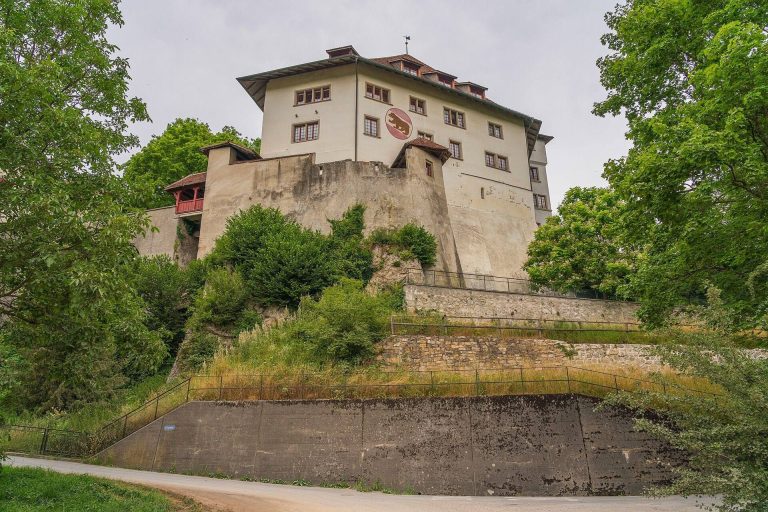
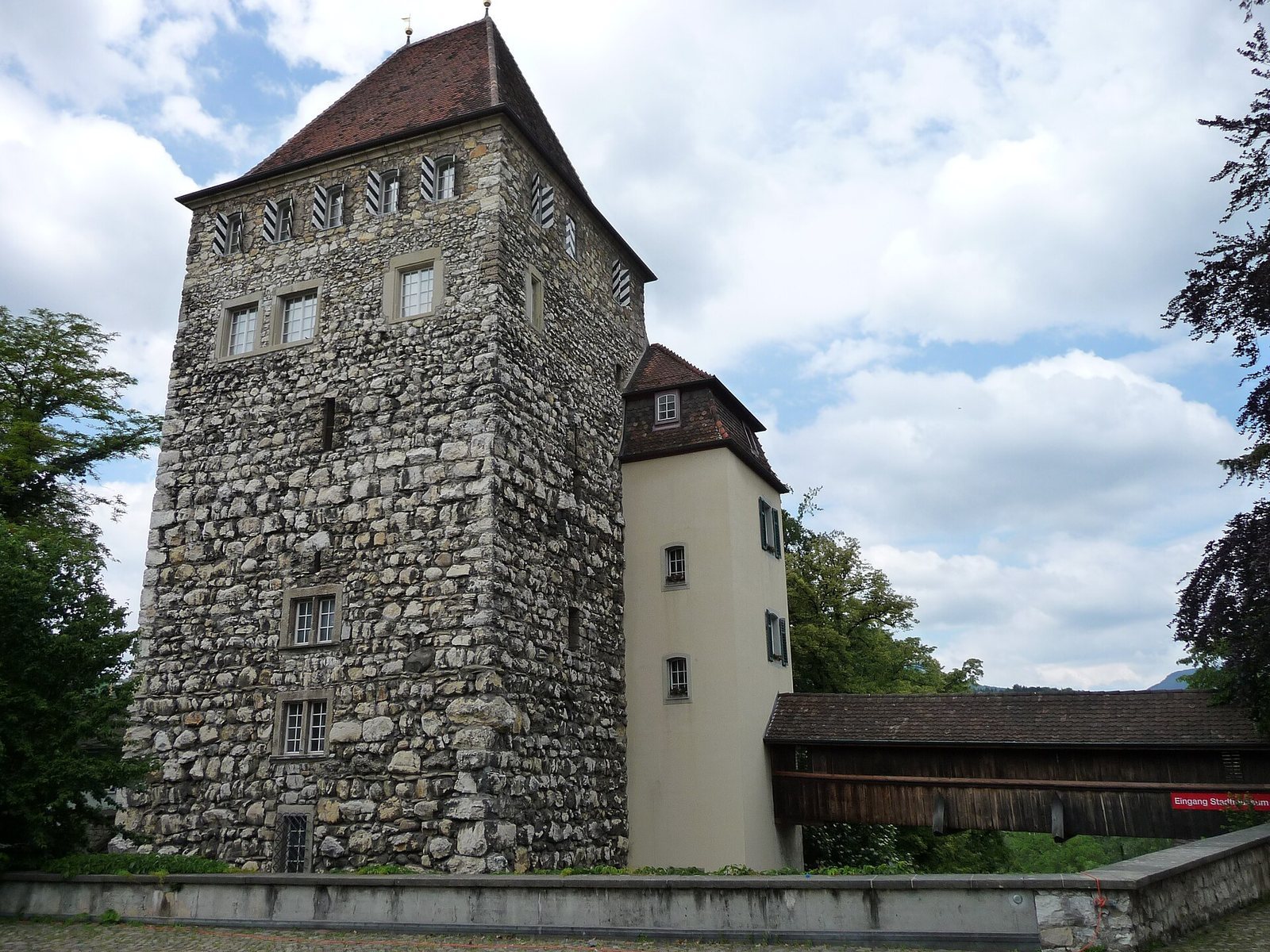
At the northeastern edge of Aarau’s old town, the castle is organized around a medieval tower, with a residential hall adjoining it to the north. Later additions stand to the east and west. The tower is built of limestone and roughly dressed boulders, while a covered wooden bridge crosses the former castle ditch.
Medieval Core
Residential Tower
The square tower measures 11.25 metres on each side and rises 25 metres. Its original stonework survives to a height of 17 metres, and roughly cut corner stones begin at the second storey. The south wall has windows in the Late Gothic style on its second and third storeys. The uppermost storey, added in 1790, was originally plastered. A roof sloping on all four sides crowns the tower.
Residential Hall
The hall adjoining the tower on the north dates to the late thirteenth or early fourteenth century. Its ground-floor walls are comparable in thickness to those of the tower, while the walls of its two upper storeys are substantially thinner. The building has a roof with partly sloping ends.
Later Additions and Museum
Stair Tower and Bridge
A stair tower attached to the main tower on the east dates to 1790. A covered wooden bridge built in the nineteenth century crosses the former castle ditch to reach it.
Museum Expansion and Exhibition
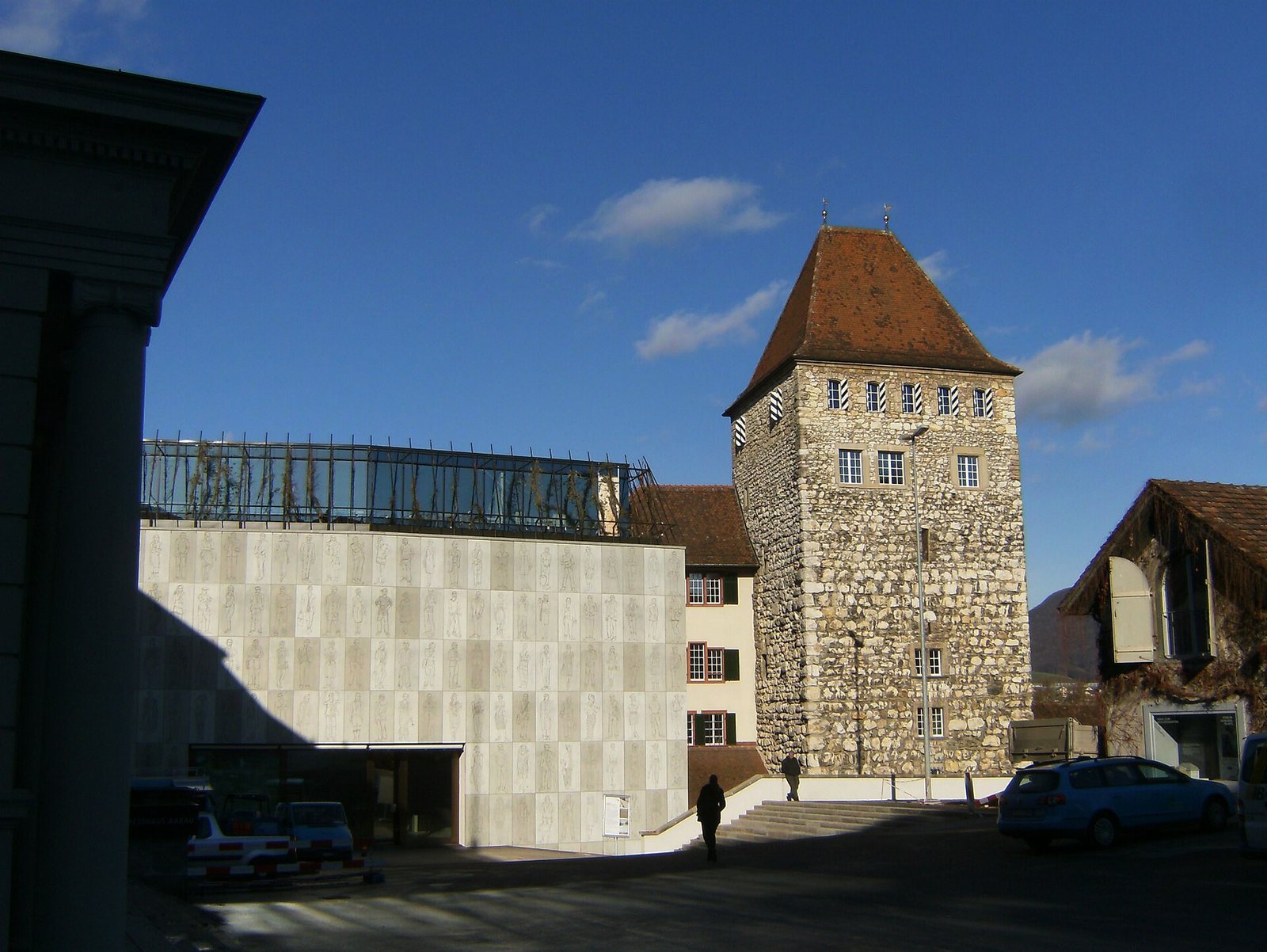
The museum expansion, carried out between 2012 and 2015, attached a new section to the west side of the old building and opened the museum toward Schlossplatz. The existing building was carefully renovated as part of the project. A new staircase and lift link the old building across five floors. The City Museum Aarau, successor to Museum Aargau, presents the permanent exhibition “100x Aarau,” which recounts the city’s story through 100 stories and more than 1,100 objects. At the end of the exhibition route, a permanent camera obscura (an optical device projecting an inverted exterior image) in the tower’s top storey casts an inverted view of the city. The installation is by Jacqueline Weiss and Kathrin Siebenhaar.
Nearby Buildings
A replica of a historic mill from Bözen was built southeast of the castle in 1975–76. The neighboring Haus zum Schlossgarten now houses Forum Schlossplatz and served as the seat of government of the Helvetic Republic, Switzerland’s short-lived republic during the French Revolutionary era, in 1798.