Chartreuse Notre-Dame des Prés: A Carthusian Monastery in France
Site at a Glance
- Popularity
- High
- Country
- France
- Primary era
- Medieval
- Eras represented
- Medieval, Early Modern
- Civilizations
- French
- Site type
- Religious
- Remains
- Monastery
On this page14 sections
History
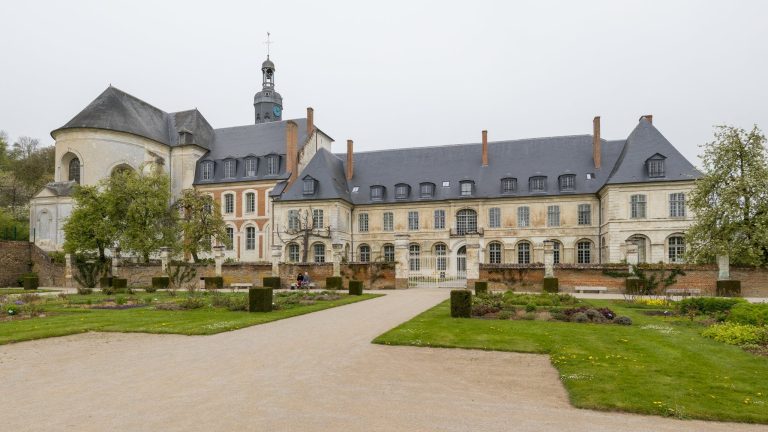
Chartreuse Notre-Dame des Prés is a Carthusian monastery in La Chartreuse, Neuville-sous-Montreuil, France, conventionally dated to 1325 and built in Romanesque and Gothic styles. It is the largest preserved Carthusian monastery in France. The Carthusian Order is a Catholic monastic community combining shared religious observances with life in individual cells. Dedicated to the Virgin Mary, the house belonged to the order’s Picardy province and the Diocese of Arras, Boulogne and Saint-Omer, an ecclesiastical district overseen by a bishop.
Foundation and repeated attacks
The foundation charter is dated 15 July 1324, while the monastery is usually dated to 1325. Its church was consecrated in 1338. The founder’s identity remains uncertain: possible candidates are Robert III, Robert VI, and Robert VII, Count of Boulogne and Auvergne. A legend linked to Robert VII tells that, after visiting the nunnery of Saint Austreberta at Montreuil-sur-Mer, he saw the face of Christ on Saint Veronica’s cloth turn toward him whenever he looked at it. The vision, the story says, prompted him to establish the monastery.
English forces sacked the house during fighting associated with the Battle of Crécy, in the period from 1346 to 1354. The battle, fought in 1346, was part of the Hundred Years’ War. Imperial forces attacked the monastery repeatedly between 1539 and 1571, and it was wrecked again in 1542. In 1584, Huguenots, French Protestants of the Reformed tradition, devastated it during the French Wars of Religion, sixteenth-century conflicts between Catholics and Protestants.
Rebuilding and suppression
Bernard Bruyant rebuilt the monastery in the latter part of the seventeenth century. It remained undisturbed until the early eighteenth century, but little of its older structure survived by the end of the 1700s. On 6 October 1767, Benoît-Joseph Labre was refused admission after spending several weeks as a postulant, a person preparing for possible entry into a religious community. He was beatified, an official step before sainthood, in 1860 and canonized by Pope Leo XIII on 8 December 1881.
The monastery was suppressed in 1790 during the French Revolution, and its monks were expelled. Church property was nationalized and sold. The Carthusians’ La Parthe farm at Bazinghen was auctioned on 11 December 1790 for its assessed value of 70,800 francs, and the monastery’s property was auctioned in 1791.
The Carthusians bought back part of their former estate before rebuilding. The Franco-German War of 1870, fought between France and Prussia and their German allies, caused further damage. Reconstruction began in 1872, using the original structure as its basis. The first stone was laid on 2 April that year, and prior Eusèbe Bergier helped advance the work to its completion in 1875.
Printing, expulsion, and new uses
From around 1880, the monastery housed the Carthusian Order’s general printing house for Europe. Its work included Carolo Le Couteulx’s Annales and an edition of the writings of Denys the Carthusian. The community also assembled a substantial library. Under the French 1901 Associations Law, legislation governing associations and religious congregations, the monks were expelled. They moved to the Charterhouse of Parkminster in England with the library, while the printing works went to the Camillians at Tournai.
From about 1905, Victor Morel adapted the former monastery for use as a hospice, then a sanatorium and hospital. He also established a phalanstery, a communal settlement associated with nineteenth-century social reform, intended for workers and employees and open to artists. Morel and Georges Clemenceau inaugurated the sanatorium in 1907. Writer Jules Rais organized the writers’ committee La Clairière, whose first meeting took place on 9 April 1908 under Jules Renard’s chairmanship. Artistic activity at the site ended in 1912.
Hospitals and Belgian civilians
From March 1915 to April 1919, about 5,000 Belgian civilians fleeing the fighting took refuge at the monastery. It became a Belgian civilian hospital with nearly 700 beds while typhus and Spanish flu were prevalent. A total of 599 people died there: 587 civilians and 12 soldiers. They were buried in a private pasture. The site was also used as a hospital during the Second World War. Hospital use continued until 1997, and hospice use is recorded through 1998.
The history of the Belgian burial ground drew renewed attention in 2014. A directional sign followed in 2015, a memorial plaque was installed in 2019, and the site was inaugurated as a garden of remembrance in 2022. In 2024, municipal archives yielded a burial list and cemetery plan recording 605 Belgian citizens. The records were handed to a representative of Belgium’s national archives to help locate descendants.
Later occupation and conservation
The Sisters of Bethlehem occupied the complex from 1998 to 2003. A proposed purchase in 2000 was cancelled after dry rot affected the roof framing. A private company acquired the site in 2008, with an association established that year holding 51 percent. The complex was listed as a historic monument in France in 1993 and received the Cultural Meeting Centre label in 2016.
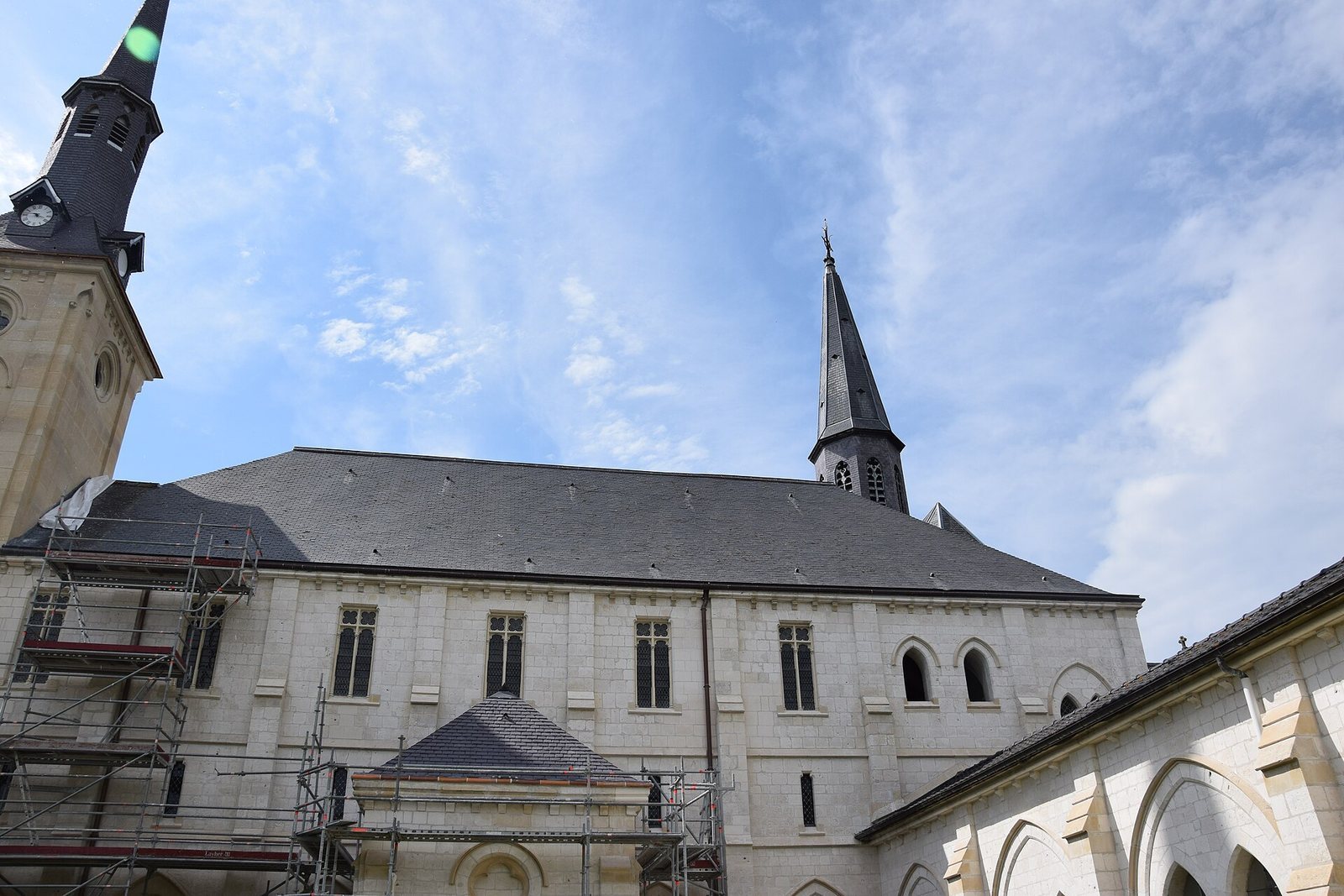
After the buildings had stood unoccupied for about two decades and deteriorated, including from fungal decay of the timber, the site association launched a restoration project in 2016. Major work began in 2017 and was divided into three stages: repairs to roofs and the exterior, treatment of floors and joists against dry rot, and interior refurbishment. The plan included relaying 380,000 roof slates, replacing 165 cubic metres of roof framing and using 350 tonnes of stone. The first stage was completed in 2023.
Remains
Monastic buildings
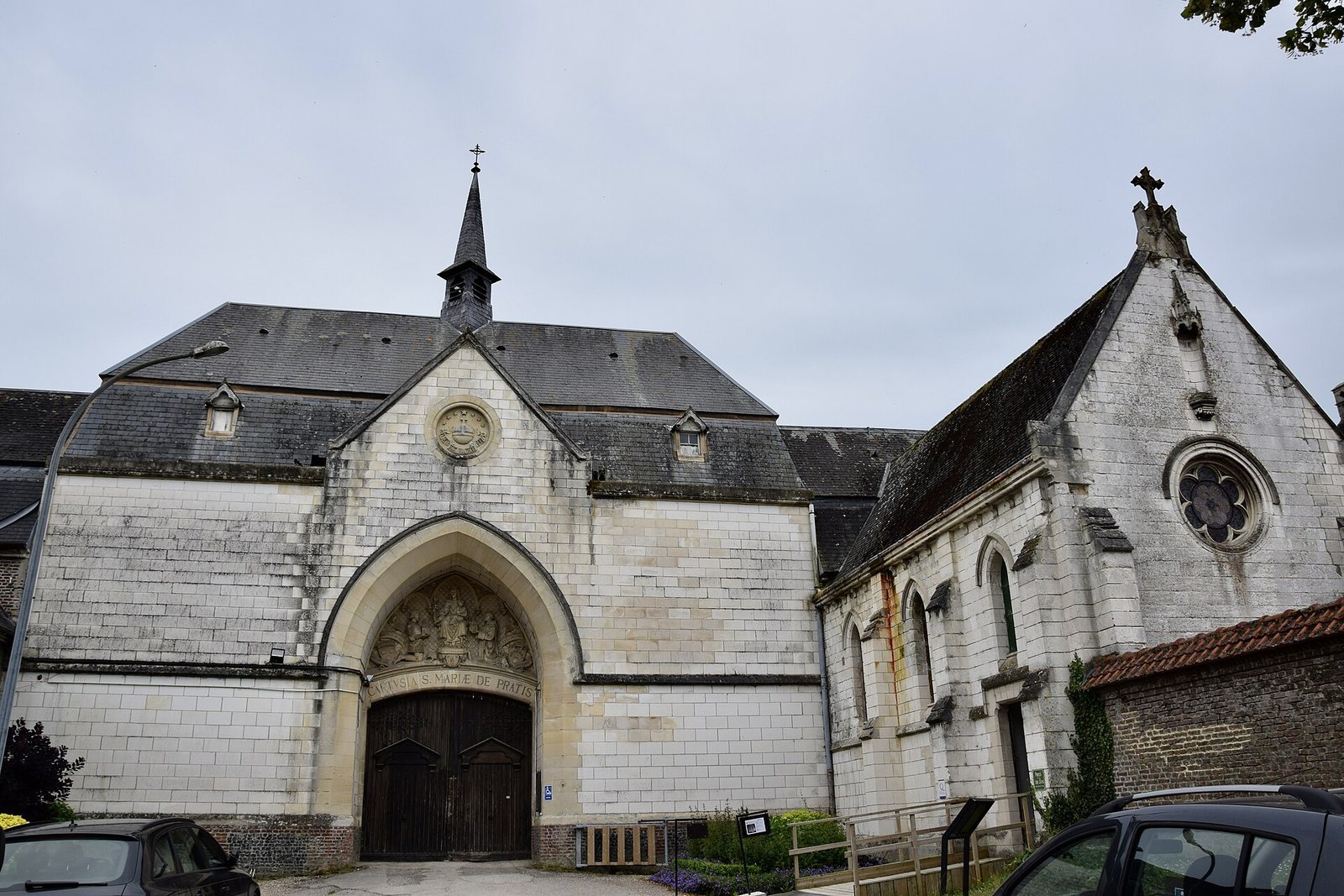
The complex occupies 12 hectares, with 2 hectares of built area. Its Romanesque and Gothic architecture reflects medieval styles associated respectively with rounded arches and heavy masonry, and pointed arches and ribbed vaults. Identified parts of the complex include an entrance portal and porch, a main courtyard, a cloister, a Carthusian cell and the monks’ section of the church.
Entrance portal and courtyard
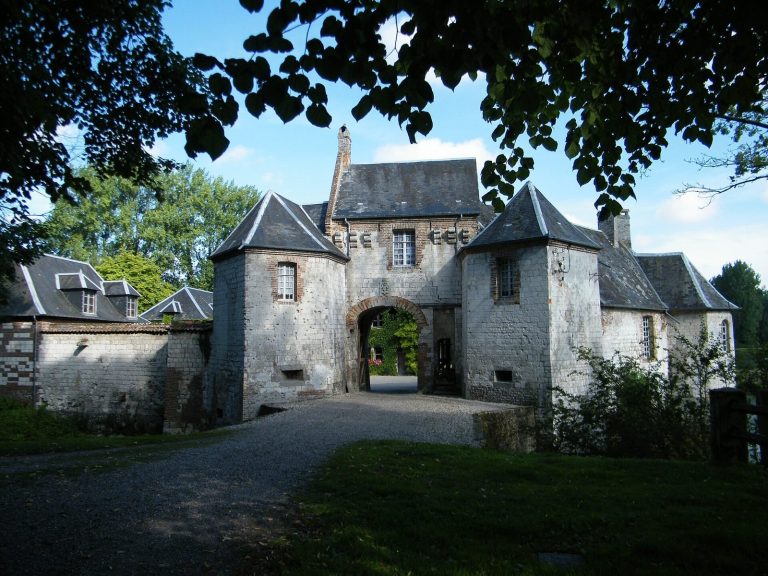
The entrance includes a portal with a tympanum, the decorated panel above a doorway, as well as a porch and the main courtyard. The tympanum depicts two episodes in the monastery’s construction history. The Virgin and Child occupy its centre; Robert III, Count of Boulogne, appears on the left as the financier of the first building, while Dom Charles-Marie Saisson, prior general of the Carthusian Order, presents the reconstructed monastery on the right. An explanatory panel dates the first construction to 1324 and describes the second monastery as rebuilt in 1870 after damage during the Revolution.
Cloister, church, and cell
The complex includes a cloister, a covered walkway around a courtyard, and a Carthusian cell reflecting the order’s life in individual quarters. The church retains choir stalls, fixed seats for monks or clergy, in the part reserved for the monks.
Gardens and burial grounds
Gardens
The gardens cover about 6,000 square metres and contain medicinal plants and old varieties of legumes. Since 2016, their management has been assigned to the Vavilov Institute in Saint Petersburg for biodiversity work.
Belgian burial ground and remembrance garden
The Belgian burial ground is a private pasture. Graves were initially marked, and a cross stood at the entrance, but traces of the cemetery disappeared during the 1950s and 1960s. The garden of remembrance is behind a chapel at the entrance to the lane leading to the monastery. Its commemorative plaques include one bearing the names of those who died.
Hospice cemetery
A separate cemetery near the former religious complex was used for hospice residents from 1950 to 1995 and has been abandoned since 1995. Volunteers and the municipality began restoring it in 2023 while seeking the identities of people buried there, who were not entered in the town’s civil records.