Château de Fressin: A Fifteenth-Century Fortified Castle


Site at a Glance
- Rating
- 4.3
- Popularity
- Low
- Country
- France
- Primary era
- Medieval
- Eras represented
- Medieval
- Civilizations
- Duchy of Burgundy
- Site type
- Military
- Remains
- Castle
On this page6 sections
History
Château de Fressin, also known as Château des Créquy, is a ruined fortified castle in Fressin, France. Jean V de Créquy built it during the fifteenth century as a seigneurial residence. He served as counsellor and chamberlain to Philippe le Bon, or Philip the Good, the fifteenth-century Duke of Burgundy, and was among the first knights of the Order of the Golden Fleece, a prestigious chivalric order founded in the Burgundian Netherlands in 1430.
The Créquy and Blanchefort-Créquy lordship
The castle remained in Jean V de Créquy’s family for generations. When Cardinal Antoine de Créquy, Bishop of Amiens, died in 1574, the property passed to his nephew Antoine de Blanchefort. He was required to adopt the Créquy name and arms, establishing the Blanchefort-Créquy succession at Fressin.
The region was repeatedly contested by France, Burgundy, and later Spain from the beginning of the sixteenth century. The Blanchefort-Créquy family continued to hold the lordship until Marguerite de Blanchefort-Créquy, who died in 1711. She was the widow of Charles Belgique Hollande de La Trémoille, fifth Duke of Thouars. Their daughter, Marie Armande de La Trémoille, married Emmanuel Théodose de La Tour d’Auvergne, Duke of Bouillon, in 1696.
Destruction and later ownership
Hesdin was captured and annexed to France in 1639. Balthazar de Fargues then defended the town against the Spanish, but in 1658 he feared an attack by royal French troops under Louis XIV. He ordered the destruction of Château de Fressin along with the castles of Beaurain, Labroye, Rollancourt, and Montcavrel. The wider conflict ended with the Treaty of the Pyrenees in 1659, which brought the Franco-Spanish War to a close and confirmed important territorial changes between France and Spain.
During the French Revolution, a period of political upheaval that began in 1789, the castle was sold as national property. Françoise Honorine Adélaïde de La Tour d’Auvergne d’Apchier, Marquise de Durfort Civrac, bought it back in 1811. Her children sold it in 1852 to Baron Seillère, a Parisian banker. The Seillère family sold the ruins in 1907 to Senator Jules Elby, who commissioned excavations in 1923 and 1924.
The ruins, including the ground and underground levels, have been protected as historic monuments since an order dated 8 August 1996. The site is owned by the Commune of Fressin.
Remains
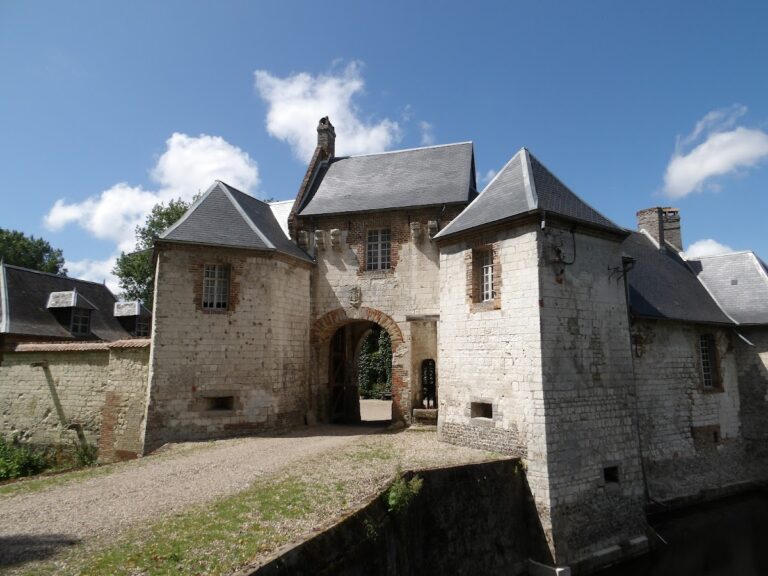
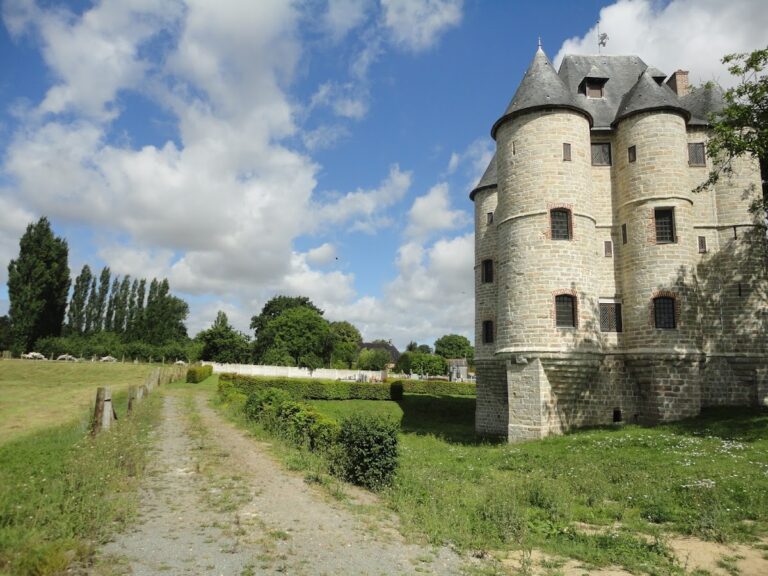
Château de Fressin survives as the remains of a substantial fifteenth-century fortress arranged around a rectangular courtyard. Its defensive design incorporated bastions, projecting fortifications intended to strengthen defensive fire against artillery, reflecting the changing requirements of warfare. Eight cylindrical towers, including a keep, were connected by curtain walls, the defensive walls running between towers or other strongpoints.
Fortifications and courtyard
The cylindrical towers and connecting walls enclosed the courtyard as a unified fortified complex. The keep served as the principal fortified tower, while the bastions strengthened the castle’s defensive system as artillery became increasingly important. The surviving fabric is ruinous, preserving the fortress’s principal ground-level arrangement and the relationship between its towers, walls, and courtyard.
Underground levels
Underground passages form part of the surviving castle remains and extend the archaeological evidence below the courtyard and fortifications. Together with the ground-level ruins, they preserve both the visible and subterranean levels of the former fortress.