Abbey of St Genevieve: A Monastery and Church in Paris
Site at a Glance
- Popularity
- Very High
- Country
- France
- Primary era
- Early Modern
- Eras represented
- Medieval, Early Modern
- Civilizations
- French
- Site type
- Religious
- Remains
- Monastery
On this page15 sections
History
The Abbey of St Genevieve was a Frankish church and later monastery founded by King Clovis I and Queen Clotilde in Paris, France, with construction beginning in 508. Its church developed through Romanesque and Gothic phases, and the abbey became a religious, scholarly, and landholding institution before its church was replaced by the Panthéon.
Foundation and early church
Tradition places the foundation in 502, when Clovis and Clotilde established a church dedicated to the Apostles Peter and Paul. In 507, Emperor Anastasius sent Clovis letters granting him the titles of patrician, a high rank, and consul, a senior civic office. After choosing Paris as his capital, Clovis planned the church at Clotilde’s urging and with the counsel of Genevieve, a Christian saint. Work began in 508, after his campaign against the Visigoths, a Germanic people whose kingdoms occupied former Roman territories.
Clovis died in 511 before construction was complete and was buried at the church as its founder. Genevieve died the following year and was laid in its crypt. Clotilde continued the building work. The basilica appears to have been completed around 520, when Remigius, bishop of Reims, dedicated it on 24 December. Clotilde also arranged for the burial there of her grandsons Theodebald and Gontran, sons of Clodomir, and her daughter Clotilde, the widow of the Visigothic king Amalaric. The grandsons had been killed by their uncles Chlothar and Childebert. When the queen died at Tours on 3 June 545, her body was brought to Paris and buried beside Genevieve.
The church hosted councils in the sixth and seventh centuries. One held in 577 was directed against Pretextatus, bishop of Rouen.
Monastery, raids, and the cult of Genevieve
By the ninth century, the basilica had become an abbey church, serving a large monastery with a writing room where texts were produced and copied. The library was in existence by 831, when it received three books. Its collection included works of history, literature, and theology.
The abbey stood outside the protected core of Paris and was exposed to Viking raids. In 856–857 and again in 861, the community fled with Genevieve’s relics, first carrying them to Athis and Draveil, then to Marizy-sur-Ourcq. During the first raid, attackers partly burned the basilica and adjoining buildings. The community returned around 863 after hurried repairs; books had also been lost or taken away during the raids.
When the Vikings approached Paris in 885, Parisians asked the community to bring Genevieve’s relics to a modest city oratory. This followed a similar practice involving the monks of Saint-Vincent and the relics of Saint Germain, a bishop of Paris. The invaders’ defeat was attributed to the saints’ intervention, strengthening Genevieve’s popular following. In gratitude, the bishop gave the community the oratory and its associated income, known as a prebend, attached to a canon’s office at Notre-Dame. Genevieve came to be regarded as Paris’s patron saint. The church’s dedication shifted gradually from Peter and Paul to Genevieve; the earlier title faded in the second half of the twelfth century and was no longer used by the thirteenth. In times of danger, processions also carried her reliquary through Paris.
Schools, reform, and medieval estates
The abbey was rebuilt in the twelfth century, in a period when it was associated with the Cluniac monastic reform movement. Around 1108, its theology school joined the schools of Notre-Dame Cathedral and the Royal Palace in the development of what became the University of Paris. Peter Abelard taught there from 1108 to 1113. In 1110, a philosophical and oratorical debate in the cloister pitted Abelard against his listener Gossuin of Anchin, who was judged the winner.
In 1147, secular canons served the church. King Louis VII and Pope Eugene III sought to restore discipline after witnessing disorder. At the request of Suger and Bernard of Clairvaux, Gildwin, the first abbot of Saint-Victor, sent that house’s prior, Odo. Some canons accepted the reform, and Sainte-Geneviève became a house of Canons Regular, clergy who lived under a religious rule while serving a church.
The abbey’s school and church also had judicial roles. A papal commission sat there from 8 August 1309 to 5 June 1311 during the trial of the Templars, a medieval Catholic military order. More than 589 members of the order came to defend it.
The abbey held lands and rights across the surrounding region. Its properties included the settlement of Saint-Médard and enclosed lands called Chardonnet, Coupeaux, Saussayes, and Cendrée, also known as Cendrier, as well as a parish cure at Vanves and land at Jossigny. In 1163, Pope Alexander III confirmed its lands, woods, and meadows at Bagneux and Fontenay. Bouchard V of Marly gave the abbey five arpents, a French land measure whose value varied by region, of vineyard land at Marly. In 1207, Abbot Jean de Toucy appointed Aubert Vien mayor of Fontenay to oversee rural affairs, paying him five sous from local rental income. In 1247, Abbot Thibaud freed the serfs of Bagneux, Aulnay, and Fontenay, with the approval of Louis IX.
By 1580, the abbey held lordship over part of Bagneux. On 10 February 1588, it sold Renée Baillet its rights at Fontenay to pay an ecclesiastical tax. The sale included rents, shares of crops, wine dues, judicial authority at several levels, and the abbey’s farm at Bagneux. The abbey kept its residence and enclosure at Fontenay and rights over its own lands, meadows, and vineyards in Bagneux, Fontenay, and nearby areas. The rights sold remained subject to feudal obligations to the abbey.
Early modern community and scholarship
In 1619, Cardinal François de La Rochefoucauld became commendatory abbot, an office that carried an abbey’s title and revenues without requiring residence in its religious community. In 1622, at the request of Louis XIII, Pope Gregory XV appointed him a papal commissioner to reform the Benedictines, Cistercians, and Canons Regular. This work was associated with the Council of Trent, the Catholic council held from 1545 to 1563 that addressed church doctrine and reform. The Congregation of France of Canons Regular was established in 1631, with Charles Faure as its first superior general. Sainte-Geneviève became its mother house, and its members became known as the Génovéfains. By the mid-seventeenth century, the congregation included more than 100 abbeys and priories. By the late eighteenth century, it comprised 67 abbeys, 28 conventual priories, two provostries, and three hospitals, with about 1,300 canons.
The abbey’s library grew into a major scholarly collection, with the third-largest book holdings in Europe. The astronomer Alexandre Guy Pingré served as librarian. During the nineteenth century, the books were transferred to the nearby Sainte-Geneviève Library. A parchment charter dated 1035, which confirmed the abbey’s privileges, is now held by the Archives nationales at Pierrefitte-sur-Seine. On 24 June 1667, René Descartes’s copper coffin was placed beneath a marble monument in the abbey.
Replacement church and revolutionary transformation
In 1744, Louis XV decided to replace the abbey church, which was in poor condition. Jacques-Germain Soufflot designed a new church, and construction began in 1755 over the old crypt. Soufflot died in 1780; his pupil Jean-Baptiste Rondelet completed the work after the French Revolution began, a period of political upheaval and secularization. The new church was converted into the Panthéon during the revolutionary period.
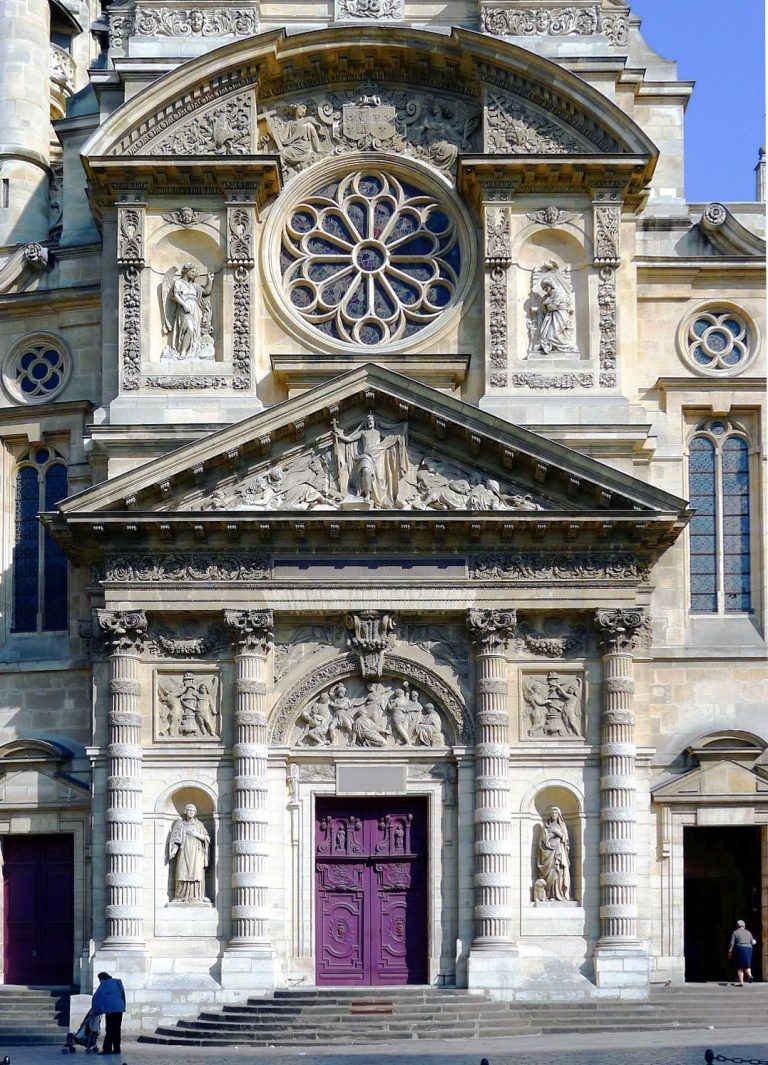
In 1790, the revolutionary assembly ended religious vows, expelled the abbey’s 39 canons, and closed the abbey and its school. The church was deconsecrated and renamed the Panthéon. In 1791, religious friezes and statues were destroyed, while the façade’s lanterns and bells were removed; patriotic statues and murals took the place of religious decoration. Genevieve’s relics were burned, and surviving remains were taken to Saint-Étienne-du-Mont. Her reliquary was melted at the Paris Mint in 1793, and her bones were burned at Place de Grève.
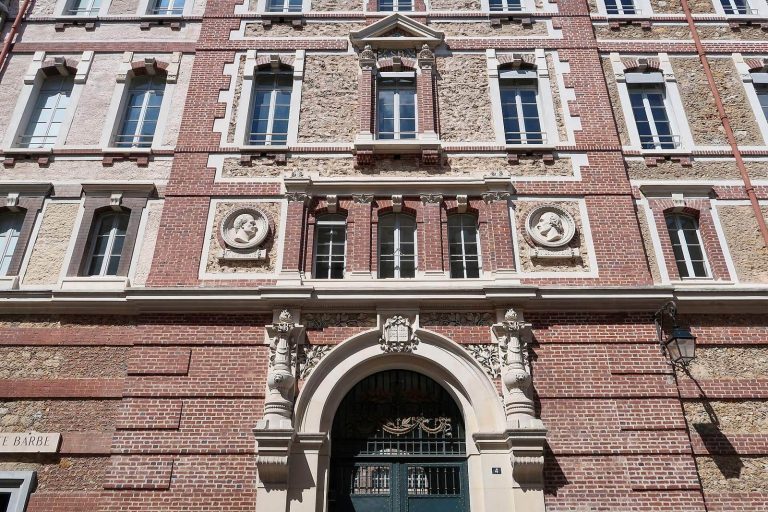
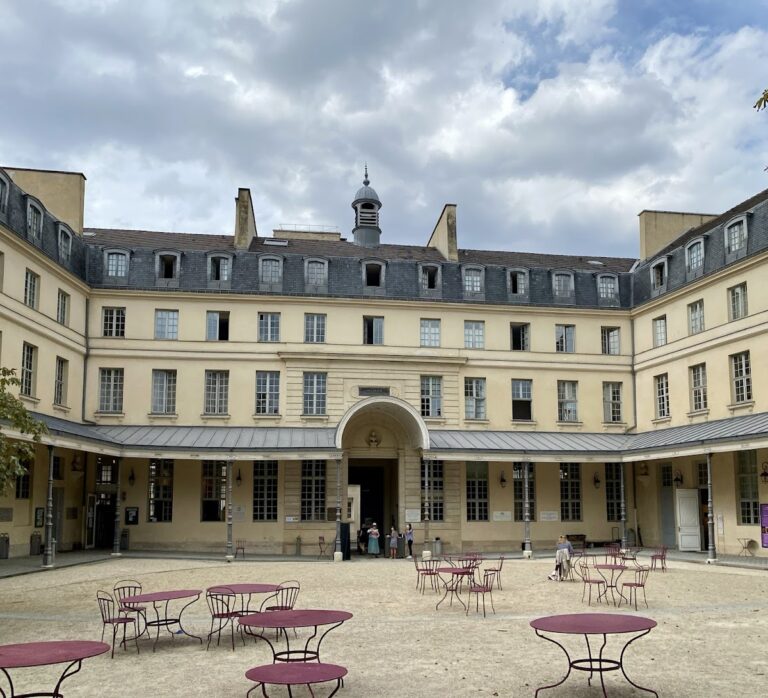
Most of the former abbey buildings were demolished between 1801 and 1807 to make way for Rue Clovis. The surviving structures were incorporated into Lycée Henri-IV, a French secondary school, which occupies the site. The remains received French historic-monument protection through listing in 1978 and classification in 1998.
Remains
The abbey occupied the summit of Mount Lucotitius on the Left Bank of the Seine, on ground associated with the forum and a pagan cemetery of the Roman town of Lutetia. Roman ruins were believed to remain beneath the later complex. The abbey’s buildings and gardens extended between Rue de l’Estrapade, Place du Panthéon, and Place Sainte-Geneviève. Its church was associated with Romanesque and Gothic architecture, while the surviving monastic fabric is incorporated into the Lycée Henri-IV.
Surviving monastic structures
Tour Clovis
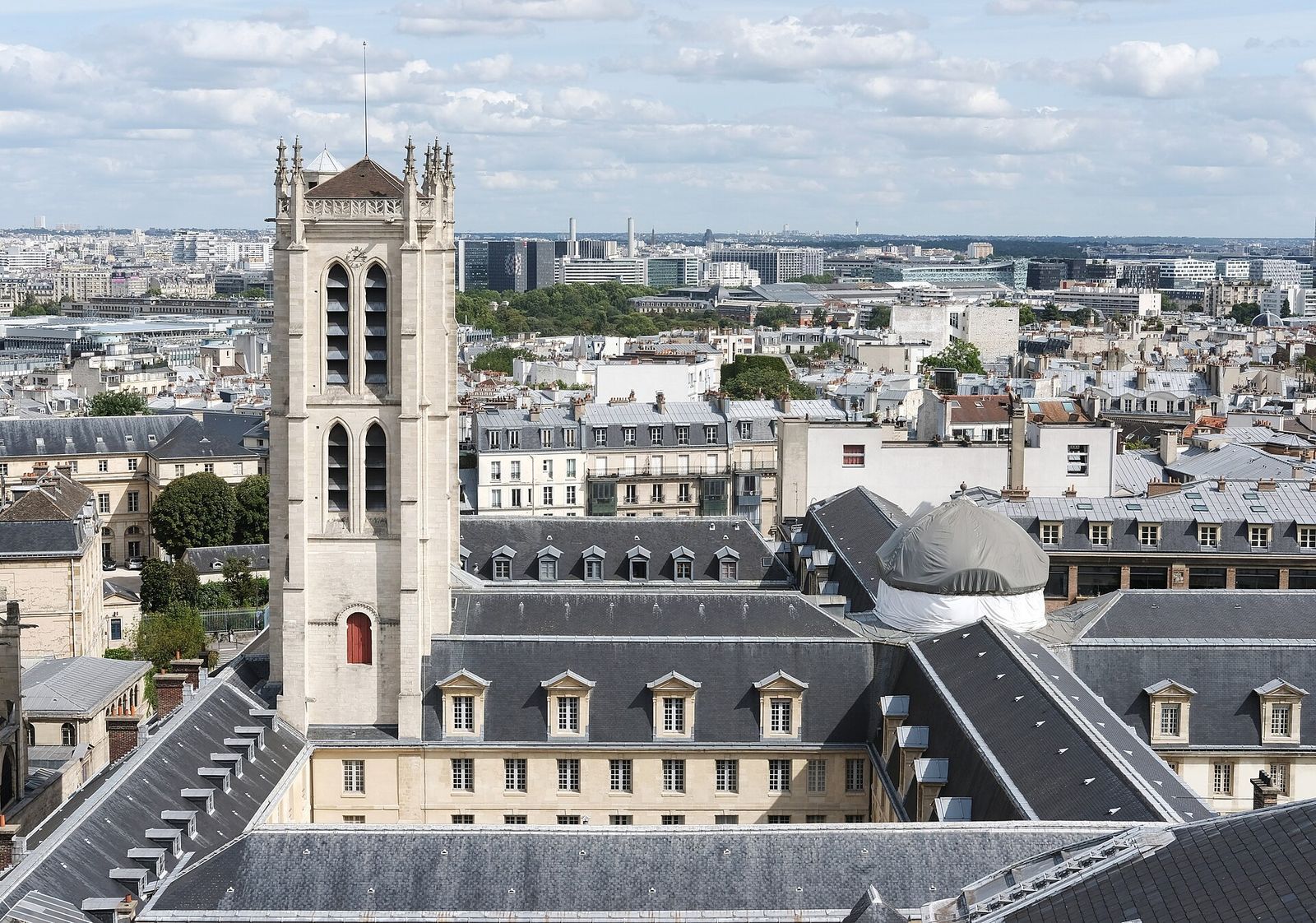
The base of the bell tower belonging to the eleventh-century church survives within the Lycée Henri-IV. Known as the Tour Clovis, it preserves part of the medieval church’s fabric.
Convent buildings and underground passages
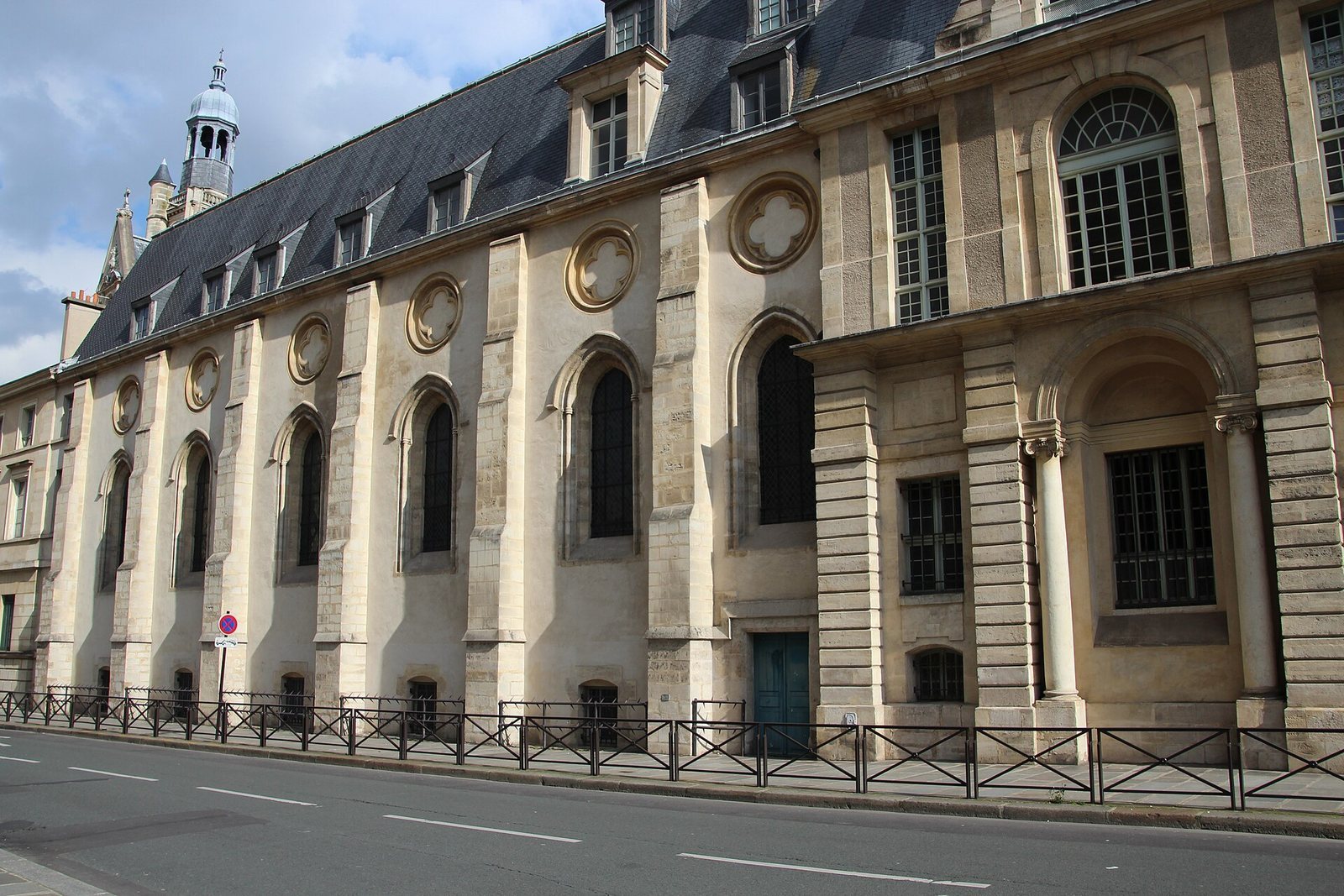
Former convent buildings from the thirteenth and seventeenth centuries form part of the school. The abbey complex also included a refectory and library; the former refectory became the site of the present chapel. Beneath the cloister, particularly under the convent buildings, passages cut into porous tufa extend below ground. Passages beneath the raised monastic cellar, directly under the present chapel, may have held Merovingian burials.
Church architecture and sculpture
The original Merovingian church probably had a basilican plan. A burial annex was probably attached to it and served as a burial place for Clovis and Clotilde. The church façade’s portal was altered in the twelfth and thirteenth centuries and decorated with statues. A statue of Genevieve, now at the Louvre, stood between statues of Peter and Paul. Several capitals from the nave are displayed at the Musée de Cluny. A depiction of Clovis and Clotilde as founders of the abbey is held by the municipal library in Valenciennes.
The replacement church
The replacement church, now the Panthéon, stands over the old crypt. Its plan is a Greek cross, with four equal arms around a central space. Tall Corinthian columns, whose capitals have leafy ornament, and a large dome define its interior. Concealed flying buttresses, exterior supports that transfer the thrust of a vault or roof, and stone vaulting support the dome. The design sought to combine the lightness associated with Gothic churches with the clarity and grandeur associated with Greek architecture. Experimental iron reinforcement was intended to allow larger windows. The design may also have drawn on St Peter’s Basilica and St Paul’s Cathedral.
Burials and devotional objects
Burial places
The abbey’s burial places received people from different periods. Those identified include Céran, bishop of Paris, who died around 615; Catherine of Alençon, daughter of Count Pierre II and lady-in-waiting to Queen Isabeau of Bavaria, who died in 1462; and Agnes of Savoy, aunt of Louise of Savoy and sister-in-law of Louis XI, who died in 1508. Others buried there included Benjamin de Brichanteau, bishop of Laon, who died in 1619; Charles Faure, first superior general of the Génovéfains, who died in 1652; Nicolas Lefèvre, priest and tutor to Philip V, who died in 1705; and Claude du Molinet, priest and historian of Brittany, who died in 1728.
Genevieve’s reliquary
The reliquary made for Genevieve was associated with the sculptor Germain Pilon and the goldsmith Bonard. In 1242, it weighed 47.237 kilograms of silver and 1.835 kilograms of gold.