Birseck Castle: A Medieval Episcopal Fortress in Switzerland


Site at a Glance
- Rating
- 4.5
- Popularity
- Low
- Country
- Switzerland
- Primary era
- Medieval
- External website
- Open
- Eras represented
- Medieval, Early Modern, Modern
- Civilizations
- Holy Roman Empire
- Site type
- Military
- Remains
- Castle
On this page13 sections
History
Birseck Castle is a medieval hilltop fortress in Arlesheim, Switzerland, built by the bishops of Basel in the thirteenth century. The present castle dates from 1243–1244, when Bishop Lüthold von Rötteln established a stronghold on a rocky hill beside Niedermünster Abbey. Its position reflected the political rivalry of the period, as the Counts of Frohburg sought to extend their territory into southern Sisgau.
Foundation and Episcopal Residence
A fortification may have occupied the hill during the twelfth century, although this remains uncertain. In 1239, Bishop Lüthold von Rötteln bought the hill to secure the site for a fortress. Burn marks in the oldest surviving masonry indicate that an earlier stone building stood there and was replaced after a fire. Some of its stones were reused, but the cause of the fire is unknown.
In 1245, Count Ludwig von Frohburg renounced his claims to the lands around Birseck and neighboring Reichenstein Castle. From the late thirteenth century, Birseck served as a residence for the bishops of Basel, who were both senior Catholic churchmen and territorial rulers. In 1270, Bishop Heinrich von Neuenburg invited the pope to the castle.
Damage, Pledging, and Administrative Use
The Basel earthquake of 1356 caused serious damage to Birseck. Deep cracks in the masonry may date from the earthquake, while fire-damaged reused limestone points to a major fire that may have followed it. The castle’s military importance later declined, and the bishops lacked the funds needed for its upkeep. In 1373 they pledged Birseck to the lords of Ramstein. The pledge was redeemed in 1435, after which the castle housed a court and the bishops’ bailiffs, officials responsible for administering the bishops’ secular territory.
The castle was enlarged during the fifteenth and seventeenth centuries. During the Counter-Reformation, the Catholic Church’s response to the Protestant Reformation, Birseck again served as an episcopal residence. Bishop Christoph Blarer used it intermittently around 1600.
Seventeenth- and Eighteenth-Century Transformation
The seventeenth-century rebuilding changed both the residential and defensive character of the complex. A larger gate complex was added, the residential buildings were reconstructed, a chapel was built, and the fortifications were strengthened. In the mid-eighteenth century, the drawbridge was replaced by a permanent stone bridge.
During the eighteenth century, poor maintenance reduced the castle’s practical importance. It ceased to function as a representative residence or an effective military installation. In 1763, Karl von Andlau ordered the episcopal bailiffs to move their seat to the village below the castle. Walls were strengthened and ceilings repaired in 1776, but these works remained modest.
Destruction and Later Restoration
In 1793, during the French Revolution, local residents burned or destroyed parts of the castle grounds and several buildings in the complex. The ruins were auctioned as national property in 1794 and were subsequently used as a source of building stone. Local farmers dismantled masonry for their own farm buildings.
Conrad von Andlau, the son of Karl von Andlau, and Canon Heinrich von Ligerz acquired the ruins in 1808. Nineteenth-century restoration altered the tower and chapel in a Neo-Gothic style. The same restoration program added the Knights’ Hall and crenellated wall crowns, giving parts of the castle a later appearance rather than preserving them as untouched medieval fabric.
Part of the northern outer wall collapsed in 2000, placing other buildings at risk. Repairs began that year, and a second restoration phase in 2005 included archaeological analysis of the buildings. The complex is managed by the Ermitage Arlesheim und Schloss Birseck Foundation. Birseck is protected as Swiss architectural heritage and as protected cultural property under inventory number KGS 01384.
Remains
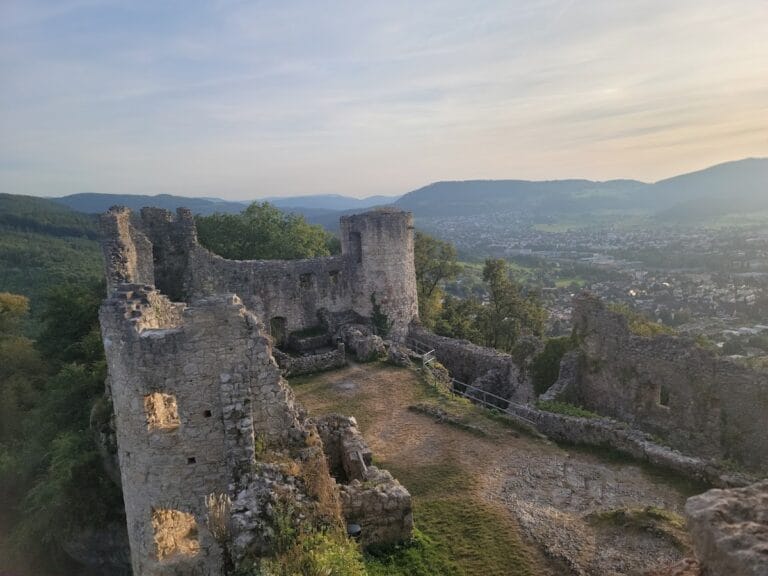
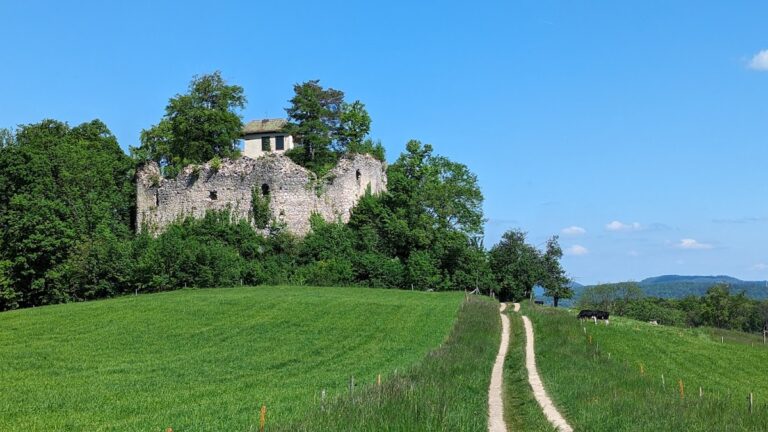
Birseck Castle occupies a rocky mountain spur above the surrounding valley and the Ermitage estate. Steep rocky ground protects the site on its west, south, northwest, and southeast sides. The complex is arranged as a partially restored core castle and a larger, more lightly fortified outer bailey, the area outside the castle’s central stronghold that commonly contained service, agricultural, and residential buildings. A farm with a dwelling and working agricultural buildings remains within the outer bailey.
Core Castle and Defenses
Rock-cut Ditch and Bridge
A deep ditch cut into the rock separates the core castle from the outer bailey. The ditch was crossed originally by a drawbridge, which was replaced by a permanent stone bridge in the mid-eighteenth century. This change belongs to the period when the castle’s defensive role was diminishing and its access arrangements were being altered.
Walls, Gate, and Tower
An irregular ring wall once enclosed the core castle. Part of this wall survives, together with a small tower near the gate. The original entrance was on the northeast side, while access is also possible from the Ermitage park. Surviving masonry consists of stone and brick. The oldest sections contain reused stones with clear traces of intense burning, linking the physical fabric to the earlier fire and rebuilding phase.
Residential and Religious Buildings
The fifteenth-century castle had crenellated upper wall sections. The seventeenth-century reconstruction created new gates, altered the residential buildings, added a chapel, and strengthened the defenses. The tower and chapel were later restored in the nineteenth-century Neo-Gothic style, so their present forms do not represent wholly authentic medieval fabric. The Knights’ Hall and the crenellated wall crowns also belong to this later restoration program.
Archaeological Context
Birseck-Ermitage Cave Burial
The Birseck-Ermitage Cave near the castle contains the oldest known Neolithic burial in Switzerland. The grave dates to approximately 5400–5000 BC and held the skeleton of a man aged about 30–40. He was buried on his back with flexed limbs. Several stones had been placed at his feet and may have formed part of a grave enclosure. No other grave goods were found with the burial.
Regional Castle Setting
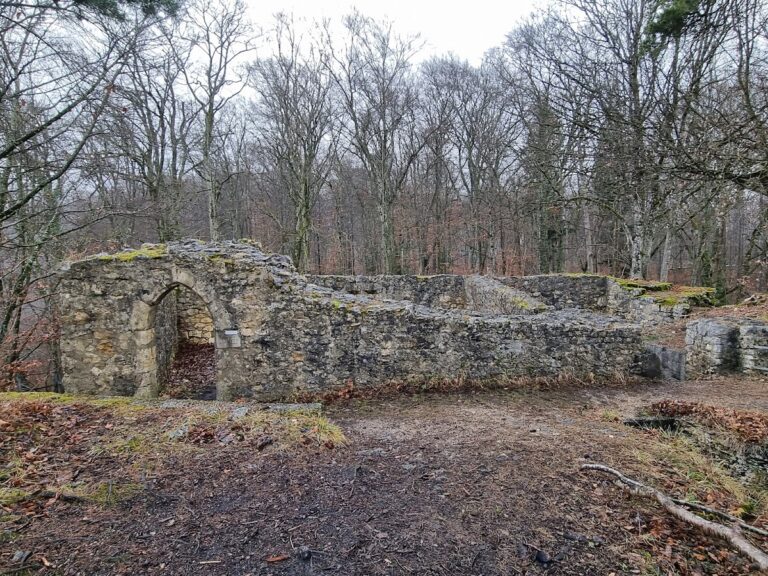
Birseck Castle forms part of a north–south line of four castles along the slopes of the historic Birseck region. The upper Birseck Castle is identified with Reichenstein Castle. The former rear and middle castles survive only as heavily ruined remains, including remnants of a round tower.
Nearby sites