Schauenburg Castle, Switzerland: A Medieval Hill Castle


Site at a Glance
- Rating
- 4.4
- Popularity
- Very Low
- Country
- Switzerland
- Primary era
- Medieval
- Eras represented
- Medieval
- Civilizations
- Holy Roman Empire
- Site type
- Military
- Remains
- Castle
On this page8 sections
History
Schauenburg Castle, also known as Alt-Schauenburg, is a medieval hill castle in Switzerland near Frenkendorf. The medieval Schauenburg family probably built it around 1275–1280 as the seat of a junior branch, during the expansion of the family’s land-clearance zone. It was the younger of two castles bearing the Schauenburg name in the area, although the later name Alt-Schauenburg reflects its ruined condition rather than its date of construction.
Foundation and short occupation
The castle was occupied for less than a century. Its position on a rocky spur formed part of the defensive and residential landscape associated with the Schauenburg family. The site’s use ended after the Basel earthquake of 1356, a major medieval earthquake that caused widespread destruction in the Basel region and damaged castles and other masonry buildings. Much of Schauenburg Castle was destroyed in the disaster.
After the earthquake, repairing Alt-Schauenburg was apparently considered uneconomical when compared with nearby Neu-Schauenburg, which was repaired instead. The damaged castle therefore became known as “old” Schauenburg because it was ruined, even though Neu-Schauenburg had been built earlier. Its goods and rights were apparently linked thereafter with Neu-Schauenburg, and the abandoned ruins gradually faded from memory.
Later history and rediscovery
The Schauenburger lords died out by the end of the fourteenth century, at the latest by 1385. The castle may subsequently have passed by inheritance to the knightly Vitztum family. Soundings carried out between 1949 and 1954 identified the location of the ruins again. Archaeological excavation followed, and the remains were conservatively restored in 1976–1977. Schauenburg Castle is listed as a Swiss cultural property of regional significance, class B.
Remains
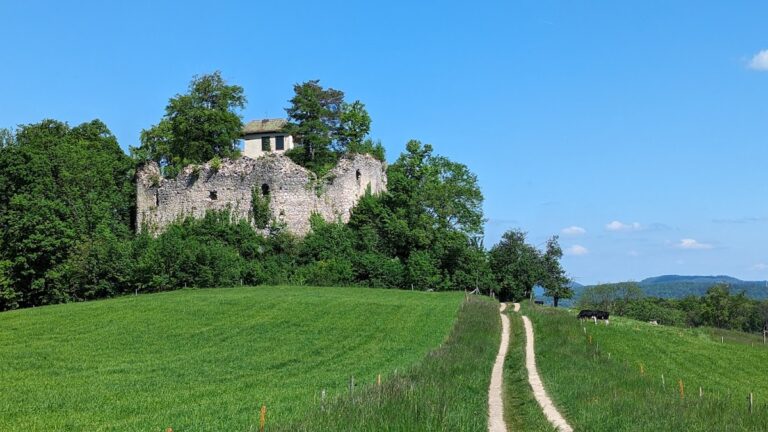
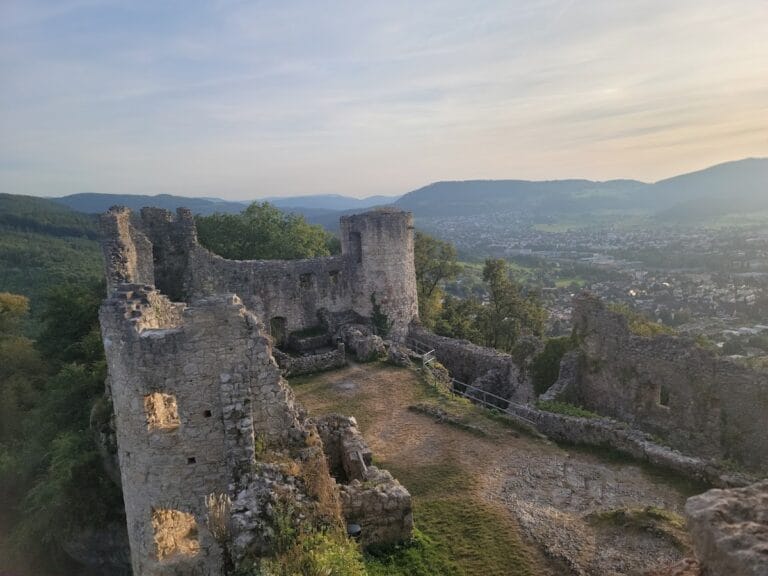
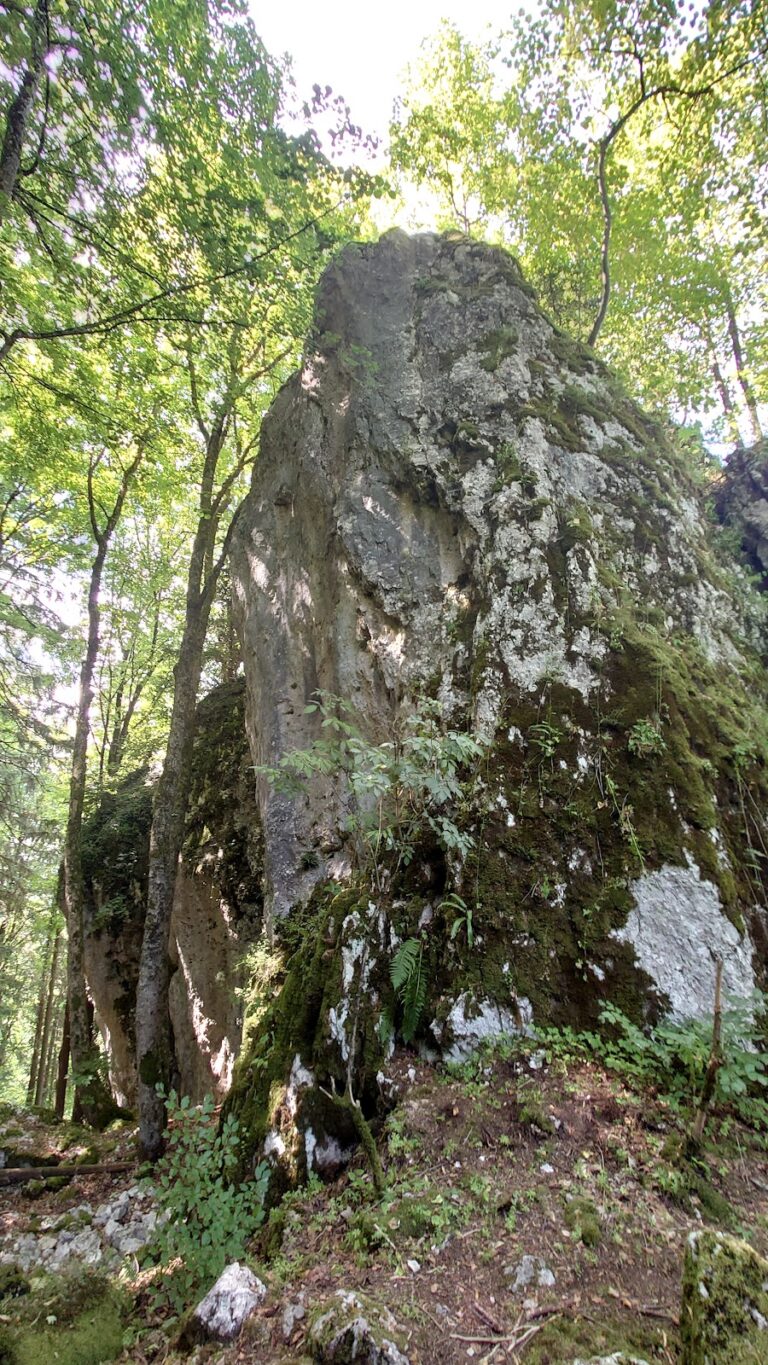
Schauenburg Castle is a stone-built hill castle at approximately 640 metres above sea level, occupying a spur on the Chleiflüeli near the Schauenburgflue and about 500 metres west of Schauenburg Bad. Near-vertical rock faces on the east, south, and north created formidable approaches. The core castle was enclosed on the south, west, and partly north by a neck ditch, a defensive trench cut across the narrow connection between a fortified spur and the surrounding ground. The ditch enlarged natural rock formations in places, while quarrying traces for building stone remain visible.
Core castle
Shield wall and entrance
Access to the core castle was provided at its south-western corner. The western side was dominated by a shield wall, a particularly strong defensive wall protecting the side most vulnerable to attack. It was up to four metres thick and ended at the north-western and south-western corners in round projections. The southern approach was also protected by this wall, whose corner protection formed a projecting semicircular section known as an avant-corps. The two vertical fissures in the rock beneath the castle existed before construction and were not caused by the earthquake of 1356.
Living rooms and rock-cut pit
Two living rooms stood behind the shield wall, each reached by an entrance at ground level from the castle courtyard. In the north-eastern corner of the core castle, a rectangular pit was cut into the rock and partly lined with masonry. Its function may have been either a cellar or a filter cistern, a reservoir using filtering material to clarify collected water. Many walls remain standing as conserved masonry.
Outer bailey
Traces of an outer bailey were found west of the core castle. This area contained two wooden buildings, possibly used for economic purposes. Its defenses were weak, or may initially have consisted of palisades. Together with the stone core castle, these remains show how the fortified spur combined a strongly protected residential area with a more lightly defended outer working space.
Nearby sites