Naegi Castle: A Tōyama Stronghold and Domain Seat in Japan
Site at a Glance
- Country
- Japan
- Primary era
- Early Modern
- Eras represented
- Medieval, Early Modern
- Civilizations
- Tokugawa
- Site type
- Military
- Remains
- Castle
On this page16 sections
History
Naegi Castle is a mountain stronghold on Mount Takamori in Japan, developed by the Tōyama family and later used as the seat of Naegi Domain. The castle was built between 1532 and 1555, during the Sengoku period, an era of conflict among regional warrior houses. Its history follows the Tōyama family’s expansion north of the Kiso River and its changing fortunes amid struggles for control of eastern Mino.
Tōyama expansion and early fortifications
In the early Kamakura period (1185–1333), the Tōyama ruled Ena District from Iwamura Castle. In 1242, Tōyama Kagemura relocated from the river’s western bank to its north bank to secure the family’s holdings, beginning its expansion in that area. Between 1331 and 1334, Tōyama Ichiun Nyūdō and his son Kagenaga built a fort on Mount Takamori. A few years later, from 1334 to 1336, Tōyama Kagetoshi built Hiroeji Castle at Uenaegi and received Prince Munenaga, a son of Emperor Go-Daigo and a leader of the Southern Court.
In 1473, Ogasawara Ienaga and Kiso Ietoyo entered eastern Mino from the Ina and Kiso valleys. The Naegi area then remained under the influence of the Kiso and Ogasawara families for an extended period. In 1524, Takashiba Kagenaga, a retainer of Ogasawara Sadamoto, was ordered to build Shinmei Shrine at Hibino. Two years later, Tōyama Ichiun Nyūdō Masatoshi moved his residence from Uenaegi to Mount Takamori.
Naegi Castle under the Tōyama
Tōyama Naokado, also known as Tōyama Masakado, built Naegi Castle on Mount Takamori between 1532 and 1555. He was the son of Tōyama Kagetomo, lord of Iwamura, who was married to Otsuya no Kata, the sister of Oda Nobunaga. In 1534, Matsuo Castle, the stronghold of the Matsuo Ogasawara family, fell. Ogasawara Sadatada fled to Kai Province and sought protection from the Takeda family, easing the Ogasawara threat to the Tōyama. In 1542, Tōyama Kageyasu donated a Buddhist bell to a shrine at Kasagi, reinforcing the family’s influence in Naegi.
In 1552, Naokado was adopted into the Naegi branch of the Tōyama family. He built Atera Castle at Tegano and later enlarged the fort on Mount Takamori, becoming lord of Naegi Castle. In 1555, the Kiso family submitted to the Takeda. Naegi Kantarō fought on the side of Oda Nobunaga at the 1560 Battle of Okehazama; he may have been Naokado. In 1565, Kantarō’s daughter Ryōshōin was adopted by Nobunaga and married Takeda Katsuyori, an arrangement intended to deter Takeda ambitions in Mino.
In 1569, Naokado invaded Hida Province on the orders of Takeda Shingen and fought the Miki family at the Battle of Daiitokuji. His forces won, but Naokado was wounded by an arrow after burning the temple there. He died the following year.
Warfare and the restoration of Tōyama rule
After Naokado’s death, Nobunaga ordered Tōyama Tomokatsu of the Iimama branch to succeed to the Naegi branch. In December 1570, Tomokatsu, Tōyama Kageyuki, Naegi Kantarō, and other Tōyama forces fought Takeda retainer Akiyama Torashige at the Battle of Kamimura. In 1573, Kiso Yoshimasa attacked a fort at Kawashiori and then Naegi. In February 1574, Takeda Katsuyori invaded eastern Mino, taking Takayama Castle, Naegi Castle, and sixteen smaller forts. Oda Nobutada recaptured Iwamura Castle and other castles in eastern Mino in 1575.
Mori Nagayoshi attacked Naegi in 1582 and again in 1583, when the castle fell. Tōyama Tomotada and his son Tomomasa escaped to Hamamatsu and entered the service of Tokugawa Ieyasu. After the Mori family was transferred to Kawanakajima in Shinano in 1599, Kawajiri Naotsugu, also called Kawajiri Hidenaga, became Naegi’s lord, with Seki Jihee as castellan, the official responsible for the castle. Kawajiri joined the Western Army led by Ishida Mitsunari at the Battle of Sekigahara in 1600 and was killed. Ieyasu then ordered Tomomasa to retake Naegi. The Tōyama regained their nearby ancestral holdings, and their return established Naegi Domain.
Domain rule and dismantling
Under the Tokugawa shogunate, Japan’s military government during the Edo period (1603–1868), Naegi Castle served as the seat of the domain’s administration. The Tōyama family held it for twelve generations. The domain’s resources were limited: in the late Edo period it was the only castle-holding domain assessed at 10,000 koku, a measure of rice yield and the usual threshold for a domain governed by a daimyō, or powerful territorial lord.
In 1869, after domain lands and population registers were returned to imperial rule, lord Tōyama Tomoyoshi became governor of the domain. The domains were abolished in 1871 and replaced by prefectures; Naegi Castle was abandoned and dismantled. Its furnishings and most of its timber were sold at auction to help pay the domain’s substantial debts. Tomoyoshi received the hereditary rank of viscount in 1884. The ruins became a National Historic Site in 1981, and in 2017 Naegi was included as entry 142 in the Continued Top 100 Japanese Castles selection.
Remains
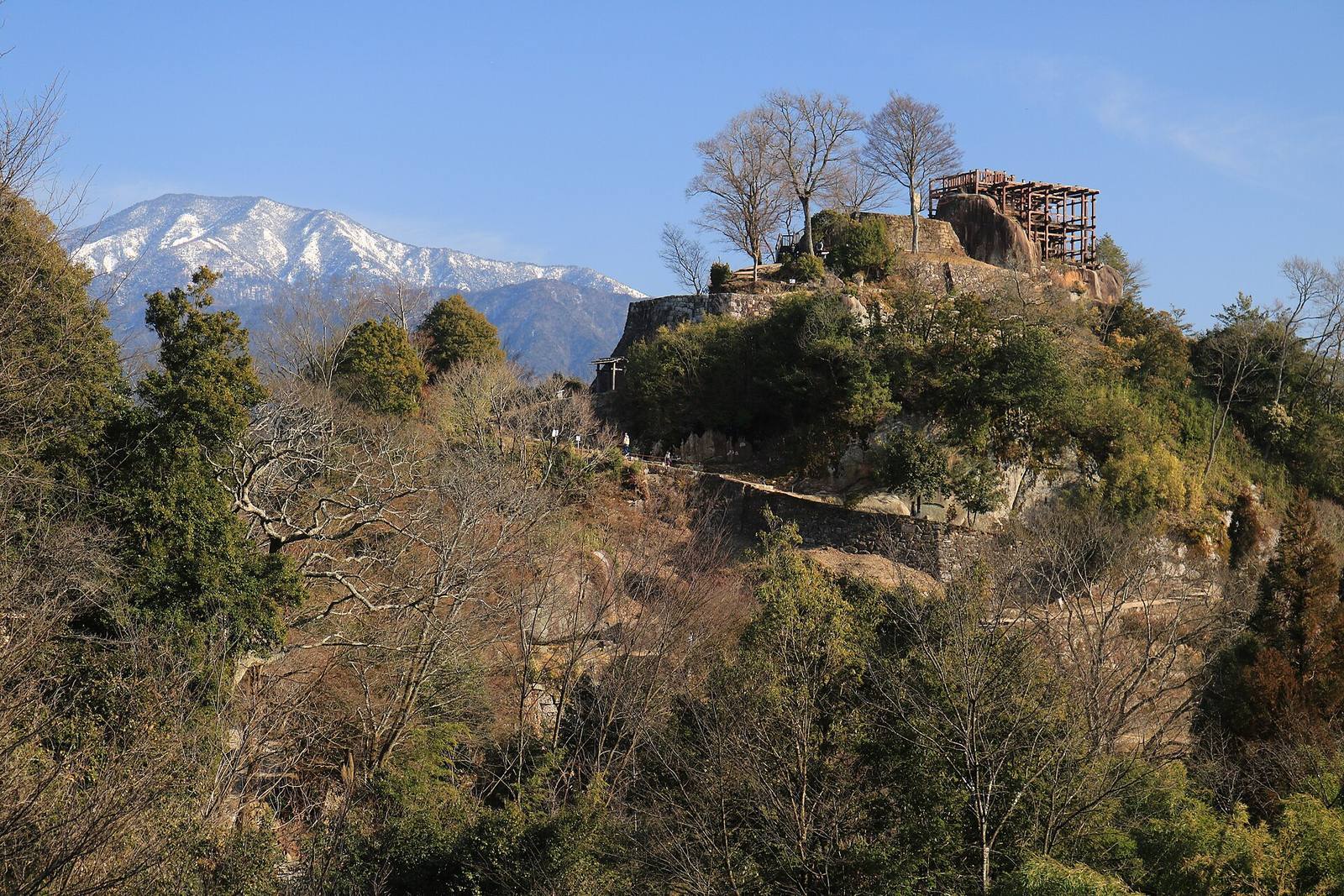
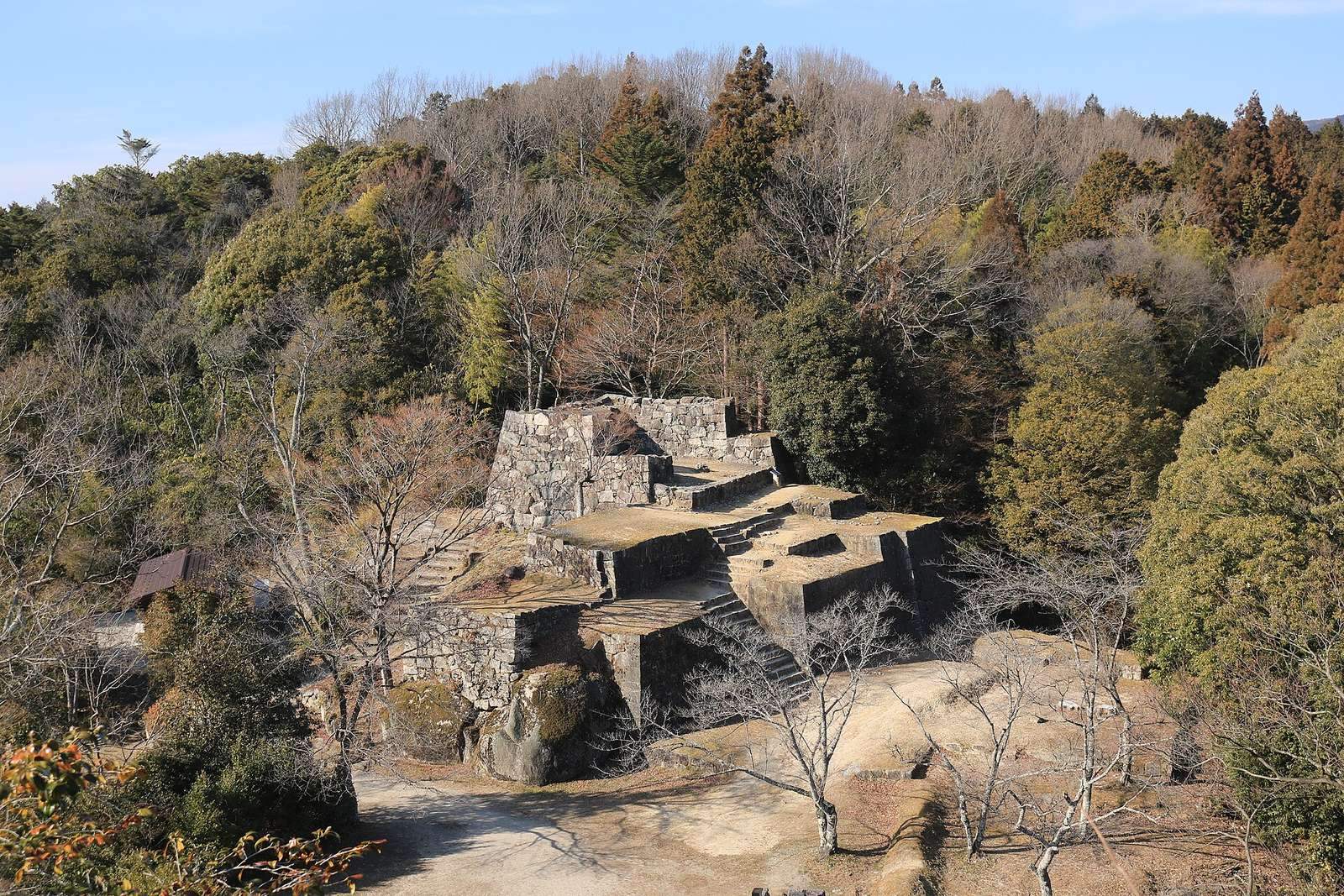
The castle occupied a steep, rocky height whose enclosures, walls, and buildings followed the mountain’s uneven contours. Stonework and large natural boulders formed part of its defenses, while raised timber supports helped accommodate the rocky ground. The inner precinct covered about 20,000 square metres; the full area, including the outer precinct, extended to about 350,000 square metres.
Mountain setting and defenses
Terrain and approach
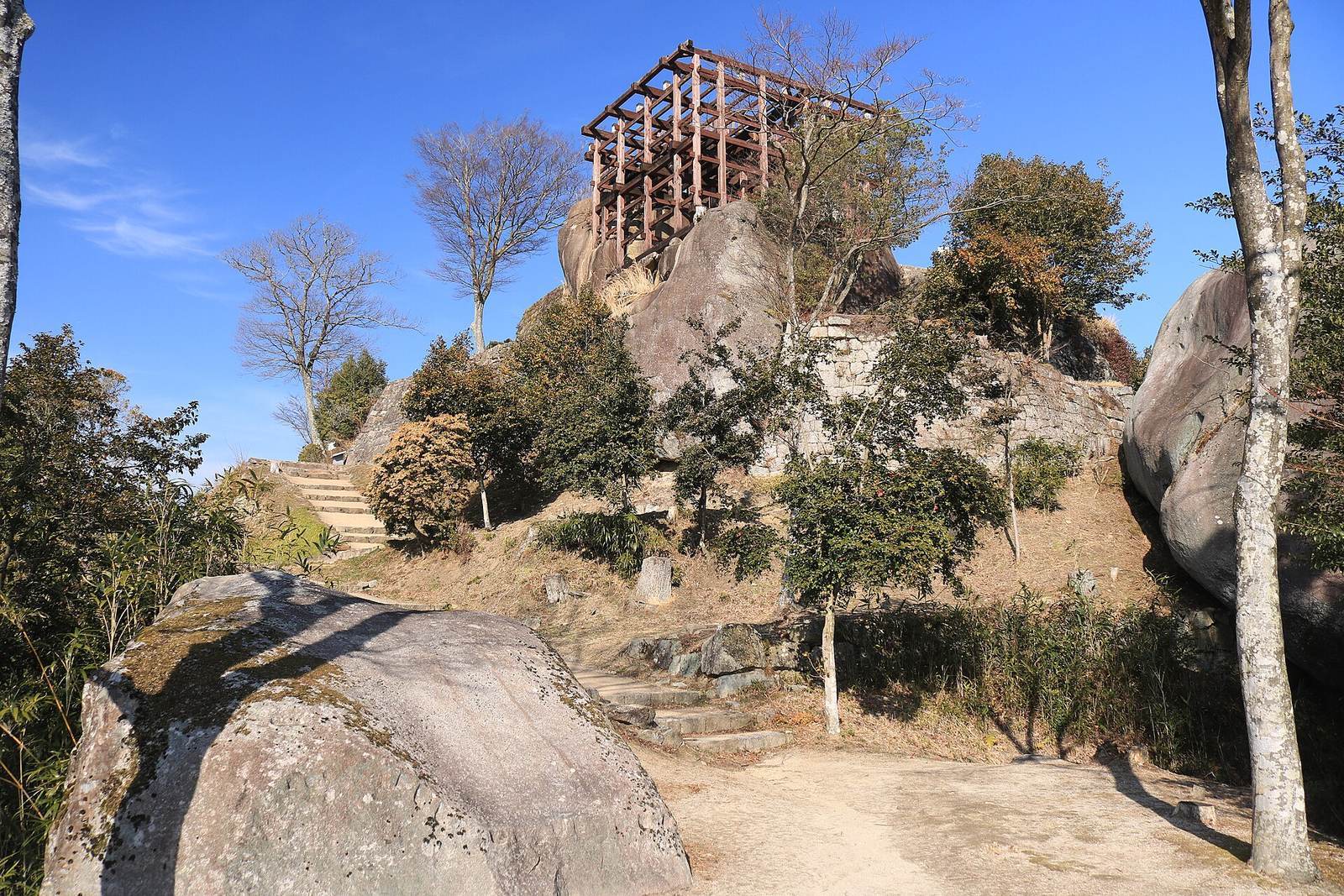
Mount Takamori rises to 432 metres on the north bank of the Kiso River, which flows east to west through Nakatsugawa. The summit stands about 170 metres above the river, which provided a natural moat along one side of the castle. With little level ground available, builders incorporated exposed rock and boulders into the fortifications. In places, they used kakezukuri, a raised timber method for supporting structures on steep or rocky ground.
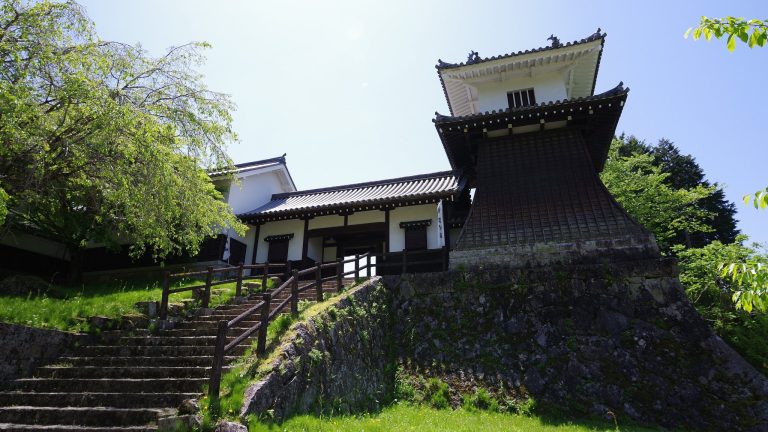
The main gate stood at the mountain’s foot on the river’s right bank. From there, the main approach climbed about 150 metres in elevation over roughly 500 metres, following a steep route with forty-eight turns. A castle gate stood at the eastern end of the town’s streets. Beyond it, the route passed below the keep platform and continued down a winding slope to a south gate at the foot, near a bridge over a stream.
Enclosures and stone walls
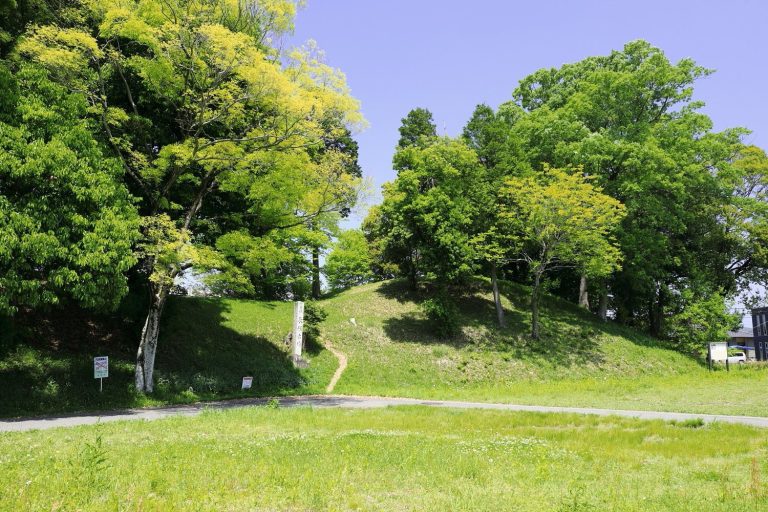
The summit was enclosed by a second precinct arranged in a spiral, while the palace stood lower on the mountain’s western side. Stone walls survive in the principal, second, and third enclosures, along with sections of the moat and traces of the Ōyagura defensive turret, Kazefuki Gate, and Watakura Gate. The southwestern walls of the principal enclosure date to the Sengoku period; some outer walls were renovated during the Edo period.
Keep platform and surviving structures
Keep platform
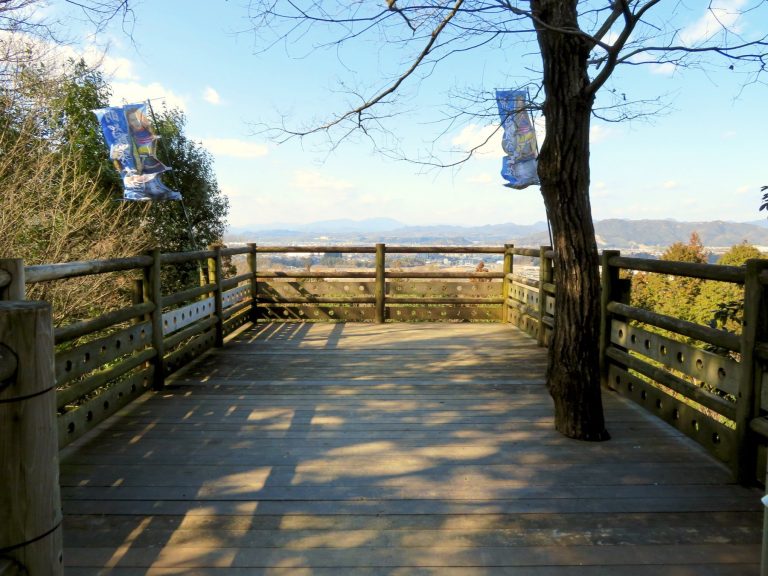
The main keep stood on a timber-framed platform built over the summit rocks. Completed in 1718, the tiered structure measured about 9 metres wide by 11 metres long, with one storey above ground and two basement levels. The keep itself no longer survives. A reconstructed timber framework on the platform now serves as a lookout over Nakatsugawa and the Kiso River. Large natural rocks also form part of the stonework at the keep platform and the Ōyagura; one of the named rocks is Umaarai Rock.
Water supply and gate remains
Sengoku Well lies below the Hishiyagura turret platform. The main gate’s door and pillars have survived and are displayed at the Nakatsugawa City Naegi Tōyama Historical Museum below the castle site. The museum also contains a model of the castle before its dismantling.
Castle town and red-earth walls
Town districts and growth
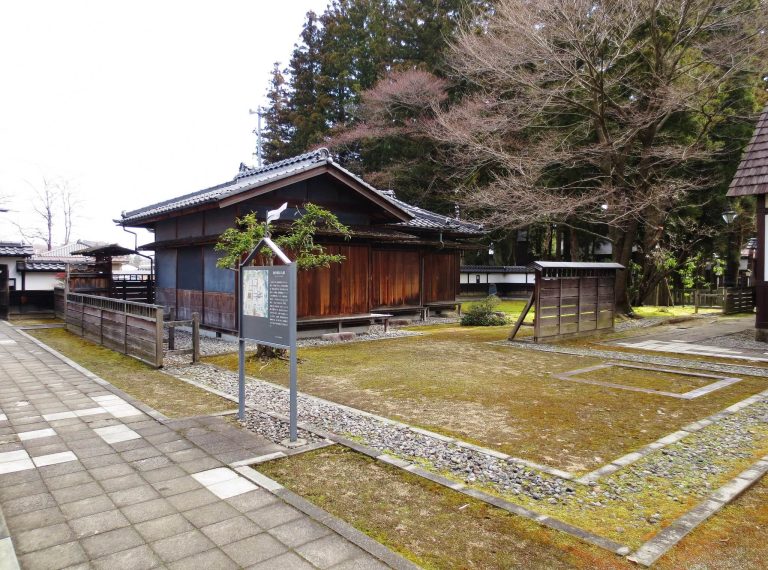
The castle town spread below the mountain’s northern foot, with samurai residences located both within and beyond the castle precincts. Their dispersed pattern indicates that retainers were not required to concentrate in a single castle town. The districts included the Upper Town, New Town, Lower Town, and Gun Town. The Upper Town had nine houses until around the Genroku era, after which additional town districts developed; it later became known as Upper Street. The New Town included the Hirokoji crossroads, which was turned into an open firebreak after a fire during the Kansei era and later renamed Honmachi.
Gun Town and Foot-Soldier Town began as areas associated with foot soldiers’ homes and gradually developed into streets of townhouses. Below a branch road toward Suzugaito, a one-sided street once consisted of three or four houses; buildings extended along both sides during the Bunsei era. Willow Town grew around a bend below Honmachi’s second block. In 1819, a resident of Takayama petitioned the Tōyama family to establish a weaving business and built townhouses there. The district’s name combined the zodiac sign for the petition year with a character from the petitioner’s surname.
Streets and town regulations
The town’s streets extended for about four chō, a traditional Japanese measure of length. They entered from the north and turned east through the upper and lower districts. Samurai were generally barred from entering townhouses freely, although they could shop there. Orders also prohibited samurai and their families from attending theatrical performances in the town or villages, except when the lord’s wife attended.
Red-earth walls and tradition
The castle’s walls exposed red earth rather than the white plaster used on many Japanese castles, giving Naegi the alternative name “Red Wall Castle.” A local tradition blamed the color on a dragon in the Kiso River that disliked white walls and sent storms to strip away their plaster. A later telling describes a lord watching from the keep as the dragon breathed hot air onto the castle. The domain’s limited finances offer a practical explanation for leaving the walls without plaster.