Palazzo dei Priori: Fermo’s Historic Municipal Palace
Site at a Glance
- Country
- Italy
- Primary era
- Medieval
- Eras represented
- Medieval, Early Modern
- Civilizations
- Papal States
- Site type
- Civic
- Remains
- Palace
On this page9 sections
History
Palazzo dei Priori is a municipal palace in Fermo, Italy, whose construction began in 1296. Its medieval origins and sixteenth-century Mannerist façade reflect its long development as a center of civic government. Mannerism was a sixteenth-century style marked by deliberately stylized forms.
Medieval foundations and civic government
The palace developed by joining two earlier buildings. To the north stood a thirteenth-century house with a tower belonging to Rinaldo di Giorgio; to the south was the church of San Martino. The church belonged to the monastery of San Savino on Vissiano Hill in 1154, and the monastery was later demolished. San Martino gave the square its medieval name.
Fermo’s municipal government planned a civic palace on the site, known as the Palazzo del Capitano del Popolo, or Palace of the Captain of the People. The title referred to a civic office in medieval Italian communes. The College of Priors, the city’s executive governing body, had exercised power since 1297 and began meeting in the palace in 1396. It remained there for about four centuries, until the political upheavals of the French Revolution brought the old institutions to an end.
Sixteenth-century rebuilding
The façade was reconstructed in the first half of the sixteenth century, with work carried out in 1525. The palace also had a bell tower, which was later demolished. It may still have been standing in the seventeenth century.
Library and civic collections
The Hall of the World Map and its old books and manuscripts became the nucleus of a seventeenth-century library collection. Cardinal Decio Azzolino the Younger began the collection with help from his friend Christina, Queen of Sweden. The room was created in her honor while she was staying as his guest.
The city library was installed in the palace from 1890, and the municipal picture gallery moved there during the 1980s. Today the building serves municipal representative functions and houses the civic art gallery, the archaeological museum, and part of the Biblioteca Spezioli, including its older holdings. In 1999, an exhibition on International Gothic art in Fermo and its surrounding area presented previously unknown works from outlying churches and museums.
Remains
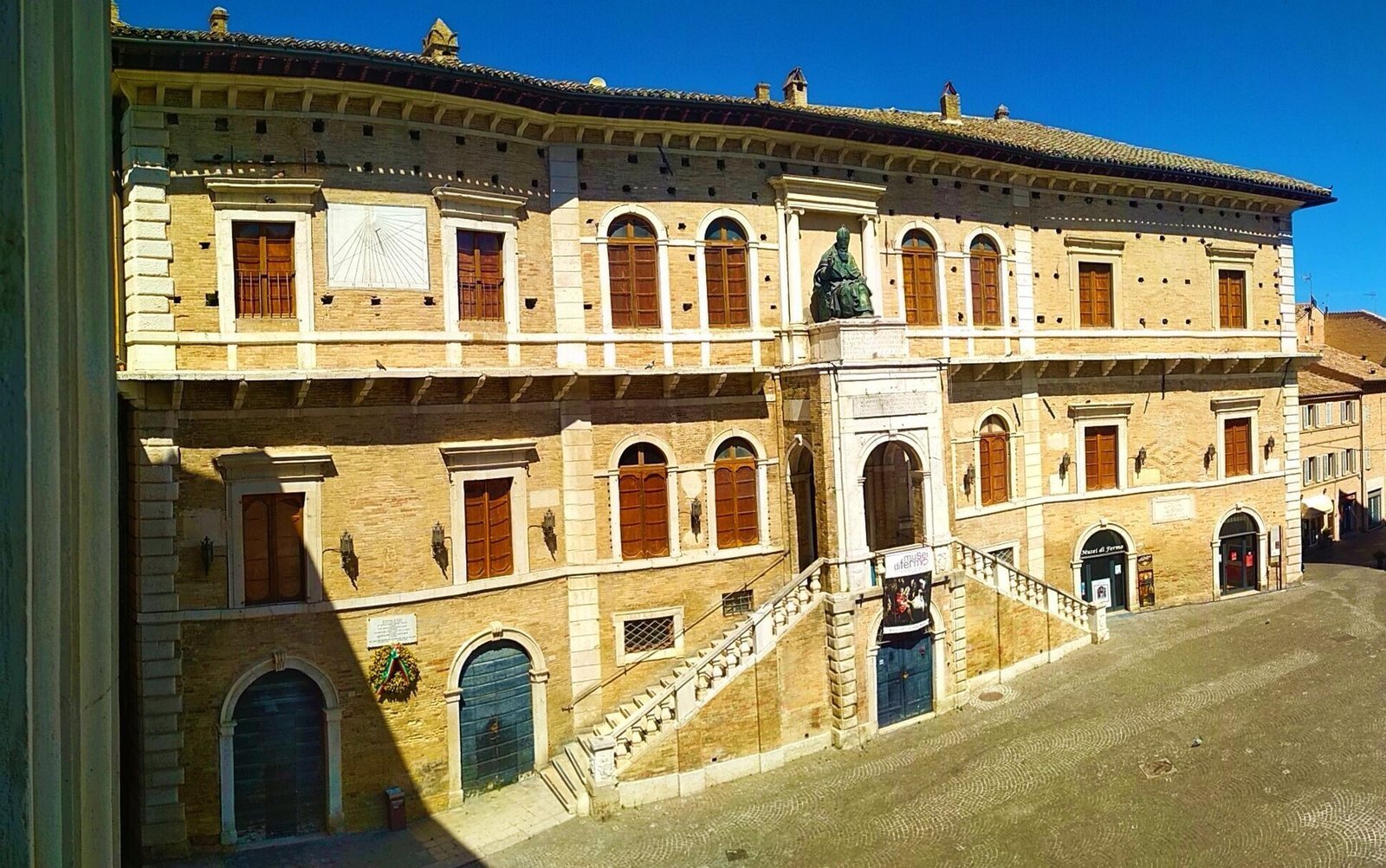
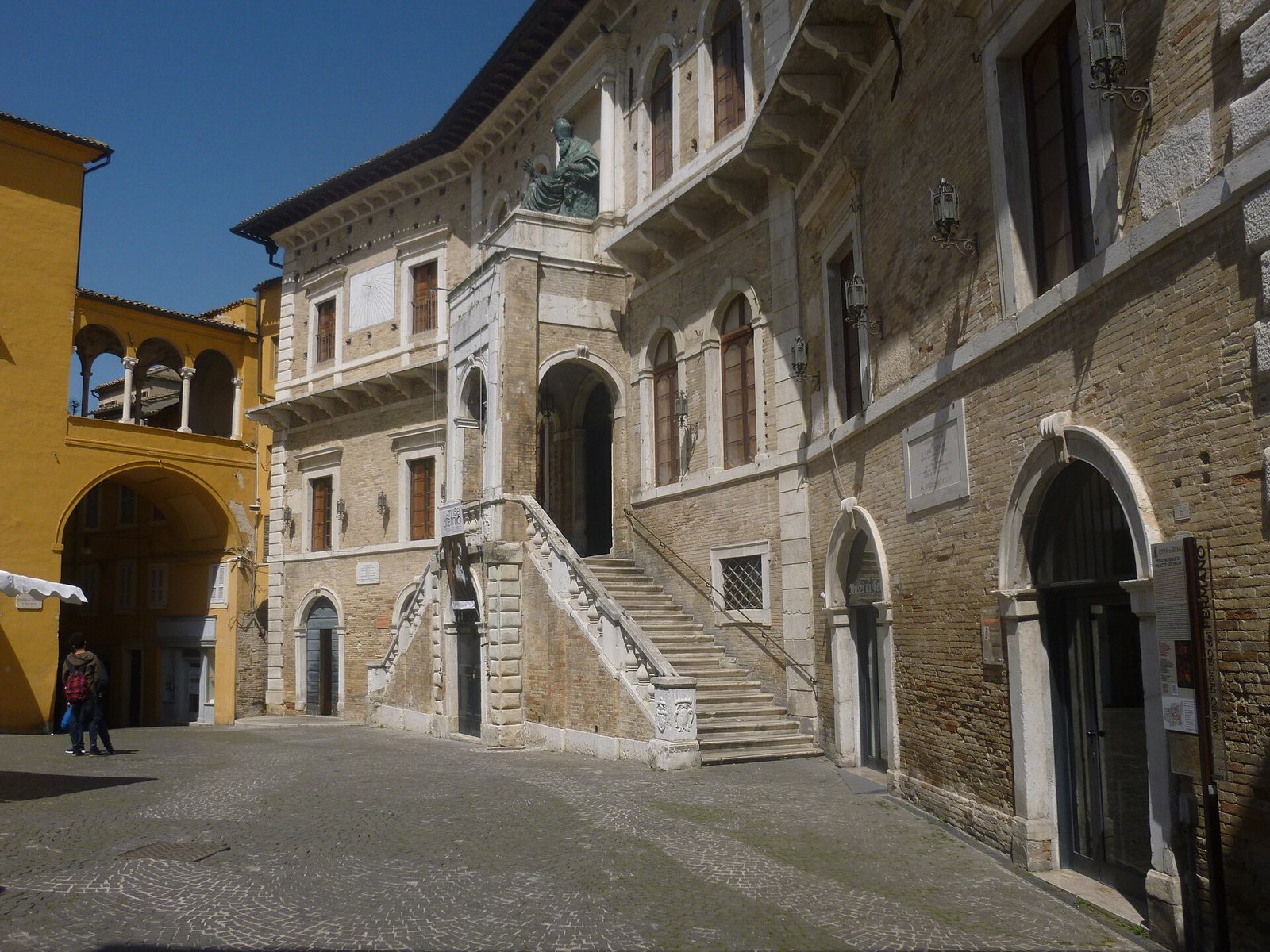
The three-storey palace faces Piazza del Popolo. Its frontage stands about three metres above the level of the original buildings and includes a distinctive fan-shaped opening from the sixteenth-century design.
Entrance and connection to the square
A double central staircase leads to the entrance loggia, a covered gallery open on one or more sides. Above it stands a bronze statue of Pope Sixtus V, made by Accursio Baldi between 1588 and 1590. The Marche-born pope is commemorated for his election and the foundation of the Studio of Fermo, a historical term for a center of higher learning. An elevated covered gallery called the Passetto links the palace to the Palazzo degli Studi (Palace of Studies) at the far end of the square.
First-floor rooms
The first-floor reception rooms include the mayor’s cabinet, the Red Room, the Hall of Coats of Arms, the Hall of Costumes, the Hall of the Eagle, and the Hall of Portraits. The Hall of the Eagle contains tempera paintings by Pio Panfili, made with pigments mixed with a binder. The Hall of Portraits was used for theatrical performances until the end of the eighteenth century, when it was called the Hall of Comedies. It now hosts conferences and concerts. Its portraits include nine cardinals from Fermo, among them Decio Azzolino the Younger, and about twenty other notable men. Domenico Pinelli, Archbishop of Fermo, donated the portraits of the men; they had previously belonged to Pope Leo XI’s collection.
Civic art gallery
The civic art gallery occupies part of the first floor and is displayed mainly on the second. Its collection includes cultural objects made in or connected with Fermo, with artists represented such as Andrea da Bologna, Francescuccio di Cecco Ghissi, Jacobello del Fiore, Vittore Crivelli, Vincenzo Pagani, Giuliano Presutti, Giovanni Lanfranco, and Peter Paul Rubens. Works include Jacobello del Fiore’s Life of Saint Lucy, Vittore Crivelli’s Crucifixion, Giovanni Lanfranco’s Pentecost, and Rubens’s Adoration of the Shepherds (1608).
Hall of the World Map
The second floor contains the Hall of the World Map, completed in 1688 by Adamo Sacripante. Its globe was finished in 1713 by geographer Silvestro Amanzio Maroncelli.