Roman Cisterns of Fermo: An Ancient Water-Storage Complex in Italy



Site at a Glance
- Rating
- 4.6
- Popularity
- Low
- Country
- Italy
- Primary era
- Classical
- External website
- Open
- Eras represented
- Classical
- Civilizations
- Roman
- Site type
- Infrastructure
- Remains
- Cistern
On this page7 sections
History
The Roman Cisterns are an ancient Roman water-storage complex in Fermo, Italy, built during the Roman period around AD 40, although a late first-century BC date is also possible. They probably lay beneath the area of the Roman forum, the central civic and public space of the city, and supplied water for urban use. Their scale and preservation make them one of the best surviving traces of Roman presence in Fermo.
Construction and Roman use
The conventional date of construction comes from a fragment of roof tile stamped with the name of Clodi Ambrosi, a contractor active around AD 40. This evidence does not exclude an earlier foundation in the late first century BC. The cisterns collected rainwater and formed part of a distribution system serving the city, while water from springs in the Sibillini Mountains also reached the complex.
Six chambers continued to collect water for urban consumption until 1980. Lead pipes carried the stored water onward to Fermo’s public fountains. A smaller contemporary installation, the Small Cisterns, performed the same function several hundred metres away at the entrance to Piazza del Popolo, at a higher elevation. Part of the town hall was later built above that structure.
Rediscovery and protection
Debris accumulated inside the chambers over many centuries. Clearing work around 1960 opened areas that had previously been inaccessible and revealed a structure that had remained practically intact for about 2,000 years. Excavation took place between 1959 and 1963, with the discovery recorded in 1960.
The complex is protected as Italian national heritage and administered by the Municipality of Fermo. Two further small chambers on Girfalco hill, near the cathedral apse, are no longer visible. They were probably built to collect water for an ancient temple dedicated to Jupiter Optimus Maximus, the formal title of Jupiter as the greatest and best Roman god.
Remains
Main underground complex
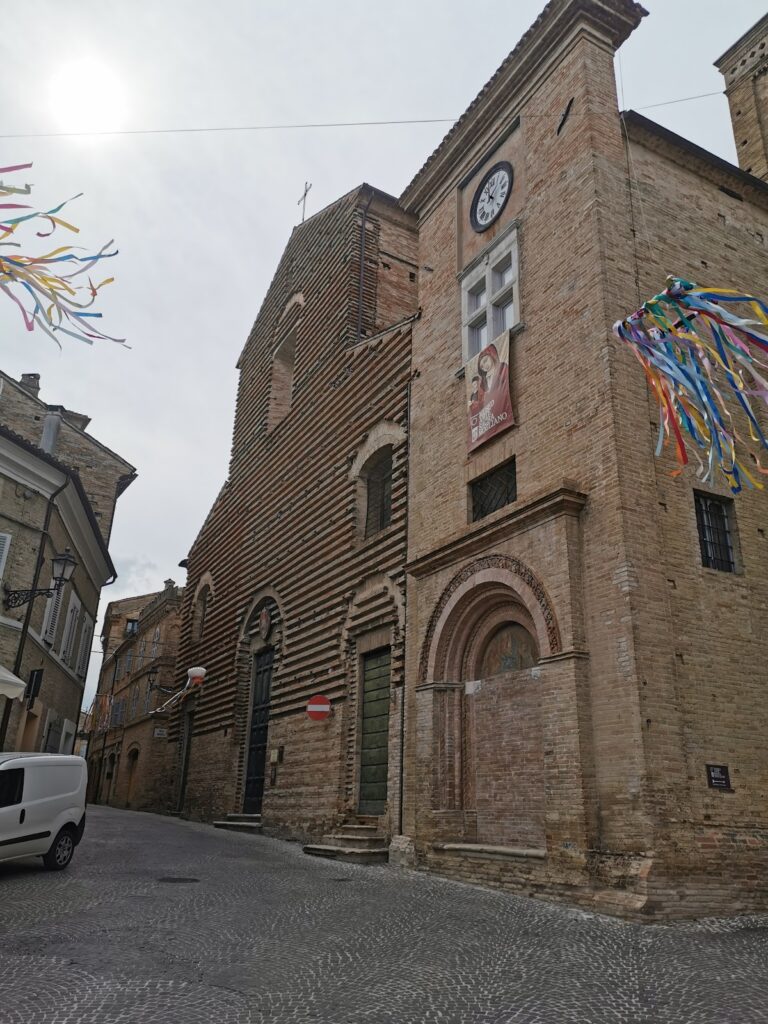
The main cisterns extend beneath Via Paccarone and partly beneath the former Dominican monastery beside the Church of San Domenico. The Dominicans were a Catholic religious order whose communities traditionally combined preaching with scholarship. Several private houses now stand over parts of the structure, leaving the complex hidden from the outside. It covers approximately 2,200 square metres, measures about 70 metres long and 30 metres wide, and reaches an approximate height of 6 metres. Its volume is about 10,000 cubic metres, and the floor slopes by roughly 1 percent.
Thirty underground chambers are arranged in three parallel rows. They were designed to collect and store rainwater before distributing it through the city. The perimeter walls use opus caementicium, Roman concrete, while traces of opus signinum, a waterproof mortar used to line water-holding structures, survive along a basal strip about 70 centimetres high. Brick divisions separate the chambers, with their walls built using a rubble-filled interior between outer faces, a method known as the sacco technique.
Entrances and water systems
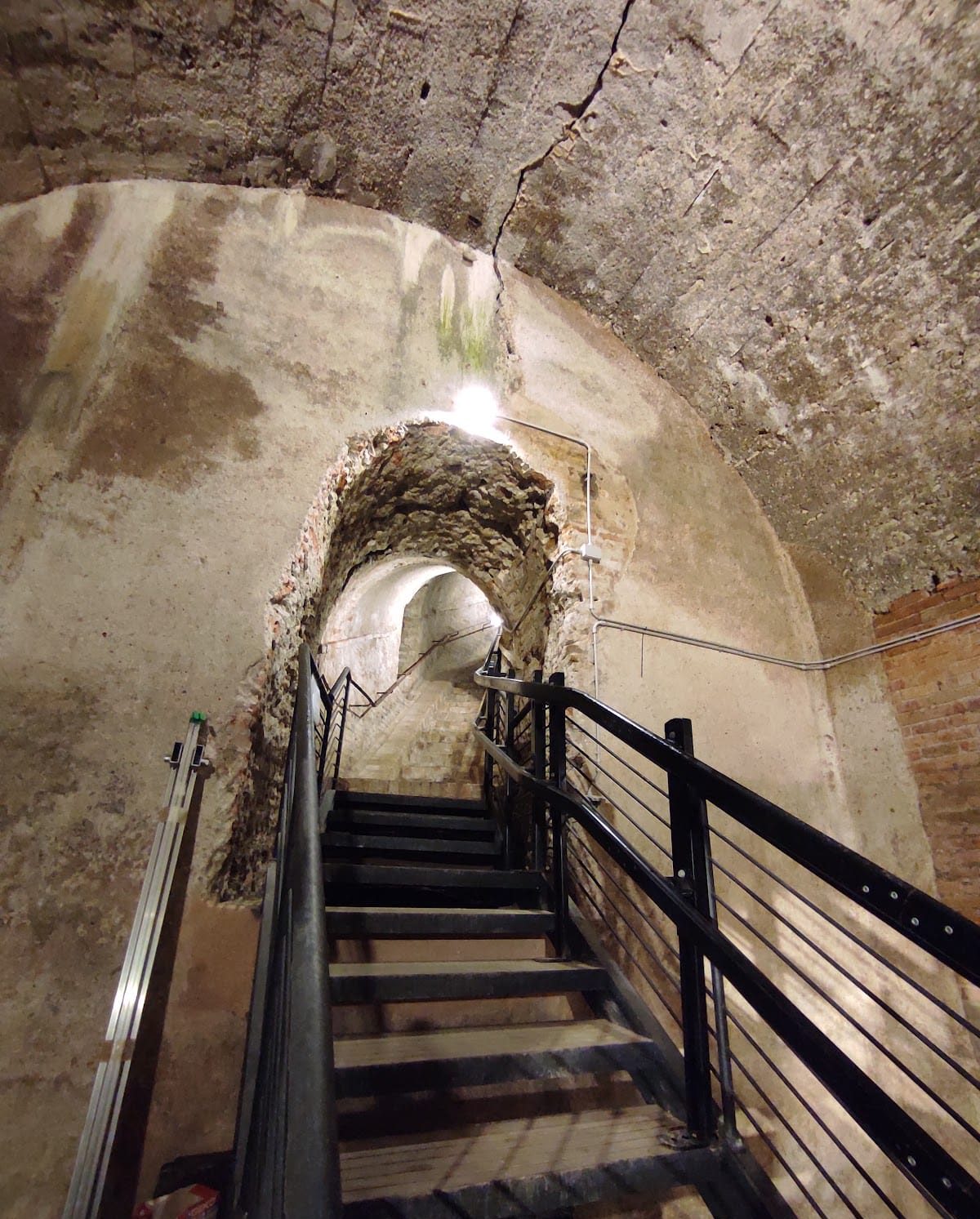
The present entrance opens from Via degli Aceti, a passage created during construction of the Dominican monastery in 1210. A secondary entrance from Vicolo Chiuso normally serves as an emergency staircase. Inside, the complex retains its only Roman-period staircase, although its external exit was walled up in recent times. Fifteen ventilation and inspection shafts remain visible, together with drainage channels used for purification and two lead pipes of different sizes. The underground chambers are accessible and remain in good physical condition.
Related cisterns
The Small Cisterns at the entrance to Piazza del Popolo survive as a smaller underground structure with the same water-collection and distribution function as the main complex. The two additional chambers on Girfalco hill belong to the wider ancient water system, but their present form cannot be examined because they are no longer visible.