Salems kyrka: A Romanesque Church in Sweden
Site at a Glance
- Country
- Sweden
- Primary era
- Medieval
- Eras represented
- Medieval, Early Modern, Modern
- Civilizations
- Swedish
- Site type
- Religious
- Remains
- Fortified Church
On this page14 sections
History
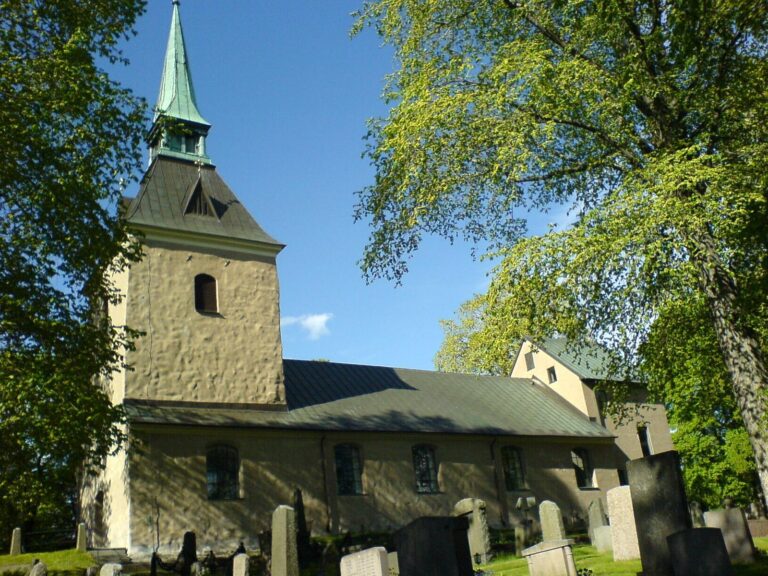
Salems kyrka is a Romanesque stone church in Fågelsta, Södertälje, Sweden, begun in the early 12th century and consecrated during that century. Romanesque is a medieval architectural style associated with rounded arches and substantial masonry. The church belongs to Salem parish in the Diocese of Strängnäs, an ecclesiastical district of the Lutheran Church of Sweden.
Early church and Botvid traditions
Tradition places an earlier wooden church dedicated to St Alban at Salem and says that St Botvid’s remains rested there for the first nine years. A wooden predecessor to the present stone church is also considered possible, though its existence is uncertain.
A separate legend tells how Botvid’s brother moved the saint’s remains in 1129 to a newly built wooden church on the family farm at Hammarby. That building was later replaced by a stone church completed in 1176 and named Botkyrka Church.
Alterations and later use
In the 15th century, the church gained an entrance porch, a larger nave, and a brick vault. A choir associated with the Wrede family was added in the 17th century. The churchyard remained a burial ground until the early 20th century, when a new cemetery opened at Säby.
In 1809, Anna Helena Thorsman, the wife of a major, financed a new altar and pulpit according to the terms of her husband’s will. The large bell’s predecessor cracked while being rung at the death of King Adolf Fredrik of Sweden. Johan Jakob Mårtenson recast the bell in 1772.
A late-medieval altarpiece that included St Botvid was donated to the State Historical Museum in Stockholm in the 1870s. Probably made in Lübeck during the 1480s by Hermen Rode and Johannes Stenrat, it was one of the church’s important earlier artworks.
The name Salem and the church’s connections
The place-name Slæm appears in 1283 and probably combines words meaning blackthorn and settlement or farm. The parish name Slem became Salem in the 17th century as a beautified form. One folk explanation linked the name to the loss of Botvid’s remains, claiming that the church had been called the “wretched church”; this derivation is rejected. In 1667, the clergyman Olaus Achatii Wallenius said that a maiden named Salema founded the church, while earlier legends named Dina. The biblical Salem, a poetic name for Jerusalem, is a more likely influence on the change.
Salems kyrka is one end of St Botvid’s Pilgrim Route, which connects it with Botkyrka Church.
Remains
Building and interior layout
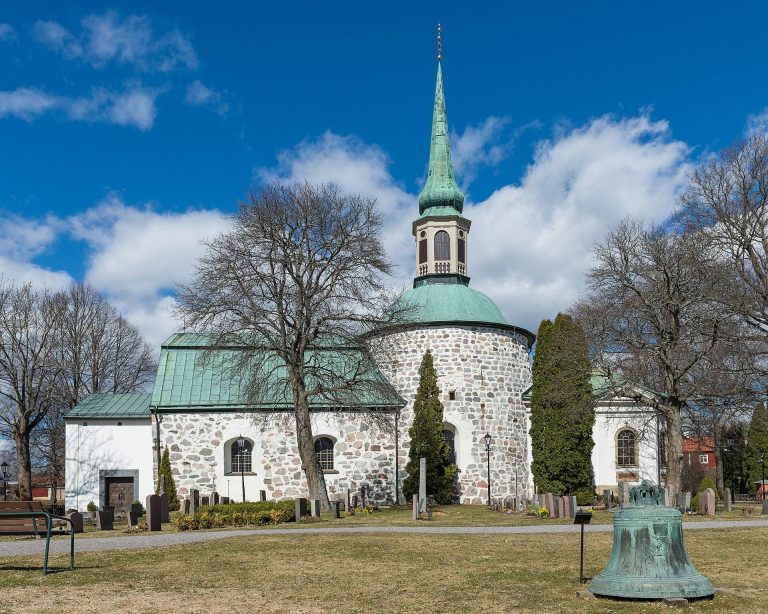
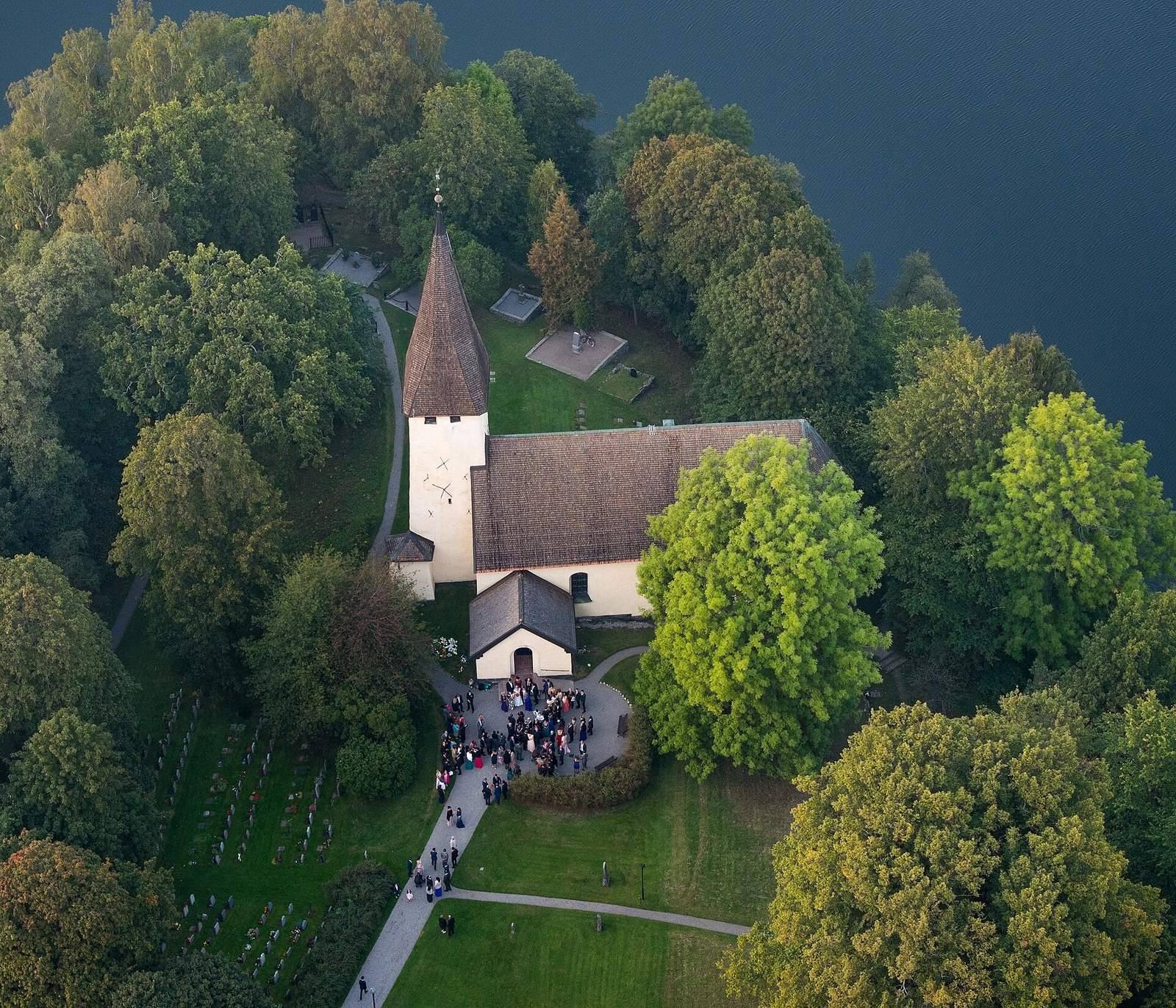
The stone church stands on a promontory south of Lake Bornsjön, among oak, linden, alder, and birch trees. The surrounding district has many ancient remains, and the old Södertälje road passes beside the church. The west tower and part of the nave’s north wall retain 12th-century masonry. Metal anchor ties in the tower and in sections of wall extending toward the sacristy connect or stabilize the masonry. Narrow openings below the tower’s north eaves suggest that it may have had a defensive function. The sacristy, a room used to prepare for services and store church objects, dates to the 13th century.
The original nave covered about 40 square metres. Its expansion to the south and east left the church somewhat asymmetrical, while the entrance porch and brick vault form part of its later medieval fabric. Despite repeated alterations, the building retains an archaic character. The Wrede family choir is also part of the interior.
Interior furnishings and memorials
Sculpture and baptismal furnishings
A baptismal font carved from red-grey sandstone dates to the 12th century. A 13th-century crucifix is mounted in the triumphal arch, the structure separating the nave, or main body of the church, from the area around the altar.
Altar, pulpit, and seating
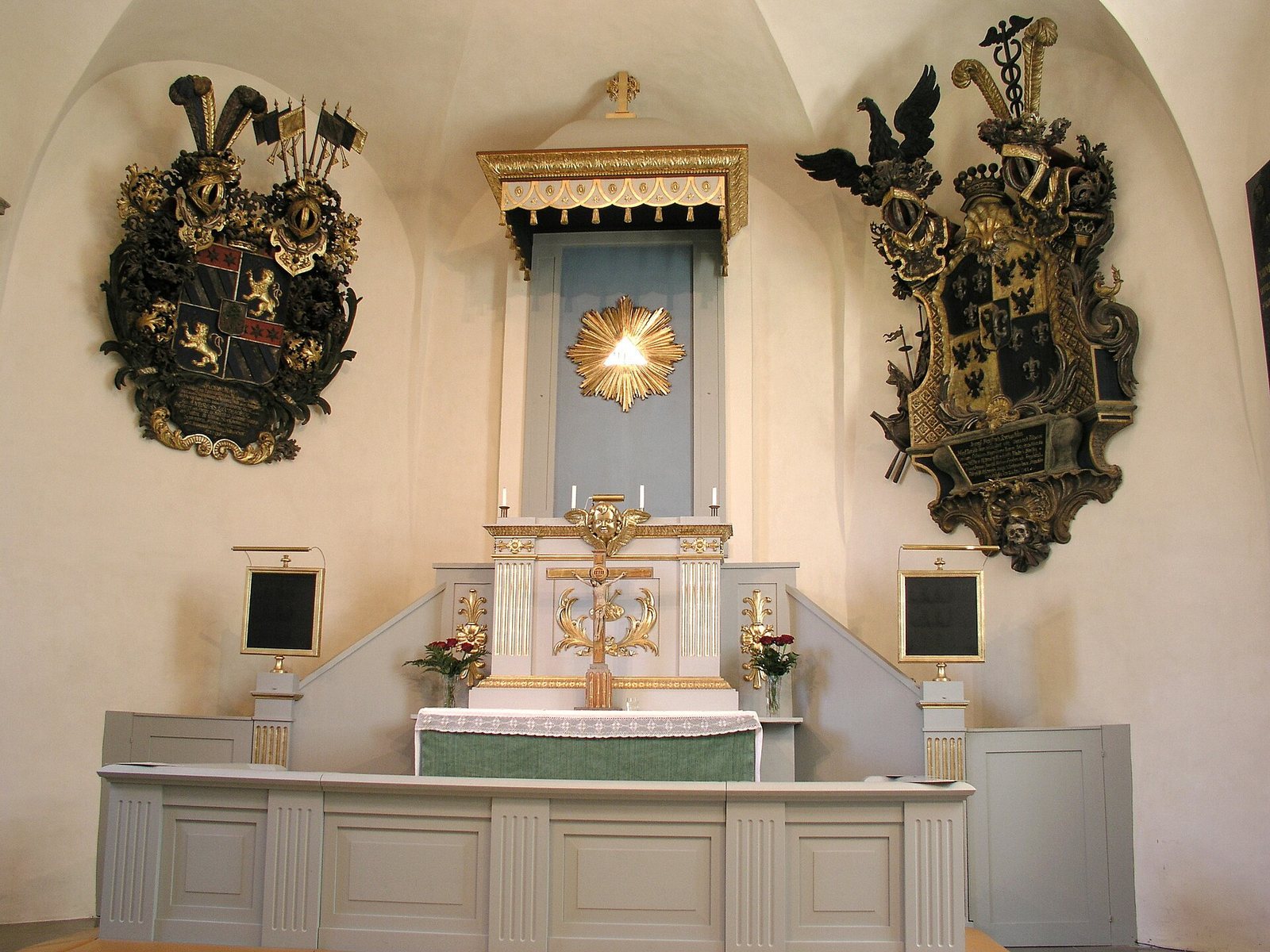
The pulpit is unusually positioned above the altar. Fixed pews form part of the church’s seating; earlier, more elaborate benches were reserved for the estates, including one for Vällinge Skårby farm. Those estate pews were removed in 1925.
Textiles and memorials
A red-and-yellow floral brocade altar frontal, the cloth covering the front of an altar, was given in 1672 by Carl Henrik Wrede and his wife Märta Fleming. Their initials appear on it. The oldest chasuble, a vestment worn by a priest during services, is red velvet embroidered with the year 1707 in gold. Memorials include Governor Anders Lindhielm’s funeral banner, a banner for Gustaf Johan Wrede, who died in 1667, and a commemorative epitaph for Ulrika Sparre, who died in 1747.
Communion vessels
The church’s silver includes a communion chalice given by Carl Henrik Wrede in 1655, with a cup enlarged in 1802. Eleonora Lindhjelm of Fogelsta gave a decorated silver jug in 1763; it was enlarged in 1802. A host box, used to hold communion bread, was remade that year and bears the arms of the Lindhielm and von Höpken families.
Bells and organs
Bells
The smaller bell was cast in 1727. Its inscription quotes Psalm 76:8: “In Salem is God’s tabernacle, and his dwelling in Zion.” The larger bell is the one recast by Johan Jakob Mårtenson.
Organs
An organ built by Jonas Ekengren in 1781 was moved to Vällinge Chapel in 1855. A new instrument by A. W. Lindgren followed that year, with eight stops, which select the organ’s sounds, and two manuals, or keyboards. The 1944 organ, built by A. Magnussons Orgelbyggeri, used air pressure to operate its pipes and had Roosevelt-type windchests, which distribute air to pipes. It also had a tremulant that produced a wavering tone, a control that added stops progressively, and automatic switching for the pedal controls. Its façade came from the 1855 organ. The present instrument was built in 2021 by Tostared Church Organ Factory. Its keys connect mechanically to the pipe valves, and its electrically controlled registration offers 20,000 preset combinations.