Tronoša Monastery: A Serbian Orthodox Monastic Center
Site at a Glance
- Country
- Serbia
- Primary era
- Early Modern
- Eras represented
- Early Modern, Modern
- Civilizations
- Ottoman, Serbian
- Site type
- Religious
- Remains
- Monastery
On this page19 sections
History
Tronoša Monastery is a Serbian Orthodox women’s monastery in Serbia and belongs to the Eparchy of Šabac, an Orthodox diocese. Its foundation is traditionally associated with King Stefan Dragutin and his wife, Queen Catherine. Construction began during Dragutin’s reign and Catherine completed the monastery in 1317. Tronoša later became a religious and cultural center for communities in the Drina region.
Foundation and rebuilding
Tronoša belonged to a group of monasteries established in the Drina region during Dragutin’s rule to counter Catholic and Bogomil influence. The Bogomils were a medieval Christian movement regarded as heretical by established churches in the region. Rača, Paprača, Tamna (also called Tavna), and Lomnica (also called Lovnica) were among the other monasteries in the group. A separate legend credits the Jugović brothers with founding Tronoša, while local tradition links the monastery’s name to the joining of three rivers nearby.
Ottoman forces looted and burned Tronoša during the fourteenth and fifteenth centuries. By 1559, its old church lay in ruins and just one residential building remained. At Easter that year, a public assembly resolved to build a new church on the site. The monastery’s superior, Pajsije, secured assistance from Arsenije, superior of Paprača, and the monk Genadije. The work was completed by Christmas, 25 December according to the Julian calendar.
Manuscript work and learning
A copying workshop produced books for Tronoša and neighboring monasteries. Under the superior Jovan, liturgical books were copied in 1571 and 1581. In 1571, the monk Jefrem copied four menologia, Orthodox books arranging saints’ commemorations by month, under Kir Jovan. Three were intended for Šišatovac and one for Kyiv. Other works from Tronoša included menologia later held at Šišatovac and a book held at the Holy Trinity Monastery near Pljevlja.
Russia assisted the monastery from the sixteenth through the eighteenth centuries. In 1625, the superior Mihailo traveled there to collect alms. Ottoman forces also forcibly removed the church’s lead roof in the late seventeenth century. Despite these pressures, Tronoša became a cultural center for the Jadar, Podrinje, Rađevina, and Potcerje regions during the eighteenth century.
Eighteenth-century events and education
During Koča’s Rebellion, a Serbian uprising against Ottoman rule in 1788 during the Austro-Turkish War, Archimandrite Stefan Jovanović joined the insurgents and fought Ottoman forces. He unsuccessfully sought Habsburg weapons to help the Serbs continue their struggle. He also opposed the conversion of Serbs to Islam and tried to secure aid for people facing famine in Jadar and Rađevina. After appealing to local Turks for help, he was poisoned.
In 1791, the priest-monk Josif Tronošac completed a chronicle using older books brought from monasteries in Fruška Gora. The work is regarded as an important Serbian literary monument of the late eighteenth century. In 1797, at about ten years old, Vuk Stefanović Karadžić began his schooling at Tronoša. He later became a leading reformer of Serbian literary language.
Uprisings and nineteenth-century change
Tronoša served as a meeting place for insurgent leaders during the First and Second Serbian Uprisings, nineteenth-century revolts against Ottoman rule. It escaped damage during the First Uprising, but Ottoman forces burned it after the revolt’s defeat, either in 1813 or in March 1814. After the territory became part of the Principality of Serbia in 1833, restoration of the monastery was completed in autumn 1834, during the abbacy of Melentije.
Filimon Grgurović, the monastery’s superior, supported the Obrenović dynasty in its political conflict with the rival Karađorđević dynasty. He joined the 1844 uprising against Prince Aleksandar Karađorđević. After the rebels’ defeat, he was captured, sentenced to death, and shot at Gnjila. In 1858, when Prince Miloš returned to power, the Loznica archpriest Ignjat Vasić arranged for Filimon’s remains to be transferred to Tronoša.
Wartime destruction and restoration
During the First World War, Tronoša stood near the front and cared for Serbian soldiers wounded in the Battle of Cer. Austro-Hungarian occupation brought severe damage to the monastery and its library. Church books were burned, the surrounding forest was cut down, and the church doors were destroyed or removed. Bronze bells were taken to be melted for military use. The superior, Tihon Ivančević, was arrested and later killed in Belgrade.
In 1941, the superior Georgije Bojić took part in planning and carrying out the operation that freed Loznica from German forces. In October, a German punitive unit burned a monastery building and outbuildings, damaged church books, and struck a wall with a cannonball. Restoration of the monastery and church followed in 1964 and 1987. Architectural and fresco restoration of the church was completed in 1987, and a memorial residence was built that year. The building now housing the museum of Karadžić’s early schooling was restored in 1964 after its destruction in 1941.
Religious memory and local custom
Stefan Jovanović was canonized by the Serbian Orthodox Church in 2017 as the Venerable Stefan of Tronoša. His feast day, 17 September, is also the official patronal feast of the Eparchy of Šabac. Tronoša has been protected since 1948 and was designated a cultural monument of great importance in 1979.
On Maundy Thursday, residents of nearby villages bring two traditional “ploughmen’s candles” into the church and light them before the icons. The custom is associated with protecting and improving the harvest and is included on Serbia’s intangible cultural heritage list.
Remains
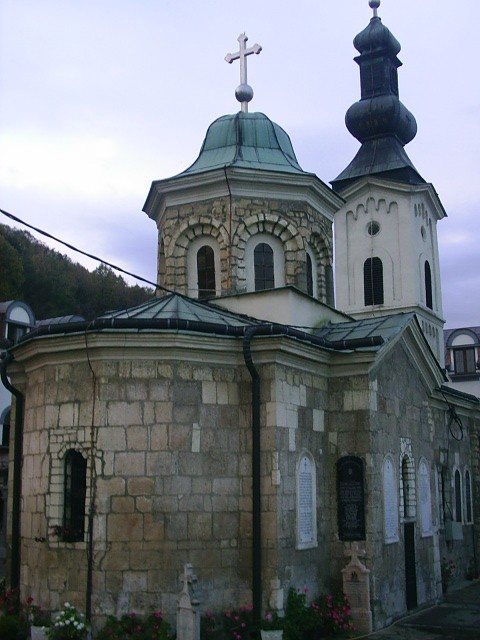
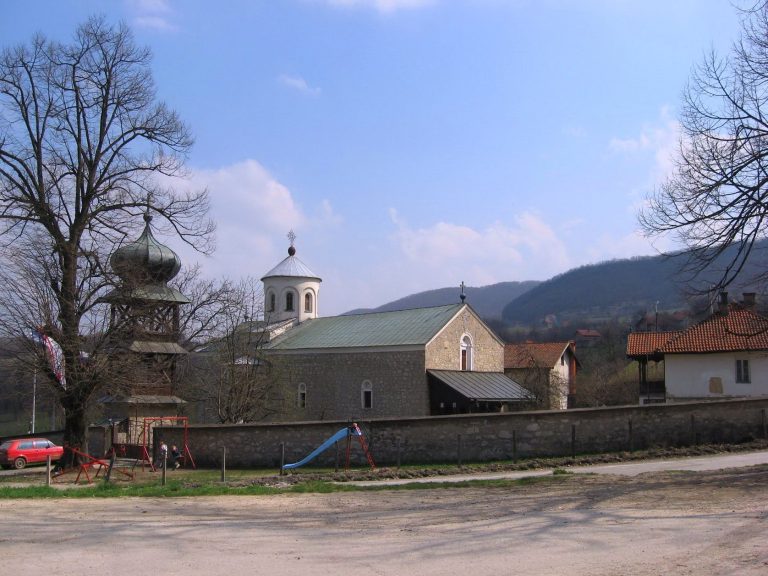
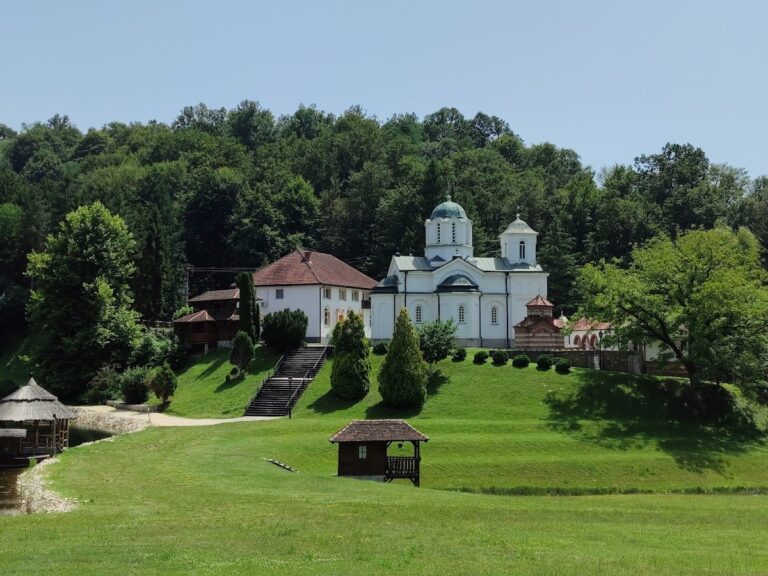
The monastery complex centers on the Church of the Presentation of the Mother of God, built in the Raška architectural style, a medieval Serbian church-building tradition. A memorial residence and a building housing a museum of Vuk Karadžić’s early schooling are also part of the complex. In front of the monastery stands a chapel, with a spring-water fountain below it.
The church
Plan and exterior
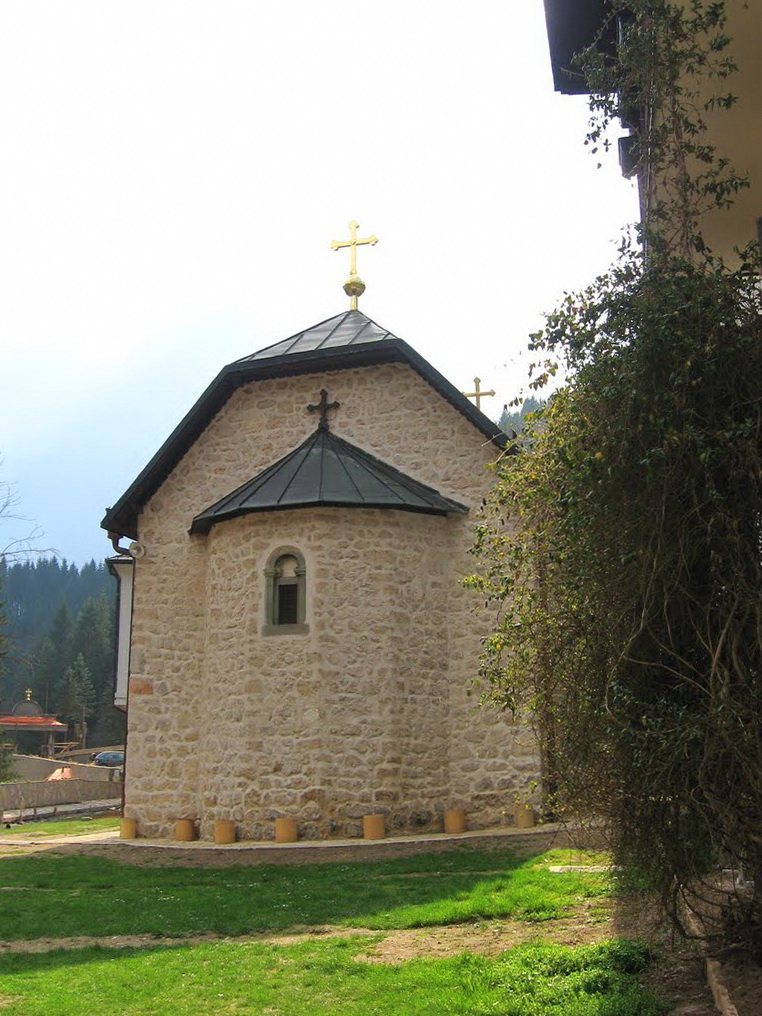
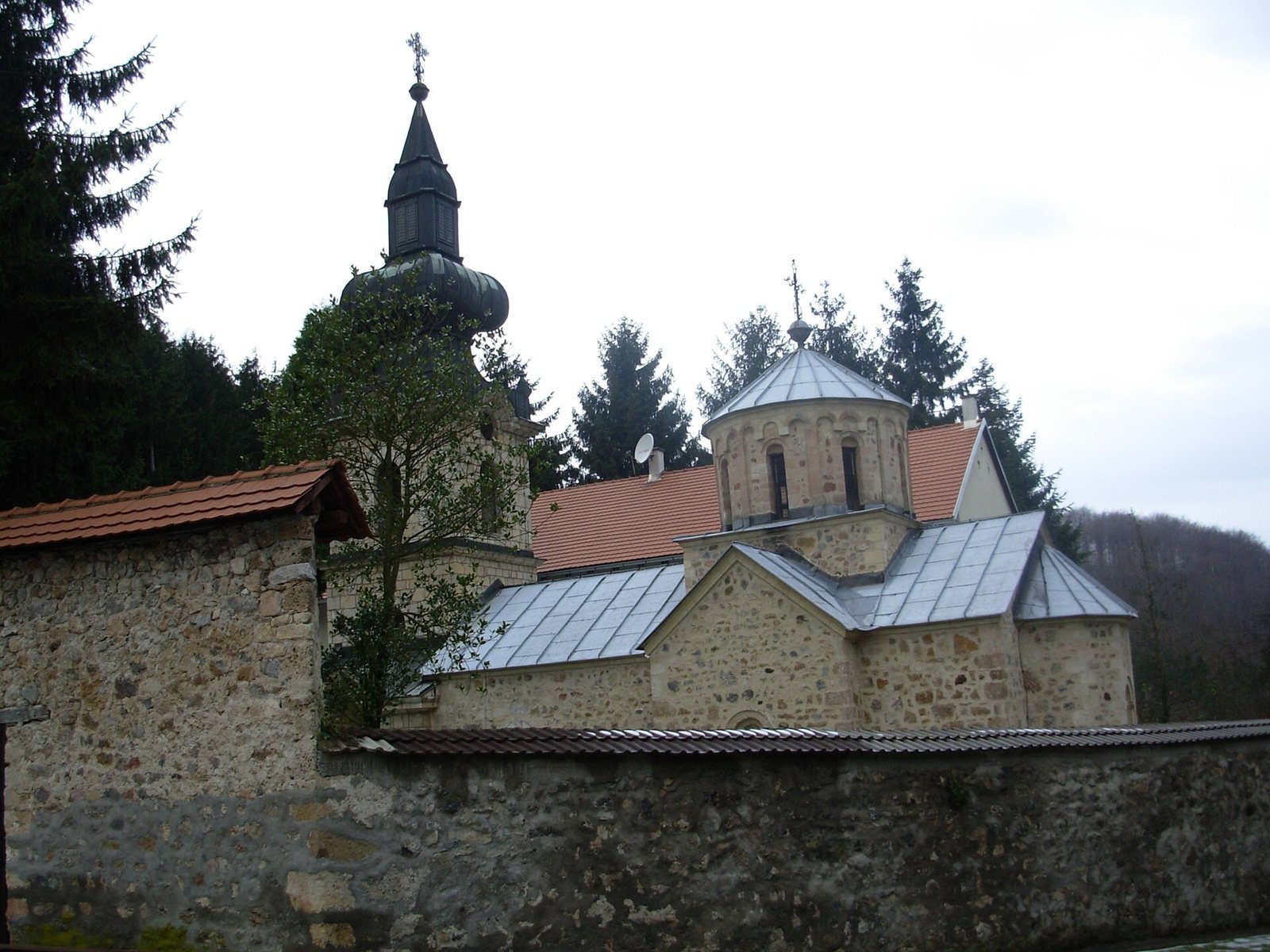
The church has a single main hall, a western entrance vestibule, a crosswise section, and a five-sided apse, the sanctuary end of the building. An eight-sided dome rises above the point where the main hall and crosswise section meet. Shallow vertical strips divide the dome’s exterior faces, which have narrow, elongated windows and a decorative band of shallow arches near the top. The doorways and windows are arched.
Paintings and furnishings
Fragments of sixteenth-century wall painting survive on the west wall of the entrance vestibule. Mihailo Konstantinović of Bitola and Nikola Janković of Ohrid painted the church in 1834. Janković also made the iconostasis, an icon-bearing screen separating the sanctuary from the main body of the church, and most of its icons. A. Đaković painted two icons in 1866, including images of Christ and the Mother of God.
The church doors were repaired in 1923 after damage or removal during the First World War. One bronze bell remains from the wartime seizure of the bells; it was installed in 1880.
Bell tower
A stone bell tower was added on the west side of the church in the nineteenth century. Its upper structure is tall and Baroque in style.
Other monastery buildings
Karadžić school museum
The museum of Karadžić’s early schooling occupies a building restored in 1964 after it was burned in 1941. Its objects commemorate Karadžić and include a plaque bearing his likeness and a room containing his desk.
Memorial residence
The memorial residence was built within the monastery complex in 1987.
Chapel and fountain
Chapel of Saint Pantaleon
The chapel in front of the monastery is dedicated to Saint Pantaleon. Tradition attributes its construction, along with the fountain below, to Jug Bogdan and his nine sons before the Battle of Kosovo. The Jugović brothers are figures in Serbian epic tradition associated with that battle.
Fountain of the Nine Jugović
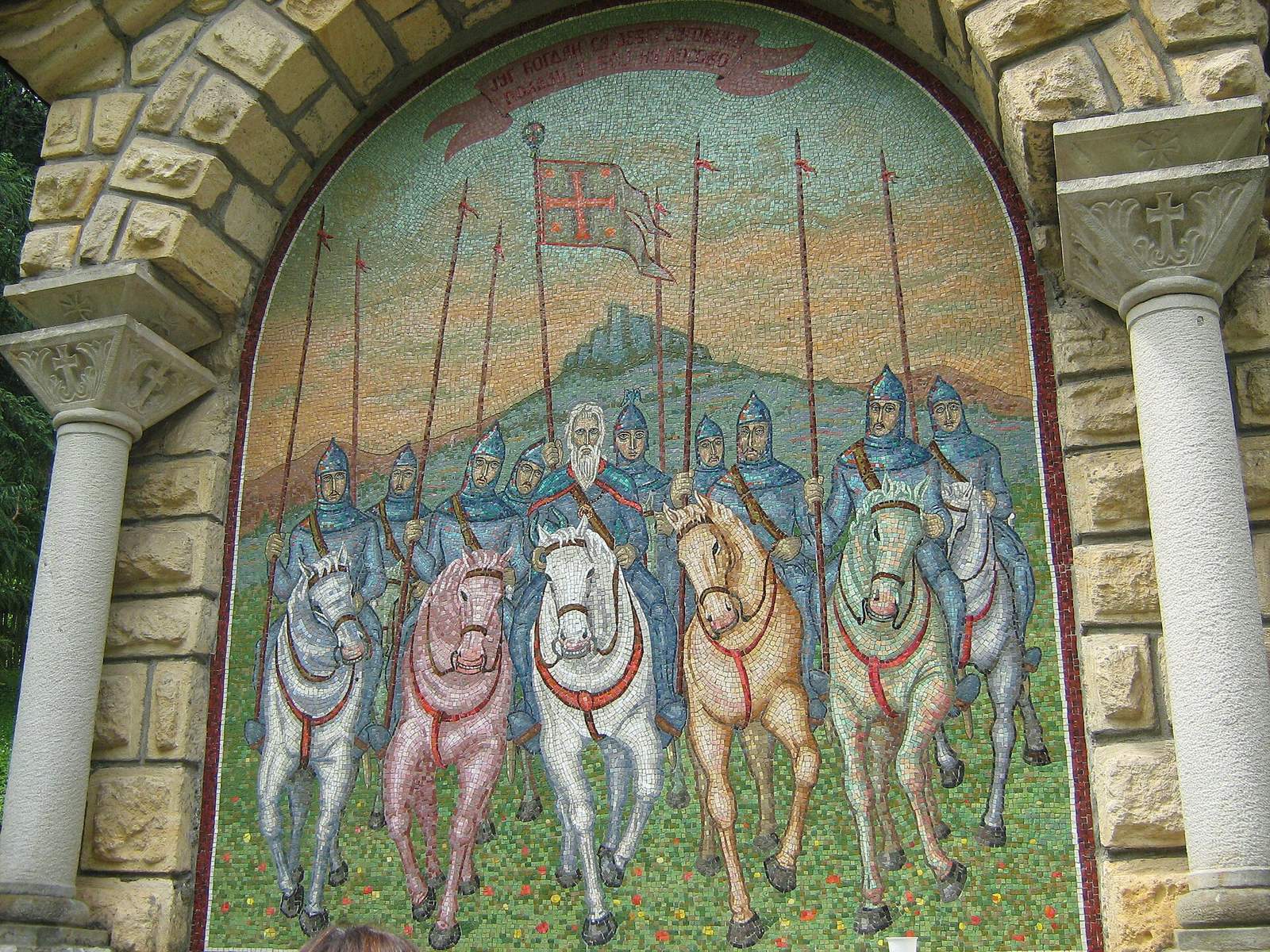
The Fountain of the Nine Jugović is a concrete drinking fountain supplied by cold spring water and fitted with ten pipes. A fresco shows Jug Bogdan and his sons setting out for battle. Archimandrite Metodije and the Lesnica merchant Mladen Isaković renewed the fountain in 1894, and it was restored in modern times, including in 1968.
The Tronoša Chronicle
A copy of Josif Tronošac’s chronicle is kept at the monastery. The original is held in Vienna.