Zakros: A Minoan Palace-Town in Greece
Site at a Glance
- Country
- Greece
- Primary era
- Bronze Age
- Eras represented
- Bronze Age
- Civilizations
- Minoan
- Site type
- City
On this page16 sections
History
Zakros is an ancient Minoan palace-town in Kato Zakros, Greece, built by the Minoans, a Bronze Age civilization centered on Crete. Its palace was first constructed around 1900 BC and rebuilt around 1600 BC. Zakros was one of six Minoan palaces and one of four principal administrative centers. Its protected harbor and position supported trade eastward, linking the town with Egypt and the Middle East.
Palatial phases and trade
The settlement was occupied around 2000 BC, across the Early Minoan III and Middle Minoan IA phases of Minoan chronology. The palace sequence includes an Old Palace associated with the late Middle Minoan period, destroyed in a major earthquake around 1700 BC. A New Palace was built around 1600 BC and destroyed in another earthquake around 1450 BC, during the transition between the Late Minoan IA and IB phases, alongside other major Minoan centers.
Zakros exported oil, wine, and timber, and received metals, ivory, and semiprecious stones from Egypt and the Middle East. The ancient name of the settlement has been proposed as Dikta.
Occupation continued on a limited scale after the New Palace’s destruction and ended around 1200 BC, in the Late Minoan III phase.
Excavation and heritage
Thomas Abel Brimage Spratt first recorded the site in 1851. Arthur Evans visited in 1894 and 1896, and D. G. Hogarth excavated there in 1901 for the British School of Archaeology at Athens, concentrating on the central area of Ayios Antonios. Nikolaos Platon began new excavations in 1961 and uncovered the New Palace. His work continued until his death in 1992 and appears to have been carried on by Lefteris Plato. A later irrigation project west of the site brought burial enclosures at Pezoules Kephala to light.
In 2025, Zakros became part of the UNESCO World Heritage property Minoan Palatial Centres, an inscription that includes multiple component sites.
Remains
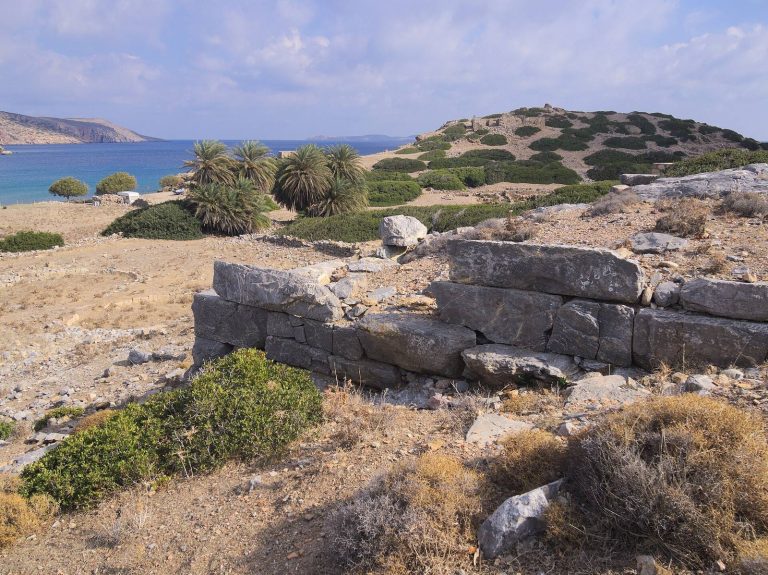
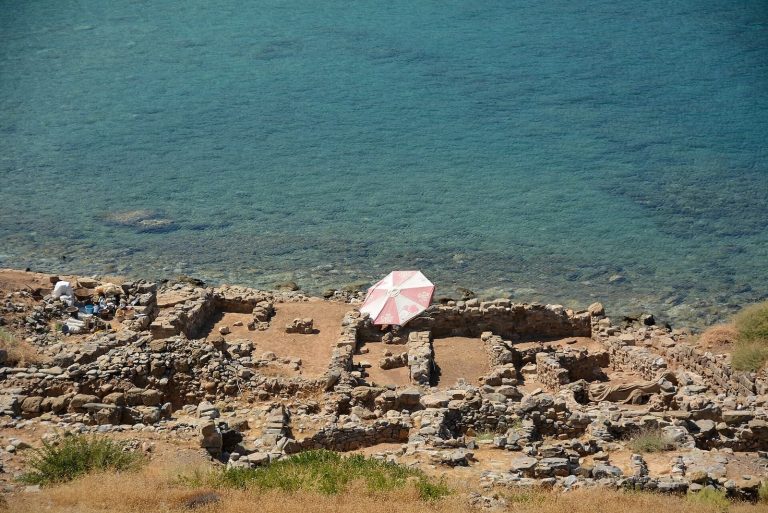
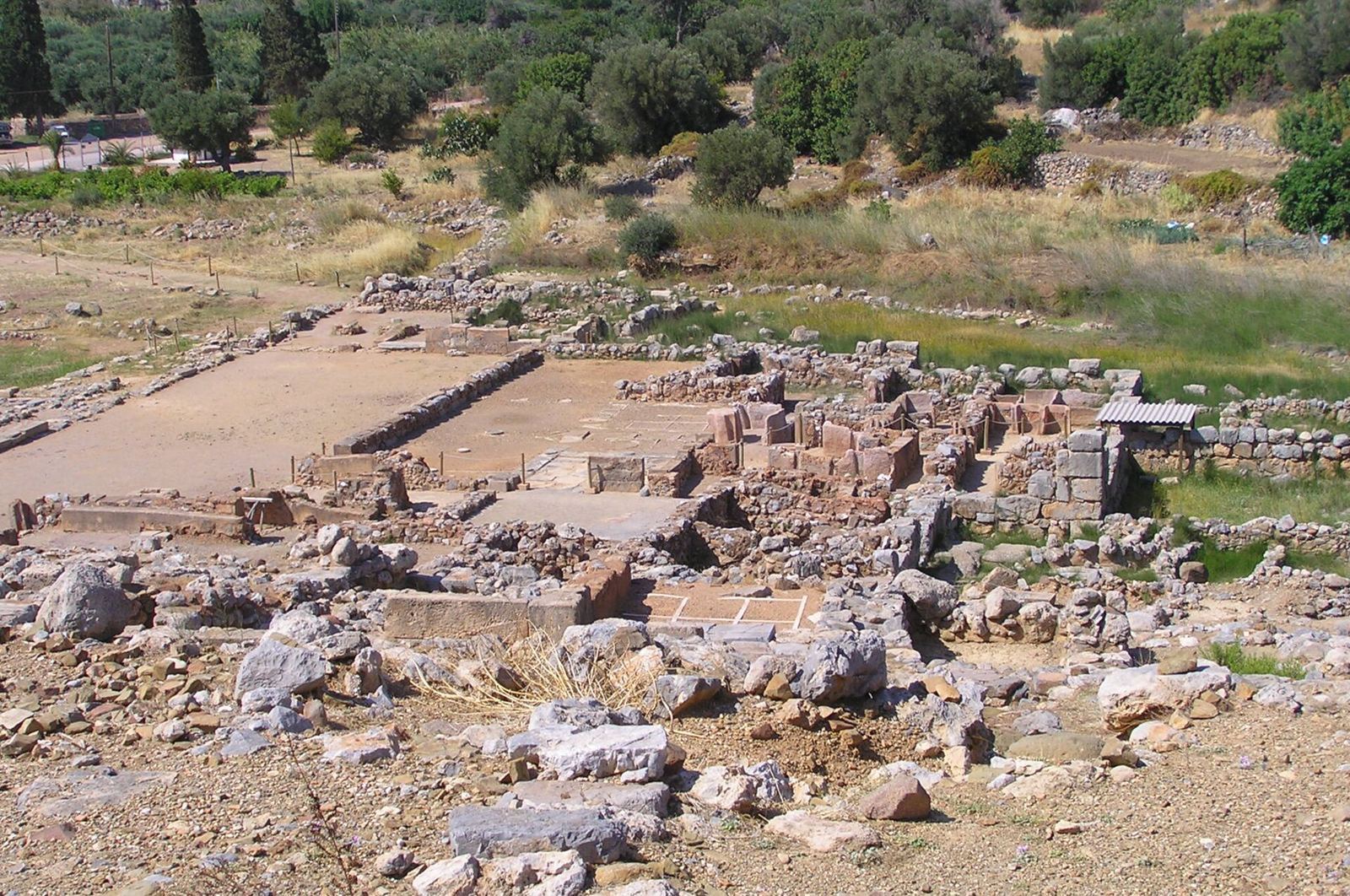
The settlement extends between Epano Zakros, on the hillside, and Kato Zakros, closer to the sea. The Ravine of the Dead runs through both areas; its name refers to burials in caves along its sides, where human remains have also been found. The wider site includes paved streets, residential areas, and a palace arranged around courtyards. A labyrinth-like structure resembling examples at Knossos and Phaistos has also been identified.
Settlement and approach
Upper and lower settlement
Large settlement areas north of the palace belong to the Protopalatial and Neopalatial periods, successive earlier and later phases of Minoan palace culture. A planned street system of broad, paved routes served the town. The width of the streets and their lack of wheel ruts have been taken to suggest that pack animals carried goods.
Road and harbor
A road about three metres wide, laid with paving slabs and fitted with drainage channels, dates to the Protopalatial period. It connected Kato Zakros with the harbor and continued to the palace’s northeast gate. During the Minoan period, sea level fell on four occasions, reaching levels of −4.00 ± 0.30 m, −2.85 ± 0.30 m, −1.25 ± 0.05 m, and −0.50 ± 0.05 m. Land uplift may alternatively explain these changes, which affected the harbor town.
Residential buildings and finds
Excavated buildings on the northeastern slope include the Strong Building, the Little Tower Building, and the Pottery Stores Building. Twelve houses were uncovered on the northeastern hill. A stone cellar in one house contained bronze objects, including two axe heads and three spearheads. Finds from the town also include bronze tools, pottery, loom weights, furniture, and seven winepresses. Pottery from some later contexts is of Mycenaean type, associated with the Bronze Age Greek civilization centered on mainland Greece.
Minoan villa
A villa near the ravine, on the route from Epano Zakros, dates to Late Minoan IA, around 1700–1625 BC, before the palace was built. A large storage jar from the villa bears a Linear A inscription around its rim recording 32 units of wine. Linear A is an undeciphered script used in Minoan Crete.
Palace and its finds
Palace layout
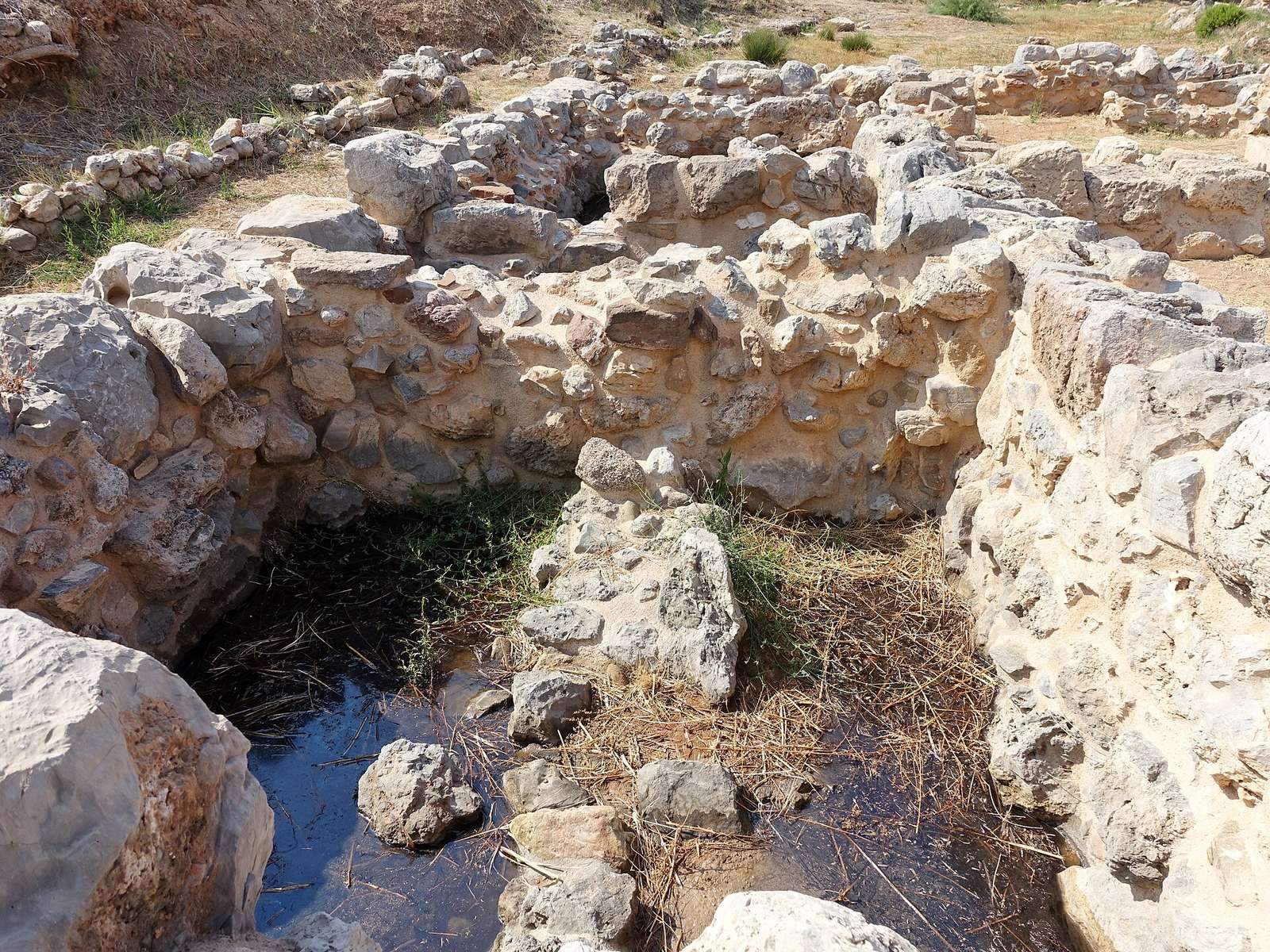
The palace ruins cover about 8,000 square metres and contain around 150 rooms. Its buildings were organized around a central paved courtyard, with a second large paved courtyard to the west. The complex included residential areas, workshops, storerooms, and ceremonial halls. Some rooms had multiple door openings, and underground installations included cisterns or lustral basins, sunken spaces associated with ritual purification that may have served ritual activities.
Linear A documents and inscribed objects
Zakros has yielded 591 Linear A documents: 31 tablets and 560 sealed documents. This is the second-largest known collection of such records after Haghia Triada. A flat, circular clay disk, or roundel, measuring about 3.00 by 2.80 by 1.20 centimetres was found with a Linear A tablet and clay sealings. The deposit lay in a destruction layer dated between Late Minoan IA and Late Minoan IB; three of the sealings bear Cretan hieroglyphs, another script used in Minoan Crete.
Other palace finds
Palace finds include seals, mostly made of steatite, a soft stone also called soapstone, and clay sealings. Two Egyptian bowls from the Early Dynastic period, an early phase of Egyptian history, came from the palace’s cult repository, a room for objects used in religious practice. They are thought to have reached Zakros through trade in objects taken from Egyptian tombs.
Many objects excavated at Zakros are held at the Heraklion Archaeological Museum, while other finds are in the archaeological museums of Sitia and Agios Nikolaos. Some objects Hogarth received from the Cretan government are held at the Ashmolean Museum in Oxford.
Valley deposits and burials
Upper Zakros Valley pits
Hogarth excavated two pits in the upper Zakros Valley. The principal pit measured about 4.8 metres across and 5.4 metres deep. Its lower deposit was about eight feet thick, while looting had disturbed the upper three feet. The finds, chiefly pottery, date to Late Minoan IA.
Pezoules Kephala burial enclosures
At Pezoules Kephala, two burial enclosures contained different tomb forms: one held a single tomb, the other a multi-chambered tomb. Excavators recovered articulated skeletons, as well as several clay tablets inscribed in Linear A. Finds also include copper oxhide ingots from Late Minoan IA, shaped like stretched hides, and a locally modified Egyptian stone jar with a bridge spout.