Kinnared Church: A Swedish Church with Medieval Origins
Site at a Glance
- Country
- Sweden
- Primary era
- Medieval
- Eras represented
- Medieval, Early Modern, Modern
- Civilizations
- Danish, Swedish
- Site type
- Religious
- Remains
- Church
On this page11 sections
History
Kinnared Church is a medieval church in Kinnared, Sweden, beside the Kilan, a tributary of the Nissan. Its eastern nave preserves substantial stonework from a single-nave predecessor probably built no earlier than the mid-13th century. The church also holds an iron chandelier regarded as Halland’s oldest.
Medieval origins and enlargement
The eastern part of the present nave incorporates masonry from the medieval church. In the second half of the 18th century, the nave was extended westward, changing the form of the older building. A wooden tower was added above the western end in 1786.
Painted interior and later changes
Sören Karulf painted the church walls in 1667. In 1776, the flat ceiling was replaced with a vaulted one, which Sven Niclas Berg painted two years later. When the church was enlarged in 1786, Samuel Lindgren added ceiling paintings in the same style. Around this period, Berg also painted flowers and leaves on the ends of the pews.
The porch was demolished and rebuilt in 1866. At that time, the medieval iron chandelier was moved to the attic. It was later kept at Halland Museum and returned to the church in 1937. A tradition held that owning one of its leaves gave a person the power to foresee and know more than others. Rust and scrapings from the leaves were also believed to cure illness.
The ceiling paintings were covered twice during the 19th century. In 1878, a Neoclassical restoration, which revived classical forms, brought white paint to the ceiling and furnishings; in 1901, stencilled decoration was added to the ceiling. During a major restoration in 1936 and 1937, restorer Carl Otto Svensson uncovered the wall and ceiling paintings, and the porch was rebuilt.
Johan Nikolaus Söderling of Gothenburg built an organ for the church in 1849 with five stops, which select sets of pipes to produce different sounds. Olof Hammarberg of Gothenburg made a six-stop organ in 1916, and a new instrument followed in 1967. The church belongs to the Church of Sweden’s Diocese of Gothenburg, a church administrative district. Since 2014 it has been part of Torup Parish, a local church community; it previously belonged to Kinnared Parish.
Remains
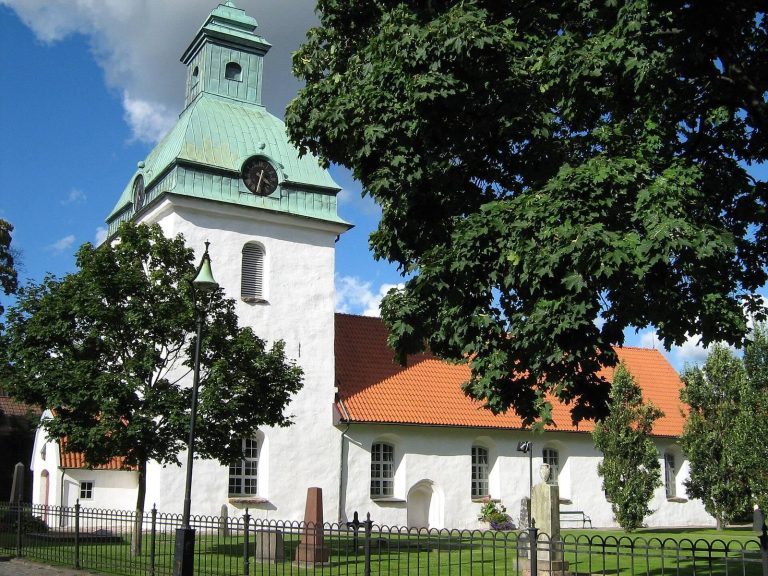
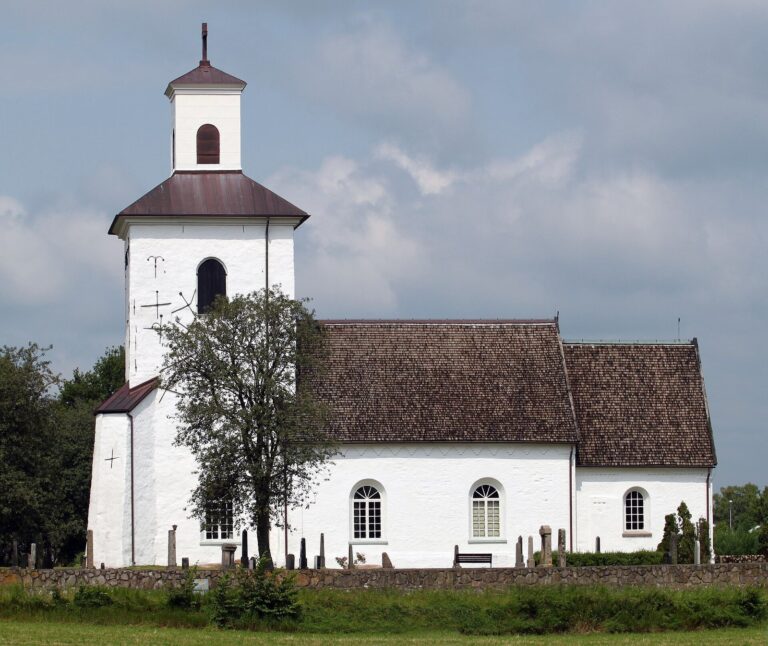
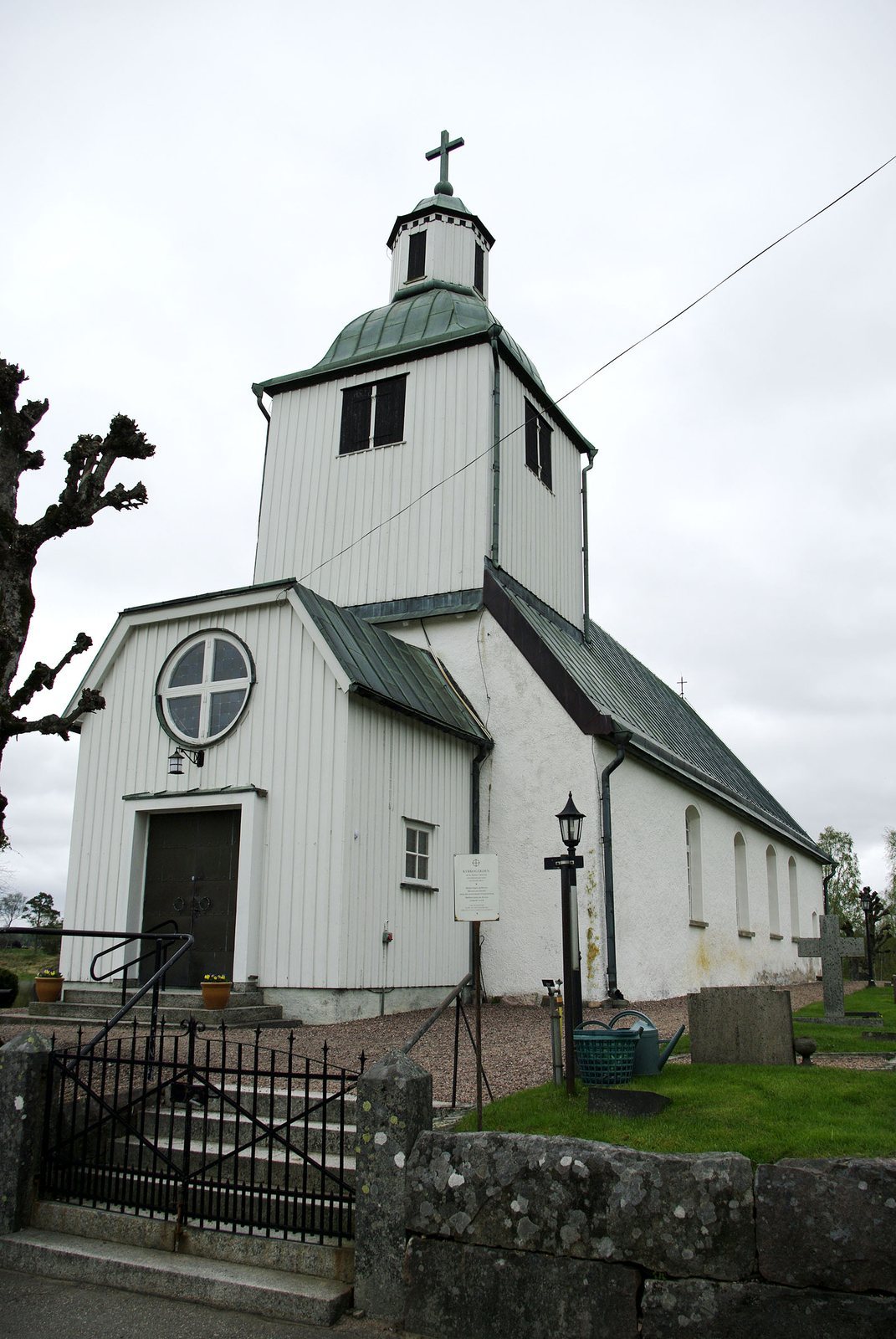
The church is arranged around a rectangular stone nave, with a wooden tower at its western end, a sacristy on the north side, and a porch to the west. The sacristy is a room for vestments and liturgical objects and for clergy preparation. Entrances are through the porch and directly into the area around the altar at the southeast. The nave’s walls are plastered white inside and out, with windows set beneath low curved arches. Its steep gabled roof contrasts with the tower’s curved hood and closed lantern, a raised structure crowning a tower or roof. The tower and other wooden additions are clad in white-painted boards, and the exterior roofs are covered in sheet metal.
Interior and furnishings
Painted surfaces
The interior retains wall paintings and a decorated vaulted ceiling. Painted flowers and leaves also appear on the ends of the pews.
Baptismal font
The fragmentary baptismal font was made in Gotland from red limestone, probably between the late 13th and early 14th centuries. Its style belongs to the mussel-cup school, a grouping of medieval baptismal fonts. Part of the bowl and its cylindrical shaft survive: the bowl has a ribbed pattern, while a raised moulding circles the shaft near its top. The upper portion is broken and badly damaged, and the old fragments rest on a newly made granite base.
Iron chandelier
The medieval iron chandelier hangs above the font. Its beehive-like form has been compared with medieval church bells. Four forged rings are held together by vertical iron bands, from which 225 forged leaves originally hung. Only two leaves remained by the time it reached the museum.
Altar window and pulpit
The stained-glass window beside the altar was made by Yngve Lundström of Gothenburg. It depicts Christ victorious and giving a blessing. The pulpit, made in 1632, has a Renaissance design inspired by classical antiquity and is decorated with sculptures. It bears the monogram of Christian IV, king of Denmark and Norway from 1588 to 1648.
Wooden sculptures
A 15th-century oak sculpture of the Madonna and Child, 111 centimetres high, was uncovered during the 1937 restoration. A 130-centimetre oak triumph crucifix, a large crucifix traditionally associated with the opening between the nave and chancel, dates to the mid-14th century and is mounted on the nave’s south wall.
Organ and bells
The present mechanical organ was made by Tostared Church Organ Factory. It has 15 stops, which select sets of pipes to produce different sounds, divided between two manuals, or hand-played keyboards, and a pedal played with the feet. It stands behind the case front made for Söderling’s earlier organ. The church’s bells were cast in 1836 and 1862; one carries a Latin inscription.