Ysby Church: A Medieval Brick Church in Laholm, Sweden
Site at a Glance
- Country
- Sweden
- Primary era
- Medieval
- Eras represented
- Medieval, Early Modern, Modern
- Civilizations
- Danish, Swedish
- Site type
- Religious
- Remains
- Church
On this page14 sections
History
Medieval beginnings
Ysby Church is a medieval brick church in Ysby church village, Laholm Municipality, Sweden. Probably built in the thirteenth century by monks from Ringsted Monastery, a medieval religious house in Denmark, it was consecrated during that century. The church is also known as Knut Lavard’s Church, after a Danish prince and duke who was later venerated as a saint. It is regarded as one of Halland’s best-preserved churches.
A wooden church probably stood here before the present building, but fire destroyed it. The earlier church’s date is not known.
Later alterations
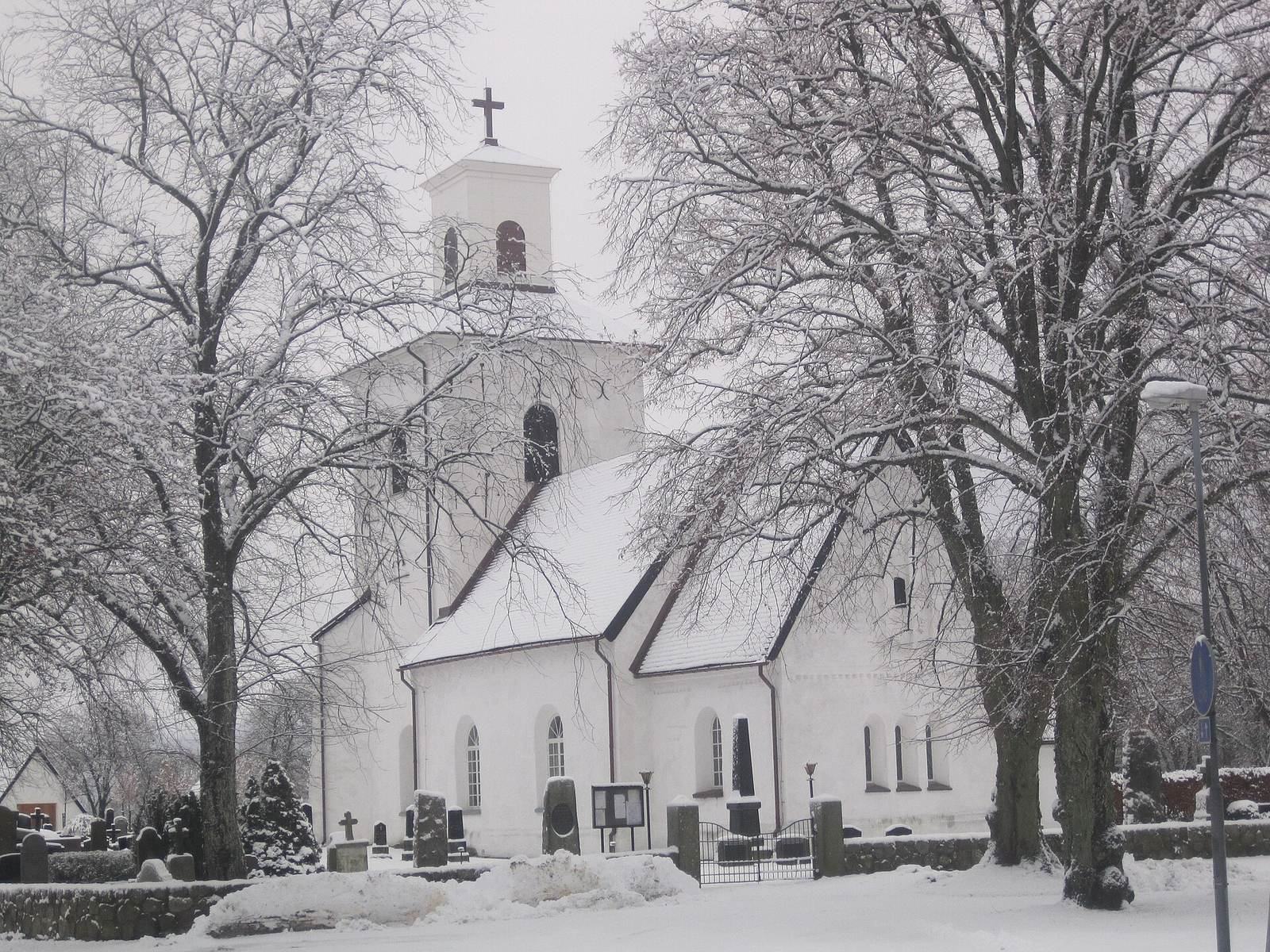
Buttresses were added to the tower in 1750. During a major restoration in 1844, workers removed the nave’s cross vaults and replaced the tower’s stepped gables with a lantern topped by a cross.
Restoration and parish changes
A restoration in 1953 added the sacristy. In 1935, the Munkagård Cross was found in a field near the church. Since 2002, the church has belonged to Ränneslöv-Ysby Parish, formerly Ysby Parish, in the Diocese of Gothenburg.
Remains
Plan and exterior
Layout and construction
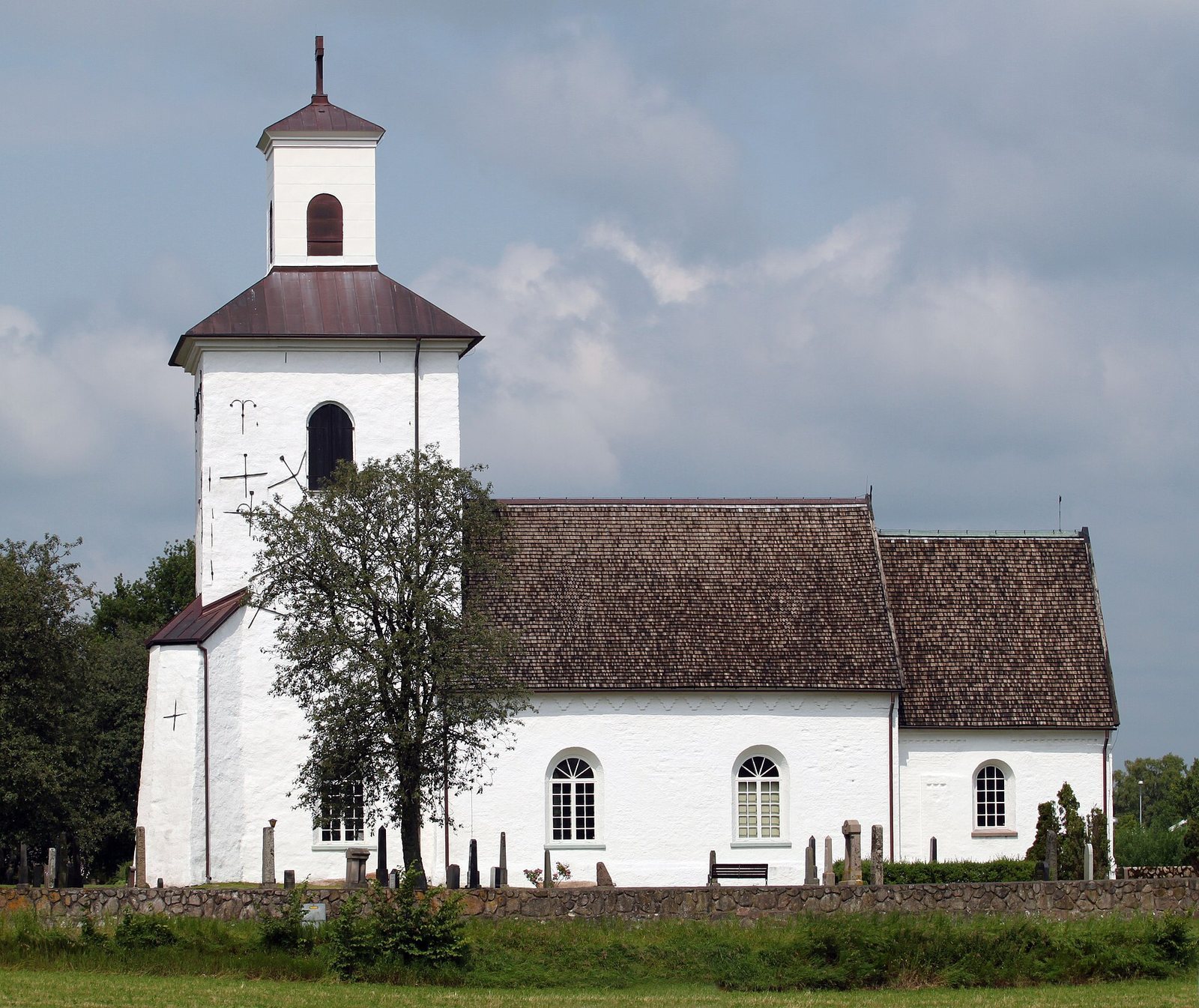
The church stands amid cultivated plains in Ysby church village, with a parish hall northeast of it. Its plan comprises a rectangular nave, the main space for the congregation, and a narrower chancel around the altar with a straight eastern end. A sacristy, used to store vestments and religious objects, adjoins the chancel’s north side. The west tower is the entrance, with the doorway on its ground floor. The tower is built of grey stone; medieval masonry survives in parts of the nave and chancel, and probably in the tower as well.
Tower and exterior decoration
The tower façade has a dense arrangement of anchor plates, metal fittings that secure ties across masonry walls. Decorative friezes and blind arcading, shallow arches that do not open through the wall, run along the upper edges of the walls and across the east gable. The tower’s lantern is topped by a cross.
Interior and furnishings
Vaults and wall paintings
A wooden vaulted ceiling covers the nave. An arch separates it from the chancel, where medieval masonry cross vaults survive; each cross vault is formed by the intersection of two barrel-shaped vaults. Three windows of Early Gothic design light the chancel. The apse, at the sanctuary’s eastern end, retains fragments of late-medieval figurative wall paintings. Leaf patterns decorate the vault ribs and extend across the vault surfaces.
Altars and baptismal fonts
The brick altar table incorporates some thirteenth-century material, and a medieval limestone altar slab dates to the twelfth century. Johan Joakim Beckman made the altarpiece in 1760; since 1953 it has served as a baptismal altar on the north side of the nave. A chancel carpet was woven by Judith Johansson of Knäred.
The preserved basin of a four-sided medieval granite baptismal font is 32 centimetres high and may also have served as a holy-water bowl. It is thought to date from the later Middle Ages, and a few letters on it cannot be deciphered. A separate holy-water basin, also from the later Middle Ages, is made of reddish granite. The carved wooden baptismal font, made in the eighteenth century or earlier, has an octagonal basin and base. It stands in front of the side altar on the north side of the church.
Pulpit and organ
The pulpit, acquired from Veinge during the 1760s, hangs on the south wall near the southeast corner and has a canopy. One of its panels bears the date 1764. Carl August Johansson of Hovmantorp built the organ in 1876. A. Magnusson Orgelbyggeri AB of Gothenburg extensively rebuilt and renovated it in 1954. The instrument has eight stops, controls that select sets of pipes for different tones, divided between keyboard and pedals. Air pressure operates its mechanism through the Roosevelt system. Many older stops and the organ’s front remain, while the console was moved from the loft to the gallery below. Together with the organ at Näsinge Church, it is one of only two surviving instruments built by Johansson of Hovmantorp.
Bells
Both bells carry inscriptions. The small bell was cast in 1431, cracked while being rung, and was recast in 1755 by Andreas Wetterholtz. The large bell dates from 1931.
Munkagård Cross
The Munkagård Cross is an Irish gold-plated crucifix dated to around 750. It is privately owned.