Brönnestad Church: A Medieval Parish Church in Sweden
Site at a Glance
- Country
- Sweden
- Primary era
- Medieval
- Eras represented
- Medieval, Early Modern, Modern
- Civilizations
- Danish, Swedish
- Site type
- Religious
- Remains
- Church
On this page15 sections
History
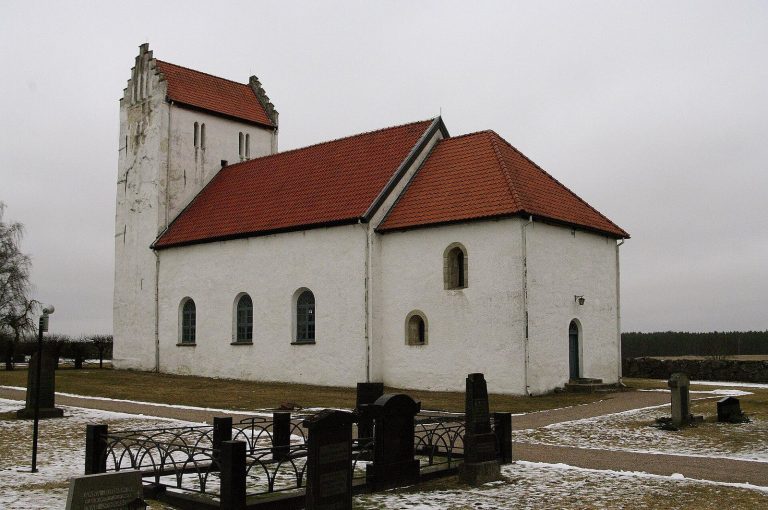
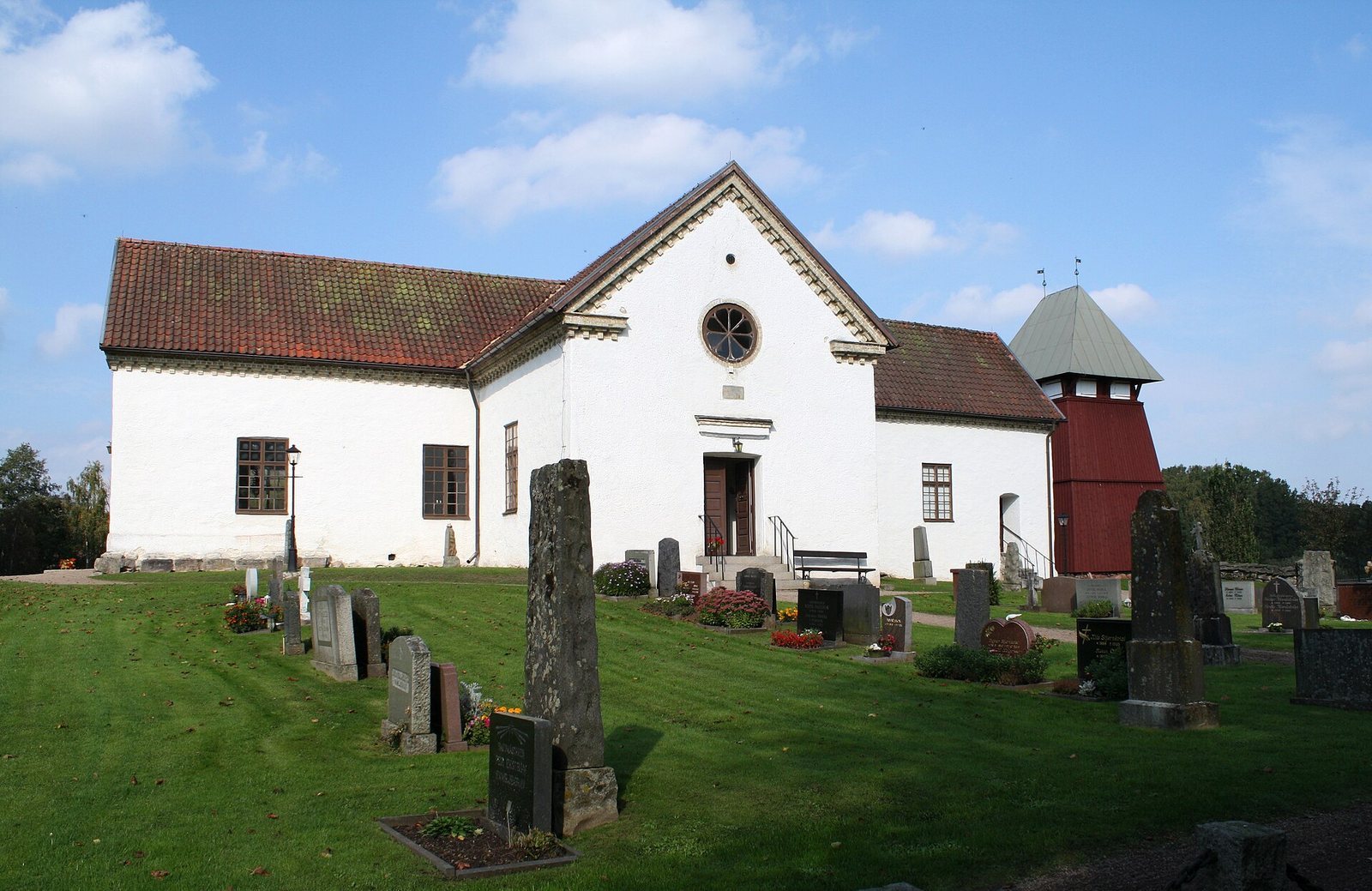
Brönnestad Church is a parish church in Hässleholm, Sweden. Construction began in the mid-12th century, and its oldest surviving parts date to the century’s third quarter. The church belongs to the Church of Sweden, within Sösdala Parish and the Diocese of Lund, and is dedicated to the Virgin Mary.
Medieval foundations and additions
The original church consisted of an apse, a rounded eastern end, a chancel, the area around the altar, and a nave, the main body of the church. Its north doorway served as the women’s entrance and its south doorway as the men’s entrance; the north entrance was blocked during the Middle Ages. After the middle of the 15th century, the church was extended westward. Its thick western walls suggest that a tower was planned, although none was built. A porch was added at the south entrance later in the medieval period.
Early modern changes
A northern extension was constructed in the 1690s and became known as the New Church. In 1734–35, the medieval apse was demolished and the chancel enlarged with a straight eastern end. Cavalry captain Casper Ehrenborg of Hovdala Castle initiated the project and arranged for a family tomb chamber beneath the chancel. In 1871, the south porch was removed and a larger extension was built on that side.
Restoration
A major restoration took place in 1935–36, the year medieval wall paintings were uncovered beneath whitewash. Their conservation was delayed until 1980–81, when conservator Våga Lindell-Andersson carried out the work.
Remains
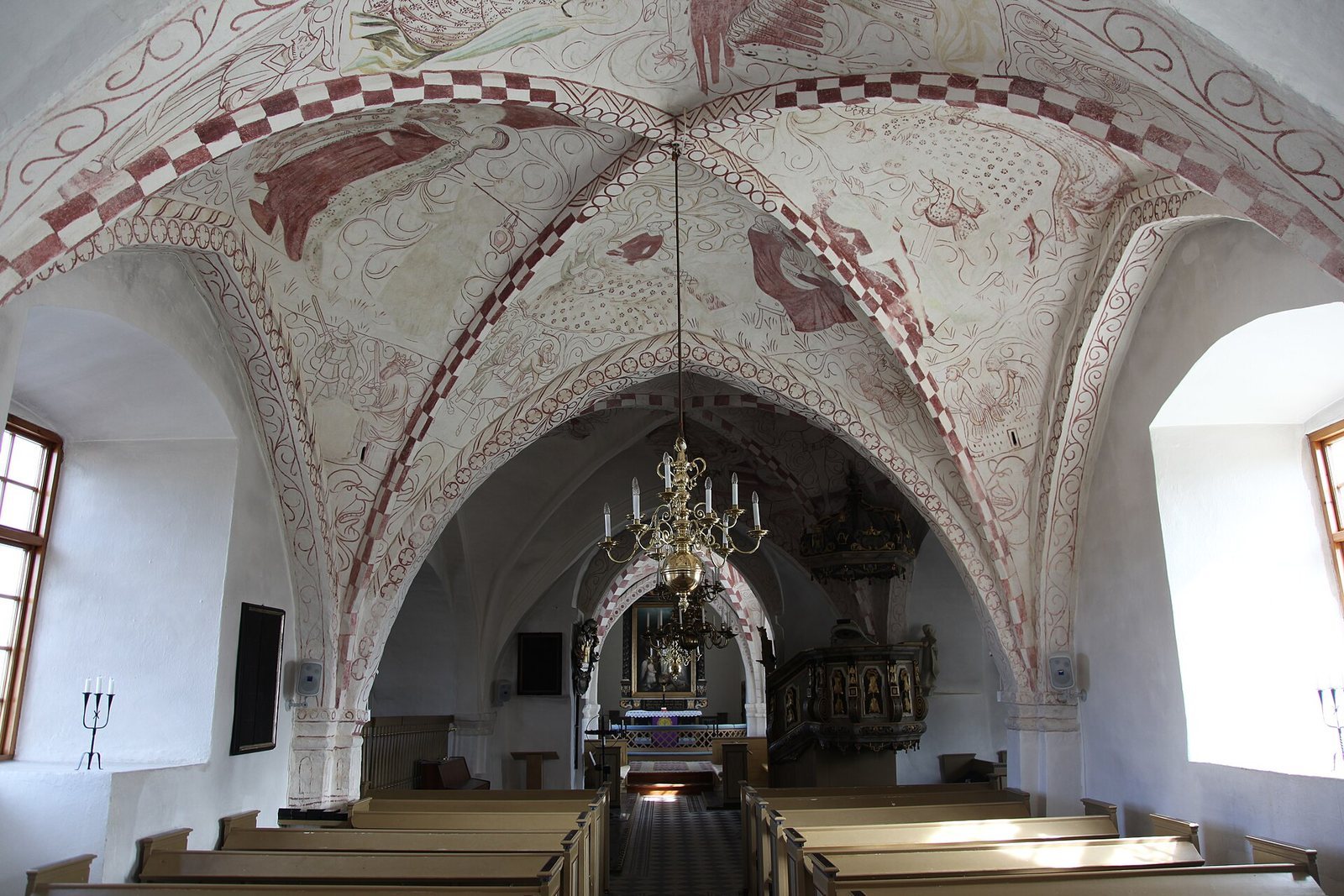
The church’s present fabric brings together the nave and chancel with additions made to the west, north, east, and south. A deep niche in the north wall marks the blocked medieval doorway, while the former south portal is now a window. The northern extension opens into the church through a large opening. Two vaulted ceilings cover the nave and another spans the chancel; all three date to the 15th century.
Wooden belfry and bells
A separate wooden bell tower stands east of the church. Tree-ring dating places its construction around 1491–92, and it is one of only nine such belfries in Scania. The large bell was first cast in 1395 and recast in 1728; the replacement carries a copy of the earlier inscription. The smaller bell dates to 1776.
Wall paintings
The paintings cover the three 15th-century vaults. Their style is late International Gothic, a European art style that spread around 1400, with carefully drawn outlines and emerging realist details. Their subjects range from biblical episodes and saints to religious legends and ornament. The imagery has connections with the paintings at Västra Sallerup Church and works associated with the Union Master, a name for an unidentified medieval painter linked to church murals in the region. The subjects are unusually varied for late medieval Nordic church painting, with few parallels in Scania and Denmark. The paintings were originally fully coloured. Most pigment has faded, leaving mainly brownish outlines where the lines were once bright red.
Western nave vault
This vault presents episodes associated with Mary’s joys. In the Annunciation, Mary holds a prayer book as the angel Gabriel tells her she will bear Jesus. Another scene shows her meeting Elizabeth, the mother of John the Baptist. The Nativity depicts Mary resting after childbirth, with fine bedding and pillows. She has been given the traditional postpartum porridge, and an attendant is about to serve her two fish. The ox and donkey appear faintly. Joseph is shown as an old man, half asleep and turned away, a conventional way of emphasizing Jesus’s divine conception.
In the Adoration of the Three Kings, the Christ child stands rather than appearing as an infant, a recurring feature of the painter’s imagery. Later scenes show Mary presenting Jesus in the Temple and officials examining him. An exceptionally rare Holy Family scene in Nordic art depicts Mary sewing the garment Jesus was said to wear throughout his life, growing as he grew. According to legend, it was the garment over which soldiers cast lots at the Crucifixion. Joseph teaches the child to walk with a walking frame.
Other scenes show Herod’s massacre of the newborn children of Bethlehem, the Flight into Egypt, and a harvest miracle. In the legend, crops grow immediately after the Holy Family passes over a newly sown field, allowing the farmers to harvest them. Pursuing soldiers ask whether anyone has passed since sowing, and the farmers can truthfully answer no. The sequence ends with a bathwater miracle in which a child with leprosy is healed after bathing in water used by Jesus.
Eastern nave vault
This vault depicts the Passion, the events leading to Jesus’s death. Its scenes include the Last Supper; Judas receiving thirty silver pieces for his betrayal; Jesus being abused by the chief priests; and his questioning by Annas, Caiaphas, and Pontius Pilate. Other episodes show him scourged while tied to a post, crowned with thorns and mocked as king of the Jews, carrying the cross toward Golgotha, and being buried. The burial takes the place of the Crucifixion, which commonly held a central position in a Passion sequence.
Chancel vault
The eastern part shows Mary nursing Jesus, a subject known as Maria Lactans. The child stands rather than appearing as a conventional infant, and Mary is shown without a crown, like an ordinary woman. Two musicians flank the scene, at least one appearing to be an angel.
On the south side, two female saints are shown without head coverings, identifying them as virgins. Catherine of Alexandria carries a wheel and sword associated with her martyrdom. Dorothy holds a basket of apples and a rose branch. Her legend tells that she promised a man at her execution that Christ, her bridegroom, would send him apples and roses, and that he later received them. On the north side, Bridget of Sweden carries a quill referring to her written revelations. Another saint carries a church and may be Gertrude or Ingrid of Skänninge. Saint Lawrence holds the iron grid on which he was martyred, while Saint Olaf carries a halberd, a pole weapon with an axe-like head, instead of his customary axe.
Interior furnishings
Baptismal font and basin
The sandstone baptismal font dates to the 12th century. Rope-twist patterns, palmettes, a fan-shaped leaf motif, and wave lines decorate its surface. A drain hole allowed baptismal water to run away. The associated basin is a South German work of the 17th century.
Altarpiece and pulpit
Sculptor Johan Ullberg of Finja made the altarpiece and pulpit, completing the commission in 1766 after receiving it in 1763. In 1880, carpenter Johan Sommarin raised and altered the altarpiece, replacing its carved wooden panel with a painting by Eva Ehrenborg. The pulpit displays the coats of arms of the Ehrenborg and Conow families. It replaced an earlier pulpit reportedly installed in 1588 by the mother of Sivert Grubbe, Hovdala Castle’s owner and a childhood friend of Christian IV, king of Denmark and Norway.
Rood cross and confessional chair
The large rood cross, a crucifix traditionally placed above the chancel entrance, probably dates to the late 15th century. Painter Cornelius Hendricksson of Kristianstad replaced its original paint in 1701. A confessional chair in the chancel dates to about 1672. Chairs of this type were used by priests when hearing confession.
Organ and memorial plaques
Knud Olsen of Copenhagen built an eight-stop organ in 1874. The present mechanical organ was made in 1963 by A. Mårtenssons Orgelfabrik AB of Lund. Memorial plaques in the church commemorate members of the Ehrenborg family.