Hovdala Castle: A Historic Estate in Sweden


Site at a Glance
- Rating
- 4.4
- Popularity
- Medium
- Country
- Sweden
- Primary era
- Early Modern
- External website
- Open
- Eras represented
- Early Modern, Modern
- Civilizations
- Danish, Swedish
- Site type
- Military
- Remains
- Castle
On this page13 sections
History
Hovdala Castle is a historic estate in Sweden whose oldest visible buildings date from the early sixteenth century, when Scania was part of Denmark. The estate was first mentioned in 1130 and developed through centuries shaped by Danish and Swedish rule, military conflict, changing ownership, and later conservation.
Medieval estate and Danish period
The squire Magnus Rabek owned Hovdala sometime before the Black Death. During the early fifteenth century, the estate belonged to the squire Klement Skaldra. At the end of that century, it passed to the Laxmand family, who erected the oldest buildings that remain visible today. Hovdala later entered the Grubbe family through marriage.
Sigvard Grubbe’s ownership brought the estate into the politics of Denmark’s late sixteenth and early seventeenth centuries. Swedish troops besieged the castle twice during the Kalmar War, the conflict between Denmark-Norway and Sweden fought from 1611 to 1613, but both attacks failed. Grubbe was an educated landowner with close ties to Christian IV, king of Denmark and Norway from 1588 to 1648. He had studied in Wittenberg and Basel.
War and the Ehrenborg family
After several further changes of ownership, the estate became the property of Jens Mikkelsen in 1651. Mikkelsen was an officer in the Danish army. When Sweden conquered Scania in 1658, he remained in the province, resigned his Danish public office, and became a Swedish subject.
The Scanian War, a Danish-Swedish conflict fought mainly in Scandinavia from 1675 to 1679, placed Mikkelsen in a dangerous position. In the summer of 1677, the Danes accused him of being a Swedish spy. He later supplied the Danish army with information about Swedish troop movements in northern Scania and criticized the methods of the Swedish commander Johan Gyllenstjerna. He also sought a safe-conduct certificate to protect his estate from Danish attacks.
On 7 August 1678, pro-Danish guerrilla fighters attacked, pillaged, and burned the castle. Mikkelsen survived the assault and was later ennobled by the Swedish king. He adopted the name Ehrenborg, and Hovdala remained in the Ehrenborg family until 1944. The final owners continued to live at the estate until 1981.
State ownership and conservation
From 1944, the former estate lands served as a military training field. They now belong to Hässleholm Municipality, while the castle is owned by Sweden’s National Property Board. Hovdala was protected as national heritage and listed as a monument in 1947.
Renovation began in 1993, and the restoration project received a Europa Nostra award in 2004. Europa Nostra is a European heritage organization that recognizes notable conservation and restoration work. In 2022, part of the land around the castle became part of a nature reserve.
Remains
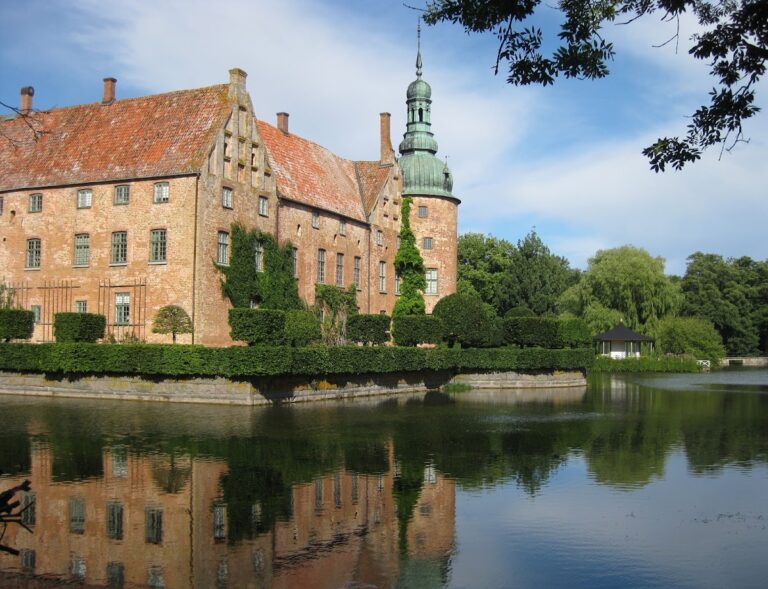
Hovdala Castle is arranged around a courtyard in a U-shape. Three principal buildings survive: the oldest stands to the north, the former living-quarters building to the east, and the most recent principal building to the south. A fourth building once closed the courtyard on the west, but the surviving complex is now defined by the three remaining sides.
Principal buildings
Northern building
The northern building dates from the early sixteenth century and may have been built in 1511, the year displayed on one of its facades. It forms the oldest visible part of the castle and anchors the northern side of the courtyard.
Eastern living quarters
The eastern building was constructed in 1681–1682 to replace an older structure destroyed during the Scanian War. It contained the living quarters, including principal representative rooms and the family library. These interiors have been restored and present the domestic environment of the upper middle classes or lower aristocracy, rather than that of the highest Danish or Swedish aristocracy or of the working class.
Southern building
The southern building is the latest of the three principal buildings and dates from 1805. Together with the northern and eastern buildings, it completes the surviving U-shaped arrangement around the courtyard.
Defensive features
Gatehouse and former moat
A gatehouse or gate tower forms part of the complex. The castle was once surrounded by a moat and entered across a drawbridge. The moat has since dried out, leaving a depression in the ground that marks its former position.
Defensive tower
A defensive tower south of the castle was erected in 1600 and endured the two Swedish attacks associated with the Kalmar War. A stone plaque on the tower bears the date 1633 and commemorates the Swedish siege of 1612.
Gardens, landscape, and collections
The castle stands within a predominantly rural landscape of forests, fields, lakes, and creeks. It formerly had a French-style park or garden, but the grounds ceased to be maintained because resources were inadequate. North of the castle, a kitchen garden and an orangery dating from 1763 remain.
The nature reserve includes the forests south of Hovdala Castle, Dalleröd, and Solhem-Björkviken beside Lake Finjasjön. Its wildlife includes 18 of Sweden’s 19 bat species, among them the rare Bechstein’s bat. A small population of endangered freshwater pearl mussels lives in Hovdalaån, the small river beside the castle.
In 2009, Sven-Eric Nilsson donated approximately 3,500 books to Hässleholm’s municipal library. The collection consists mainly of works concerning the history of the district around Hovdala Castle and is housed in one of the castle’s annexes.