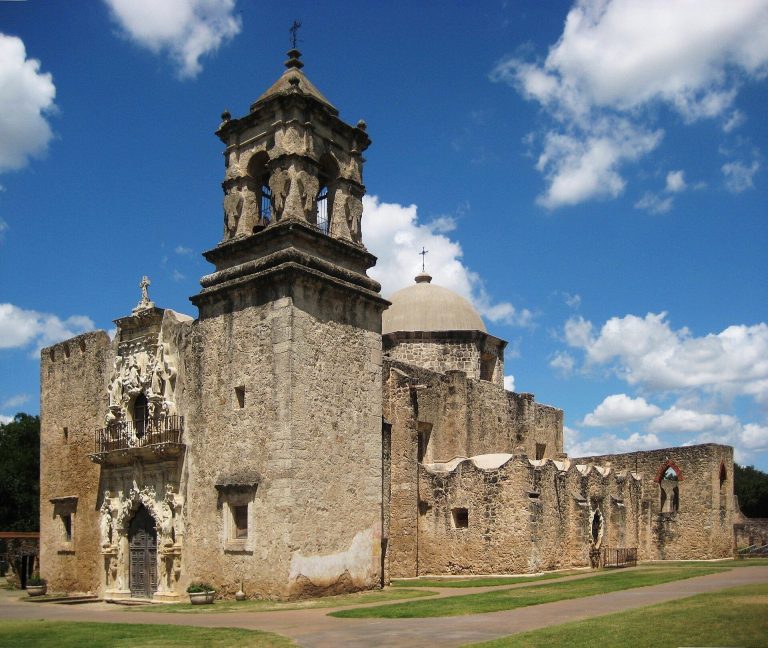
The Alamo Mission: A Spanish Mission and Texas Revolutionary Site
Site at a Glance
- Country
- United States
- Primary era
- Early Modern
- Eras represented
- Early Modern, Modern
- Civilizations
- Spanish
- Site type
- Religious
On this page13 sections
History
The Alamo Mission is a former Spanish Catholic mission in San Antonio, Texas, in the United States, founded on May 1, 1718. Established by Governor Martín de Alarcón and Franciscan priest Antonio de San Buenaventura y Olivares, it was intended to convert Indigenous people to Christianity and educate them, as well as supply Spanish settlements between the Rio Grande and East Texas. Its original name, Misión San Antonio de Valero, honored Saint Anthony of Padua and the Marquess of Valero, a title held by the viceroy of New Spain.
Mission and Spanish colonial rule
The mission continued the work of San Francisco Solano, founded near the Rio Grande in 1700. Water shortages prompted that community’s relocation toward San Antonio. Some residents accompanied Olivares at first, and others arrived later. The new mission stood near a Coahuiltecan community and drew Payaya residents, though its early number of converts was small. Those who came from San Francisco Solano may have increased the community to about 200 people.
Alarcón’s expedition first established the mission near the headwaters of the San Antonio River. It moved to the river’s west bank within a year, then relocated again in 1724 after a hurricane from the Gulf Coast damaged its buildings. The new site lay across the river from San Antonio de Béxar. Around the same time, Alarcón founded the presidio of San Antonio de Béxar, a Spanish military garrison, about two kilometres to the north, as well as a civilian settlement that grew into San Antonio.
By 1744, more than 300 Indigenous converts lived at the mission. Its farming and livestock supported much of the community: herds included roughly 2,000 cattle and 1,300 sheep, while annual harvests reached as much as 2,000 bushels of corn and 100 bushels of beans. Cotton was also grown. The population later fell from 328 people in 1756 to 44 in 1777.
The mission’s residents also helped defend the nearby settlement. In 1745, about 100 people from the mission drove off an Apache force of roughly 300 that had surrounded the presidio. This role reflected the garrison’s limited manpower and the continuing threat of Apache and Comanche raids.
Spanish colonial commander Teodoro de Croix sought to curb the missions’ influence. In 1778, he ordered that cattle without brands belonged to the government. Raids had already taken most of the mission’s horses, making it difficult to collect and brand its herd. The resulting losses weakened the mission’s finances and its ability to support converts. Only 12 Indigenous residents remained by 1793, when the mission was secularized, meaning its administration passed from a religious order to diocesan clergy. It was abandoned soon afterward.
Military occupation and the 1836 battle
The name Alamo came into use during the nineteenth century. It may have referred to a nearby cottonwood grove, or to the Second Flying Company of San Carlos de Parras, which occupied the abandoned mission in 1803 after coming from Álamo de Parras in Coahuila. Parts of the complex served as a political prison during the Mexican War of Independence. From 1806 to 1812, it also housed San Antonio’s first hospital, with renovations made for medical use.
After Mexican independence in 1821, the complex passed from Spanish to Mexican control and continued to house troops. In December 1835, Mexican general Martín Perfecto de Cos surrendered it to Texian forces after the two-month Siege of Béxar. Texian was a contemporary term for people and forces from Texas. Before withdrawing, Cos’s troops improved the defences and left 19 cannon, including one weighing 16 pounds.
Colonel James C. Neill then commanded about 100 Texian soldiers at the Alamo and sought reinforcements. General Sam Houston directed Colonel James Bowie to bring 35 to 50 men to remove the artillery and destroy the fortification. The defenders instead chose to stay, believing the site helped protect settlements to the east. Neill and engineer Green B. Jameson strengthened the position. When Neill left on February 11, 1836, Bowie and William Travis agreed to share command.
On February 23, Mexican forces under President-General Antonio López de Santa Anna began a 13-day siege to retake San Antonio de Béxar. The assault ended on March 6 with the Battle of the Alamo. Most Texian defenders died. Henry Warnell may have escaped, but he died months later from wounds sustained either in the fighting or during his escape. Santa Anna ordered the Texian dead burned; Gregorio Esparza was buried after his brother obtained permission. About 400 to 600 Mexican soldiers were killed or wounded in the final assault.
About 1,000 Mexican troops under General Juan Andrade remained at the mission for two months after the battle to repair and strengthen it. Following the Mexican defeat at San Jacinto and Santa Anna’s capture, Andrade’s garrison withdrew on May 24, 1836. The soldiers disabled the cannon, pulled down many walls, and set fires across the complex.
Changing control and preservation
Texian forces briefly used the Alamo as a fortification in December 1836 and January 1839. Mexican forces took control again in March 1841 and during a temporary occupation of San Antonio de Béxar in September 1842. Fighting and subsequent removal or sale of stone further altered the site. In 1841, the Republic of Texas legislature returned the sanctuary to the Catholic Church. After Texas joined the United States in 1845, the complex deteriorated while abandoned.
During the Mexican-American War, U.S. troops took over part of the property in 1846 for the Quartermaster’s Department. The army repaired the convent for offices and storage and rented the chapel from the Church while ownership was disputed. In 1855, the Texas Supreme Court confirmed the Church’s ownership of the chapel. The army continued using the site for supplies, offices, storage, a blacksmith shop, and stables. During the Civil War, Confederate forces took control. In February 1861, Texas militia leaders Ben McCulloch and Sam Maverick confronted U.S. commander David E. Twiggs at the Alamo. Twiggs surrendered, transferring the supplies to the Texans. The U.S. Army later returned, but left in 1876 after Fort Sam Houston was established nearby.
The Church sold the convent to merchant Honore Grenet, whose wholesale grocery business used the building and a new addition. Hugo & Schmeltzer continued the business after acquiring Grenet’s firm. The Church sold the chapel to Texas in 1883, but the state did not initially undertake its restoration.
The Daughters of the Republic of Texas (DRT), formed in the early 1890s, made preservation of the Alamo a central aim. Adina de Zavala and Clara Driscoll helped secure state action in 1905 to acquire the remaining buildings and entrust them to the DRT. Driscoll paid much of the purchase cost and was later reimbursed. The two advocates disagreed over the site’s future: de Zavala wanted the buildings, especially the Long Barracks, restored toward their 1836 appearance, while Driscoll favoured removing the barracks to create an open area around the chapel.
The disagreement produced a prolonged struggle over custody. In 1908, de Zavala barricaded herself inside the Hugo & Schmeltzer building to protest its proposed lease and feared the chapel would be demolished. Governor Thomas Mitchell Campbell ordered state officials to take the property, and a judge assigned custody to Driscoll’s DRT faction. Governor Oscar Colquitt later removed the DRT as custodian and announced a plan to rebuild the convent. Restoration began but stopped for lack of funds. While Colquitt was away, Lieutenant Governor William Harding Mayes authorized the removal of the Long Barracks’ upper walls. This dispute became known as the Second Battle of the Alamo. The DRT regained custody later in 1912.
Driscoll secured the state’s acquisition of two parcels between the chapel and Crockett Street in 1931. During the Great Depression, federal work-relief projects helped build a wall and museum and clear several later buildings from the property. The DRT acquired a nearby building for its library in 1935, and the Alamo Cenotaph was completed in 1940. The site became a National Historic Landmark in 1960, was documented by the Historic American Buildings Survey in 1961, and joined the National Register of Historic Places in 1966. In 1977, it became a contributing property in the Alamo Plaza Historic District. The Long Barracks were roofed and converted into a museum in 1968.
Debate over how the Alamo’s history should be presented continued. Protests in 1988 challenged a film’s negative portrayal of Mexicans and its limited recognition of Tejano contributions, meaning contributions by people of Mexican heritage from Texas. In the 1990s, local heritage groups called for a broader historical park that gave greater attention to the mission period as well as the Texas Revolution. The DRT opposed the proposal, and Governor George W. Bush pledged to veto legislation that would remove the organization from custody.
Human remains were found at the site in 1936, and the plaza was identified as covering a cemetery in 1976. Later archival research by San Antonio county archivist John Leal identified 1,006 people buried in the area, 921 of them of Native American or mestizo descent. Mestizo is a historical term for a person of mixed Indigenous and European ancestry. The DRT placed a marker recognizing the Indigenous burial ground in 1994. Beginning in 1995, members of the Tap Pilam Coahuiltecan Nation held ceremonies at the church to honour those buried there; the community was denied entry in 2019.
A 2010 investigation by the Texas Attorney General’s office found failures in the DRT’s management, including inadequate maintenance, misuse of public funds, and breaches of fiduciary duties. A state law signed in 2011 transferred custodianship to the Texas General Land Office, with the change taking effect in 2015. The Alamo is now a museum within the Alamo Plaza Historic District. On July 5, 2015, it joined the other four San Antonio missions in a UNESCO World Heritage listing.
Remains
Courtyard and mission buildings
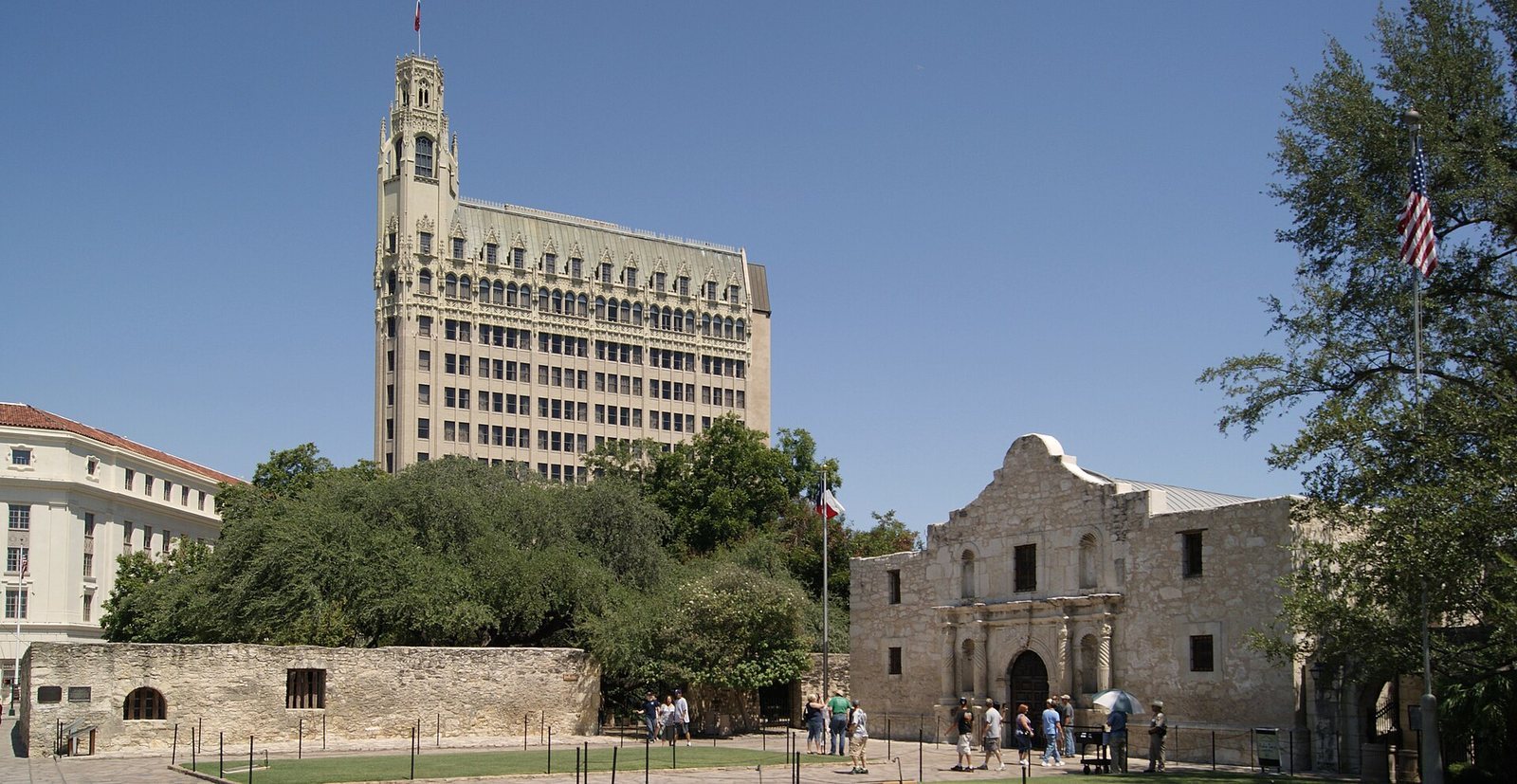
The historic compound grew to about 1.2 hectares and was arranged around an inner courtyard; the UNESCO-listed property covers five acres. Its earliest permanent building was probably a two-storey, L-shaped stone residence for the priests, forming sections of the courtyard’s west and south sides. Adobe barracks housed Indigenous residents, and a textile workshop served the mission. As many as 30 additional adobe or mud structures were used as workshops, storerooms, and homes.
Chapel
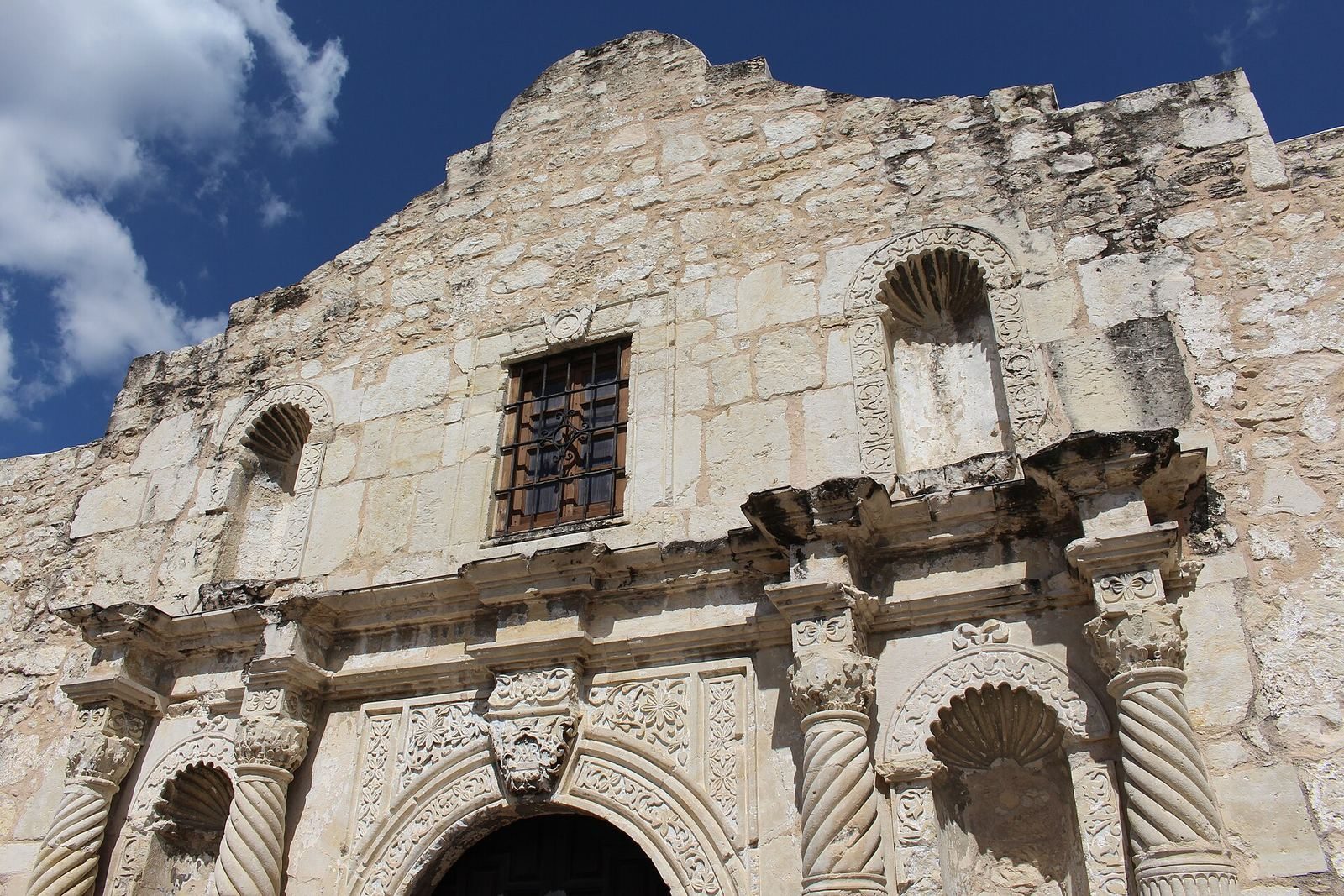
The chapel stands at the courtyard’s southern end. Work on a more permanent church began in 1744, but the church, tower, and sacristy collapsed in the late 1750s; rebuilding started in 1758. Limestone blocks, about 1.2 metres thick, form its walls. The plan is cross-shaped, with a long central worship hall and short arms extending from it. Construction reached the second level of an intended three-storey design. Four stone arches were built to carry a planned dome, while bell towers were intended for either side. The unfinished church was probably never used for worship.
Carved niches were planned on each side of the doorway and across its upper levels. They held figures of Saint Francis and Saint Dominic below, and Saint Clare and Saint Margaret of Cortona above. Carving also framed the entrance. The figures had been removed by the late 1840s. The chapel is also called the Shrine of Texas Liberty.
Walls and defensive changes
Walls built in 1758 enclosed the Indigenous residences, but did not fully surround the convent and church. They stood about 2.4 metres high and 60 centimetres thick, enclosing an area roughly 150 metres from north to south and 49 metres from east to west. A turret beside the main gate, armed with three cannon, was added in 1762. By 1793, a small one-pound cannon stood on a rampart near the convent.
Cos’s troops probably took apart the chapel’s four arches and reused the stone to make a raised gun platform at the apse, the curved end of the church. They placed three cannon there to fire over the roofless chapel walls and built a wooden barrier across a gap between the church, former convent barracks, and south wall. During the 1836 siege, defenders cut firing openings through the chapel and Long Barracks walls. Courtyard-facing doorways were protected by semicircular earth banks covered with cowhides, and some rooms had trenches in their floors. A well dug at the plaza’s south end weakened an earth-and-timber bank near the barracks, which collapsed. Sandbags blocked the chapel entrance, where defenders operated two 12-pound cannon. A Mexican 18-pound cannon destroyed the barricade.
Repairs and later building changes
During army repairs, soldiers rebuilt the convent and mission walls, reusing much of the original stone scattered around the grounds. They added a wooden roof to the chapel and a bell-shaped facade to its front wall, and cut new windows, including two in the upper facade. Fire destroyed the roof in 1861. The convent later gained a two-storey wooden addition for commercial use. In the early twentieth century, the upper walls of the Long Barracks were removed, leaving its west and south portions standing one storey high.
The site’s limestone came from quarries along the San Antonio River. Damp conditions cause it to expand, while falling temperatures cause it to contract; repeated cycles loosen small fragments. Measures have been taken to slow this deterioration.
Memorials, museum spaces, and grounds
Memorials
The Alamo Cenotaph, designed by Pompeo Coppini, was completed in 1940. A cenotaph is a memorial for people whose remains lie elsewhere or are not held within it. The monument honours 32 men from Gonzales who died in the Battle of the Alamo. A granite memorial poem, written by a Japanese geography professor in 1914, compares the battle with the 1575 siege of Nagashino Castle, a Japanese stronghold attacked during the Sengoku period. Another plaque recognizes Clara Driscoll’s role in securing the state’s acquisition of the Alamo.
Museum displays
The chapel and Long Barracks serve as museum spaces. The Long Barracks displays paintings, weapons, and other objects related to the Texas Revolution. Another building presents historical objects alongside a large model of the complex as it appeared in 1836. A mural, the Wall of History, traces the site from its mission era into modern times.
Burial marker and courtyard features
A marker on the grounds recognizes the site’s earlier use as an Indigenous burial ground. An old well and an oak tree stand in the courtyard, while a cactus grows beside the main Alamo building.