Tanella di Pitagora: An Etruscan Chamber Tomb at Cortona
Site at a Glance
- Country
- Italy
- Primary era
- Classical
- Eras represented
- Classical
- Civilizations
- Etruscan
- Site type
- Burial
- Remains
- Tomb
On this page8 sections
History
Tanella di Pitagora is an Etruscan burial chamber on the slope of Cortona, Italy, built by the Etruscans, an ancient people of central Italy whose civilization preceded Roman dominance. It is regarded as Cortona’s best-known Etruscan monument. Its date is disputed: the Accademia Etrusca, a scholarly and antiquarian institution in Cortona, assigns it to the 2nd century BCE, while catalogue entries place it in the 4th century BCE. The tomb is also dated to the Hellenistic Etruscan period, when Greek cultural influence followed Alexander the Great.
The name and Etruscan associations
In Cortona, tanella is a local term for a Hellenistic chamber tomb built on a circular base. The name of this tomb reflects a later misunderstanding rather than its original burial purpose.
The tomb has been attributed to the Cusu family, a prominent lineage in Hellenistic Cortona. The family is also named in the Tabula Cortonensis, an Etruscan inscribed tablet, and inscriptions connect it with nearby Tanella Angori, another Etruscan chamber tomb.
Renaissance identification
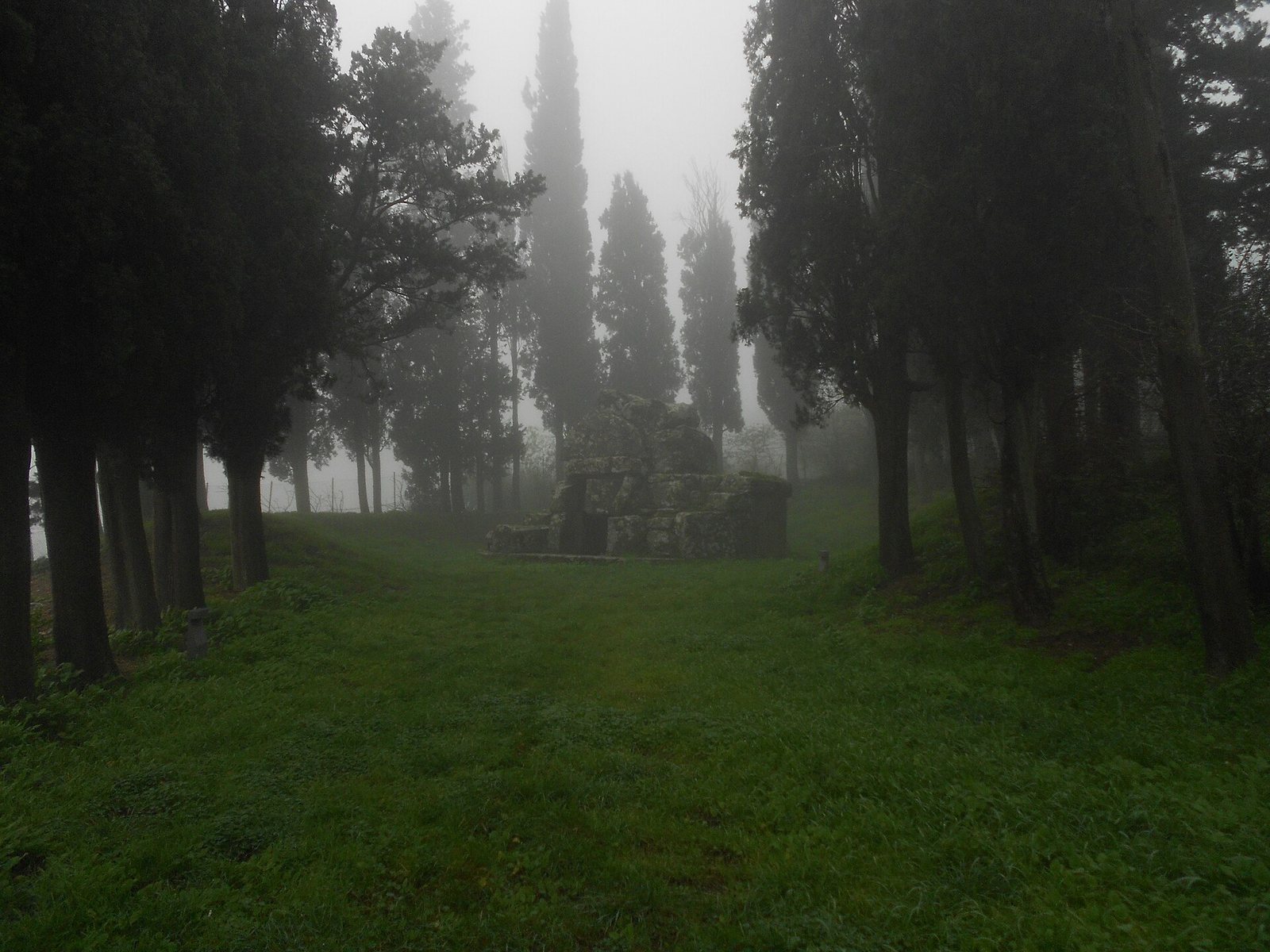
During the Renaissance, scholars linked Cortona with Kroton, where Pythagoras, an ancient Greek philosopher, had lived and taught. Amid renewed 16th-century interest in Pythagorean teachings, the partly exposed tomb came to be identified as the philosopher’s house. Giorgio Vasari, a 16th-century Italian artist and writer, visited in 1566 and mentioned the monument in a letter, its first recorded reference.
Damage and conservation
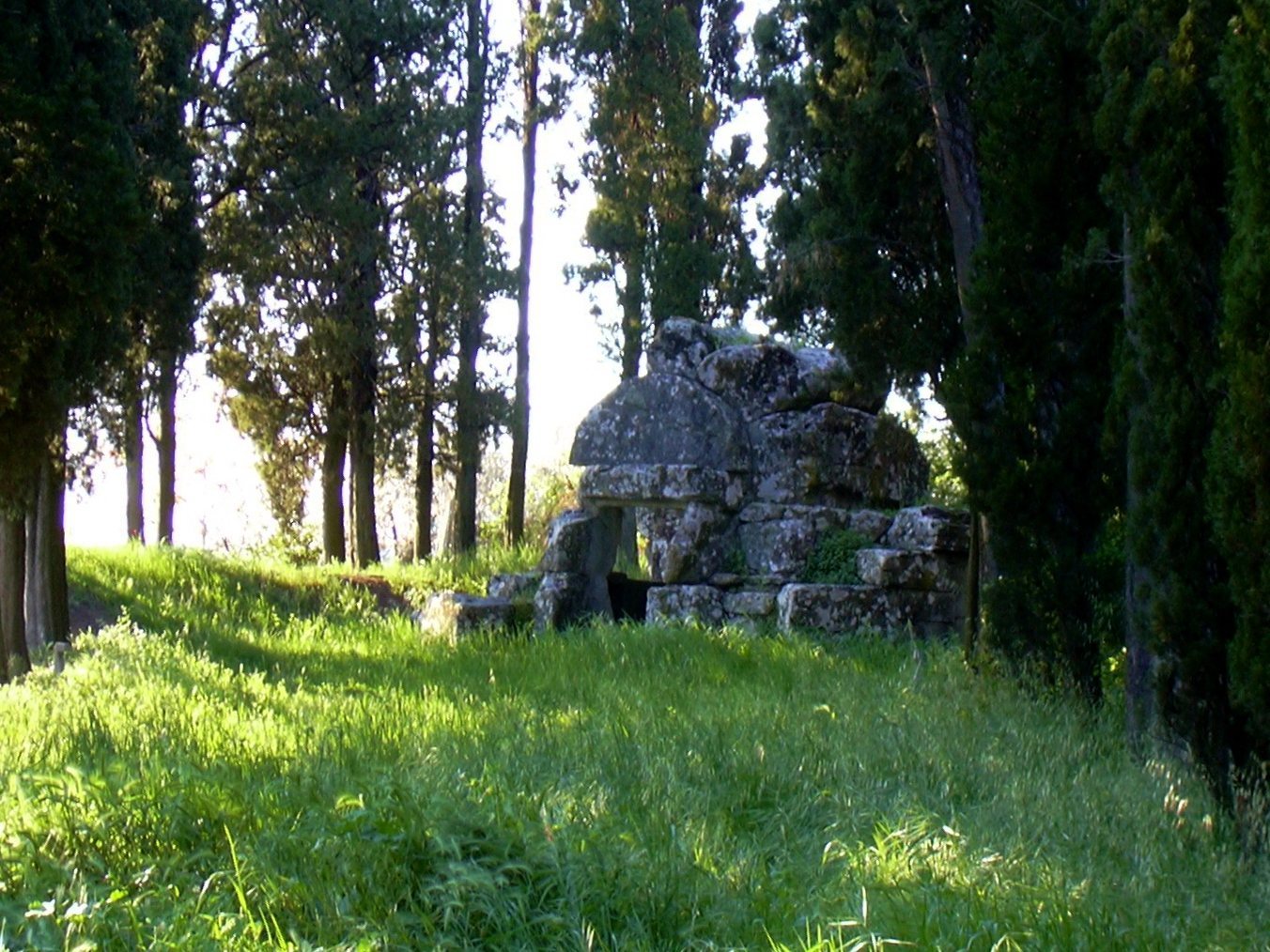
In 1808, French soldiers travelling toward Rome seriously damaged the tomb through vandalism. Regular investigations to expose it fully began in the first half of the 19th century, and excavations during that century recovered burial material. In 1929, its owner, Countess Maria Laparelli Pitti, donated the monument to the Accademia Etrusca, which retains ownership. The Academy restored the tomb and planted cypress trees around it.
Remains
Setting and external form
The tomb stands beside the road descending toward the Chiana Valley, near Tanella Angori. Built from local sandstone masonry rather than cut into bedrock, it has a circular base and drum that were surmounted by a mound. The original structure measured about 8 metres in diameter and 23 metres in circumference. Its base rests directly on bedrock and is made of sandstone slabs; eight unequal slabs form the outer course, laid without mortar. The circular, monumental form reworks the earlier mound-tomb tradition of the Cortona area, represented by the tombs at Sodo and Camucia. These belong to the Orientalizing and Archaic periods, successive early phases of Etruscan art and culture.
Entrance, chamber, and vault
A short, trapezoidal entrance passage measures 0.97 by 1.63 metres. At its upper end, a lintel supported a two-leaf stone door hung on hinges. Beyond it, the rectangular burial chamber measures about 2.7 metres long and 2.05 metres wide. Six niches in the side and rear walls held cinerary urns, which contained cremated remains, along with pots and grave goods. Five adjoining monoliths, each a single large block of stone, formed the barrel vault. Earth or slabs probably covered the vault to produce the mound-like exterior, and a small section survives despite repairs.
Regional architecture and burial finds
Tanella di Pitagora belongs to a small group of northern Etruscan tombs that includes the Tomb of the Grand Duke at Chiusi and the Tomb of San Manno at Perugia. The group is characterized by carefully squared wall blocks and vaults made from wedge-shaped stones. Monumental tombs in ancient Macedonia dating to the mid-4th century BCE have been proposed as models. An inscribed lid from a small cinerary urn, found near Tanella di Pitagora, is now held in Cortona’s city museum. It names Vel Cusu Crespe as the father of Lart(e) and son of Petrui.