Alfta Church: A Medieval Parish Church Rebuilt in the 18th Century
Site at a Glance
- Country
- Sweden
- Primary era
- Early Modern
- Eras represented
- Medieval, Early Modern, Modern
- Civilizations
- Swedish
- Site type
- Religious
- Remains
- Church
On this page12 sections
History
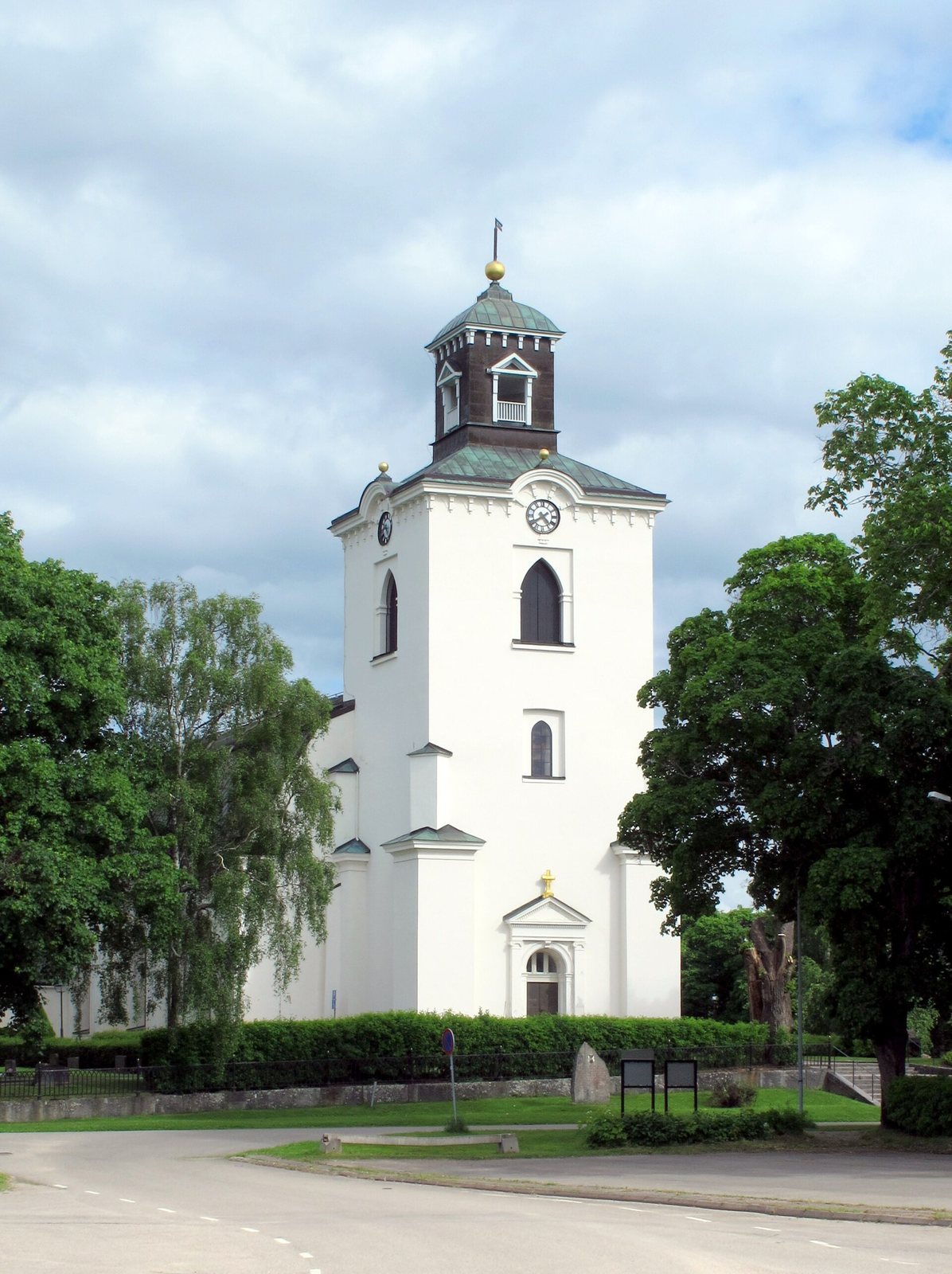
Alfta Church is a parish church in Alfta, Sweden, consecrated during the medieval period and rebuilt in the late-Gustavian style, a Swedish style associated with the late 18th century. It serves Alfta-Ovanåker Parish in the Church of Sweden, a Lutheran church, within the Uppsala Diocese, a regional ecclesiastical district. The church’s oldest surviving part is its tower, probably built in the later Middle Ages.
Rebuilding and fire
Major rebuilding took place between 1765 and 1770, including work described as a rebuilding and extension in 1769. The older church was demolished in 1767, while its existing tower was retained. A fire damaged the building in 1793. Its fixed furnishings were renewed over the following years, and the church was back in working condition by 1799.
Restorations and later changes
A major restoration in 1897–1899 was directed by Alfta builder Jonas Holm, with architect Carl Axel Ekholm overseeing the work. Stockholm painters E. Bergh and E. Norstedt completed the decoration and painting. Joinery was supplied by engineer Larsson’s carpentry factory in Uppsala, and sculptural carving was carried out by Wilhelm Hoffman of Stockholm.
An interior restoration in 1958–1959 sought to recover, as far as possible, the church’s early-19th-century appearance; several additions from the later 19th century were removed. A small extension was added during the 1950s, and rooms beneath the gallery were created in 1980.
Organ history
In 1658 Petter Hansson Thel built a small organ with one hand keyboard and seven stops, controls that select sets of pipes. It was removed when the older church was demolished in 1767. Lars Fredrik Hammardahl of Arbrå built a replacement between 1778 and 1783. In 1830 Eric Nordqvist and Lars Niclas Nordqvist of Alfta rebuilt it, leaving it with 16½ stops. In May 1900, the instrument was sent by rail in three parts to organ builders Anders Victor Lundahl in Stockholm, Per Johan Johansson in Ore, and Björklund in Edsbyn.
Lundahl built another organ for the church in 1898, with 18 stops, two hand keyboards, and a foot keyboard. The present organ dates to 1961.
Remains
Plan and exterior
The church’s main plan is a rectangular nave with a sacristy, a room for preparing worship and keeping liturgical items, on its north side. A small extension fills the corner between them. The west entrance passes through the tower’s ground floor, while another doorway is centered on the nave’s south side. The white-plastered walls, both inside and out, have round-arched windows separated by substantial pilasters, flat vertical supports set against a wall. The tower has a low roof topped by a lantern, a raised structure that crowns a roof or tower. The exterior has a late-Gustavian character, and neoclassical surrounds, drawing on ancient Greek and Roman forms, frame the portals.
Interior and furnishings
Vaults, gallery, and heating
The interior has vaulted ceilings throughout and includes an organ gallery. Small rooms for different functions occupy the space beneath it. Central heating, based on W. Dahlgren’s system, replaced the earlier heating stoves.
Altar and pulpit
The church has pews, an altar with a rail, and a frame for its altarpiece. The present pulpit was made in 1815 by parishioners Olof Brunk and Pehr Tulpan. Albert Blombergsson created the altarpiece in 1840, basing it on Fredric Westin’s work at Kungsholm Church in Stockholm. It depicts the Resurrection of Christ.
Windows and metalwork
Leaded cathedral-glass windows were installed during the major late-19th-century restoration. Stained glass by the Stockholm firm Neuman and Vogel fills the two chancel windows. The Gävle firm Ax made chandeliers, candelabra, wall sconces, and shields for the church. One red-metal chandelier holds 60 candles.
Textiles and liturgical objects
Alma Fredlund sewed the altar cloth, and Letty Oldberg made the antependium, a decorative hanging for the front of an altar. The baptismal font came from the earlier church and dates to around 1400. A 17th-century brass candlestick is ornamented with a late-medieval cross of the kind carried in processions or used to hold relics.
A chasuble is an outer vestment worn by a priest during the Eucharist. One made of Turkish silk brocade has silver and gold relief embroidery, with a crucifix on both its back and breast panels. A red-brown velvet chasuble has shaded and laid-thread embroidery. The garment dates to the 17th century, while its embroidery dates to the 15th; its breast panel shows the Virgin and Child, and its back bears a cross. A red chasuble embroidered in silk is also dated to the 15th century.
Organ
The present organ was built by Åkerman & Lunds Nya Orgelfabriks AB of Knivsta. It has a mechanical action, slider chests that direct wind to the pipes, and a compass of 56/30. Its façade dates to 1830.